Comprehensive Overview of Vietnam's Value Added Tax (VAT) System and Regulations
1.
VALUE ADDED TAX
Lecturer:Le Phuong Thao, MBA
School of Economics, Finance, and Accounting- International University
2.
Objective
After complete thislecture, you are able to
Determine the primary authorities on Value Added Tax
Understand the scope of Value Added Tax
Understand the tax bases and methods of tax computation
Understand tax registration, declaration, and finalization
3.
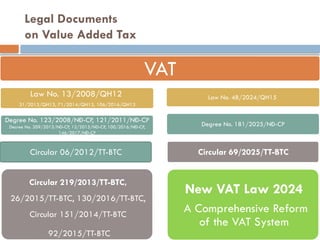
Legal Documents
on ValueAdded Tax
VAT
Law No. 13/2008/QH12
31/2013/QH13, 71/2014/QH13, 106/2016/QH13
Degree No. 123/2008/NĐ-CP, 121/2011/NĐ-CP
Decree No. 209/2013/ND-CP, 12/2015/ND-CP, 100/2016/NĐ-CP,
146/2017/NĐ-CP
Circular 06/2012/TT-BTC
Circular 219/2013/TT-BTC,
26/2015/TT-BTC, 130/2016/TT-BTC,
Circular 151/2014/TT-BTC
92/2015/TT-BTC
Law No. 48/2024/QH15
Degree No. 181/2025/NĐ-CP
Circular 69/2025/TT-BTC
New VAT Law 2024
A Comprehensive Reform
of the VAT System
4.
What is VAT?
TheValue Added Tax (VAT) is a consumption-based
tax levied on the value added to goods and services at
each stage of the supply chain.
VAT is paid to the tax authorities by the seller (the “taxpayer”), but in
substance it is borne by the buyer, who pays VAT to the seller as part of
the selling price. Therefore, VAT is an indirect tax.
Each taxpayer in the supply chain—from manufacturer to wholesaler to
retailer—charges VAT on their sales (output VAT) and is entitled to
deduct the VAT they have paid on their purchases (input VAT).
By offsetting input VAT against output VAT, VAT is effectively imposed
only on the value added at each stage of production and distribution,
hence the term “Value Added Tax.”
VAT is ultimately a consumption tax because the final consumer bears
the entire tax. It is not a cost to businesses operating under the credit
method.
5.
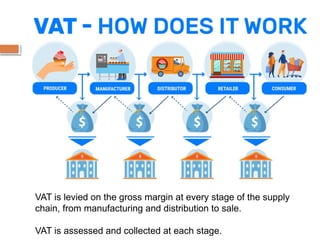
VAT is leviedon the gross margin at every stage of the supply
chain, from manufacturing and distribution to sale.
VAT is assessed and collected at each stage.
6.
Scope of VAT
Taxable objects
Goods and services used for production, business
and consumption in Vietnam (including goods and
services purchased from organizations and individuals
abroad),
Except for those specifically exempted to VAT
7.
Scope of VAT
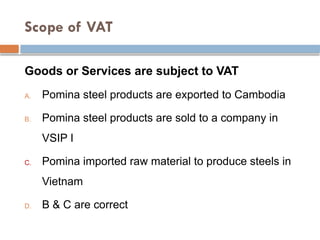
Goodsor Services are subject to VAT
A. Pomina steel products are exported to Cambodia
B. Pomina steel products are sold to a company in
VSIP I
C. Pomina imported raw material to produce steels in
Vietnam
D. B & C are correct
8.
VAT taxpayers
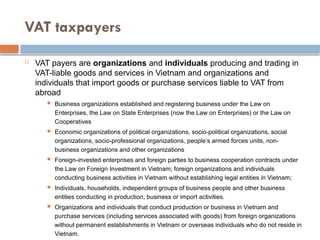
VATpayers are organizations and individuals producing and trading in
VAT-liable goods and services in Vietnam and organizations and
individuals that import goods or purchase services liable to VAT from
abroad
Business organizations established and registering business under the Law on
Enterprises, the Law on State Enterprises (now the Law on Enterprises) or the Law on
Cooperatives
Economic organizations of political organizations, socio-political organizations, social
organizations, socio-professional organizations, people’s armed forces units, non-
business organizations and other organizations
Foreign-invested enterprises and foreign parties to business cooperation contracts under
the Law on Foreign Investment in Vietnam; foreign organizations and individuals
conducting business activities in Vietnam without establishing legal entities in Vietnam;
Individuals, households, independent groups of business people and other business
entities conducting in production, business or import activities.
Organizations and individuals that conduct production or business in Vietnam and
purchase services (including services associated with goods) from foreign organizations
without permanent establishments in Vietnam or overseas individuals who do not reside in
Vietnam.
9.
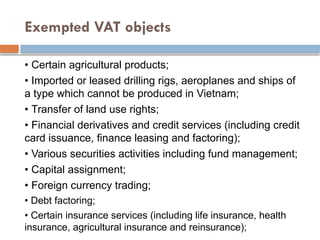
Exempted VAT objects
•Certain agricultural products;
• Imported or leased drilling rigs, aeroplanes and ships of
a type which cannot be produced in Vietnam;
• Transfer of land use rights;
• Financial derivatives and credit services (including credit
card issuance, finance leasing and factoring);
• Various securities activities including fund management;
• Capital assignment;
• Foreign currency trading;
• Debt factoring;
• Certain insurance services (including life insurance, health
insurance, agricultural insurance and reinsurance);
10.
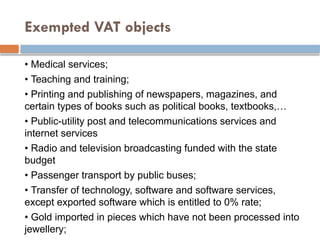
Exempted VAT objects
•Medical services;
• Teaching and training;
• Printing and publishing of newspapers, magazines, and
certain types of books such as political books, textbooks,…
• Public-utility post and telecommunications services and
internet services
• Radio and television broadcasting funded with the state
budget
• Passenger transport by public buses;
• Transfer of technology, software and software services,
except exported software which is entitled to 0% rate;
• Gold imported in pieces which have not been processed into
jewellery;
11.
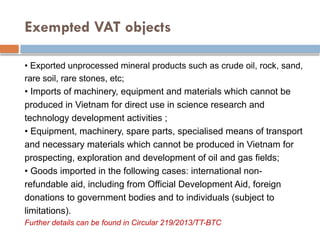
Exempted VAT objects
•Exported unprocessed mineral products such as crude oil, rock, sand,
rare soil, rare stones, etc;
• Imports of machinery, equipment and materials which cannot be
produced in Vietnam for direct use in science research and
technology development activities ;
• Equipment, machinery, spare parts, specialised means of transport
and necessary materials which cannot be produced in Vietnam for
prospecting, exploration and development of oil and gas fields;
• Goods imported in the following cases: international non-
refundable aid, including from Official Development Aid, foreign
donations to government bodies and to individuals (subject to
limitations).
Further details can be found in Circular 219/2013/TT-BTC
12.
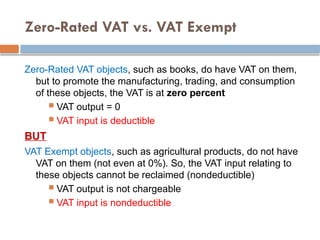
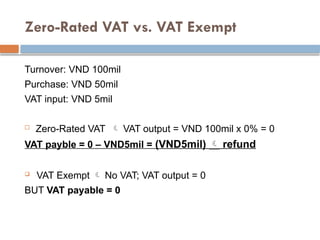
Zero-Rated VAT vs.VAT Exempt
Zero-Rated VAT objects, such as books, do have VAT on them,
but to promote the manufacturing, trading, and consumption
of these objects, the VAT is at zero percent
VAT output = 0
VAT input is deductible
BUT
VAT Exempt objects, such as agricultural products, do not have
VAT on them (not even at 0%). So, the VAT input relating to
these objects cannot be reclaimed (nondeductible)
VAT output is not chargeable
VAT input is nondeductible
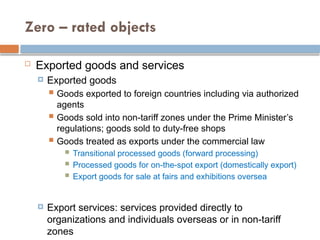
Zero – ratedobjects
Exported goods and services
Exported goods
Goods exported to foreign countries including via authorized
agents
Goods sold into non-tariff zones under the Prime Minister’s
regulations; goods sold to duty-free shops
Goods treated as exports under the commercial law
Transitional processed goods (forward processing)
Processed goods for on-the-spot export (domestically export)
Export goods for sale at fairs and exhibitions oversea
Export services: services provided directly to
organizations and individuals overseas or in non-tariff
zones
15.
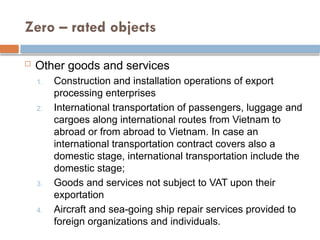
Zero – ratedobjects
Other goods and services
1. Construction and installation operations of export
processing enterprises
2. International transportation of passengers, luggage and
cargoes along international routes from Vietnam to
abroad or from abroad to Vietnam. In case an
international transportation contract covers also a
domestic stage, international transportation include the
domestic stage;
3. Goods and services not subject to VAT upon their
exportation
4. Aircraft and sea-going ship repair services provided to
foreign organizations and individuals.
16.
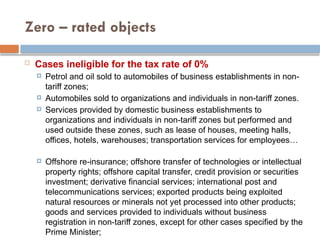
Zero – ratedobjects
Cases ineligible for the tax rate of 0%
Petrol and oil sold to automobiles of business establishments in non-
tariff zones;
Automobiles sold to organizations and individuals in non-tariff zones.
Services provided by domestic business establishments to
organizations and individuals in non-tariff zones but performed and
used outside these zones, such as lease of houses, meeting halls,
offices, hotels, warehouses; transportation services for employees…
Offshore re-insurance; offshore transfer of technologies or intellectual
property rights; offshore capital transfer, credit provision or securities
investment; derivative financial services; international post and
telecommunications services; exported products being exploited
natural resources or minerals not yet processed into other products;
goods and services provided to individuals without business
registration in non-tariff zones, except for other cases specified by the
Prime Minister;
17.
Non Tariff Zone
export processing zones, export processing
enterprises,
bonded zones, bonded warehouses,
special commercial and economic zones,
commercial and industrial zones
other economic zones established and enjoying
tax incentives like non-tariff zones under the
Prime Minister’s decisions.
Goods purchase, sale and exchange relations between
these zones and outside areas are import and export
relations.
18.
Non Tariff Zone
SonHa Co. provides the transportation service (transferring
employees to the workplace) to a company located in the Tan Thuan
export processing zone. The service provided is:
A. VAT exempt
B. 0% VAT
C. 10% VAT
D. None of the above
19.
5% VAT rateobjects
1. Clean water for production and daily life
2. Fertilizers; ores used for fertilizer production; insecticides, pesticides and
growth stimulants for livestock and plants.
3. Feeds for cattle, poultry and for other livestock
4. Services of digging, embanking and dredging canals, ditches, ponds and
lakes for agricultural production; cultivating, tending and preventing and
eliminating pests for plants; preliminarily processing and preserving
agricultural products
5. Cultivation, husbandry, aquatic and marine products (paddy, rice, maize,
potatoes, cassava and wheat) which are unprocessed or have been
preliminarily processed by cleaning, sun-drying, heat-drying, peeling,
pitting, slicing, grinding, freezing, salting or other ordinary methods of
preservation at the trading stage
6. Preliminarily processed rubber latex in the forms of crepe, sheets, strips or
granules; preliminarily processed pine resin; nets, net ropes and yarns for
plaiting fish nets, including fishing nets, assorted yarns and ropes for
exclusive use in plaiting fishing nets, regardless of their production
materials.
20.
5% VAT rateobjects
7. Fresh and raw foods; forest products not yet processed, at the trading stage
8. Sugar and by-products in sugar production, including molasses, bagasse, dregs.
9. Products made of jute, rush, bamboo, rattan, leaves, straw, coir, water hyacinth, and
other handicraft products made of raw materials from agricultural production
10. Specialized machinery and equipment for agricultural production
11. Medical equipment and instruments
12. Teaching and learning aids
13. Cultural, exhibition, physical training and sport activities; art performances; film
production; film importation, distribution and screening.
14. Children’s toys; books of various kinds
15. Scientific and technological services
From 1.7.2013:
the sales, lease and hire-purchase of social houses according to the Law on Housing
the 50% reduction of the 10% VAT from 01 July 2013 until 30 June 2014 on the sales, ,
lease and hire-purchase of commercial houses, which are finished apartments smaller
than 70 m2 and sold at price of less than VND 15 million/m2.
21.
VAT calculation
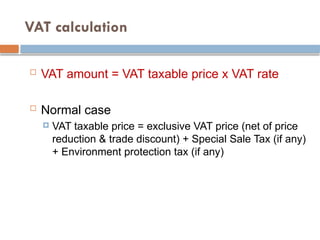
VATamount = VAT taxable price x VAT rate
Normal case
VAT taxable price = exclusive VAT price (net of price
reduction & trade discount) + Special Sale Tax (if any)
+ Environment protection tax (if any)
22.
VAT taxable price
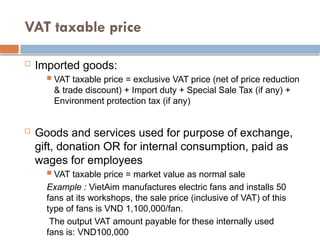
Imported goods:
VAT taxable price = exclusive VAT price (net of price reduction
& trade discount) + Import duty + Special Sale Tax (if any) +
Environment protection tax (if any)
Goods and services used for purpose of exchange,
gift, donation OR for internal consumption, paid as
wages for employees
VAT taxable price = market value as normal sale
Example : VietAim manufactures electric fans and installs 50
fans at its workshops, the sale price (inclusive of VAT) of this
type of fans is VND 1,100,000/fan.
The output VAT amount payable for these internally used
fans is: VND100,000
23.
VAT taxable price
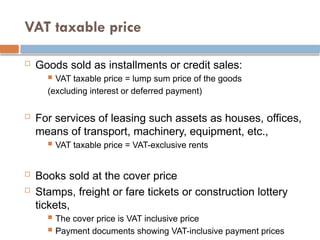
Goods sold as installments or credit sales:
VAT taxable price = lump sum price of the goods
(excluding interest or deferred payment)
For services of leasing such assets as houses, offices,
means of transport, machinery, equipment, etc.,
VAT taxable price = VAT-exclusive rents
Books sold at the cover price
Stamps, freight or fare tickets or construction lottery
tickets,
The cover price is VAT inclusive price
Payment documents showing VAT-inclusive payment prices
24.
Tax point
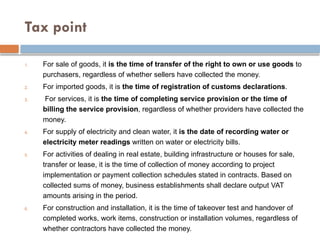
1. Forsale of goods, it is the time of transfer of the right to own or use goods to
purchasers, regardless of whether sellers have collected the money.
2. For imported goods, it is the time of registration of customs declarations.
3. For services, it is the time of completing service provision or the time of
billing the service provision, regardless of whether providers have collected the
money.
4. For supply of electricity and clean water, it is the date of recording water or
electricity meter readings written on water or electricity bills.
5. For activities of dealing in real estate, building infrastructure or houses for sale,
transfer or lease, it is the time of collection of money according to project
implementation or payment collection schedules stated in contracts. Based on
collected sums of money, business establishments shall declare output VAT
amounts arising in the period.
6. For construction and installation, it is the time of takeover test and handover of
completed works, work items, construction or installation volumes, regardless of
whether contractors have collected the money.
25.
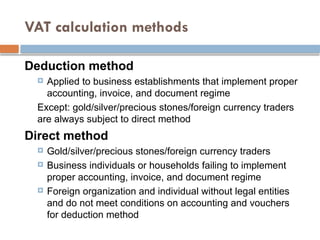
VAT calculation methods
Deductionmethod
Applied to business establishments that implement proper
accounting, invoice, and document regime
Except: gold/silver/precious stones/foreign currency traders
are always subject to direct method
Direct method
Gold/silver/precious stones/foreign currency traders
Business individuals or households failing to implement
proper accounting, invoice, and document regime
Foreign organization and individual without legal entities
and do not meet conditions on accounting and vouchers
for deduction method
26.
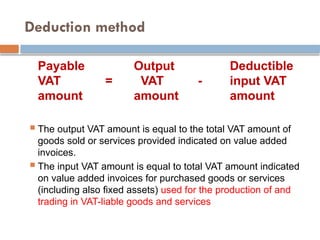
Deduction method
Payable OutputDeductible
VAT = VAT - input VAT
amount amount amount
The output VAT amount is equal to the total VAT amount of
goods sold or services provided indicated on value added
invoices.
The input VAT amount is equal to total VAT amount indicated
on value added invoices for purchased goods or services
(including also fixed assets) used for the production of and
trading in VAT-liable goods and services
27.
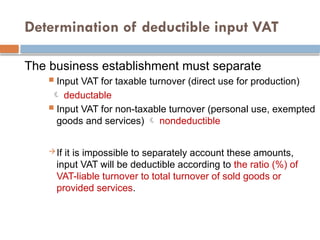
Determination of deductibleinput VAT
The business establishment must separate
Input VAT for taxable turnover (direct use for production)
deductable
Input VAT for non-taxable turnover (personal use, exempted
goods and services) nondeductible
If it is impossible to separately account these amounts,
input VAT will be deductible according to the ratio (%) of
VAT-liable turnover to total turnover of sold goods or
provided services.
28.
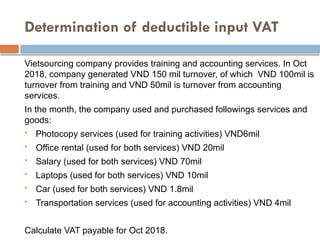
Determination of deductibleinput VAT
Vietsourcing company provides training and accounting services. In Oct
2018, company generated VND 150 mil turnover, of which VND 100mil is
turnover from training and VND 50mil is turnover from accounting
services.
In the month, the company used and purchased followings services and
goods:
Photocopy services (used for training activities) VND6mil
Office rental (used for both services) VND 20mil
Salary (used for both services) VND 70mil
Laptops (used for both services) VND 10mil
Car (used for both services) VND 1.8mil
Transportation services (used for accounting activities) VND 4mil
Calculate VAT payable for Oct 2018.
29.
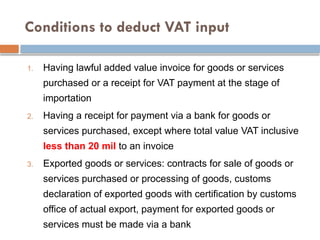
Conditions to deductVAT input
1. Having lawful added value invoice for goods or services
purchased or a receipt for VAT payment at the stage of
importation
2. Having a receipt for payment via a bank for goods or
services purchased, except where total value VAT inclusive
less than 20 mil to an invoice
3. Exported goods or services: contracts for sale of goods or
services purchased or processing of goods, customs
declaration of exported goods with certification by customs
office of actual export, payment for exported goods or
services must be made via a bank
30.
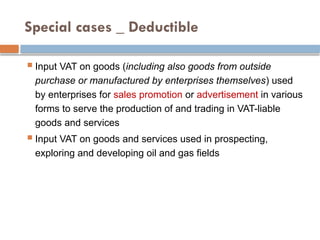
Special cases _Deductible
Input VAT on goods (including also goods from outside
purchase or manufactured by enterprises themselves) used
by enterprises for sales promotion or advertisement in various
forms to serve the production of and trading in VAT-liable
goods and services
Input VAT on goods and services used in prospecting,
exploring and developing oil and gas fields
31.
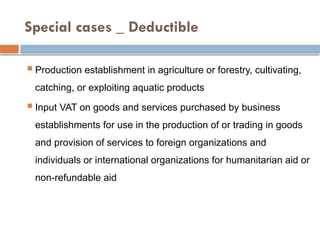
Special cases _Deductible
Production establishment in agriculture or forestry, cultivating,
catching, or exploiting aquatic products
Input VAT on goods and services purchased by business
establishments for use in the production of or trading in goods
and provision of services to foreign organizations and
individuals or international organizations for humanitarian aid or
non-refundable aid
32.
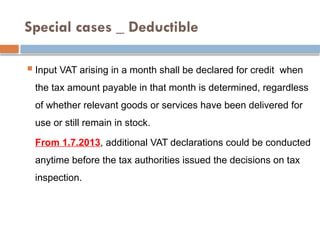
Special cases _Deductible
Input VAT arising in a month shall be declared for credit when
the tax amount payable in that month is determined, regardless
of whether relevant goods or services have been delivered for
use or still remain in stock.
From 1.7.2013, additional VAT declarations could be conducted
anytime before the tax authorities issued the decisions on tax
inspection.
33.
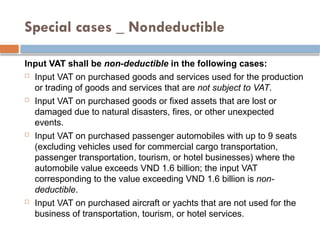
Special cases _Nondeductible
Input VAT shall be non-deductible in the following cases:
Input VAT on purchased goods and services used for the production
or trading of goods and services that are not subject to VAT.
Input VAT on purchased goods or fixed assets that are lost or
damaged due to natural disasters, fires, or other unexpected
events.
Input VAT on purchased passenger automobiles with up to 9 seats
(excluding vehicles used for commercial cargo transportation,
passenger transportation, tourism, or hotel businesses) where the
automobile value exceeds VND 1.6 billion; the input VAT
corresponding to the value exceeding VND 1.6 billion is non-
deductible.
Input VAT on purchased aircraft or yachts that are not used for the
business of transportation, tourism, or hotel services.
34.
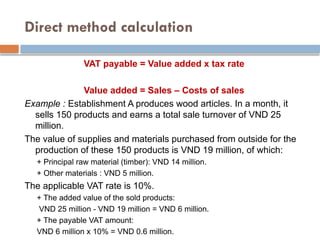
Direct method calculation
VATpayable = Value added x tax rate
Value added = Sales – Costs of sales
Example : Establishment A produces wood articles. In a month, it
sells 150 products and earns a total sale turnover of VND 25
million.
The value of supplies and materials purchased from outside for the
production of these 150 products is VND 19 million, of which:
+ Principal raw material (timber): VND 14 million.
+ Other materials : VND 5 million.
The applicable VAT rate is 10%.
+ The added value of the sold products:
VND 25 million - VND 19 million = VND 6 million.
+ The payable VAT amount:
VND 6 million x 10% = VND 0.6 million.
35.
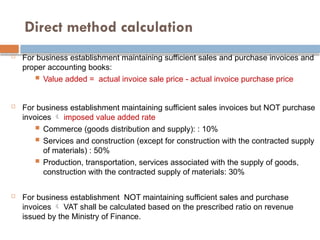
Direct method calculation
For business establishment maintaining sufficient sales and purchase invoices and
proper accounting books:
Value added = actual invoice sale price - actual invoice purchase price
For business establishment maintaining sufficient sales invoices but NOT purchase
invoices imposed value added rate
Commerce (goods distribution and supply): : 10%
Services and construction (except for construction with the contracted supply
of materials) : 50%
Production, transportation, services associated with the supply of goods,
construction with the contracted supply of materials: 30%
For business establishment NOT maintaining sufficient sales and purchase
invoices VAT shall be calculated based on the prescribed ratio on revenue
issued by the Ministry of Finance.
36.
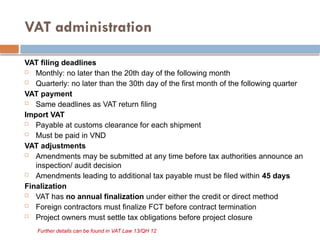
VAT administration
VAT filingdeadlines
Monthly: no later than the 20th day of the following month
Quarterly: no later than the 30th day of the first month of the following quarter
VAT payment
Same deadlines as VAT return filing
Import VAT
Payable at customs clearance for each shipment
Must be paid in VND
VAT adjustments
Amendments may be submitted at any time before tax authorities announce an
inspection/ audit decision
Amendments leading to additional tax payable must be filed within 45 days
Finalization
VAT has no annual finalization under either the credit or direct method
Foreign contractors must finalize FCT before contract termination
Project owners must settle tax obligations before project closure
Further details can be found in VAT Law 13/QH 12