BA 5th
Sem. Minor (Vocational)
World Heritage Archaeological Sites & Monuments in India
Sachin Kr.Tiwary
sachintiwary@bhu.ac.in
1. World Heritage Convention (विश्व धरोहर सम्मलेन):
Introduction to the World Heritage Convention (1972)
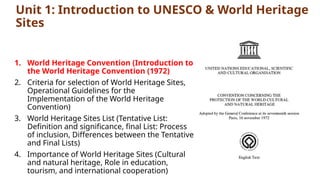
Unit 1: Introduction to UNESCO & World Heritage
Sites
1. World Heritage Convention (Introduction to
the World Heritage Convention (1972)
2. Criteria for selection of World Heritage Sites,
Operational Guidelines for the
Implementation of the World Heritage
Convention)
3. World Heritage Sites List (Tentative List:
Definition and significance, final List: Process
of inclusion, Differences between the Tentative
and Final Lists)
4. Importance of World Heritage Sites (Cultural
and natural heritage, Role in education,
tourism, and international cooperation)
Learning
Objective
s
After today's lecture students will understand:
1. Why the Convention was needed
2. Historical background
3. Objectives
4. Structure
5. Major Articles
6. States Parties
7. World Heritage Committee
8. World Heritage Fund
9. Obligations of Member Countries
10. India's role
World Heritage Convention (1972)
Convention Concerning the Protection of the World
Cultural and Natural Heritage
UNESCO
1972
Why do we
need an
International
Convention?
•Why can't
every
country
protect its
own
heritage?
•War
•Natural disasters
•Climate change
•Urbanization
•Looting
•Tourism
•Pollution
•Development projects
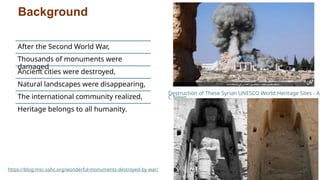
Background
After the Second World War,
Thousands of monuments were
damaged
Ancient cities were destroyed,
Natural landscapes were disappearing,
The international community realized,
Heritage belongs to all humanity.
Destruction of These Syrian UNESCO World Heritage Sites - AB
C News
https://blog.msc-sahc.org/wonderful-monuments-destroyed-by-war/
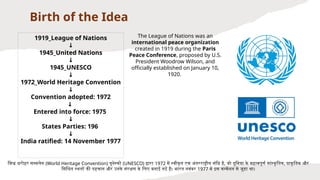
Birth of the Idea
1919_League of Nations
↓
1945_United Nations
↓
1945_UNESCO
↓
1972_World Heritage Convention
↓
Convention adopted: 1972
↓
Entered into force: 1975
↓
States Parties: 196
↓
India ratified: 14 November 1977
विश्व धरोहर सम्मलेन (World Heritage Convention) यूनेस्को (UNESCO) द्वारा 1972 में स्वीकृत एक अंतरराष्ट्रीय संधि है, जो दुनिया के महत्वपूर्ण सांस्कृ तिक, प्राकृतिक और
मिश्रित स्थलों की पहचान और उनके संरक्षण के लिए बनाई गई है। भारत नवंबर 1977 में इस कन्वेंशन से जुड़ा था।
The League of Nations was an
international peace organization
created in 1919 during the Paris
Peace Conference, proposed by U.S.
President Woodrow Wilson, and
officially established on January 10,
1920.
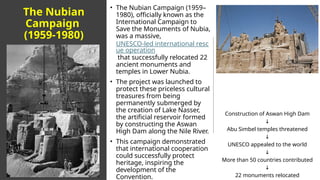
The Nubian
Campaign
(1959-1980)
• The Nubian Campaign (1959–
1980), officially known as the
International Campaign to
Save the Monuments of Nubia,
was a massive,
UNESCO-led international resc
ue operation
that successfully relocated 22
ancient monuments and
temples in Lower Nubia.
• The project was launched to
protect these priceless cultural
treasures from being
permanently submerged by
the creation of Lake Nasser,
the artificial reservoir formed
by constructing the Aswan
High Dam along the Nile River.
• This campaign demonstrated
that international cooperation
could successfully protect
heritage, inspiring the
development of the
Convention.
Construction of Aswan High Dam
↓
Abu Simbel temples threatened
↓
UNESCO appealed to the world
↓
More than 50 countries contributed
↓
22 monuments relocated
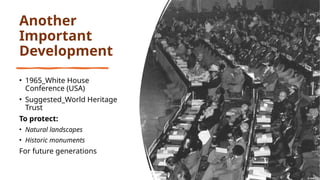
Another
Important
Development
• 1965_White House
Conference (USA)
• Suggested_World Heritage
Trust
To protect:
• Natural landscapes
• Historic monuments
For future generations
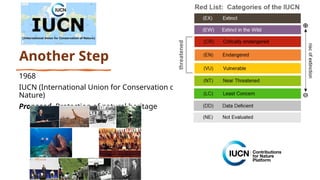
Another Step
1968
IUCN (International Union for Conservation of
Nature)
Proposed- Protection of natural heritage
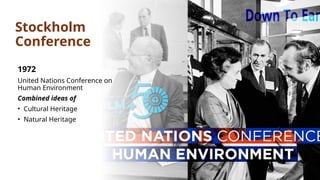
Stockholm
Conference
1972
United Nations Conference on
Human Environment
Combined ideas of
• Cultural Heritage
• Natural Heritage
Adoption of the Convention
• 16 November 1972_UNESCO General
Conference
• Paris
• Signed_23 November 1972
• Came into force_17 December 1975
(after 20 ratifications)
• Official Name: Convention Concerning the
Protection of the World Cultural and Natural
Heritage
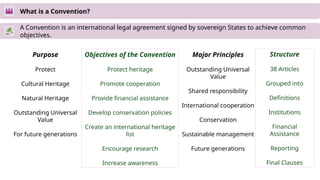
What is a Convention?
A Convention is an international legal agreement signed by sovereign States to achieve common
objectives.
Purpose
Protect
Cultural Heritage
Natural Heritage
Outstanding Universal
Value
For future generations
Objectives of the Convention
Protect heritage
Promote cooperation
Provide financial assistance
Develop conservation policies
Create an international heritage
list
Encourage research
Increase awareness
Major Principles
Outstanding Universal
Value
Shared responsibility
International cooperation
Conservation
Sustainable management
Future generations
Structure
38 Articles
Grouped into
Definitions
Institutions
Financial
Assistance
Reporting
Final Clauses
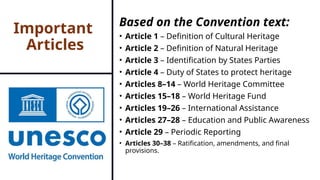
Important
Articles
Based on the Convention text:
• Article 1 – Definition of Cultural Heritage
• Article 2 – Definition of Natural Heritage
• Article 3 – Identification by States Parties
• Article 4 – Duty of States to protect heritage
• Articles 8–14 – World Heritage Committee
• Articles 15–18 – World Heritage Fund
• Articles 19–26 – International Assistance
• Articles 27–28 – Education and Public Awareness
• Article 29 – Periodic Reporting
• Articles 30–38 – Ratification, amendments, and final
provisions.
The World
Heritage
Committee
The World Heritage Committee (WHC) is the governing body responsible for implementing
the World Heritage Convention (1972). It is one of the most important institutions created
under the Convention and is entrusted with identifying, protecting, conserving, and
transmitting World Heritage properties to future generations.
Composition
• Consists of 21 Member States (States Parties) elected by the General Assembly of States
Parties.
• Members are elected for a term of six years (although many voluntarily limit their service
to four years to allow broader participation).
• Elections are held during the UNESCO General Assembly of States Parties, which meets
every two years.
Major Functions
The Committee:
• Decides which sites are to be inscribed on the World Heritage List.
• Examines reports on the conservation status of already inscribed sites.
• Places threatened properties on the List of World Heritage in Danger.
• Allocates financial assistance from the World Heritage Fund.
• Formulates policies and strategies for conservation.
Annual Meeting
• The Committee meets once every year, and each meeting is hosted by a different member
country.
Example:
• 46th Session (2024): New Delhi, India.
• 48th Session (2026): Hosted by another member state (update according to current
session).
World
Heritage
Centre
• The World Heritage Centre is the Secretariat of the World Heritage
Convention.
• Established: 1992
• Headquarters: UNESCO Headquarters, Paris, France.
• Why was it created?: Before 1992, different UNESCO departments handled
World Heritage matters separately. To improve coordination, UNESCO
established the World Heritage Centre as a single administrative body.
Major Responsibilities
• Coordinates implementation of the Convention.
• Organizes meetings of the World Heritage Committee.
• Receives nomination dossiers from States Parties.
• Maintains the official World Heritage List.
• Monitors the conservation status of World Heritage Sites.
• Coordinates emergency assistance during crises.
Example: When India submits the nomination of a site such as Sarnath, the
nomination dossier is first received and processed by the World Heritage
Centre before being forwarded to the Advisory Bodies.
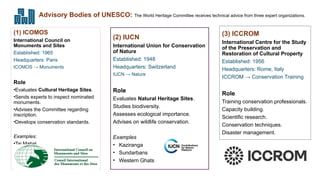
Advisory Bodies of UNESCO: The World Heritage Committee receives technical advice from three expert organizations.
(1) ICOMOS
International Council on
Monuments and Sites
Established: 1965
Headquarters: Paris
ICOMOS → Monuments
Role
•Evaluates Cultural Heritage Sites.
•Sends experts to inspect nominated
monuments.
•Advises the Committee regarding
inscription.
•Develops conservation standards.
Examples:
•Taj Mahal
•Sanchi
•Dholavira
•Khajuraho
(2) IUCN
International Union for Conservation
of Nature
Established: 1948
Headquarters: Switzerland
IUCN → Nature
Role
Evaluates Natural Heritage Sites.
Studies biodiversity.
Assesses ecological importance.
Advises on wildlife conservation.
Examples
• Kaziranga
• Sundarbans
• Western Ghats
(3) ICCROM
International Centre for the Study
of the Preservation and
Restoration of Cultural Property
Established: 1956
Headquarters: Rome, Italy
ICCROM → Conservation Training
Role
Training conservation professionals.
Capacity building.
Scientific research.
Conservation techniques.
Disaster management.
World
Heritage
Fund
• The World Heritage Fund was established under Article 15 of
the Convention.
• Its objective is to provide financial assistance for protecting
World Heritage properties.
Sources of the Fund
• Compulsory contributions from States Parties.
• Voluntary donations.
• Contributions from international organizations.
• Private institutions and philanthropists.
Uses
• Emergency conservation.
• Disaster response.
• Capacity building.
• Technical assistance.
• Preparation of nomination dossiers.
• Conservation research.
Example: If an earthquake damages a World Heritage Site, financial
assistance may be requested from the Fund.
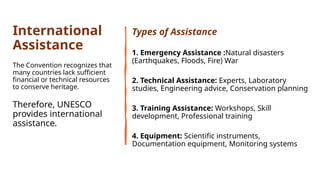
International
Assistance
The Convention recognizes that
many countries lack sufficient
financial or technical resources
to conserve heritage.
Therefore, UNESCO
provides international
assistance.
Types of Assistance
1. Emergency Assistance :Natural disasters
(Earthquakes, Floods, Fire) War
2. Technical Assistance: Experts, Laboratory
studies, Engineering advice, Conservation planning
3. Training Assistance: Workshops, Skill
development, Professional training
4. Equipment: Scientific instruments,
Documentation equipment, Monitoring systems
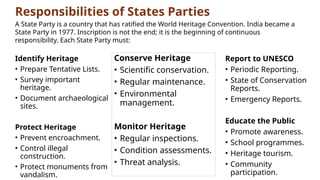
Responsibilities of States Parties
Identify Heritage
• Prepare Tentative Lists.
• Survey important
heritage.
• Document archaeological
sites.
Protect Heritage
• Prevent encroachment.
• Control illegal
construction.
• Protect monuments from
vandalism.
A State Party is a country that has ratified the World Heritage Convention. India became a
State Party in 1977. Inscription is not the end; it is the beginning of continuous
responsibility. Each State Party must:
Conserve Heritage
• Scientific conservation.
• Regular maintenance.
• Environmental
management.
Monitor Heritage
• Regular inspections.
• Condition assessments.
• Threat analysis.
Report to UNESCO
• Periodic Reporting.
• State of Conservation
Reports.
• Emergency Reports.
Educate the Public
• Promote awareness.
• School programmes.
• Heritage tourism.
• Community
participation.
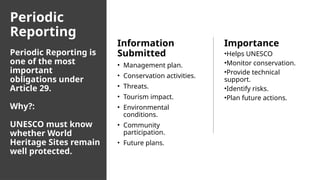
Periodic
Reporting
Periodic Reporting is
one of the most
important
obligations under
Article 29.
Why?:
UNESCO must know
whether World
Heritage Sites remain
well protected.
Information
Submitted
• Management plan.
• Conservation activities.
• Threats.
• Tourism impact.
• Environmental
conditions.
• Community
participation.
• Future plans.
Importance
•Helps UNESCO
•Monitor conservation.
•Provide technical
support.
•Identify risks.
•Plan future actions.
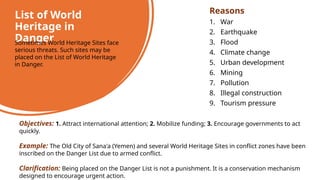
List of World
Heritage in
Danger
Reasons
1. War
2. Earthquake
3. Flood
4. Climate change
5. Urban development
6. Mining
7. Pollution
8. Illegal construction
9. Tourism pressure
Sometimes World Heritage Sites face
serious threats. Such sites may be
placed on the List of World Heritage
in Danger.
Objectives: 1. Attract international attention; 2. Mobilize funding; 3. Encourage governments to act
quickly.
Example: The Old City of Sana'a (Yemen) and several World Heritage Sites in conflict zones have been
inscribed on the Danger List due to armed conflict.
Clarification: Being placed on the Danger List is not a punishment. It is a conservation mechanism
designed to encourage urgent action.
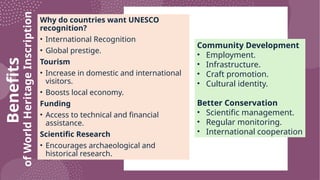
Benefits
of
World
Heritage
Inscription
Why do countries want UNESCO
recognition?
• International Recognition
• Global prestige.
Tourism
• Increase in domestic and international
visitors.
• Boosts local economy.
Funding
• Access to technical and financial
assistance.
Scientific Research
• Encourages archaeological and
historical research.
Community Development
• Employment.
• Infrastructure.
• Craft promotion.
• Cultural identity.
Better Conservation
• Scientific management.
• Regular monitoring.
• International cooperation
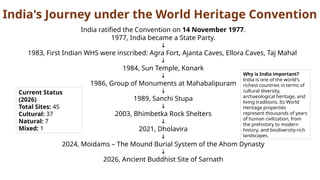
India's Journey under the World Heritage Convention
India ratified the Convention on 14 November 1977.
1977, India became a State Party.
↓
1983, First Indian WHS were inscribed: Agra Fort, Ajanta Caves, Ellora Caves, Taj Mahal
↓
1984, Sun Temple, Konark
↓
1986, Group of Monuments at Mahabalipuram
↓
1989, Sanchi Stupa
↓
2003, Bhimbetka Rock Shelters
↓
2021, Dholavira
↓
2024, Moidams – The Mound Burial System of the Ahom Dynasty
↓
2026, Ancient Buddhist Site of Sarnath
Current Status
(2026)
Total Sites: 45
Cultural: 37
Natural: 7
Mixed: 1
Why is India important?
India is one of the world's
richest countries in terms of
cultural diversity,
archaeological heritage, and
living traditions. Its World
Heritage properties
represent thousands of years
of human civilization, from
the prehistory to modern
history, and biodiversity-rich
landscapes.
Thank You!
Task:
List the continent-wise list of the sites destroyed in the
war:
https://blog.msc-sahc.org/wonderful-monuments-destr
oyed-by-war/
https://whc.unesco.org/en/convention/
https://whc.unesco.org/en/conventiontext/
https://www.youtube.com/watch?v=2XtYN-aAHSE
The Nubian Campaign (1959–1980)
https://www.youtube.com/watch?v=uFc7MybQoVA