Comprehensive Overview of the Teaching-Learning Process and Effective Teaching Characteristics
Explores definitions, elements, and nature of teaching-learning processes, emphasizing good teaching practices, behavior modification, and the role of teachers in fostering student development and competence.
Definition
Teaching-learning process isa means through which the teacher,
the learner, the curriculum and other variables are organized in a
systematic manner, in order to attain predetermined goals and objectives.
Teaching-learning process is aimed at the acquisition of
knowledge, skills and attitudes which enable the students to lead a well-
adjusted life. Teaching-learning process is basically an interaction between
the teacher and learners, which is aimed to bring about behavior
modification in learners.
3.
Elements of Teaching-LearningProcess
A learner, whose nervous system, senses and muscles operate in sequences of patterned activity,
which we speak of as behavior.
A teacher, selecting and organizing teaching-learning methods, consciously planning and
controlling a situation directed to the achievement of optimum student learning.
A series of learning objectives, related to students anticipated and desired behavioral changes.
As discussed elsewhere, objectives are intended learning outcomes, the level of attainment of which
can be observed and measured.
A sequence of stimulus-response situations affecting teacher and learner, resulting in
persistent and observable changes in the learner's behavior from which we may infer 'learning. That
learning is directed by the teacher to enhancement of students' cognitive, affective and psychomotor
abilities.
4.
• Reinforcement ofthat behavior by 'reinforcement' we refer to an activity which
increases the likelihood that some event will occur again; it may take the form of a
response of the environment, an automatic response of the student or something
added to the learning situation by an individual other than the student, for example,
an overt expression of approval by the teacher.
• The monitoring, assessment, and evaluation The learner's changes in behavior in
relation to the objectives of the teaching-learning process.
• Appropriate media and technology: In today's teaching-learning process selection
of appropriate media and technology is important.
5.
DEFINITION OF TEACHING
Flanders:"Teaching is an interaction process. Interaction means participation of both teacher and
student and both are benefited by this. The interaction takes place for achieving desire
objectives." This definition is appreciated for its purpose of teaching and roles designate to the
student and teacher. Nowadays, participatory approach is widely recognized as a worthwhile way
of teaching. In participatory approach, students are allowed to active participate in the teaching-
learning process by keeping an aim or objectives in mind.
Burton: "Teaching is the stimulation, guidance, direction and encouragement of learning Burton
believes that hat teaching is much more than imparting knowledge and he says that "teaching is a
matter of helping the child to respond to his environment in an effective manner. The teacher
simplifies the technique, modifies the environment, helps the children to adjust, to strengthen the
knowledge and helps them to develop beginning skills, abilities and knowledge." Burton's further
explanation for his simply articulated and concised definition motivated educationists to analyze
the multiple aspects of teaching other than imparting knowledge.
6.
Yoakam and Simpson:"Teaching is the means whereby the society trains
the young in a specific or selected environment to adjust themselves to
the world in which they live as quickly as possible." This wisely coined
definition conveys the real sense of teaching.
7.
DEFINITION OF TEACHINGNURSING
• "Teaching nursing is a dynamic process of transforming nursing student to good human beings
with qualities of a competent professional nurse through behavior modification by way of
appropriate teaching-learning process."
This definition comprises three vital components:
• 1. Dynamic process: Teaching nursing is a dynamic process. Aims of nursing education change
in accordance with development in cognitive neuroscience, trends in general education an
trends in health care.
• 2. Competent professional nurse: Competent professional nurse is capable of promotion health,
preventing illness, restoring health and alleviating suffering depending on context of care.
• 3.Appropriate teaching-learning process: Appropriate teaching-learning process enables
nursing students to acquire relevant attitude, knowledge and skills essential to become a
professional nurse.
8.
Nature of GoodTeaching:
• Good teaching recognizes individual differences: Good teaching always
respect the individuality of students. Considering each student as unique individual,
good teaching pay attention to the individual differences and develops strategies to
cater the educational needs of the individual student. Good teaching is a cause to learn:
Good teaching promotes proactive learning, i.e., the child is learning for himself as a
result of intrinsic motivation instead of extrinsic motivation.
• Good teaching provides opportunities for activity: Good teaching keeps
the student active and this will promote his physical and mental health.
• Good teaching involves guiding learning: In learning, direction is more
important than speed. Good teaching helps the student to develop desirable learning
habits to achieve the desired aims.
9.
• Good teachingis kind and sympathetic: Good teaching creates an atmosphere of
acceptance, sympathy and understanding. Nowadays, threat is not considered as an
ingredient of teaching activity. Students should feel comfortable in the presence of teacher.
• Good teaching reduces the distance between teacher and student: Barriers should be
kept minimum between teachers and students. Teachers have to come out of the glass tower
and remain approachable by conveying a sense of trust.
• Good teaching is flexible and not tied to any method: There is no shortage of teaching
methods and teacher is free to devise new methods of teaching without violating the basic
principles of teaching. A good teacher not only selects teaching method according to the
context but also individualize his method of teaching with a distinctive idea. Good teaching
is always flexible. Instead of adhering to a single well-known method, teacher has to try
other methods also as needed or indicated.
10.
Good teachingincorporates cooperativeness and suggestiveness: Teaching is teamwork and as
team-mates, teacher and students achieve more through combined efforts. Good teacher always
request cooperation and encourage the students to come up with suggestions.
Good teaching is democratic: Teaching is meant for all students in the class. Irrespective of the
intelligence, socioeconomic status and gender, teacher has to motivate all students to think and express
their ideas. Freely expressed ideas will make the class atmosphere more active and interesting. Student
can be compared to a kite in the hands of the teacher. Just li the kite in the sky, student is free to think
and act but teacher should keep the controlling thread intact and use it appropriately to control the
student.
Good teaching provides desirable and selective information: Good teaching always identify
desirable and needed information from the jungle of information. While sharing information, teacher
should also consider the need and level of students.
11.
• Good teachinghelps the child to adjust himself to his environment: This is the very aim teaching and good teaching
helps the child to overcome adverse situations by concentrating on his strengths.
• Good teaching is progressive: Good teaching will unleash the talents of students and enab them to reach good
positions in life. Good teaching is progressive in the sense that it wi contribute to the further development of the student.
• Good teaching always considers the level of students: In order to make the teaching mor student-friendly and
interesting, teacher has to consider previous knowledge of studen level of intelligence, receptivity and mental maturity.
• Good teaching leads to emotional stability: Good teaching not only trains the student behave rationally than
emotionally but also teaches to ventilate emotions in a healthy way.
• Good teaching is diagnostic and remedial: A talented teacher always diagnoses the problems of students, especially
those related to the learning through proper assessment and evaluation. This is usually done in the beginning stage itself
and helps the studen overcome the problem by suggesting or implementing appropriate remedial measures.
12.
• Good teachingis stimulating: Good teaching prepares the students for receiving the knowledge. Entry of a
talented teacher into the class itself will send a wave of enthusiasm and makes the students active and receptive.
• Good teaching should be on the basis of previous knowledge of the student: Good teaching always
correlates previous knowledge of the students with the present teaching This will help the students to get a unified
view regarding what is being taught.
• Good teaching will develop initiative, independence in thinking and doing, sell reliance and
confidence among students: Good teaching never spoon-feed students with prefabricated knowledge, on the
contrary it fosters initiative, critical thinking, hard work and self-confidence. In short, good teaching equips the
student to lead a socially and economically productive life.
• Good teaching is carefully planned: Planning is essential for any activity and particular for effective teaching.
When a teacher fails to take one-hour class effectively for 50 student due to inadequate preparation, total time wasted
is 51 hours. Then you can imagine the enormous amount of time wasted in an academic year due to inadequate
preparation from the side of a teacher. The proverb "if you fail to plan, you are planning to fail" is applicable to
teaching also.
13.
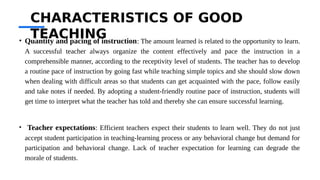
CHARACTERISTICS OF GOOD
TEACHING
•Quantity and pacing of instruction: The amount learned is related to the opportunity to learn.
A successful teacher always organize the content effectively and pace the instruction in a
comprehensible manner, according to the receptivity level of students. The teacher has to develop
a routine pace of instruction by going fast while teaching simple topics and she should slow down
when dealing with difficult areas so that students can get acquainted with the pace, follow easily
and take notes if needed. By adopting a student-friendly routine pace of instruction, students will
get time to interpret what the teacher has told and thereby she can ensure successful learning.
• Teacher expectations: Efficient teachers expect their students to learn well. They do not just
accept student participation in teaching-learning process or any behavioral change but demand for
participation and behavioral change. Lack of teacher expectation for learning can degrade the
morale of students.
14.
•
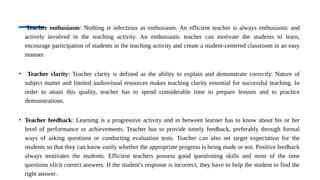
Teacher enthusiasm: Nothingis infectious as enthusiasm. An efficient teacher is always enthusiastic and
actively involved in the teaching activity. An enthusiastic teacher can motivate the students to learn,
encourage participation of students in the teaching activity and create a student-centered classroom in an easy
manner.
• Teacher clarity: Teacher clarity is defined as the ability to explain and demonstrate correctly. Nature of
subject matter and limited audiovisual resources makes teaching clarity essential for successful teaching. In
order to attain this quality, teacher has to spend considerable time to prepare lessons and to practice
demonstrations.
• Teacher feedback: Learning is a progressive activity and in between learner has to know about his or her
level of performance or achievements. Teacher has to provide timely feedback, preferably through formal
ways of asking questions or conducting evaluation tests. Teacher can also set target expectation for the
students so that they can know easily whether the appropriate progress is being made or not. Positive feedback
always motivates the students. Efficient teachers possess good questioning skills and most of the time
questions elicit correct answers. If the student's response is incorrect, they have to help the student to find the
right answer.
15.
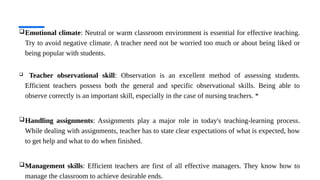
Emotional climate: Neutralor warm classroom environment is essential for effective teaching.
Try to avoid negative climate. A teacher need not be worried too much or about being liked or
being popular with students.
Teacher observational skill: Observation is an excellent method of assessing students.
Efficient teachers possess both the general and specific observational skills. Being able to
observe correctly is an important skill, especially in the case of nursing teachers. *
Handling assignments: Assignments play a major role in today's teaching-learning process.
While dealing with assignments, teacher has to state clear expectations of what is expected, how
to get help and what to do when finished.
Management skills: Efficient teachers are first of all effective managers. They know how to
manage the classroom to achieve desirable ends.
16.
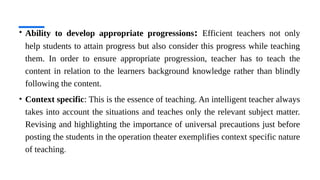
• Ability todevelop appropriate progressions: Efficient teachers not only
help students to attain progress but also consider this progress while teaching
them. In order to ensure appropriate progression, teacher has to teach the
content in relation to the learners background knowledge rather than blindly
following the content.
• Context specific: This is the essence of teaching. An intelligent teacher always
takes into account the situations and teaches only the relevant subject matter.
Revising and highlighting the importance of universal precautions just before
posting the students in the operation theater exemplifies context specific nature
of teaching.
17.
PRINCIPLES OF TEACHING
•According to J Gilbert, purposes of teaching is to help students:
(a) Acquire, retain and be able to use knowledge
(b) Understand, analyze, synthesize and evaluate
(c) Achieve skills
(d) Establish habits
(e) Develop attitudes
Principles of teaching will assist the teacher to achieve these purposes. Moreover, principles
of teaching will help the teacher to develop an insight regarding his strengths and weaknesses
and provide information on vital elements pertaining to teaching like whom to teach, why to
teach, where to teach, what to teach, how to teach and when to teach. Following principles is
a combination of psychological principles and general principles of teaching:
18.
• Principle ofmotivation: The best teacher is one who inspires the student. The
human mind is like a parachute, and it works only when open, so through teaching,
teacher should try to unleash the talents of the students by motivating them.
Motivation is a combination of recognizing, communicating and participating.
Teacher has to recognize students as individuals, encourage their participation while
teaching and communicate enthusiasm. Motivation promotes proactive learning and
thereby enabling students to achieve success in a systematic way. This principle
holds good during the entire nursing educational program, especially during the first
year period. Presence of a motivating teacher during the initial days of any nursing
educational program will provide an atmosphere of confidence and help students to
develop a positive attitude towards patient care.
19.
• Principle ofactivity: Teaching is basically an active process. While teaching, teacher
should be alert, smart and follow the most suitable method of teaching. Teacher
should also participate in various activities along with the students like discussions or
conducting research. Activity generates the drive and drive is essential to achieve
more heights in life. Teacher must provide various types of activities, such as
assignments or projects to enhance creative skills of students.
• Teacher should arouse interest among students: Even though we say teaching is
sharing of knowledge, knowledge will not flow from one person to another just like
money. To make students receptive, teacher has to elicit interest by adopting suitable
methods like telling a story, citing an example or by asking questions.
20.
• There shouldbe well-defined objectives: To attain good results, all teaching activities should be
based on predetermined objectives. With an objective in mind, it is easy to prepare the content,
select suitable method and evaluate the effectiveness of the teaching session. Statement of well-
defined objectives in advance will make the teacher more confident and enthusiastic. If you are
planning to take a class on lecture method, the following objective will serve the purpose "after
attending the class students will acquire knowledge regarding the practice of lecture method,
recognize its value as a teaching method and able to practice it effectively by limiting the
demerits."
• Principle of individual difference: Good teaching always respects the individuality of students.
By considering each student as a unique individual, teacher can pay attention to the individual
differences and develop strategies to cater the educational needs of the individual student.
• Principle of creativity: By applying creativity, teacher can convert a passive teaching-learning
situation into an active one. Through creativity teacher can arouse students' natural motivation to
learn and this will in turn convert a usually teacher-centered classroom into a more desirable
learner-centered classroom.
21.
• Principle ofselection: Teacher should select the appropriate content,
teaching method, teaching situation, media of instruction, AV aids, textbooks
and journal articles for teaching a particular subject matter in order to make
teaching more meaningful and comprehensible to students.
• Principle of division: Particular teaching activity should have definite
divisions based on valid reasons. Teacher should be aware about the division
and present the content to the students in well-organized steps..
22.
• Principle ofrevision and practice: During a teaching session, teacher has to revise in
the middle and in the end. Revising or summarizing the content in the end of a teaching
session is called recapitulation. In addition to the recapitulation, the teacher has to
motivate the students to practice the learned lessons periodically to enhance easy
recollection.
• Principle of correlation: The function of teaching is to share knowledge,
development of understanding and skills. While teaching, teacher has to take care that
the transferred knowledge will not remain segregated and as far as possible correlate
with the previous or related knowledge. Correlation helps the student to develop a
unified view regarding what is taught. Teaching nursing invariably require correlation
because to render comprehensive nursing care, one has to correlate different branches
of knowledge.
23.
• Principle ofconnecting with life: Relationship between life and education is
proved undoubtfully and teaching is an integral part of education, so all the teaching
activities are connected with life. The maximum attention span of human beings at a
stretch is 40-45 minutes and based on this fact, usually a teaching session is planned
for 45 minutes. The aim of nursing is the preservation of life with emphasis to
quality. Naturally, teaching nursing is connected to the life of the student as well as to
the life of the patient The principle of connecting with life is the reason for giving
one day off once in seven days for nursing students in order to recharge their depleted
energy levels and teaching students to administer diuretics, preferably in the morning
hours to provide an uninterrupted sleep to the patient for maintaining his biological
rhythm of life.
24.
BARRIERS TO TEACHING
•Inappropriate attitude of teachers and learners: Teachers' inappropriate attitude
regarding teaching, self-improvement, developing teaching skills, communication with
learners and relationship with learners act as barriers to teaching. Learners low interest in
learning, less expectations and lack of proper intrinsic motivation and effort also act as
barriers to teaching.
• Lack of proper classroom management skills of teacher: when the teacher fails
to maintain proper discipline in classroom through appropriate classroom management
skills it can create barriers to teaching.
• Lack of proper communication skills: Poor communication skills of both teacher
and learner is one of the main barrier of teaching.
25.
• Poor teacherstudent interaction: Teacher-student interaction is an integral part of teaching-
learning process. According to Halstead and Bills "teacher-student interaction is a two-way
communication process intended to bring out behavior modification of the learner in accordance
with predetermined behavioral objectives by effectively processing the feedback received from
students." Thus, poor teacher-student interaction is definitely a barrier to teaching.
• Environmental barriers: Environmental barriers such as lack of physical facilities both in the
college and clinical area can affect teaching.
• Emotional barrier: Emotional intelligence of both teacher and student is essential for creating
a conducive classroom environment for teaching and learning. Low emotional intelligence of
teacher as well as students can create problems in the teaching-learning process.
26.
• Lack ofteacher awarenesses: Vanessa R recommends five awarenesses, a teacher
must possess for conducting effective teaching. They are (1) awareness about learner.
(2) awareness about teacher-student interaction, (3) awareness of self as a teacher
(4) awareness of teaching practice and (5) awareness of context of teaching (in
classroom or clinical settings). Lack of these awarenesses act as barriers to teaching.
• Inadequate teaching skills of teacher: It is clear that inadequate teaching skills,
especially in teaching content and assessment strategies can adversely affect
teaching.
• Inappropriate use of technology in the teaching-learning process: Proper use of
technology definitely enhance quality of teaching. If the teacher uses technology in an
excess manner by ignoring human element in teaching-learning process can lead to
ineffective teaching. In the same way, underutilization of technology also result in
poor teaching by denying learning opportunity to students.
27.
•
Lack of resources:It is very clear that lack of resources like human resources, financial
resources, time, etc., can badly affect teaching.
• Low teacher expectations: In simple terms, teacher expectations are beliefs of a teacher
about the achievement of students or learning outcomes. High teacher expectations positively
affect student learning and thereby improve learning outcomes.
• Less number of teachable moments: Teachable moments are times when learning is
most achievable, when time is right for knowledge to be shared and built in the teaching-
learning process. Naturally, less number of teachable moments affect effective teaching.
• Lack of good relationship between teacher and students: A good relationship
between teacher and students is essential for creating a conductive class environment for
learning.Lack of good relationship can negatively affect teaching.
28.
DEFINITION -LEARNING
• Accordingto GA Kimble, “Learning is a relatively permanent change in behavioral
potentiality that occurs as a result of reinforced practice".
• According to Paivio, "Learning is the process of acquiring new or modifying
existing attitude, knowledge, behavior, skills values and preferences".
This definition highlights the comprehensive nature of learning. Learning is a
continuous process and knowledge gained through experience is an integral part of
learning.
29.
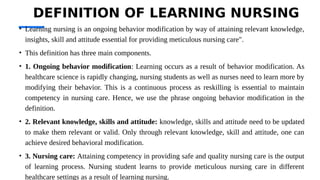
DEFINITION OF LEARNINGNURSING
• Learning nursing is an ongoing behavior modification by way of attaining relevant knowledge,
insights, skill and attitude essential for providing meticulous nursing care".
• This definition has three main components.
• 1. Ongoing behavior modification: Learning occurs as a result of behavior modification. As
healthcare science is rapidly changing, nursing students as well as nurses need to learn more by
modifying their behavior. This is a continuous process as reskilling is essential to maintain
competency in nursing care. Hence, we use the phrase ongoing behavior modification in the
definition.
• 2. Relevant knowledge, skills and attitude: knowledge, skills and attitude need to be updated
to make them relevant or valid. Only through relevant knowledge, skill and attitude, one can
achieve desired behavioral modification.
• 3. Nursing care: Attaining competency in providing safe and quality nursing care is the output
of learning process. Nursing student learns to provide meticulous nursing care in different
healthcare settings as a result of learning nursing.
30.
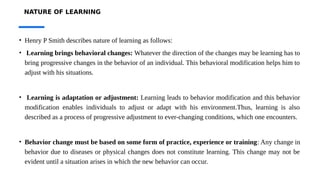
NATURE OF LEARNING
•Henry P Smith describes nature of learning as follows:
• Learning brings behavioral changes: Whatever the direction of the changes may be learning has to
bring progressive changes in the behavior of an individual. This behavioral modification helps him to
adjust with his situations.
• Learning is adaptation or adjustment: Learning leads to behavior modification and this behavior
modification enables individuals to adjust or adapt with his environment.Thus, learning is also
described as a process of progressive adjustment to ever-changing conditions, which one encounters.
• Behavior change must be based on some form of practice, experience or training: Any change in
behavior due to diseases or physical changes does not constitute learning. This change may not be
evident until a situation arises in which the new behavior can occur.
31.
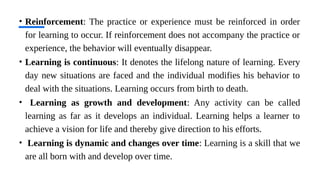
• Reinforcement: Thepractice or experience must be reinforced in order
for learning to occur. If reinforcement does not accompany the practice or
experience, the behavior will eventually disappear.
• Learning is continuous: It denotes the lifelong nature of learning. Every
day new situations are faced and the individual modifies his behavior to
deal with the situations. Learning occurs from birth to death.
• Learning as growth and development: Any activity can be called
learning as far as it develops an individual. Learning helps a learner to
achieve a vision for life and thereby give direction to his efforts.
• Learning is dynamic and changes over time: Learning is a skill that we
are all born with and develop over time.
32.
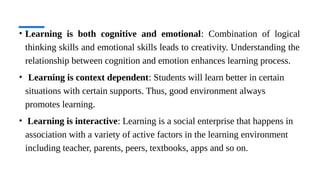
• Learning isboth cognitive and emotional: Combination of logical
thinking skills and emotional skills leads to creativity. Understanding the
relationship between cognition and emotion enhances learning process.
• Learning is context dependent: Students will learn better in certain
situations with certain supports. Thus, good environment always
promotes learning.
• Learning is interactive: Learning is a social enterprise that happens in
association with a variety of active factors in the learning environment
including teacher, parents, peers, textbooks, apps and so on.
33.
CHARACTERISTICS OF LEARNING
•The characteristics of learning are:
• ❖ Learning is a process which can be inferred from the behavioral change of the individual.
• ❖ The change in behavior need not occur immediately following the learning experience.
• ❖ Learning is relatively a permanent change in behavior.
• ❖ The change in behavior from learning is distinct from changes due to maturation,
motivation, etc.
• ❖ Learning is to be differentiated from instinctive behaviors.
• ❖ Learning is influenced by experience and practice.
34.
• SK mangaldescribes characteristics of learning as follows:
• Learning is a lifelong process: Learning is a continuous process. Learning occurs throughout life.
Learning can be formal or informal and it may be direct or indirect. When a learner learns, he develops
knowledge, skills, habits, attitudes and aptitudes.
• Learning is change in behavior: The result of the learning process can be measured as behavioral
changes. This change can be in any form. It can be desirable or undesirable. But in dsirable form, these
changes should occur in a positive direction. In true sense, learning is a change in desirable manner.
• Learning is a universal process: Learning is a universal process. It can happen everywhere. Learning
is a process for all living creatures. Human beings across all cultures learn as it is a lifelong process.
35.
• Learning ispurposeful and goal oriented: Learning always has a purpose. It is goal-oriented
because a teacher always has learning objectives in mind while teaching. If we don't have any aim or
goal, then the process of learning will not bring any change in behavior. Through the process of
learning, we can move towards predetermined learning goals. in any direction Learning is a process of
progress and development: Learning can occur These directions can be desirable or undesirable.
Learning aims development in a desirable direction. Learning should try to bring progressive changes
in the behavior of the learner always.
• Learning is the systematic organization of experiences: The basis of learning is the acquisition of
new experiences. Change in behavior occurs as a result of new experience. Learning of new
experiences, Chad interaction with environment: Interaction with the environment is very essential for
the learning process. The more the children interact with their environment, the more they learn. The
absence of activity and interaction hampers the quality of learning. Experiences gain from these
interactions bring out changes in the behavior of learner.
36.
• Learning helpsin achieving teaching objectives: Process of learning helps in achieving the objectives of
teaching. With learning, we expect a change in the behavior of individuals These changes happen with the
development of knowledge, insight, interests, skills and attitude, so for achieving teaching objectives, the
learning process plays an important role.
• * Learning is the fundamental process of life: Without learning the progress of an individual is not
possible. It acts as the basis for the progress of society and civilization.
• * Learning is the relationship between stimulus and response: Learning is generally a relationship
between stimulus and response. A person is considered as a learned person if he reacts according to the task
to be learned. Through learning, a person learns to react appropriately to the stimulus associated with the
situation of life.
• Learning is transferable: The learning acquired in one situation can be transferred to some other situation.
The learner should be careful not to let previously gained knowledge interfere in acquiring new knowledge
and experiences.
37.
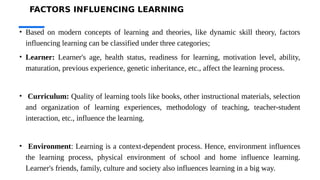
FACTORS INFLUENCING LEARNING
•Based on modern concepts of learning and theories, like dynamic skill theory, factors
influencing learning can be classified under three categories;
• Learner: Learner's age, health status, readiness for learning, motivation level, ability,
maturation, previous experience, genetic inheritance, etc., affect the learning process.
• Curriculum: Quality of learning tools like books, other instructional materials, selection
and organization of learning experiences, methodology of teaching, teacher-student
interaction, etc., influence the learning.
• Environment: Learning is a context-dependent process. Hence, environment influences
the learning process, physical environment of school and home influence learning.
Learner's friends, family, culture and society also influences learning in a big way.
38.
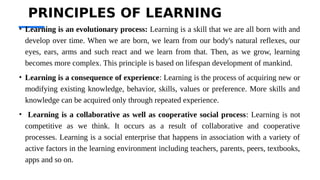
PRINCIPLES OF LEARNING
•Learning is an evolutionary process: Learning is a skill that we are all born with and
develop over time. When we are born, we learn from our body's natural reflexes, our
eyes, ears, arms and such react and we learn from that. Then, as we grow, learning
becomes more complex. This principle is based on lifespan development of mankind.
• Learning is a consequence of experience: Learning is the process of acquiring new or
modifying existing knowledge, behavior, skills, values or preference. More skills and
knowledge can be acquired only through repeated experience.
• Learning is a collaborative as well as cooperative social process: Learning is not
competitive as we think. It occurs as a result of collaborative and cooperative
processes. Learning is a social enterprise that happens in association with a variety of
active factors in the learning environment including teachers, parents, peers, textbooks,
apps and so on.
39.
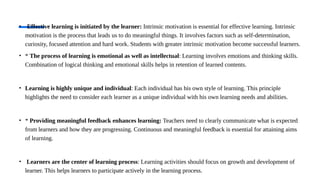
• Effective learningis initiated by the learner: Intrinsic motivation is essential for effective learning. Intrinsic
motivation is the process that leads us to do meaningful things. It involves factors such as self-determination,
curiosity, focused attention and hard work. Students with greater intrinsic motivation become successful learners.
• * The process of learning is emotional as well as intellectual: Learning involves emotions and thinking skills.
Combination of logical thinking and emotional skills helps in retention of learned contents.
• Learning is highly unique and individual: Each individual has his own style of learning. This principle
highlights the need to consider each learner as a unique individual with his own learning needs and abilities.
• * Providing meaningful feedback enhances learning: Teachers need to clearly communicate what is expected
from learners and how they are progressing. Continuous and meaningful feedback is essential for attaining aims
of learning.
• Learners are the center of learning process: Learning activities should focus on growth and development of
learner. This helps learners to participate actively in the learning process.
40.
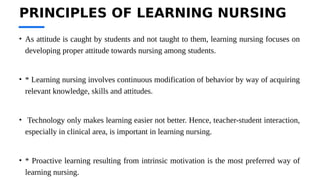
PRINCIPLES OF LEARNINGNURSING
• As attitude is caught by students and not taught to them, learning nursing focuses on
developing proper attitude towards nursing among students.
• * Learning nursing involves continuous modification of behavior by way of acquiring
relevant knowledge, skills and attitudes.
• Technology only makes learning easier not better. Hence, teacher-student interaction,
especially in clinical area, is important in learning nursing.
• * Proactive learning resulting from intrinsic motivation is the most preferred way of
learning nursing.
41.
•
* Deliberate practiceis an integral part of learning nursing. It is learning with intense concentration
and purpose.
• Learning nursing prepares students for taking up expanding or evolving professional roles in nursing.
• Learning nursing is a lifelong process in accordance with the changes in the healthcare delivery
system.
• Learning nursing prepares the student for life by becoming a good human being with qualities of a
professional nurse.
• As nursing profession is evolving it is important to learn, unlearn and relearn to maintain
competency in nursing.
42.
BARRIERS TO LEARNING
•HEALTH & EMOTIONAL PROBLEMS
• FAMILY PROBLEMS
• FINANCIAL ISSUES
• LACK OF ADEQUATE TEACHER & PARENTAL SUPPORT
• LACK OF PURPOSE/INTEREST OR ATTITUDE
• LACK OF ADEQUATE STUDENT SUPPORT & GUIDANCE PROGRAM (SSGP)
• ENVIRONMENTAL ISSUES
• LACK OF FOCUSED ATTENTION
• LACK OF TIME MANAGEMENT /PLANNING
• OVERUSE OF SOCIAL MEDIA
• FAILURE TO EMBRACE BOREDOM