Comprehensive Overview of the Nursing Process: Assessment to Implementation
Detailed exploration of the nursing process including assessment, diagnosis, planning, implementation, and evaluation with emphasis on critical thinking and patient-centered care.
Definition
⚫ is adeliberate problem-solving
approach for meeting people’s
health care and nursing needs.
⚫ Components include
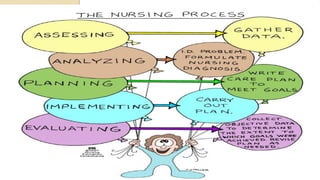
assessment, diagnosis,
planning, implementation, and
evaluation
⚫ An organized sequence of
problem-solving steps used to
identify and to manage the health
problems of clients (American
Nurses Association)
3.
The Nursing Process
⚫Itis an organizational framework for the practice of
nursing
⚫Cyclic and dynamic nature
⚫ client- Centeredness
⚫Focus on problem-solving and decision making
⚫Use of critical thinking
⚫Includes all steps taken by the nurse in caring for a
patient
4.
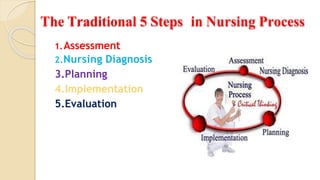
The Traditional 5Steps in Nursing Process
1.Assessment
2.Nursing Diagnosis
3.Planning
4.Implementation
5.Evaluation
6.
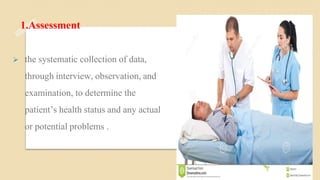
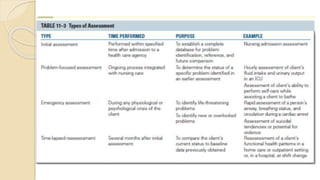
1.Assessment
the systematiccollection of data,
through interview, observation, and
examination, to determine the
patient’s health status and any actual
or potential problems .
7.
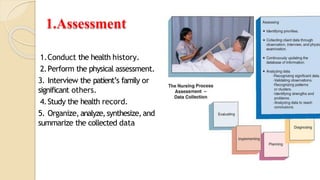
1.Assessment
1.Conduct the healthhistory.
2.Perform the physical assessment.
3. Interview the patient’s family or
significant others.
4.Study the health record.
5. Organize,analyze,synthesize, and
summarize the collected data
8.
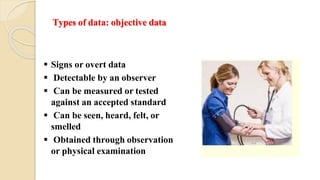
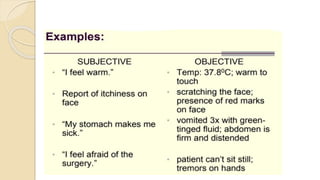
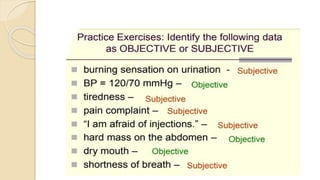
Types of data:objective data
Signs or overt data
Detectable by an observer
Can be measured or tested
against an accepted standard
Can be seen, heard, felt, or
smelled
Obtained through observation
or physical examination
9.
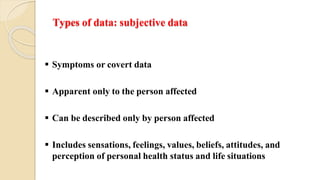
Types of data:subjective data
Symptoms or covert data
Apparent only to the person affected
Can be described only by person affected
Includes sensations, feelings, values, beliefs, attitudes, and
perception of personal health status and life situations
12.
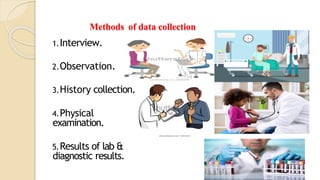
Methods of datacollection
1.Interview.
2.Observation.
3.History collection.
4.Physical
examination.
5.Results of lab &
diagnostic results.
13.
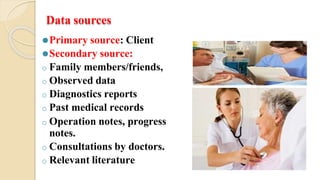
Data sources
⚫Primary source:Client
⚫Secondary source:
o Family members/friends,
o Observed data
o Diagnostics reports
o Past medical records
o Operation notes, progress
notes.
o Consultations by doctors.
o Relevant literature
15.
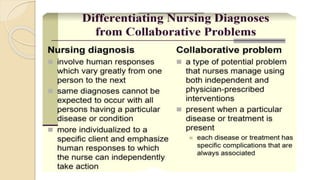
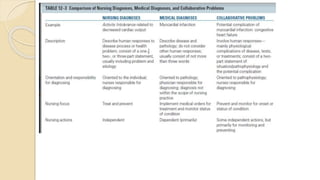
2.Nursing Diagnosis
isthe second phase of the nursing process
Nurses use critical thinking skills to interpret assessment data and
identify client strengths and problems
DIAGNOSING – refers to the REASONING process
DIAGNOSIS – statement or conclusion regarding the nature of a
phenomenon
DIAGNOSTIC LABELS - the standardized NANDA names for the
diagnoses
16.
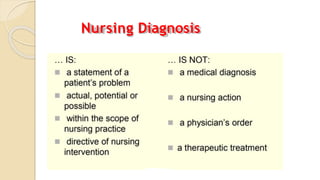
NURSING DIAGNOSIS
NURSINGDIAGNOSIS - refers to the client’s PROBLEM
STATEMENT and its etiology
NANDA definition “. . . a clinical judgment about individual, family, or
community responses to actual and potential health problems/life
processes. A nursing diagnosis provides the basis for selection of nursing
interventions to achieve outcomes for which the nurse is accountable”
17.
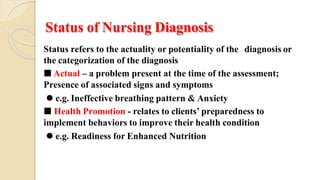
Status of NursingDiagnosis
Status refers to the actuality or potentiality of the diagnosis or
the categorization of the diagnosis
■ Actual – a problem present at the time of the assessment;
Presence of associated signs and symptoms
⚫ e.g. Ineffective breathing pattern & Anxiety
■ Health Promotion - relates to clients’ preparedness to
implement behaviors to improve their health condition
⚫ e.g. Readiness for Enhanced Nutrition
18.
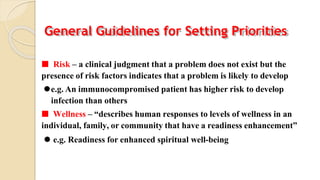
General Guidelines forSetting Priorities
■ Risk – a clinical judgment that a problem does not exist but the
presence of risk factors indicates that a problem is likely to develop
⚫e.g. An immunocompromised patient has higher risk to develop
infection than others
■ Wellness – “describes human responses to levels of wellness in an
individual, family, or community that have a readiness enhancement”
⚫ e.g. Readiness for enhanced spiritual well-being
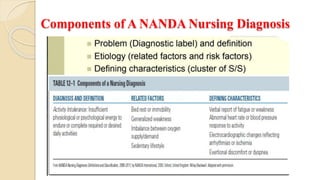
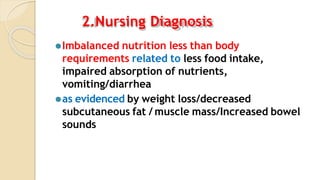
2.Nursing Diagnosis
⚫Imbalanced nutritionless than body
requirements related to less food intake,
impaired absorption of nutrients,
vomiting/diarrhea
⚫as evidenced by weight loss/decreased
subcutaneous fat / muscle mass/Increased bowel
sounds
25.
2.Nursing Diagnosis
⚫Ineffective individualcoping related to chronic
illness/death threats/severe pain/no adequate support
system as evidenced by inability to face problems/
hopelessness/anxiety/depression and dependence.
⚫ Risk for infection related to invasive procedures/
trauma/ tissue destruction/ immunosuppression /
chronic disease/indwellingcatheters/ endotracheal or
tracheostomy tubes.
26.
2.Nursing Diagnosis
⚫Knowledge Deficitrelated to disease condition/
prognosis /treatment secondary to misinterpretation
of information
⚫ as evidenced by asking questions, request of
information, not following the instructions.
⚫Fluid volume excess related to excessive intake of
sodium from foods/, intravenous (IV) solutions/,
medications,/renal insufficiency/decreased cardiac
output/ disease condition
⚫as evidenced by weight gain / edema/ polyuria
27.
2.Nursing Diagnosis
⚫IneffectiveTissue Perfusionrelated to reduction
in the number of red blood cells as
⚫evidenced by pallor/ Pale conjunctiva and mucous
membranes
⚫Anxiety related to disease condition/changes in
health status/,low socio-economic status
⚫as evidenced by increased tension/ distress,/fear/
irritability/reduced focus of attention
28.
2.Nursing Diagnosis
⚫Fluid volumedeficit related to inadequate fluid
intake/vomiting/ diarrhea/ increased fluid loss/
fever
⚫as evidenced by dry skin or mucus membrane/
thirst/ decreased urine output.
⚫Sleep pattern disturbance related to pain/
hospitalization/ anxiety
⚫as evidenced by frequent yawning/ dark circle
under eyes.
29.
2. Nursing Diagnosis
⚫Self-CareDeficit bathing/hygiene;
Dressing/Grooming/ Feeding/Toileting related to
impaired mobility/ energy deficit/ neuromuscular
impairment secondary to cerebrovascular
accident (CVA)
⚫as evidenced by Inability to feed /dress /bathe and
groom/ toileting independently.
30.
Objectives/ Goals
It isthe expected outcome.
⚫Expected outcomes are realistic, achievable & safe.
⚫It is patient centered rather than nurse centered.
Types
Short-Term Goals
⚫Outcomes achievable in a few days or 1 week
Long-Term Goals
⚫Desirable outcomes that take weeks or months
31.
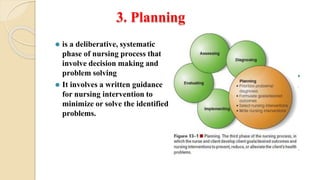
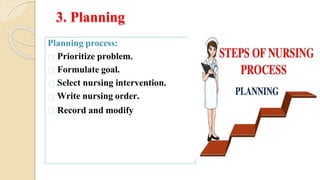
3. Planning
⚫ isa deliberative, systematic
phase of nursing process that
involve decision making and
problem solving
⚫ It involves a written guidance
for nursing intervention to
minimize or solve the identified
problems.
32.
Types of Planning
1.Initial Planning
⚫ The nurse who performs the admission assessment usually develops the
initial comprehensive plan of care
2. Ongoing planning
⚫ done by all nurses who work with the client and occurs at the beginning
of a shift
3. Discharge planning:
⚫ The process of anticipating and planning for needs after discharge
⚫ Effective discharge planning begins at first client contact needs
33.
3. Planning
⚫Determine problemsthat require immediate action of
problems of the patient.
⚫ For example:IneffectiveAirway Clearance would pose
more threat to life than the diagnosis Risk for Impaired
skin integrity.
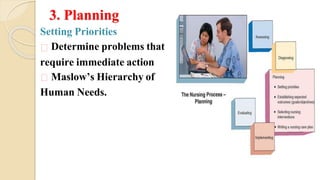
Setting Priorities :is the process of establishing
a preferential sequence for addressing nursing
diagnoses and interventions
deciding which nursing diagnosis requires
attention first, which second..
Group the diagnosis according to:
High Priority - Life-threatening problems,
such as impaired respiratory or cardiac
function
Medium Priority - Health-threatening
problems, such as acute illness and decreased
coping ability
Low Priority - arises from normal
developmental needs or that requires only
minimal nursing support
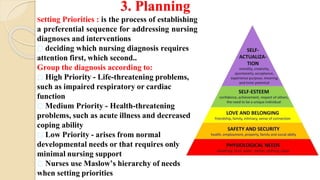
Nurses use Maslow’s hierarchy of needs
when setting priorities
37.
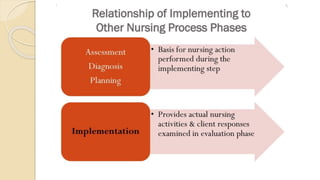
4. Implementation
➢ theaction phase in which the nurse performs the nursing
interventions -“puts the plan into action”
➢ Nursing Interventions Classification (NIC) - consists of
doing and documenting the activities that are the specific
nursing actions needed to carry out the interventions
➢ Performs or delegates the nursing activities for the
interventions that were developed in the planning step and
recording nursing activities and the resulting client
responses
39.
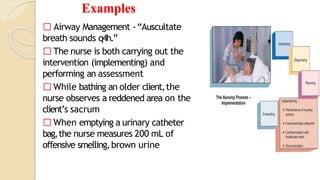
Examples
Airway Management -“Auscultate
breathsounds q4h.”
The nurse is both carrying out the
intervention (implementing) and
performing an assessment
While bathing an older client,the
nurse observes a reddened area on the
client’s sacrum
When emptying a urinary catheter
bag,the nurse measures 200 mL of
offensive smelling,brown urine
41.
Guidelines in Implementingthe Nursing Interventions
⚫ Based on scientific knowledge, nursing research & professional
standards of care (Evidence-based Practice)
⚫ Clearly understand the interventions to be implemented and
question any that are not understood
⚫ Adapt activities to client (beliefs, values, age, health status, and
environment)
⚫ Implement safe care
⚫ Provide teaching, support, and comfort
⚫ Be holistic (viewing client & responses as a whole)
⚫ Respect the dignity of the client and enhance self-esteem (Privacy
and allowing clients to make own decisions)
⚫ Encourage clients to participate actively
42.
Documenting Nursing Activities
⚫Record the interventions and client responses in the nursing progress notes
⚫ Nursing care must not be recorded in advance
⚫ May record routine or recurring activities (mouth care) in the client record at
the end of a shift (personal record on a worksheet)
⚫ Nursing activities are communicated verbally as well as in writing
⚫ It is important to record a nursing intervention immediately after
implemented especially for administration of medications and treatments
⚫ Recorded data about a client must be up to date, accurate, and available
⚫ to other nurses and health care professionals
⚫ Immediate recording helps safeguard the client, for example, from receiving
a duplicate dose of medication
⚫ Report client status at a change of shift and on a client's discharge to another
unit or health agency in person, via a voice recording, or in writing
43.
Evaluation
⚫“to judge orto appraise”
⚫“Planned,Ongoing,Purposeful activity” – determines
client's progress toward achievement of goals/outcomes and
the effectiveness of the nursing care plan
⚫ Conclusions drawn determine whether the nursing
nterventions should be terminated,continued,or changed
⚫“Continuous” - enable to make on-the-spot modifications
in an intervention
⚫“Responsibility and Accountability for actions” -
interest in the results of the nursing activities and not
perpetuate ineffective actions but to adopt more effective ones