Comprehensive Overview of the Indian Knowledge System (IKS) and Its Relevance
Explores the Indian Knowledge System's origins, structure, disciplines, and its importance in preserving culture, promoting sustainability, and complementing modern science.
Comprehensive Overview of the Indian Knowledge System (IKS) and Its Relevance
1.
INDIAN KNOWLEDGE SYSTEM
PresentedBy
Mrs.R.Kiruba
Assistant Professor (Sr.G)
Department of EIE
Sri Ramakrishna Engineering College
Coimbatore-22
2.
2
Introduction
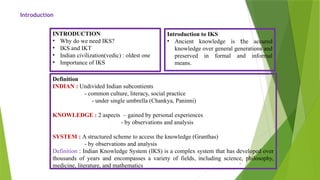
INTRODUCTION
• Why dowe need IKS?
• IKS and IKT
• Indian civilization(vedic) : oldest one
• Importance of IKS
Introduction to IKS
• Ancient knowledge is the accured
knowledge over general generations and
preserved in formal and informal
means.
Definition
INDIAN : Undivided Indian subcontients
- common culture, literacy, social practice
- under single umbrella (Chankya, Paninni)
KNOWLEDGE : 2 aspects – gained by personal experiences
- by observations and analysis
SYSTEM : A structured scheme to access the knowledge (Granthas)
- by observations and analysis
Definition : Indian Knowledge System (IKS) is a complex system that has developed over
thousands of years and encompasses a variety of fields, including science, philosophy,
medicine, literature, and mathematics
3.
3
Meaning of IndianKnowledge System
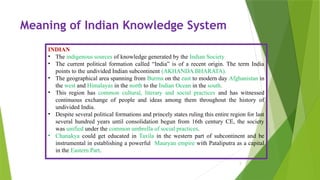
INDIAN
• The indigenous sources of knowledge generated by the Indian Society
• The current political formation called “India” is of a recent origin. The term India
points to the undivided Indian subcontinent (AKHANDA BHARATA).
• The geographical area spanning from Burma on the east to modern day Afghanistan in
the west and Himalayas in the north to the Indian Ocean in the south.
• This region has common cultural, literary and social practices and has witnessed
continuous exchange of people and ideas among them throughout the history of
undivided India.
• Despite several political formations and princely states ruling this entire region for last
several hundred years until consolidation begun from 16th century CE, the society
was unified under the common umbrella of social practices.
• Chanakya could get educated in Taxila in the western part of subcontinent and be
instrumental in establishing a powerful Mauryan empire with Pataliputra as a capital
in the Eastern Part.
4.
4
Meaning of IndianKnowledge System
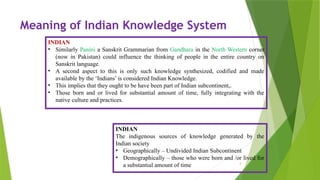
INDIAN
• Similarly Panini a Sanskrit Grammarian from Gandhara in the North Western corner
(now in Pakistan) could influence the thinking of people in the entire country on
Sanskrit language.
• A second aspect to this is only such knowledge synthesized, codified and made
available by the ‘Indians’ is considered Indian Knowledge.
• This implies that they ought to be have been part of Indian subcontinent,.
• Those born and or lived for substantial amount of time, fully integrating with the
native culture and practices.
INDIAN
The indigenous sources of knowledge generated by the
Indian society
• Geographically – Undivided Indian Subcontinent
• Demographically – those who were born and /or lived for
a substantial amount of time
5.
5
Meaning of IndianKnowledge System
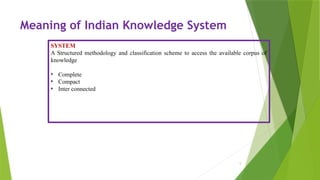
SYSTEM
A Structured methodology and classification scheme to access the available corpus of
knowledge
• Complete
• Compact
• Inter connected
7
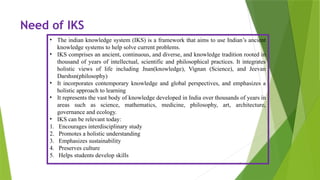
Need of IKS
•The indian knowledge system (IKS) is a framework that aims to use Indian’s ancient
knowledge systems to help solve current problems.
• IKS comprises an ancient, continuous, and diverse, and knowledge tradition rooted in
thousand of years of intellectual, scientific and philosophical practices. It integrates
holistic views of life including Jnan(knowledge), Vignan (Science), and Jeevan
Darshsn(philosophy)
• It incorporates contemporary knowledge and global perspectives, and emphasizes a
holistic approach to learning
• It represents the vast body of knowledge developed in India over thousands of years in
areas such as science, mathematics, medicine, philosophy, art, architecture,
governance and ecology.
• IKS can be relevant today:
1. Encourages interdisciplinary study
2. Promotes a holistic understanding
3. Emphasizes sustainability
4. Preserves culture
5. Helps students develop skills
8.
8
Need of IKS
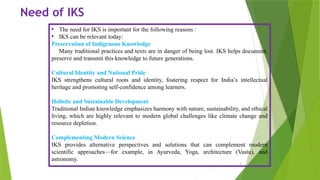
•The need for IKS is important for the following reasons :
• IKS can be relevant today:
Preservation of Indigenous Knowledge
Many traditional practices and texts are in danger of being lost. IKS helps document,
preserve and transmit this knowledge to future generations.
Cultural Identity and National Pride
IKS strengthens cultural roots and identity, fostering respect for India’s intellectual
heritage and promoting self-confidence among learners.
Holistic and Sustainable Development
Traditional Indian knowledge emphasizes harmony with nature, sustainability, and ethical
living, which are highly relevant to modern global challenges like climate change and
resource depletion.
Complementing Modern Science
IKS provides alternative perspectives and solutions that can complement modern
scientific approaches—for example, in Ayurveda, Yoga, architecture (Vastu), and
astronomy.
9.
9
Need of IKS
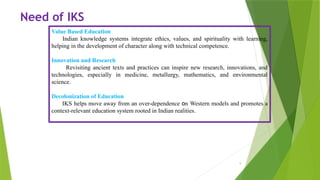
ValueBased Education
Indian knowledge systems integrate ethics, values, and spirituality with learning,
helping in the development of character along with technical competence.
Innovation and Research
Revisiting ancient texts and practices can inspire new research, innovations, and
technologies, especially in medicine, metallurgy, mathematics, and environmental
science.
Decolonization of Education
IKS helps move away from an over-dependence on Western models and promotes a
context-relevant education system rooted in Indian realities.
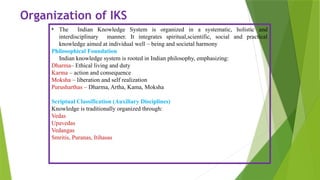
11
Organization of IKS
•The Indian Knowledge System is organized in a systematic, holistic and
interdisciplinary manner. It integrates spiritual,scientific, social and practical
knowledge aimed at individual well – being and societal harmony
Philosophical Foundation
Indian knowledge system is rooted in Indian philosophy, emphasizing:
Dharma– Ethical living and duty
Karma – action and consequence
Moksha – liberation and self realization
Purusharthas – Dharma, Artha, Kama, Moksha
Scriptual Classification (Auxiliary Disciplines)
Knowledge is traditionally organized through:
Vedas
Upavedas
Vedangas
Smritis, Puranas, Itihasas
12.
12
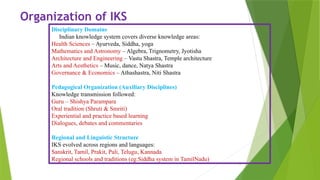
Organization of IKS
DisciplinaryDomains
Indian knowledge system covers diverse knowledge areas:
Health Sciences – Ayurveda, Siddha, yoga
Mathematics and Astronomy – Algebra, Trignometry, Jyotisha
Architecture and Engineering – Vastu Shastra, Temple architecture
Arts and Aesthetics – Music, dance, Natya Shastra
Governance & Economics – Athashastra, Niti Shastra
Pedagogical Organization (Auxiliary Disciplines)
Knowledge transmission followed:
Guru – Shishya Parampara
Oral tradition (Shruti & Smriti)
Experiential and practice based learning
Dialogues, debates and commentaries
Regional and Linguistic Structure
IKS evolved across regions and languages:
Sanskrit, Tamil, Prakit, Pali, Telugu, Kannada
Regional schools and traditions (eg:Siddha system in TamilNadu)
13.
13
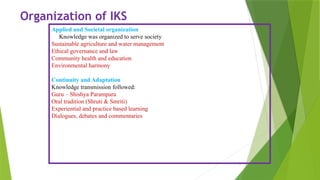
Organization of IKS
Appliedand Societal organization
Knowledge was organized to serve society
Sustainable agriculture and water management
Ethical governance and law
Community health and education
Environmental harmony
Continuity and Adaptation
Knowledge transmission followed:
Guru – Shishya Parampara
Oral tradition (Shruti & Smriti)
Experiential and practice based learning
Dialogues, debates and commentaries
14.
14
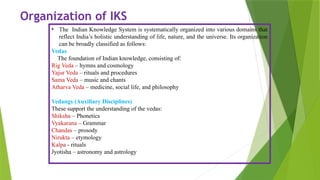
Organization of IKS
•The Indian Knowledge System is systematically organized into various domains that
reflect India’s holistic understanding of life, nature, and the universe. Its organization
can be broadly classified as follows:
Vedas
The foundation of Indian knowledge, consisting of:
Rig Veda – hymns and cosmology
Yajur Veda – rituals and procedures
Sama Veda – music and chants
Atharva Veda – medicine, social life, and philosophy
Vedangs (Auxiliary Disciplines)
These support the understanding of the vedas:
Shiksha – Phonetics
Vyakarana – Grammar
Chandas – prosody
Nirukta – etymology
Kalpa - rituals
Jyotisha – astronomy and astrology
15.
15
Organization of IKS
UpaVedas(Applied Knowledge)
Practical applications of vedic knowledge:
Ayurveda – medicine and health
Dhanurveda – military science
Gandharvaveda – music and arts
Sthapatyaveda – architecture and town planning
Darshanas (Philosophical Systems)
Six schools of Indian philosophy:
Nyaya – logic
Vaisheshika – atomic theory
Samkhya – metaphysics
Yoga – discipline and self - realization
Mimamsa – ritual interpretation
Vedanta – ultimate reality
16.
16
Organization of IKS
UpaVedas(Applied Knowledge)
Practical applications of vedic knowledge:
Ayurveda – medicine and health
Dhanurveda – military science
Gandharvaveda – music and arts
Sthapatyaveda – architecture and town planning
Darshanas (Philosophical Systems)
Six schools of Indian philosophy:
Nyaya – logic
Vaisheshika – atomic theory
Samkhya – metaphysics
Yoga – discipline and self - realization
Mimamsa – ritual interpretation
Vedanta – ultimate reality