A GREAT STRUGGLE
“Longyears ago we made a tryst with destiny and
now the time comes when we shall redeem our
pledge not wholly or in full measure ,but very
substantially . At the stroke of the midnight hour,
when the world sleeps, India will awake to life and
freedom.”
This was the speech made by Jawaharlal
Nehru as the Prime Minister of an
Independent India , addressing the
constituent assembly and the Indian nation
on 15th
August 1947.
3.
Various
Stages
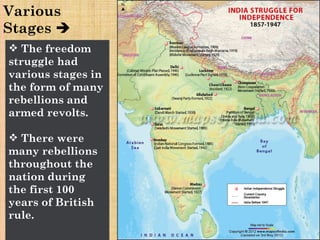
Thefreedom
struggle had
various stages in
the form of many
rebellions and
armed revolts.
There were
many rebellions
throughout the
nation during
the first 100
years of British
rule.
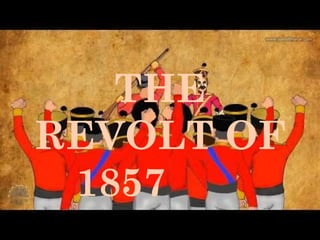
The traditionalopposition finally culminated in the Revolt of 1857, in
which princely rulers, soldiers as well as peasants , alike took part.
The revolt was the product of accumulated grievances of all these people
towards British imperialism.
Though a failure ,it produced many heroes and also created unity among
all Indians.
Mangal Panday is considered as one of the greatest heroes of the
revolt of 1857.
Some other people who fought in this revolt were Rani Lakshami
Bai, Tantia Tope,Bahadur Shah, Nana Sahib and Begum
Hazrat Mahal.
The revolt Shook the very foundation of British Rule in India.
Finally, it led to the power of Indians to be transferred from ………….
East India Company British crown.
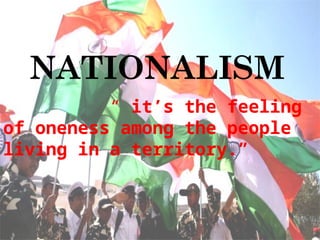
RISE OF INDIAN
NATIONALISM
(1885-1905)
The period from 1885-1905 was
the period of sowing the seed of
Indian nationalism
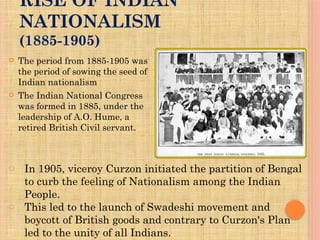
The Indian National Congress
was formed in 1885, under the
leadership of A.O. Hume, a
retired British Civil servant.
o In 1905, viceroy Curzon initiated the partition of Bengal
to curb the feeling of Nationalism among the Indian
People.
o This led to the launch of Swadeshi movement and
boycott of British goods and contrary to Curzon's Plan
led to the unity of all Indians.
8.
BOYCOTT
MOVEMENT
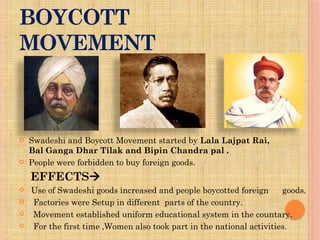
Swadeshi andBoycott Movement started by Lala Lajpat Rai,
Bal Ganga Dhar Tilak and Bipin Chandra pal .
People were forbidden to buy foreign goods.
EFFECTS
Use of Swadeshi goods increased and people boycotted foreign goods.
Factories were Setup in different parts of the country.
Movement established uniform educational system in the countary.
For the first time ,Women also took part in the national activities.
9.
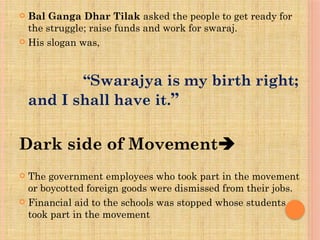
Bal GangaDhar Tilak asked the people to get ready for
the struggle; raise funds and work for swaraj.
His slogan was,
“Swarajya is my birth right;
and I shall have it.”
Dark side of Movement
The government employees who took part in the movement
or boycotted foreign goods were dismissed from their jobs.
Financial aid to the schools was stopped whose students
took part in the movement
10.
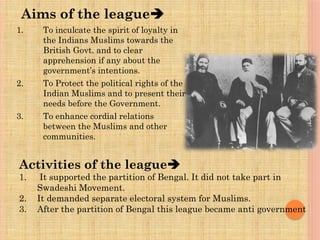
THE MUSLIM LEAGUE
Muhammadan Educational conference was held in Dacca and the
Muslim leader founded “All India Muslim League” on 30th
December, 1906.
Aga Khan, Nawa-Salim-ulla Khan, Nawab-Moshine-ul-Mulk and
Nawab-Wakar-ul-mulk played a significant role in founding the
League.
Reasons for the birth of Muslim league
1. British policy of divide and rule.
2. Backwardness of the Muslims
3. Deplorable economic Conditions of the Muslims
4. Muslims did not adopt the English system of education
5. Partition of Bengal ,1905
6. Spread of communal ideas through the study of Indian history
11.
Aims of theleague
1. To inculcate the spirit of loyalty in
the Indians Muslims towards the
British Govt. and to clear
apprehension if any about the
government’s intentions.
2. To Protect the political rights of the
Indian Muslims and to present their
needs before the Government.
3. To enhance cordial relations
between the Muslims and other
communities.
Activities of the league
1. It supported the partition of Bengal. It did not take part in
Swadeshi Movement.
2. It demanded separate electoral system for Muslims.
3. After the partition of Bengal this league became anti government
12.
REVOLUTIONARY MOVEMENT
From1905 to 1919, the leadership of National Movement
was in the hands of Radicals but humiliating treatment of
Indians abroad ,economic exploitation, terrible plague etc.
led to the birth of Revolutionary movement.
Aims
To create lawlessness,
They would not hesitate to sacrifice their life.
To dislodge the British Rules it was a curse for them
Main Centers Bengal, Maharashtra, Punjab,
Revolutionaries activities abroad
The Ghadar Party movement was one of the
Revolutionary Movement started by the Indians settled in
America and Canada in 1913.
13.
IMPACT OF THEFIRST
WORLD WAR
During the war , Indians
rendered valuable help to
England.
Political awareness among
the Indians
Plans of the
revolutionaries
Indians demand for
democracy
Emergence of the spirit of
self respect among the
Indians
Lucknow pact
14.
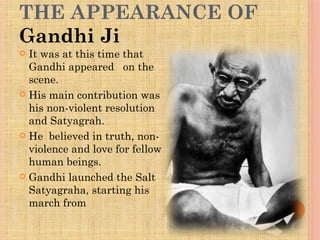
THE APPEARANCE OF
GandhiJi
It was at this time that
Gandhi appeared on the
scene.
His main contribution was
his non-violent resolution
and Satyagrah.
He believed in truth, non-
violence and love for fellow
human beings.
Gandhi launched the Salt
Satyagraha, starting his
march from
15.
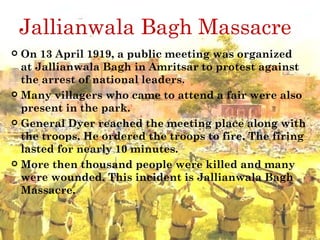
On 13April 1919, a public meeting was organized
at Jallianwala Bagh in Amritsar to protest against
the arrest of national leaders.
Many villagers who came to attend a fair were also
present in the park.
General Dyer reached the meeting place along with
the troops. He ordered the troops to fire. The firing
lasted for nearly 10 minutes.
More then thousand people were killed and many
were wounded. This incident is Jallianwala Bagh
Massacre.
Jallianwala Bagh Massacre
16.
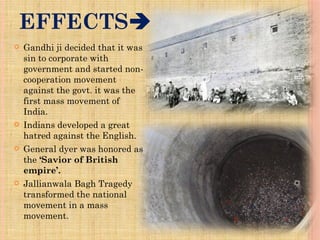
EFFECTS
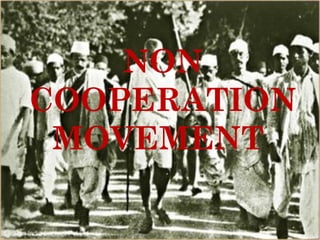
Gandhi jidecided that it was
sin to corporate with
government and started non-
cooperation movement
against the govt. it was the
first mass movement of
India.
Indians developed a great
hatred against the English.
General dyer was honored as
the ‘Savior of British
empire’.
Jallianwala Bagh Tragedy
transformed the national
movement in a mass
movement.
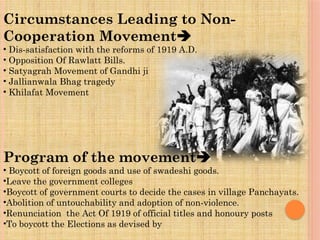
Circumstances Leading toNon-
Cooperation Movement
• Dis-satisfaction with the reforms of 1919 A.D.
• Opposition Of Rawlatt Bills.
• Satyagrah Movement of Gandhi ji
• Jallianwala Bhag tragedy
• Khilafat Movement
Program of the movement
• Boycott of foreign goods and use of swadeshi goods.
•Leave the government colleges
•Boycott of government courts to decide the cases in village Panchayats.
•Abolition of untouchability and adoption of non-violence.
•Renunciation the Act Of 1919 of official titles and honoury posts
•To boycott the Elections as devised by
19.
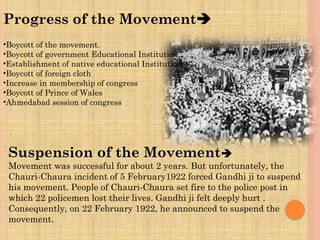
Progress of theMovement
•Boycott of the movement.
•Boycott of government Educational Institution.
•Establishment of native educational Institution
•Boycott of foreign cloth
•Increase in membership of congress
•Boycott of Prince of Wales
•Ahmedabad session of congress
Suspension of the Movement
Movement was successful for about 2 years. But unfortunately, the
Chauri-Chaura incident of 5 February1922 forced Gandhi ji to suspend
his movement. People of Chauri-Chaura set fire to the police post in
which 22 policemen lost their lives. Gandhi ji felt deeply hurt .
Consequently, on 22 February 1922, he announced to suspend the
movement.
20.
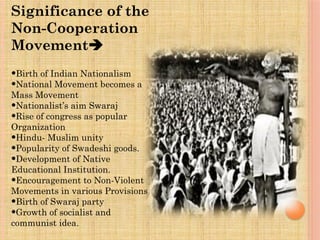
Significance of the
Non-Cooperation
Movement
•Birthof Indian Nationalism
•National Movement becomes a
Mass Movement
•Nationalist’s aim Swaraj
•Rise of congress as popular
Organization
•Hindu- Muslim unity
•Popularity of Swadeshi goods.
•Development of Native
Educational Institution.
•Encouragement to Non-Violent
Movements in various Provisions
•Birth of Swaraj party
•Growth of socialist and
communist idea.
21.
THE KAKORI
CONSIPRACY
The KakoriConspiracy (Kakori Case) was a train robbery that
took place between Kakori and , near Lucknow, on 9 August
1925 during the Indian Independence Movement against the
British Indian Government.
The robbery was conceived by Ram Prasad Bismil and
Ashfaqullah Khan.
In this case Ram Prasad Bismil and Ashfaqullah Khan were
hanged.
Chander shekhar azad and khudiram Bose were some of the
important revolutionary leaders of the time.
On March 1931, Bhagat singh, Rajguru and Sukhdev were
hanged, following a Series of concipracies.
There were other Revolutionary groups like Chittagong group
led by Surya Sen.
22.
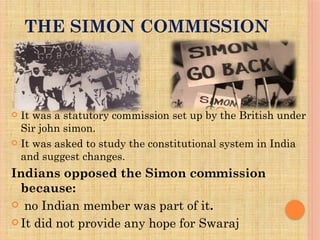
THE SIMON COMMISSION
It was a statutory commission set up by the British under
Sir john simon.
It was asked to study the constitutional system in India
and suggest changes.
Indians opposed the Simon commission
because:
no Indian member was part of it.
It did not provide any hope for Swaraj
23.
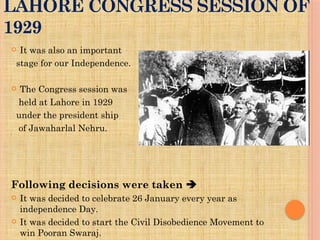
LAHORE CONGRESS SESSIONOF
1929
It was also an important
stage for our Independence.
The Congress session was
held at Lahore in 1929
under the president ship
of Jawaharlal Nehru.
Following decisions were taken
It was decided to celebrate 26 January every year as
independence Day.
It was decided to start the Civil Disobedience Movement to
win Pooran Swaraj.
24.
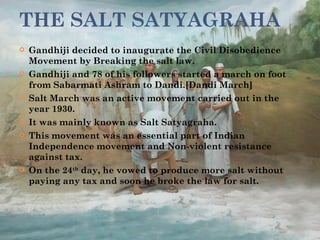
THE SALT SATYAGRAHA
Gandhiji decided to inaugurate the Civil Disobedience
Movement by Breaking the salt law.
Gandhiji and 78 of his followers started a march on foot
from Sabarmati Ashram to Dandi.[Dandi March]
Salt March was an active movement carried out in the
year 1930.
It was mainly known as Salt Satyagraha.
This movement was an essential part of Indian
Independence movement and Non-violent resistance
against tax.
On the 24th
day, he vowed to produce more salt without
paying any tax and soon he broke the law for salt.
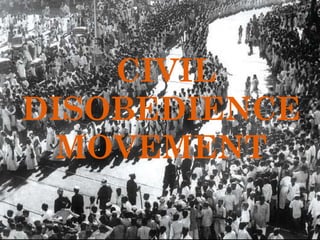
MAIN FEATURES
Gandhijiled a march on foot from Sabarmati to Dandi. He
broke the Salt Law at Dandi and inaugurated the Movement.
People broke salt law in many places. Foreign goods were
boycotted . Liquor shops were picketed.
Government servants resigned their jobs.
Forest laws were broken.
People refused to pay taxes.
Leaders were arrested
Workers attacked government offices
Gandhi ji called off the movement on 5 March 1931 under the
Gandhi Irwin act He agreed to attend the second Round
Table Conference.
It was restarted when Gandhi ji returned from London. It
was finally called of in 1934
27.
Main contribution ofthe
movement
It was the first struggle to win Pooran Swaraj or
Complete Independence.
It was based on Non violent Satyagrah.
Women participated in large number in this movement
It was a real masses movement. Different social groups
participated.
It was an open challenge to the British rule. The people
openly disobeyed laws.
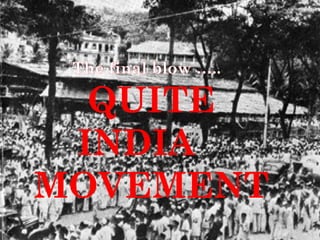
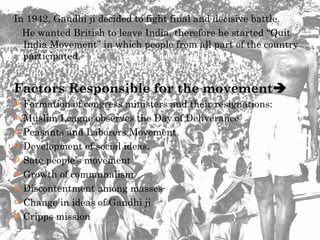
In 1942, Gandhiji decided to fight final and decisive battle.
He wanted British to leave India, therefore he started “Quit
India Movement” in which people from all part of the country
participated.
Factors Responsible for the movement
Formation of congress ministers and their resignations:
Muslim League observes the Day of Deliverance
Peasants and Laborers Movement.
Development of social ideas.
Sate people’s movement
Growth of communalism
Discontentment among masses
Change in ideas of Gandhi ji
Cripps mission
30.
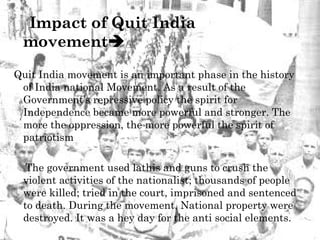
Impact of QuitIndia
movement
Quit India movement is an important phase in the history
of India national Movement. As a result of the
Government’s repressive policy the spirit for
Independence became more powerful and stronger. The
more the oppression, the more powerful the spirit of
patriotism
The government used lathis and guns to crush the
violent activities of the nationalist; thousands of people
were killed; tried in the court, imprisoned and sentenced
to death. During the movement, National property were
destroyed. It was a hey day for the anti social elements.
31.
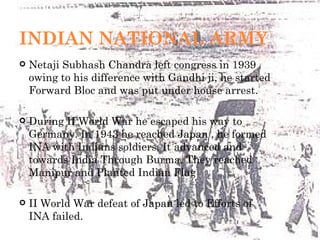
INDIAN NATIONAL ARMY
Netaji Subhash Chandra left congress in 1939
owing to his difference with Gandhi ji, he started
Forward Bloc and was put under house arrest.
During II World War he escaped his way to
Germany. In 1943 he reached Japan , he formed
INA with Indians soldiers. It advanced and
towards India Through Burma. They reached
Manipur and Planted Indian Flag
II World War defeat of Japan led to Efforts of
INA failed.
32.
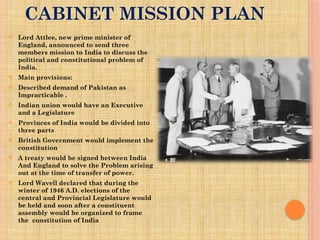
CABINET MISSION PLAN
Lord Attlee, new prime minister of
England, announced to send three
members mission to India to discuss the
political and constitutional problem of
India.
Main provisions:
Described demand of Pakistan as
Impracticable .
Indian union would have an Executive
and a Legislature
Provinces of India would be divided into
three parts
British Government would implement the
constitution
A treaty would be signed between India
And England to solve the Problem arising
out at the time of transfer of power.
Lord Wavell declared that during the
winter of 1946 A.D. elections of the
central and Provincial Legislature would
be held and soon after a constituent
assembly would be organized to frame
the constitution of India
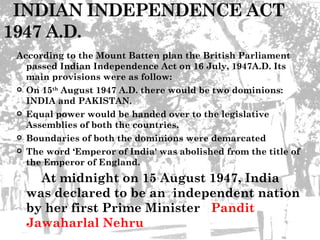
INDIAN INDEPENDENCE ACT
1947A.D.
According to the Mount Batten plan the British Parliament
passed Indian Independence Act on 16 July, 1947A.D. Its
main provisions were as follow:
On 15th
August 1947 A.D. there would be two dominions:
INDIA and PAKISTAN.
Equal power would be handed over to the legislative
Assemblies of both the countries.
Boundaries of both the dominions were demarcated
The word ‘Emperor of India' was abolished from the title of
the Emperor of England.
At midnight on 15 August 1947, India
was declared to be an independent nation
by her first Prime Minister Pandit
Jawaharlal Nehru
 Most read
 Most read
 Most read