Comprehensive Overview of the Drug Development Process and Regulatory Framework
Explore the stages of drug development, regulatory requirements, clinical trials, and multidisciplinary team roles ensuring safe, effective, and high-quality medicines reach the market.
Comprehensive Overview of the Drug Development Process and Regulatory Framework
1.
Overview of DrugDevelopment
Process and Drug Development
Teams
Dr. Chinmaya Mahapatra
2.
Learning Objectives
At theend of this lecture, students should be able to:
•Explain the complete drug development process.
•Describe various stages of drug development.
•Understand the timeline from drug discovery to market approval.
•Discuss the regulatory framework governing drug approval.
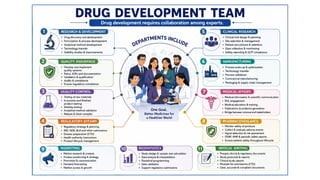
•Explain the role of multidisciplinary drug development teams.
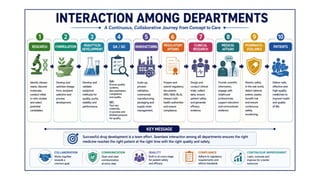
•Describe interactions among different functional departments
during drug development.
3.
Why Do WeNeed Drug
Development?
Medicines should be
•Safe
•Effective
•High Quality
•Stable
•Affordable
Drug development ensures that every medicine reaching patients has
demonstrated
•Quality
•Safety
•Efficacy
before marketing approval.
Key Message
Patients receive only those medicines whose benefits outweigh their risks.
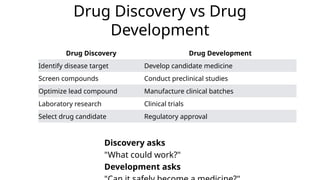
Drug Discovery vsDrug
Development
Drug Discovery v Drug Development
Drug Discovery Drug Development
Identify disease target Develop candidate medicine
Screen compounds Conduct preclinical studies
Optimize lead compound Manufacture clinical batches
Laboratory research Clinical trials
Select drug candidate Regulatory approval
Discovery asks
"What could work?"
Development asks
8.
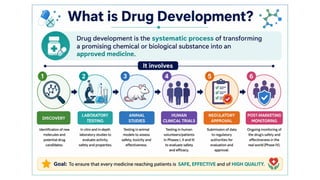
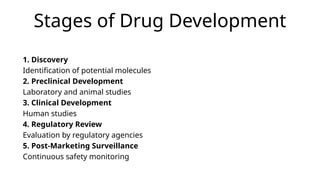
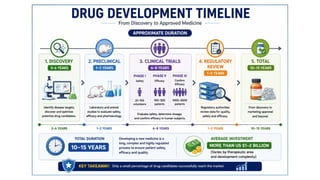
Stages of DrugDevelopment
1. Discovery
Identification of potential molecules
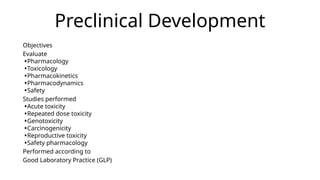
2. Preclinical Development
Laboratory and animal studies
3. Clinical Development
Human studies
4. Regulatory Review
Evaluation by regulatory agencies
5. Post-Marketing Surveillance
Continuous safety monitoring
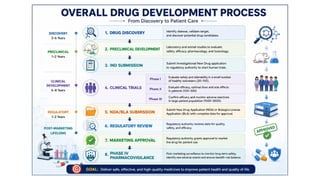
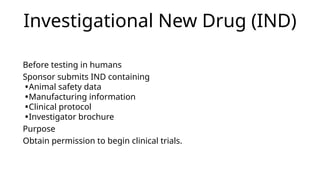
Investigational New Drug(IND)
Before testing in humans
Sponsor submits IND containing
•Animal safety data
•Manufacturing information
•Clinical protocol
•Investigator brochure
Purpose
Obtain permission to begin clinical trials.
11.
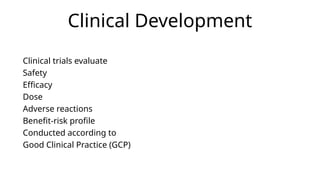
Clinical Development
Clinical trialsevaluate
Safety
Efficacy
Dose
Adverse reactions
Benefit-risk profile
Conducted according to
Good Clinical Practice (GCP)
12.
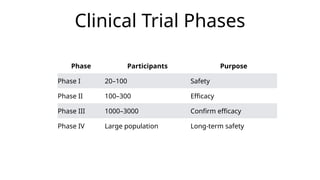
Clinical Trial Phases
PhaseParticipants Purpose
Phase I 20–100 Safety
Phase II 100–300 Efficacy
Phase III 1000–3000 Confirm efficacy
Phase IV Large population Long-term safety
14.
Why Does DrugDevelopment Take So Long?
Reasons
Rigorous testing
Patient safety
Regulatory compliance
Manufacturing validation
Clinical recruitment
Data analysis
Low success rate
Only a very small fraction of screened compounds eventually become approved
medicines.
International Council forHarmonisation
(ICH)
Purpose
Harmonize technical requirements globally.
Major members
•FDA
•EMA
•Japan
Benefits
Common standards
Reduced duplication
Global submissions
Improved quality
18.
Important ICH Guidelines
Quality(Q)
Safety (S)
Efficacy (E)
Multidisciplinary (M)
Examples
Q8 Pharmaceutical Development
Q9 Quality Risk Management
Q10 Pharmaceutical Quality System
E6 Good Clinical Practice
M4 Common Technical Document
21.
Challenges in Drug
Development
Highfailure rate
Long timelines
Huge investment
Regulatory complexity
Patient recruitment
Data integrity
Changing guidelines
Market competition