Comprehensive Overview of Suspension Systems in Automobile Engineering
Detailed exploration of suspension system types, components, functions, and design considerations for improved ride comfort, handling, and safety in vehicles.
This presentation covers the basics to advanced knowledge about automobile suspension systems. How its made, what are its components, its significance and many more.
Comprehensive Overview of Suspension Systems in Automobile Engineering
1.
Sanjivani Rural EducationSociety’s
Sanjivani College of Engineering, Kopargaon-423603
(An Autonomous Institute Affiliated to Savitribai Phule Pune University, Pune)
NAAC ‘A’ Grade Accredited, ISO 9001:2015 Certified
Department of Mechanical Engineering
Subject : Electric Vehicle Design
Class : T.Y. Mechanical
Subject Code : ME 311D
Unit 1 : Introduction to Automobile Engineering
By
V. P. Bhaurkar
Department of Mechanical Engineering
2026 – 27 (sem - 5)
2.
V. P. BhaurkarAI and ML (T. Y. Mechanical)
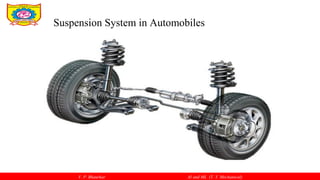
Suspension System in Automobiles
3.
V. P. BhaurkarAI and ML (T. Y. Mechanical)
Suspension System in Automobiles
Introduction
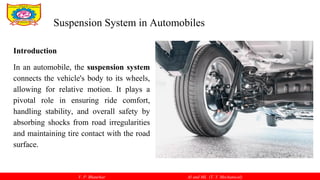
In an automobile, the suspension system
connects the vehicle's body to its wheels,
allowing for relative motion. It plays a
pivotal role in ensuring ride comfort,
handling stability, and overall safety by
absorbing shocks from road irregularities
and maintaining tire contact with the road
surface.
4.
V. P. BhaurkarAI and ML (T. Y. Mechanical)
Functions of the Suspension System
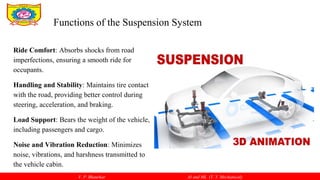
Ride Comfort: Absorbs shocks from road
imperfections, ensuring a smooth ride for
occupants.
Handling and Stability: Maintains tire contact
with the road, providing better control during
steering, acceleration, and braking.
Load Support: Bears the weight of the vehicle,
including passengers and cargo.
Noise and Vibration Reduction: Minimizes
noise, vibrations, and harshness transmitted to
the vehicle cabin.
5.
V. P. BhaurkarAI and ML (T. Y. Mechanical)
Main Components
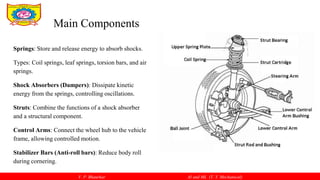
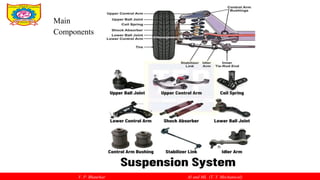
Springs: Store and release energy to absorb shocks.
Types: Coil springs, leaf springs, torsion bars, and air
springs.
Shock Absorbers (Dampers): Dissipate kinetic
energy from the springs, controlling oscillations.
Struts: Combine the functions of a shock absorber
and a structural component.
Control Arms: Connect the wheel hub to the vehicle
frame, allowing controlled motion.
Stabilizer Bars (Anti-roll bars): Reduce body roll
during cornering.
6.
V. P. BhaurkarAI and ML (T. Y. Mechanical)
Main
Components
7.
V. P. BhaurkarAI and ML (T. Y. Mechanical)
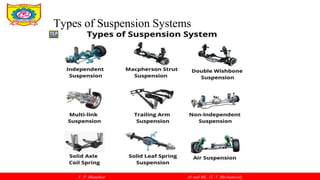
Types of Suspension Systems
8.
V. P. BhaurkarAI and ML (T. Y. Mechanical)
Types of Suspension Systems
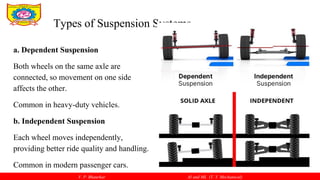
a. Dependent Suspension
Both wheels on the same axle are
connected, so movement on one side
affects the other.
Common in heavy-duty vehicles.
b. Independent Suspension
Each wheel moves independently,
providing better ride quality and handling.
Common in modern passenger cars.
9.
V. P. BhaurkarAI and ML (T. Y. Mechanical)
Suspension System Classifications
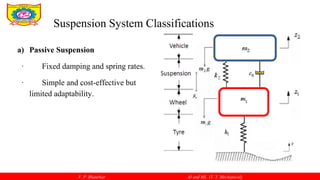
a) Passive Suspension
· Fixed damping and spring rates.
· Simple and cost-effective but
limited adaptability.
10.
V. P. BhaurkarAI and ML (T. Y. Mechanical)
Suspension System Classifications
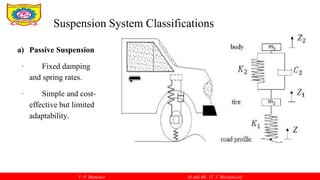
a) Passive Suspension
· Fixed damping
and spring rates.
· Simple and cost-
effective but limited
adaptability.
11.
V. P. BhaurkarAI and ML (T. Y. Mechanical)
Suspension System Classifications
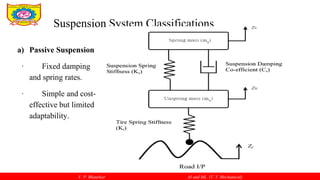
a) Passive Suspension
· Fixed damping
and spring rates.
· Simple and cost-
effective but limited
adaptability.
12.
V. P. BhaurkarAI and ML (T. Y. Mechanical)
Suspension System Classifications
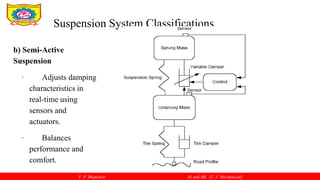
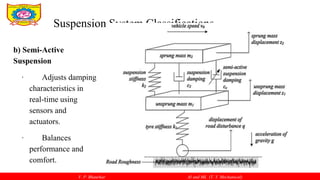
b) Semi-Active
Suspension
· Adjusts damping
characteristics in
real-time using
sensors and
actuators.
· Balances
performance and
comfort.
13.
V. P. BhaurkarAI and ML (T. Y. Mechanical)
Suspension System Classifications
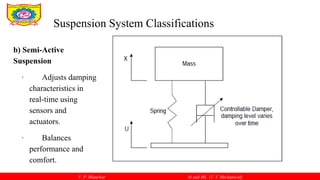
b) Semi-Active
Suspension
· Adjusts damping
characteristics in
real-time using
sensors and
actuators.
· Balances
performance and
comfort.
14.
V. P. BhaurkarAI and ML (T. Y. Mechanical)
Suspension System Classifications
b) Semi-Active
Suspension
· Adjusts damping
characteristics in
real-time using
sensors and
actuators.
· Balances
performance and
comfort.
15.
V. P. BhaurkarAI and ML (T. Y. Mechanical)
Suspension System Classifications
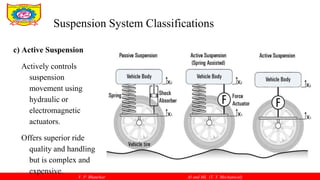
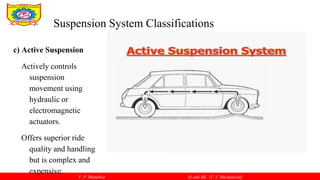
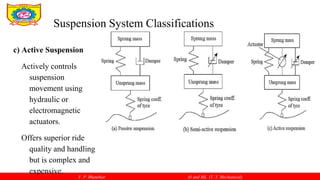
c) Active Suspension
Actively controls
suspension
movement using
hydraulic or
electromagnetic
actuators.
Offers superior ride
quality and handling
but is complex and
expensive.
16.
V. P. BhaurkarAI and ML (T. Y. Mechanical)
Suspension System Classifications
c) Active Suspension
Actively controls
suspension
movement using
hydraulic or
electromagnetic
actuators.
Offers superior ride
quality and handling
but is complex and
expensive.
17.
V. P. BhaurkarAI and ML (T. Y. Mechanical)
Suspension System Classifications
c) Active Suspension
Actively controls
suspension
movement using
hydraulic or
electromagnetic
actuators.
Offers superior ride
quality and handling
but is complex and
expensive.
18.
V. P. BhaurkarAI and ML (T. Y. Mechanical)
Suspension System Classifications
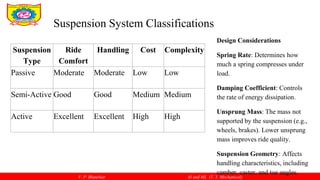
Design Considerations
Spring Rate: Determines how
much a spring compresses under
load.
Damping Coefficient: Controls
the rate of energy dissipation.
Unsprung Mass: The mass not
supported by the suspension (e.g.,
wheels, brakes). Lower unsprung
mass improves ride quality.
Suspension Geometry: Affects
handling characteristics, including
camber, caster, and toe angles.
Suspension
Type
Ride
Comfort
Handling Cost Complexity
Passive Moderate Moderate Low Low
Semi-Active Good Good Medium Medium
Active Excellent Excellent High High
 Most read
 Most read
 Most read