Sanjivani Rural Education Society’s
Sanjivani College of Engineering, Kopargaon-423603
(An Autonomous Institute Affiliated to Savitribai Phule Pune University, Pune)
NAAC ‘A’ Grade Accredited, ISO 9001:2015 Certified
Department of Mechanical Engineering
Subject : Electric Vehicle Design
Class : T.Y. Mechanical
Subject Code : ME 311D
Unit 1 : Introduction to Automobile Engineering
By
V. P. Bhaurkar
Department of Mechanical Engineering
2025 – 26 (sem - 5)
V. P. Bhaurkar AI and ML (T. Y. Mechanical)
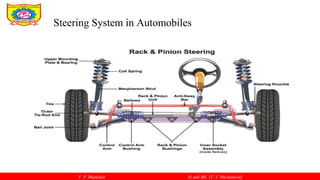
Steering System in Automobiles
V. P. Bhaurkar AI and ML (T. Y. Mechanical)
Introduction
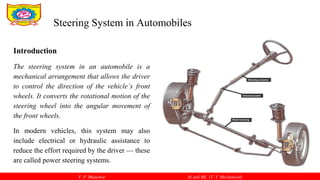
The steering system in an automobile is a
mechanical arrangement that allows the driver
to control the direction of the vehicle’s front
wheels. It converts the rotational motion of the
steering wheel into the angular movement of
the front wheels.
In modern vehicles, this system may also
include electrical or hydraulic assistance to
reduce the effort required by the driver — these
are called power steering systems.
Steering System in Automobiles
V. P. Bhaurkar AI and ML (T. Y. Mechanical)
Purpose of Steering System
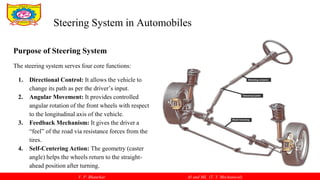
The steering system serves four core functions:
1. Directional Control: It allows the vehicle to
change its path as per the driver’s input.
2. Angular Movement: It provides controlled
angular rotation of the front wheels with respect
to the longitudinal axis of the vehicle.
3. Feedback Mechanism: It gives the driver a
―feel‖ of the road via resistance forces from the
tires.
4. Self-Centering Action: The geometry (caster
angle) helps the wheels return to the straight-
ahead position after turning.
Steering System in Automobiles
V. P. Bhaurkar AI and ML (T. Y. Mechanical)
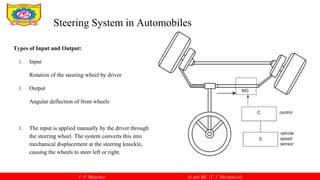
Types of Input and Output:
1. Input
Rotation of the steering wheel by driver
1. Output
Angular deflection of front wheels
1. The input is applied manually by the driver through
the steering wheel. The system converts this into
mechanical displacement at the steering knuckle,
causing the wheels to steer left or right.
Steering System in Automobiles
V. P. Bhaurkar AI and ML (T. Y. Mechanical)
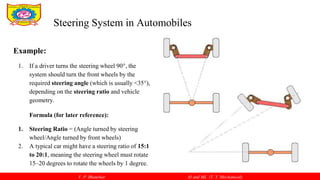
Example:
1. If a driver turns the steering wheel 90°, the
system should turn the front wheels by the
required steering angle (which is usually <35°),
depending on the steering ratio and vehicle
geometry.
Formula (for later reference):
1. Steering Ratio = (Angle turned by steering
wheel/Angle turned by front wheels)
2. A typical car might have a steering ratio of 15:1
to 20:1, meaning the steering wheel must rotate
15–20 degrees to rotate the wheels by 1 degree.
Steering System in Automobiles
V. P. Bhaurkar AI and ML (T. Y. Mechanical)
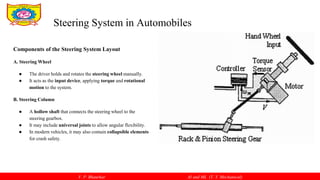
Components of the Steering System Layout
A. Steering Wheel
● The driver holds and rotates the steering wheel manually.
● It acts as the input device, applying torque and rotational
motion to the system.
B. Steering Column
● A hollow shaft that connects the steering wheel to the
steering gearbox.
● It may include universal joints to allow angular flexibility.
● In modern vehicles, it may also contain collapsible elements
for crash safety.
Steering System in Automobiles
V. P. Bhaurkar AI and ML (T. Y. Mechanical)
Components of the Steering System Layout
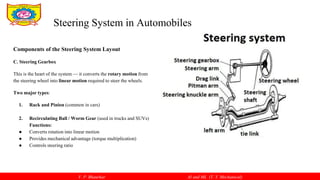
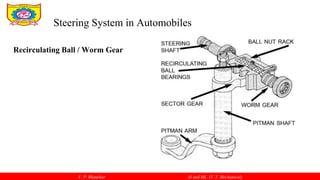
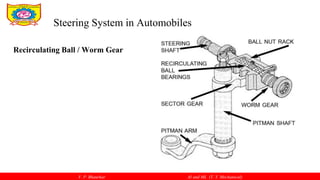
C. Steering Gearbox
This is the heart of the system — it converts the rotary motion from
the steering wheel into linear motion required to steer the wheels.
Two major types:
1. Rack and Pinion (common in cars)
2. Recirculating Ball / Worm Gear (used in trucks and SUVs)
Functions:
● Converts rotation into linear motion
● Provides mechanical advantage (torque multiplication)
● Controls steering ratio
Steering System in Automobiles
V. P. Bhaurkar AI and ML (T. Y. Mechanical)
Components of the Steering System Layout
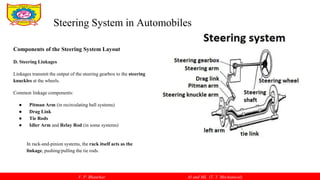
D. Steering Linkages
Linkages transmit the output of the steering gearbox to the steering
knuckles at the wheels.
Common linkage components:
● Pitman Arm (in recirculating ball systems)
● Drag Link
● Tie Rods
● Idler Arm and Relay Rod (in some systems)
In rack-and-pinion systems, the rack itself acts as the
linkage, pushing/pulling the tie rods.
Steering System in Automobiles
V. P. Bhaurkar AI and ML (T. Y. Mechanical)
Components of the Steering System Layout
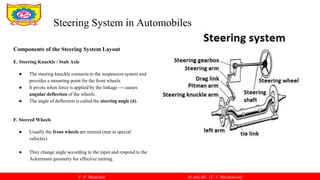
E. Steering Knuckle / Stub Axle
● The steering knuckle connects to the suspension system and
provides a mounting point for the front wheels.
● It pivots when force is applied by the linkage → causes
angular deflection of the wheels.
● The angle of deflection is called the steering angle (δ).
F. Steered Wheels
● Usually the front wheels are steered (rear in special
vehicles).
● They change angle according to the input and respond to the
Ackermann geometry for effective turning.
Steering System in Automobiles
V. P. Bhaurkar AI and ML (T. Y. Mechanical)
Recirculating Ball / Worm Gear
Steering System in Automobiles
V. P. Bhaurkar AI and ML (T. Y. Mechanical)
Recirculating Ball / Worm Gear
Steering System in Automobiles
V. P. Bhaurkar AI and ML (T. Y. Mechanical)
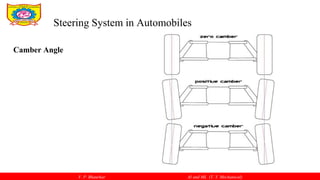
Camber Angle
Steering System in Automobiles
V. P. Bhaurkar AI and ML (T. Y. Mechanical)
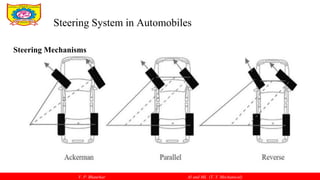
Steering Mechanisms
Steering System in Automobiles
V. P. Bhaurkar AI and ML (T. Y. Mechanical)
Thank You !