OrthoArena
Relevant Anatomy
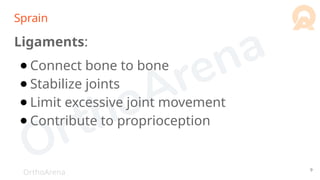
Ligaments aredense connective-tissue
structures composed predominantly of:
● Collagen fibers
● Extracellular matrix
● Fibroblasts
● Water
● Small amounts of elastin
2
3.
OrthoArena
Relevant Anatomy -Ligaments
Functions;
● Mechanical stabilization
● Limitation of excessive movement
● Guidance of joint motion
● Proprioception
3
4.
OrthoArena
Relevant Anatomy -Ligaments
Clinical implication;
● Ligament injury can result in:
○ Pain + swelling + joint instability
4
5.
OrthoArena
Relevant Anatomy
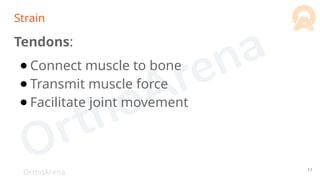
MUSCLE–TENDON UNIT
●Muscles - Produces force through
contraction.
● Tendon - Transfers muscle force to bone
● Muscle-Tendon unit - functions as a
coordinated mechanical system
5
OrthoArena
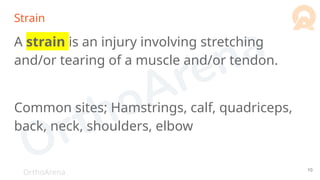
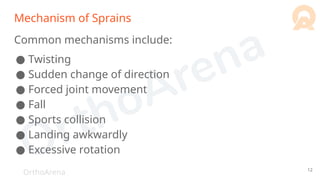
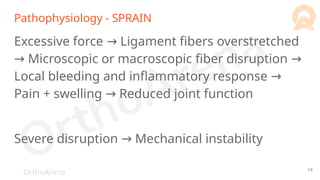
Pathophysiology - SPRAIN
Excessiveforce Ligament fibers overstretched
→
Microscopic or macroscopic fiber disruption
→ →
Local bleeding and inflammatory response →
Pain + swelling Reduced joint function
→
Severe disruption Mechanical instability
→
19
20.
OrthoArena
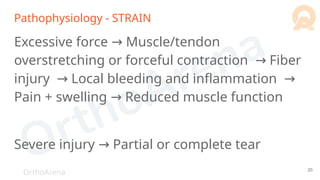
Pathophysiology - STRAIN
Excessiveforce Muscle/tendon
→
overstretching or forceful contraction Fiber
→
injury Local bleeding and inflammation
→ →
Pain + swelling Reduced muscle function
→
Severe injury Partial or complete tear
→
20
21.
OrthoArena
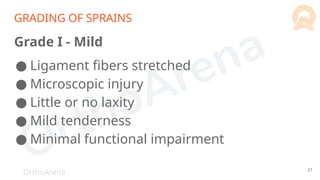
GRADING OF SPRAINS
GradeI - Mild
● Ligament fibers stretched
● Microscopic injury
● Little or no laxity
● Mild tenderness
● Minimal functional impairment
21
22.
OrthoArena
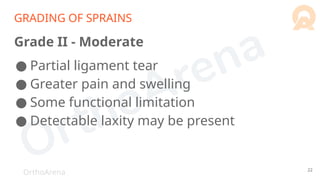
GRADING OF SPRAINS
GradeII - Moderate
● Partial ligament tear
● Greater pain and swelling
● Some functional limitation
● Detectable laxity may be present
22
23.
OrthoArena
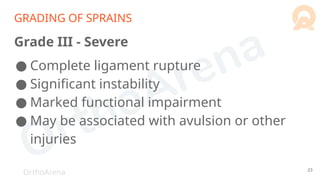
GRADING OF SPRAINS
GradeIII - Severe
● Complete ligament rupture
● Significant instability
● Marked functional impairment
● May be associated with avulsion or other
injuries
23
24.
OrthoArena
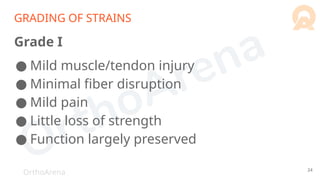
GRADING OF STRAINS
GradeI
● Mild muscle/tendon injury
● Minimal fiber disruption
● Mild pain
● Little loss of strength
● Function largely preserved
24
OrthoArena
GRADING OF STRAINS
GradeIII
● Complete rupture
● Severe functional impairment
● Major weakness or loss of function
● May require surgical assessment
26
27.
OrthoArena
Clinical Presentation -SPRAINS
Typical findings:
● Pain
● Local tenderness
● Swelling
● Bruising/ecchymosis
● Reduced range of motion
● Difficulty bearing weight
● Joint stiffness
● Instability in more severe injuries
27
28.
OrthoArena
Clinical Presentation -STRAINS
Typical findings:
● Localized pain
● Tenderness
● Swelling
● Muscle spasm
● Weakness
● Pain with active contraction
● Pain with passive stretching
● Reduced function
28
29.
OrthoArena
Clinical Presentation -STRAINS
Severe strains may produce:
● Palpable defect
● Marked weakness
● Loss of function
● Extensive bruising
29
30.
OrthoArena
Clinical Assessment
Start withthe trauma approach.
Determine if its an isolated injury or a
polytrauma
Assess;
● Airway; Breathing; Circulation; Disability;
Expose. Then musculoskeletal assessment
30
31.
OrthoArena
Clinical Assessment
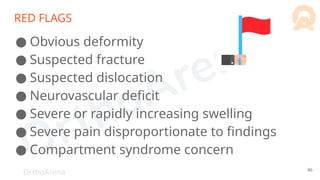
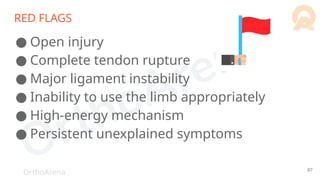
Do notbecome anchored on "sprain."
Always consider:
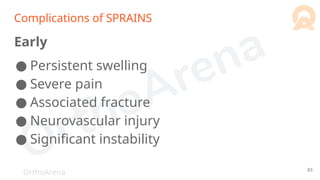
● Fracture
● Dislocation
● Tendon rupture
● Neurovascular injury
● Compartment syndrome
● Open injury
31
32.
OrthoArena
History - Askabout;
Mechanism;
● What happened?
● Was there twisting?
● Was there direct trauma?
● Was the joint forced into an abnormal
position?
● Was there sudden acceleration?
32
33.
OrthoArena
History - Askabout;
Symptoms;
● Pain
● Swelling
● Bruising
● Weakness
● Instability
● Loss of function
● Numbness/tingling
33
34.
OrthoArena
History - Askabout;
Functional status;
● Can the patient walk?
● Can they bear weight?
● Can they actively move the joint?
34
35.
OrthoArena
Past History -Ask about;
● Previous injury
● Previous sprains
● Previous surgery
● Joint instability
● Chronic musculoskeletal disease
● Previous tendon injury
WHY??
35
36.
OrthoArena
Past History -Ask about;
WHY??
Previous injury may predispose to:
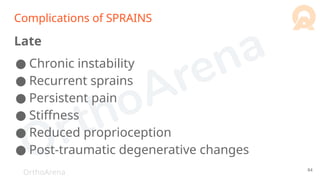
● Recurrent sprain
● Chronic instability
● Altered biomechanics
● Reduced proprioception
36
37.
OrthoArena
Inspection - lookfor;
● Swelling
● Bruising
● Deformity
● Joint asymmetry
● Muscle wasting
● Skin injury
● Abnormal posture
Compare with the opposite limb when appropriate
37
38.
OrthoArena
Inspection - lookfor;
Red flag
● Obvious deformity consider
→
fracture/dislocation until proven otherwise.
38
39.
OrthoArena
Palpation - Assess;
●Site of maximum tenderness
● Ligament attachment points
● Joint line
● Bone
● Tendon
● Muscle belly
● Myotendinous junction
39
40.
OrthoArena
Range of Motion- Assess;
● Active movement - Patient moves the joint.
● Passive movement - Examiner moves the
joint.
● Resisted movement - Patient moves against
resistance.
40
41.
OrthoArena
Range of Motion- Assess;
Clinical interpretation. Pain during:
● Active contraction may suggest
→
muscle/tendon involvement
● Passive stretch may indicate muscle/tendon
→
injury
● Ligament stress may reproduce
→
pain/instability
41
42.
OrthoArena
Stability Testing
For suspectedligament injury:
● Perform appropriate ligament-specific
stress tests.
● Compare with the opposite side where
appropriate.
● Assess both pain and abnormal laxity.
42
OrthoArena
Investigations
Imaging is consideredwhen:
● Fracture is suspected
● Severe injury is present
● There is marked tenderness over bone
● Significant functional loss exists
● Deformity is present
● Diagnosis is uncertain
● Symptoms persist unexpectedly
● Significant tendon injury is suspected
46
OrthoArena
Plain Radiographs
MRI
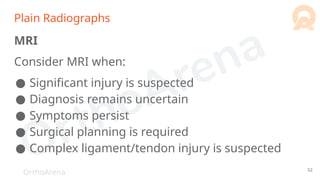
Consider MRIwhen:
● Significant injury is suspected
● Diagnosis remains uncertain
● Symptoms persist
● Surgical planning is required
● Complex ligament/tendon injury is suspected
52
53.
OrthoArena
Management
Management aims to:
●Control pain.
● Minimize excessive swelling.
● Protect the injured tissue.
● Maintain appropriate mobility.
● Restore strength.
● Restore proprioception and balance.
● Restore normal function.
● Prevent recurrence.
53
54.
OrthoArena
Acute Management -RICE
● R - Rest Reduce activities that aggravate the
→
injury.
● I - ICE Cold application may help with pain and
→
swelling.
● C - Compression Appropriate compression may
→
reduce swelling.
● E - Elevation → Elevate the injured limb where
practical.
54
55.
OrthoArena
Acute Management -RICE
● RICE is an initial approach for many acute
soft-tissue injuries. Do not present RICE as
the entire treatment.
● New updates
○ RICE → PRICE
55
OrthoArena
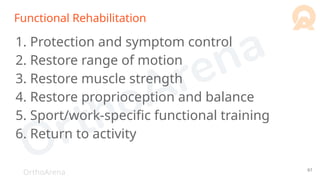
Functional Rehabilitation
1. Protectionand symptom control
2. Restore range of motion
3. Restore muscle strength
4. Restore proprioception and balance
5. Sport/work-specific functional training
6. Return to activity
61
OrthoArena
Range of Motion
Avoid
●Aggressive stretching of an acutely torn
ligament
● Excessive loading before tissue healing
● Prolonged unnecessary immobilization
64
OrthoArena 66
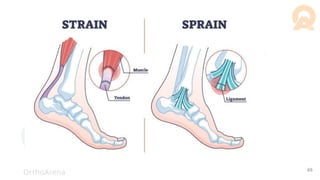
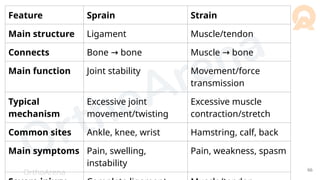
Feature SprainStrain
Main structure Ligament Muscle/tendon
Connects Bone bone
→ Muscle bone
→
Main function Joint stability Movement/force
transmission
Typical
mechanism
Excessive joint
movement/twisting
Excessive muscle
contraction/stretch
Common sites Ankle, knee, wrist Hamstring, calf, back
Main symptoms Pain, swelling,
instability
Pain, weakness, spasm
OrthoArena
OTTAWA ANKLE RULES
Useclinical decision rules to determine whether
radiographs are indicated in appropriate patients.
The Ottawa Ankle Rules help reduce unnecessary
radiographs while maintaining appropriate
fracture detection.
79
80.
OrthoArena
OTTAWA ANKLE RULES
ConsiderX-ray when there is:
● Bone tenderness at relevant malleolar
locations
● Inability to bear weight both immediately
and during assessment
80
81.
OrthoArena
OTTAWA ANKLE RULES
Formidfoot assessment, consider:
● Base of fifth metatarsal tenderness
● Navicular tenderness
● Inability to bear weight
81
OrthoArena
Case
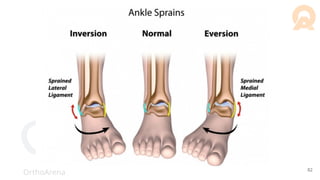
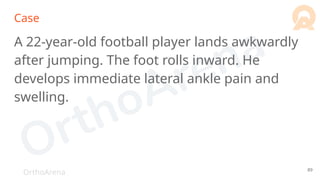
A 22-year-old footballplayer lands awkwardly
after jumping. The foot rolls inward. He
develops immediate lateral ankle pain and
swelling.
89
90.
OrthoArena
Questions
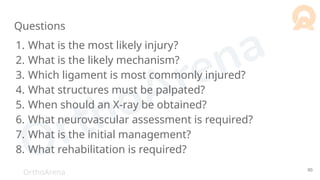
1. What isthe most likely injury?
2. What is the likely mechanism?
3. Which ligament is most commonly injured?
4. What structures must be palpated?
5. When should an X-ray be obtained?
6. What neurovascular assessment is required?
7. What is the initial management?
8. What rehabilitation is required?
90
OrthoArena
Questions
1. What isthe likely diagnosis?
2. What tissue is injured?
3. What mechanism caused the injury?
4. What examination should be performed?
5. What are the important differential diagnoses?
6. What is the initial management?
7. What rehabilitation principles apply?
8. What criteria should guide return to sport?
92
93.
OrthoArena
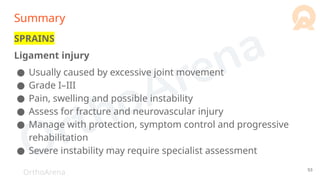
Summary
SPRAINS
Ligament injury
● Usuallycaused by excessive joint movement
● Grade I–III
● Pain, swelling and possible instability
● Assess for fracture and neurovascular injury
● Manage with protection, symptom control and progressive
rehabilitation
● Severe instability may require specialist assessment
93
94.
OrthoArena
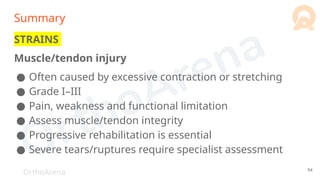
Summary
STRAINS
Muscle/tendon injury
● Oftencaused by excessive contraction or stretching
● Grade I–III
● Pain, weakness and functional limitation
● Assess muscle/tendon integrity
● Progressive rehabilitation is essential
● Severe tears/ruptures require specialist assessment
94