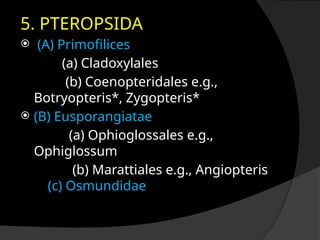
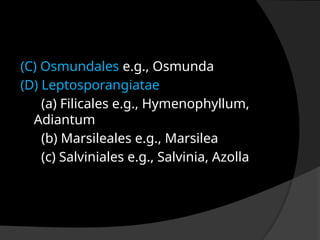
Pteridophyta (Gr,Pteron =
feather, phyton = plant), the
name was originally given to
those groups of plants which
have well developed pinnate
or frond like leaves.
Pteridophytes are
cryptogams (Gr. kruptos =
hidden, and Gamos =
wedded) which have well
developed vascular tissue.
Reproduction is hidden
5.
known asvascular cryptogams or
snakes of plant kingdom.
They are represented by about 400
living and fossil genera and some
10,500 species
Includes Ferns, horsetails, etc.
6.
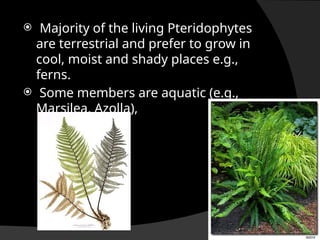
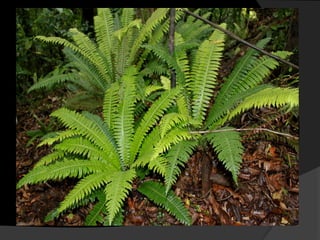
Majority ofthe living Pteridophytes
are terrestrial and prefer to grow in
cool, moist and shady places e.g.,
ferns.
Some members are aquatic (e.g.,
Marsilea, Azolla),
8.
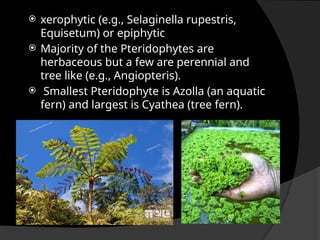
xerophytic (e.g.,Selaginella rupestris,
Equisetum) or epiphytic
Majority of the Pteridophytes are
herbaceous but a few are perennial and
tree like (e.g., Angiopteris).
Smallest Pteridophyte is Azolla (an aquatic
fern) and largest is Cyathea (tree fern).
9.
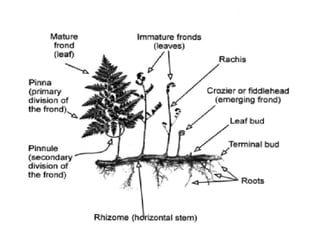
Plant body issporophytic and can be
differentiated into root, stem and leaves.
Roots are adventitious in nature with
monopodial or dichotomous branching.
Internally usually they are diarch.
Stem is usually branched. Branching is
monopodial or dichotomous.
Branches do not arise in the axil of the
leaves.
In many Pteridophytes stem is
represented by rhizome.
11.
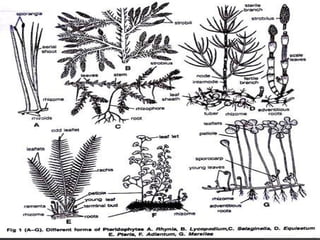
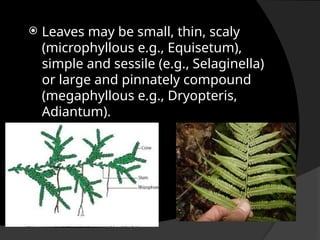
Leaves maybe small, thin, scaly
(microphyllous e.g., Equisetum),
simple and sessile (e.g., Selaginella)
or large and pinnately compound
(megaphyllous e.g., Dryopteris,
Adiantum).
12.
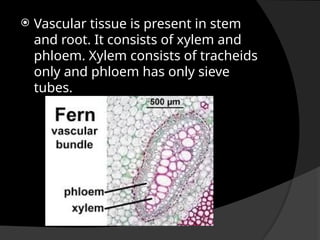
Vascular tissueis present in stem
and root. It consists of xylem and
phloem. Xylem consists of tracheids
only and phloem has only sieve
tubes.
13.
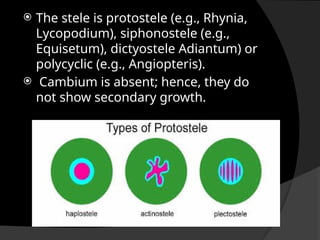
The steleis protostele (e.g., Rhynia,
Lycopodium), siphonostele (e.g.,
Equisetum), dictyostele Adiantum) or
polycyclic (e.g., Angiopteris).
Cambium is absent; hence, they do
not show secondary growth.
14.
Reproduction takesplace by means of
spores which are produced inside
sporangia.
The development of the sporangium may
be leptosporangiate (sporangium
originates from a single cell) or
eusporangiate (sporangium develops from
a group of cells).
Sporangia may be borne either on stem or
leaves.
On the stem -They may be – Terminal,
ventral, marginal or dorsal
Spores on germination give prothallus
16.
On thestem sporangia may be
terminal e.g. Rhynia, lateral in
Lycopodium,
on the surface of leaves (Sporophyll)
in Ferns.
The sporangia are borne on ventral
side of specialized leaf called
Sporophyll.
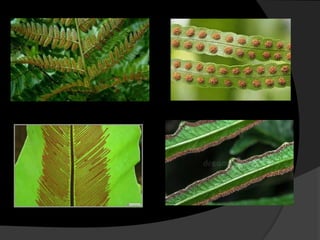
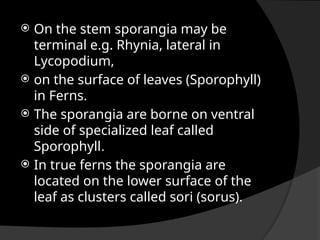
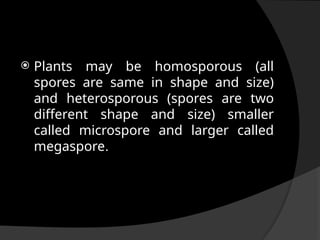
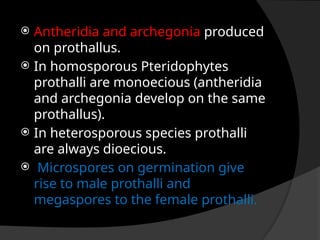
In true ferns the sporangia are
located on the lower surface of the
leaf as clusters called sori (sorus).
17.
Plants maybe homosporous (all
spores are same in shape and size)
and heterosporous (spores are two
different shape and size) smaller
called microspore and larger called
megaspore.
18.
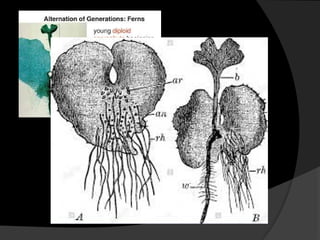
Antheridia andarchegonia produced
on prothallus.
In homosporous Pteridophytes
prothalli are monoecious (antheridia
and archegonia develop on the same
prothallus).
In heterosporous species prothalli
are always dioecious.
Microspores on germination give
rise to male prothalli and
megaspores to the female prothalli.
20.
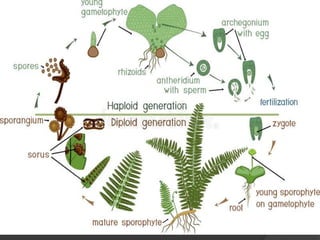
Water isessential for fertilization
(zooidogamous).
Fertilization results in the formation of
zygote or oospore, which ultimately
develops into well-developed
sporophyte.
The fertilized egg divides transversely
or vertically. Another cross wall forms a
quadrant stage producing stem, leaf,
foot and root.
Plants show heteromorphic alternation
of generation. The main plant body is
sporophytic and forms a dominant
phase in the life cycle.
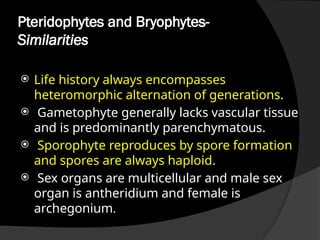
Pteridophytes and Bryophytes-
Similarities
Life history always encompasses
heteromorphic alternation of generations.
Gametophyte generally lacks vascular tissue
and is predominantly parenchymatous.
Sporophyte reproduces by spore formation
and spores are always haploid.
Sex organs are multicellular and male sex
organ is antheridium and female is
archegonium.
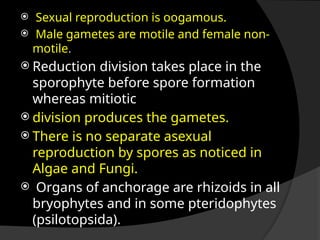
32.
Sexual reproductionis oogamous.
Male gametes are motile and female non-
motile.
Reduction division takes place in the
sporophyte before spore formation
whereas mitiotic
division produces the gametes.
There is no separate asexual
reproduction by spores as noticed in
Algae and Fungi.
Organs of anchorage are rhizoids in all
bryophytes and in some pteridophytes
(psilotopsida).
33.
Spores are ofone kind in all bryophytes and in a
good number of pteridophytes.
Fertilization is internal but the presence of
moisture is essential as there is no
siphonogamy.
Sperms are attracted chemotactically towards
the archegonia in both groups.
34.
Differences
The predominantplant body is
sporophyte in pteridophytes, while it is a
gametophyte in bryophytes.
The sporophyte is relatively
undifferentiated and does not go beyond
foot, seta and capsule,
while in pteridophytes, it is distinguished
into root, stem, leaves, etc.
The sporophyte is dependent on the
gametophyte in bryophytes, while in
pteridophytes both are independent.
35.
The gametophytein bryophytes may be
thalloid or leafy, but in pteridophytes, it is
always thalloid.
Rhizoids are of two types in bryophytes,
whereas they are of only one kind in
pteridophytes.
6. Archegonia and antheridia of
pteridophytes are highly reduced when
compared to those of bryophytes.
There is no vasculature is bryophytes, but
the sporophytes of pteridophytes have a
well developed vasculature.
36.
There areno roots in bryophytes, but
pteridophytes have roots.
All bryophytes are homosporous, while
pteridophytes may be homosporous or
heterosporous.
Gametophytes of pteridophytes may be
autotrophic, saprophytic or extremely
reduced microscopic structures, whereas in
bryophytes, they are always autotrophic
and macroscopic.
‘Leaves’ are produced in the gametophytes
of some bryophytes, while only the
sporophytes are leafy in pteridophytes.
37.
Pteridophytes and Gymnosperms
Similarities
There is a regular heteromorphic alteration
of generations.
Sporophyte is the predominant plant body
and is differentiated into root, stem and
leaves.
Some pteridophytes and some
gymnosperms exhibit air cinate vernation in
young leaves.
There are no vessels anatomically in both
pteridophytes (except Selaginella, Marsilea)
and gymnosperms (except Gnetales).
38.
Phloem doesnot have companion
cells.
Spores are always haploid as they
are always a product of meiosis.
Some pteridophytes and all
gymnosperms are heterosporous.
Gametophyte is comparatively a
reduced structure in both.
39.
In heterosporouspteridophytes and all
gymnosperms, megaspore is always
retained within the
megasporangium. Sex organs of the
gametophytes
40.
Differences
The sporophyticplant body is, and large,
arborescent in gymnosperms while it is not
so in pteridophytes
Roots are adventitious in pteridophytes
while they arise from the radicle (tap root) in
gymnosperms.
Pteridophytes may be homosporous or
heterosporous, while all gymnosperms are
heterosporous.
Most of the pteridophytes have a preference
for cool, moist areas, while gymnosperms
generally exhibit xeric characters.
41.
Branching ofthe stem is dichotomous in
pteridophytes while it is lateral in gymnosperms.
Heterospory has never resulted in dioeciousness
in the sporophyte in pteridophytes, while it is so
in many gymnosperms.
Generally, secondary growth is absent in
pteridophytes, while it is present in
gymnosperms.
In pteridophytes, both microspores and
megaspores are released from their respective
sporangia,
whereas in gymnosperms, megaspore is
permanently retained.
42.
There ispollination in gymnosperms, while it
is absent in pteridophytes.
Siphonogamous fertilization (pollen tube
development) is seen in only gymnosperms.
Male gametes are ciliate in pteridophytes,
while they are not in gymnosperms (except
for few like Cycas).
Gymnosperms are seed plants
(spermatophytes), while there is no seed in
pteridophytes.
 Most read
 Most read