Comprehensive Overview of PROM, EPROM, EEPROM, and Flash Memory Technologies
1.
Digital and logicdesign (dld) Assignment
• Madda Walabu University
College of Engineering
Department of Electrical
Engineering
2.
PROM, EPROM, andEEPROM
PROM, EPROM, and EEPROM are types of Read-Only Memory (ROM) that store data
non-volatilely, differing in how they're programmed and erased: PROM is Programmable
Read-Only Memory, written once; EPROM (Erasable Programmable ROM) uses UV light
for erasure; and EEPROM (Electrically Erasable Programmable ROM) uses electrical
signals for byte-level erasing and rewriting, making it the most flexible and commonly used in
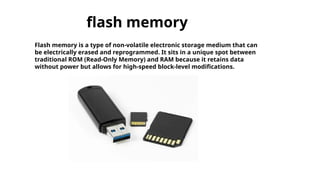
modern devices.
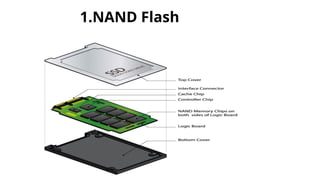
PROM (Programmable Read-Only Memory)
• Programming: Can be programmed by the user only once after manufacturing,
making it a "write-once, read-many" (WORM) memory.
• Erasure: Irreversible; data cannot be changed once written.
• Use: For permanent, fixed data like
3.
boot instructions (BIOS/UEFI)in older systems.
EPROM (Erasable Programmable Read-Only Memory)
• Programming: Can be written to multiple times.
• Erasure: Requires removal from the device and exposure to strong Ultraviolet (UV)
light for several minutes to erase the entire chip.
• Feature: Often has a quartz window on the chip for UV exposure.
4.
EEPROM (Electrically Erasable
ProgrammableRead-Only Memory)
• Programming: Can be programmed and erased electrically.
• Erasure: Allows for byte-by-byte erasure and reprogramming
without removing the
chip, using electrical signals.
• Advantage: More flexible than EPROM, as it doesn't need
special UV light or removal.
• Modern Relevance: The basis for modern Flash Memory (a
faster, higher-density
EEPROM type) used in USB drives, SSDs, and memory cards.
5.
What is ROM?
ROMis a non-volatile storage media used in computer systems and other electronic
devices.
Its main purpose is to store data that can only be read and not changed, making it easier
for
different hardware components to communicate with one another. There are different
types
of ROM, some ROM allow data to be written only once, while others can be rewritten in
special ways.
Different Types of ROM
There are four types of ROM, which are mentioned below:
• Electrically Erasable Programmable Read-Only Memory(EEPROM)
• Mask ROM
• Erasable Programmable Read-Only Memory(EPROM)
• Programmable Read-Only Memory(PROM)
6.
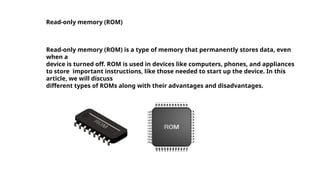
Read-only memory (ROM)is a type of memory that permanently stores data, even
when a
device is turned off. ROM is used in devices like computers, phones, and appliances
to store important instructions, like those needed to start up the device. In this
article, we will discuss
different types of ROMs along with their advantages and disadvantages.
Read-only memory (ROM)
7.
1. Electrically ErasableProgrammable
Read-Only Memory(EEPROM)
Electrically Erasable Programmable Read-Only Memory (EEPROM) is a type of non-
volatile memory that allows data to be erased and reprogrammed electrically. Data
in
EEPROM can be erased and rewritten without removing the chip from the device
and without
the need for special light sources.
Advantages of EEPROM
• EEPROM does not need of removed from the device to write new data or erase
existing data.
• Data may be erased and rewritten indefinitely using EEPROM technology.
• Electric current is used to upload and erase EEPROM data.
• It is possible to erase data from the EEPROM chip byte.
8.
Disadvantages of EEPROM
•In EEPROM, Different voltages are needed for operations,
including recording
and erasing data from memory chips.
• Compared to other ROM chips, EEPROM is more costly.
• EEPROM often has a finite capacity, and updating it might be
costly or
challenging.
• Data stored on EEPROMs has a finite lifespan.
9.
2. Mask ROM
MaskROM is a type of read-only memory(ROM) whose capacity is programmed by the
integrated circuit manufacturer. The memory is furnished by the customer to the device
manufacturer. Mask ROM is not able to allow the user to alter the data contained therein,
much like other forms of ROM.
Advantages of Mask ROM
• The cost of mask ROM is its primary benefit. Compared to all other
semiconductor memory types, mask ROM was the most compact kind per bit.
• The user may program it. The information and instructions therein are
unchangeable once coded.
Disadvantages of Mask ROM
• MASK ROM has to be replaced frequently and has a very limited lifespan.
• If the stored data has to be altered, it cannot be reprogrammed.
• Changing the stored data when system needs change is quite costly.
• Mask ROM is valuable correlated to other ROM chips.
10.
3. Erasable ProgrammableRead-Only
Memory(EPROM)
EPROM is reorganized. Whereas PROM is more expensive, EPROM is non-volatile.
Erasable Programmable Read-Only Memory is for erasing and rewriting the
programming.
EPROM is more economical than PROM. Reprogrammed of it is limited. Before
the era of
EEPROM and flash memory, EPROM was used in microcontrollers.
Advantages of Erasable Programmable Read-Only Memory
• In Erasable Programmable Read-Only Memory, programme be erased and
rewritten.
• The nature of EPROM is non-volatile.
• EPROM is more economical than PROM.
• It Delete all of the prior data in order to reprogram it.
11.
Disadvantages of ErasableProgrammable Read-Only
Memory
• EPROM cannot erase a single byte on its own. if you
delete a single byte, all of
EPROM's bytes are also destroyed.
• Data deletion from the EPROM Memory Chip requires
extra time.
• Changing the stored data when system needs change is
quite costly.
• Users can not add information frequently and guidelines
based on what they need.
12.
4. Programmable Read-OnlyMemory
(PROM)
• PROM has the ability to program it. Data and
instructions cannot be altered after they have been
programmed. Hardwiring the ROM chip is not necessary
for programming. The data stored in it are permanently
stored and can not be changed or erasable. It is used in
low-level programs such as firmware or microcode.
13.
Advantages of ProgrammableRead-Only Memory
• Due to the simplicity of its circuitry, this memory is more dependable.
• Today's market is filled with a wide variety of programming software.
• Hardwiring the ROM chip is not necessary for programming.
• Data may be erased and rewritten indefinitely using Programmable read-only memory.
Disadvantages of Programmable Read-Only Memory
• Data of Programmable read-only memory can not be modified.
• Programmable read-only memory often has a finite capacity, and updating it
might be costly or challenging.
• Users can not add information frequently and guidelines based on what they need.
• The programmer can burn undesired fuses by selecting a specific path for the
current by applying a high voltage.
14.
flash memory
Flash memoryis a type of non-volatile electronic storage medium that can
be electrically erased and reprogrammed. It sits in a unique spot between
traditional ROM (Read-Only Memory) and RAM because it retains data
without power but allows for high-speed block-level modifications.
15.
Types of FlashMemory
• Types of Flash Memory
•
The classification of Flash memory is based on the logical architecture
of the internal storage cells:
•
1. NAND Flash
•
Definition: NAND Flash uses floating-gate transistors connected in a
way that resembles a NAND logic gate.
•
Characteristics: It is designed for high-density data storage. It has
faster erase and write times but slower read speeds compared to
NOR. Because it is accessed in blocks (not byte-addressable), it is not
suitable for direct code execution.
•
Common Uses: SSDs, USB drives, and SD cards.
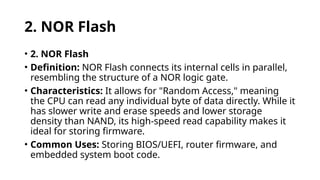
2. NOR Flash
•2. NOR Flash
•
Definition: NOR Flash connects its internal cells in parallel,
resembling the structure of a NOR logic gate.
•
Characteristics: It allows for "Random Access," meaning
the CPU can read any individual byte of data directly. While it
has slower write and erase speeds and lower storage
density than NAND, its high-speed read capability makes it
ideal for storing firmware.
•
Common Uses: Storing BIOS/UEFI, router firmware, and
embedded system boot code.
18.
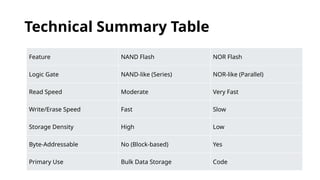
Technical Summary Table
FeatureNAND Flash NOR Flash
Logic Gate NAND-like (Series) NOR-like (Parallel)
Read Speed Moderate Very Fast
Write/Erase Speed Fast Slow
Storage Density High Low
Byte-Addressable No (Block-based) Yes
Primary Use Bulk Data Storage Code