Sanjivani Rural Education Society’s
Sanjivani College of Engineering, Kopargaon-423603
(An Autonomous Institute Affiliated to Savitribai Phule Pune University, Pune)
NAAC ‘A’ Grade Accredited, ISO 9001:2015 Certified
Department of Mechanical Engineering
Subject : Electric Vehicle Design
Class : T.Y. Mechanical
Subject Code : ME 311D
Unit 1 : Introduction to Automobile Engineering
By
V. P. Bhaurkar
Department of Mechanical Engineering
2025 – 26 (sem - 5)
V. P. Bhaurkar AI and ML (T. Y. Mechanical)
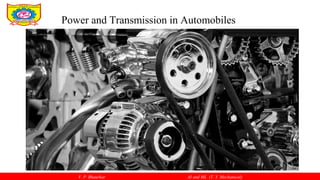
Power and Transmission in Automobiles
V. P. Bhaurkar AI and ML (T. Y. Mechanical)
Power and Transmission in Automobiles
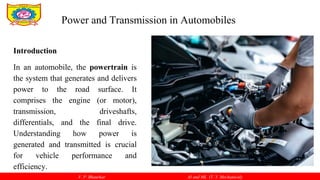
Introduction
In an automobile, the powertrain is
the system that generates and delivers
power to the road surface. It
comprises the engine (or motor),
transmission, driveshafts,
differentials, and the final drive.
Understanding how power is
generated and transmitted is crucial
for vehicle performance and
efficiency.
V. P. Bhaurkar AI and ML (T. Y. Mechanical)
Power Generation
Introduction
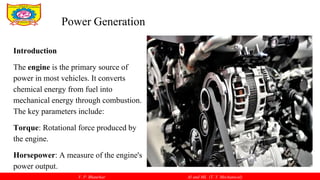
The engine is the primary source of
power in most vehicles. It converts
chemical energy from fuel into
mechanical energy through combustion.
The key parameters include:
Torque: Rotational force produced by
the engine.
Horsepower: A measure of the engine's
power output.
V. P. Bhaurkar AI and ML (T. Y. Mechanical)
Transmission System
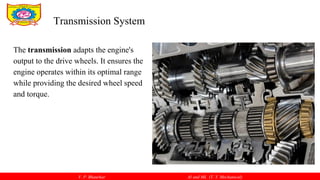
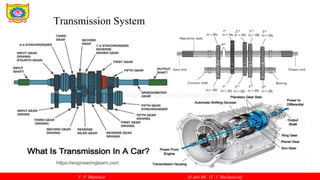
The transmission adapts the engine's
output to the drive wheels. It ensures the
engine operates within its optimal range
while providing the desired wheel speed
and torque.
V. P. Bhaurkar AI and ML (T. Y. Mechanical)
Transmission System
V. P. Bhaurkar AI and ML (T. Y. Mechanical)
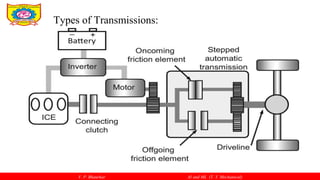
Types of Transmissions:
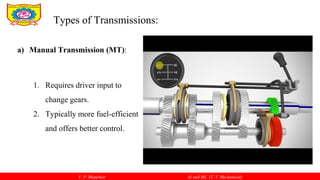
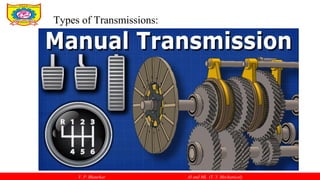
a) Manual Transmission (MT):
1. Requires driver input to
change gears.
2. Typically more fuel-efficient
and offers better control.
V. P. Bhaurkar AI and ML (T. Y. Mechanical)
Types of Transmissions:
V. P. Bhaurkar AI and ML (T. Y. Mechanical)
Types of Transmissions:
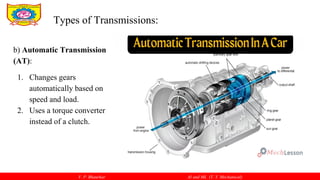
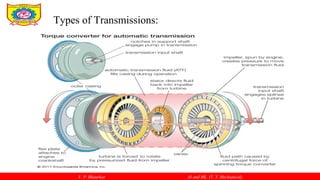
b) Automatic Transmission
(AT):
1. Changes gears
automatically based on
speed and load.
2. Uses a torque converter
instead of a clutch.
V. P. Bhaurkar AI and ML (T. Y. Mechanical)
Types of Transmissions:
V. P. Bhaurkar AI and ML (T. Y. Mechanical)
Types of Transmissions:
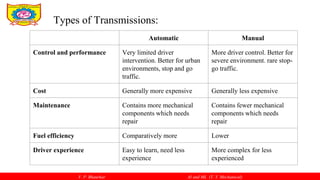
Automatic Manual
Control and performance Very limited driver
intervention. Better for urban
environments, stop and go
traffic.
More driver control. Better for
severe environment. rare stop-
go traffic.
Cost Generally more expensive Generally less expensive
Maintenance Contains more mechanical
components which needs
repair
Contains fewer mechanical
components which needs
repair
Fuel efficiency Comparatively more Lower
Driver experience Easy to learn, need less
experience
More complex for less
experienced
V. P. Bhaurkar AI and ML (T. Y. Mechanical)
Types of Transmissions:
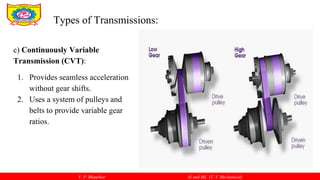
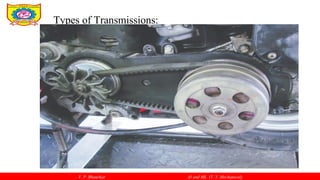
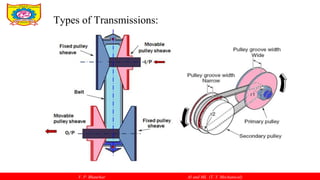
c) Continuously Variable
Transmission (CVT):
1. Provides seamless acceleration
without gear shifts.
2. Uses a system of pulleys and
belts to provide variable gear
ratios.
V. P. Bhaurkar AI and ML (T. Y. Mechanical)
Types of Transmissions:
V. P. Bhaurkar AI and ML (T. Y. Mechanical)
Types of Transmissions:
V. P. Bhaurkar AI and ML (T. Y. Mechanical)
Types of Transmissions:
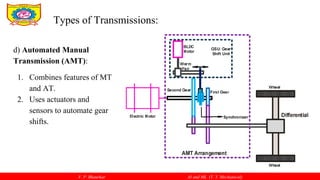
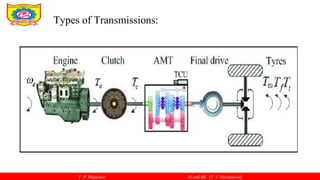
d) Automated Manual
Transmission (AMT):
1. Combines features of MT
and AT.
2. Uses actuators and
sensors to automate gear
shifts.
V. P. Bhaurkar AI and ML (T. Y. Mechanical)
Types of Transmissions:
V. P. Bhaurkar AI and ML (T. Y. Mechanical)
Types of Transmissions:
V. P. Bhaurkar AI and ML (T. Y. Mechanical)
Transmissions System
Components of the Transmission
System
Clutch: Connects and disconnects the engine
from the transmission.
Gearbox: Contains gears that adjust torque
and speed.
Driveshaft: Transmits torque from the
transmission to the differential.
Differential: Distributes torque to the drive
wheels, allowing them to rotate at different
speeds.
Importance of Transmission Systems
Efficiency: Proper gear ratios ensure the
engine runs efficiently.
Performance: Enhances acceleration and
top speed.
Fuel Economy: Optimized transmissions
can improve fuel consumption.
Emissions: Efficient power transmission
reduces harmful emissions.
V. P. Bhaurkar AI and ML (T. Y. Mechanical)
Thank You !