Comprehensive Overview of Plasma Volume Expanders in Medical Use
Detailed insights into types, uses, contraindications, and adverse effects of plasma volume expanders including crystalloids and colloids for fluid replacement in clinical settings.
INTRODUCTION
intravenous fluidsolutions that are used to increase or
retain the volume of fluid in the circulating blood.
Generally used to replace fluids that are lost due to
illness, trauma or surgery.
3.
Requirements of anIdeal Plasma Expander
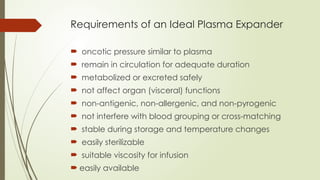
oncotic pressure similar to plasma
remain in circulation for adequate duration
metabolized or excreted safely
not affect organ (visceral) functions
non-antigenic, non-allergenic, and non-pyrogenic
not interfere with blood grouping or cross-matching
stable during storage and temperature changes
easily sterilizable
suitable viscosity for infusion
easily available
4.
Types of VolumeExpanders
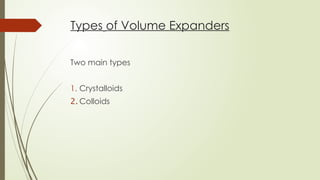
Two main types
1. Crystalloids
2. Colloids
5.
1. Crystalloids
Aqueoussolutions of mineral salts or other water-soluble
molecules.
freely cross biological barriers to enter interstitial tissue
hence, their effects are not restricted within vessels.
E.g. Normal Saline, Dextrose, Ringer's Solution etc.
6.
Dextrose 5% inWater (D5W)
Contains 5% glucose in water
When glucose metabolism is normal→ acts like free
water
Osmolality lower than serum
Not suitable for volume replacement
Water distributes into total body water
Infusion of 1 L increases blood volume by 100 mL
7.
In general,colloids are superior to crystalloids in
maintaining blood volume.
But they are expensive and they may not always be
available.
Hence, 0.9% sodium chloride or Ringer-lactate is used
commonly.
8.
2. Colloids
Largemolecules
Retains more easily in the intravascular space
Increase osmotic pressure.
Duration of action is relatively longer than crystalloids.
Dextran, Human Albumin, Gelatin and Blood.
9.
COMMON PLASMA EXPANDERS
Human albumin
Dextran
Polygeline or Degraded gelatin polymer
Hetastarch or Hydroxyethyl starch
10.
1. HUMAN ALBUMIN
Obtained from pooled human plasma
Given as 5% or 20% solution for volume replacement.
20% albumin has a high oncotic effect:
• 100 ml of 20% albumin ≈ osmotic effect of ~400 ml fresh
frozen plasma or ~800 ml whole blood.
Does not interfere with blood grouping, cross-matching
or coagulation.
No risk of sensitization on repeated use; heat-treated to
reduce infection risk.
11.
Uses
-Hypovolemia andshock
-Burns with plasma loss
-extensive tissue damage
Adverse Effects
-Occasional febrile/allergic reactions
-Expensive compared to synthetic colloids
12.
2. DEXTRAN
Itis polysaccharide and is available in two form Dextran-70 and
Dextran-40. It is obtained from sugar beet.
It interfere with blood grouping
Its dose should not exceed 20ml/kg in 24 hours for adults.
It is not recommended for children.
It can interfere with coagulation and platelet function,
thus prolong bleeding time
It can cause anaphylactic reaction, urticaria, itching
bronchospasm and prolongation of bleeding time.
13.
Dextran-40
Dextran-40 Itacts more rapidly than dextran-70.
It reduces blood viscosity and prevents RBC sludging
that occurs in shock by coating them and maintaining
their electronegative charge.
However, it is rapidly filtered at the glomerulus
expands plasma volume for a shorter period
can be stored for 10 years and are cheap
They are the most commonly used plasma expanders.
14.
3. POLYGELINE
Itis synthetic polymer (polypeptide) of M. L
30,000.
It does not show any interference with blood grouping and
cross matching.
It can cause hypersensitivity reactions like urticaria,
flushing, wheezing and hypotension.
It is not metabolized in the body; excreted slowly by the
kidney.
Expansion of plasma volume lasts for 12 hours.
It is more expensive than dextran.
Drugs available:-Haemaccel; Seraccel 500ml injection.
15.
4. HETASTARCH
Itis derived from starch (mixture of ethoxylated
amylopectin of various molecular sizes)
Doesn't show any interference with blood grouping and
cross matching.
The main side effect : vomiting, mild fever, itching, flu like
symptoms, swelling of salivary glands, periorbital odema,
bronchospasm.
Drugs available:- Expan 6% inj(100,500 ml vac)
16.
Indications
colloidal solutionsare used primarily as
substitutes for plasma in conditions where plasma
has been lost or has moved to extravascular
compartment
Eg:- Burns
Hypovolemic shock,
Severe trauma,
Surgical procedures
Dialysis
17.
Apart fromalbumin, other plasma expanders should
not be used for maintenance of plasma volume in
conditions like burns, where proteins leakout with
fluids for several days.
18.
Contraindications
Congestive heartfailure
↑ intravascular volume → may precipitate pulm. edema &worsen HF
Renal failure
excreted by kidneys → may accumulate and worsen renal impairment.
Severe anemia
Plasma expanders ↑ volume but do not carry oxygen → may further reduce
oxygen delivery due to hemodilution
Pulmonary edema
Further expansion of plasma volume worsens lung congestion and hypoxia.
Coagulation disorders / bleeding tendency
Dextran and hydroxyethyl starch can interfere with platelet function and clotting
factors, increasing bleeding risk.
19.
ADVERSE EFFECTS
Circulatoryoverload
- Rapid volume expansion increases hydrostatic pressure in capillaries.
Allergy
-Especially with dextran and gelatin due to immune reactions to large
molecules.
kidney failure
- Particularly with hydroxyethyl starch (HES); can cause tubular injury and
osmotic nephrosis.
Interference with blood grouping and cross-matching (Dextran)
- Dextran coats RBCs and may affect laboratory testing.
Hypotension (when administered polygeline)
Coagulation defects and bleeding