Comprehensive Overview of Physical Pharmaceutics-I: Drug Solubility and Molecular Interactions
Detailed exploration of drug solubility, solvent-solute interactions, and physicochemical properties essential for pharmaceutical formulation and stability testing.
INTRODUCTION
Physical pharmaceuticsis the branch of pharmacy that
concentrate on the application of physics and chemistry
to study of pharmaceutics.
In other words, study of effect of dosage forms at
molecular level.
3.
OBJECTIVE
Understand variousphysicochemical properties of drug molecules in the
designing the dosage forms and in formulation development.
Know the principal of chemical kinetics & to us them for stability
testing and determination of expiry date formulation
4.
Unit-I : Solubilityof drug.
Unit-II : State of matter and properties of matter
Unit-III : Micromeretics
Unit-IV : Complexation and Protein binding
Unit-V : pH, Buffer and Isotonic solution
5.
IIIRD SEMESESTER B.PHARMACY
PHYSICAL PHARMACEUTICS-I
UNIT-I
SOLUBILITY OF DRUGS
Presented by :
Miss Pooja D. Bhandare
(Assistant Professor)
Kandhar college of Pharmacy, nanded
6.
DEFINATIONS
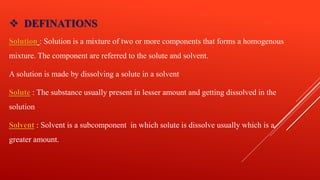
Solution :Solution is a mixture of two or more components that forms a homogenous
mixture. The component are referred to the solute and solvent.
A solution is made by dissolving a solute in a solvent
Solute : The substance usually present in lesser amount and getting dissolved in the
solution
Solvent : Solvent is a subcomponent in which solute is dissolve usually which is a
greater amount.
7.
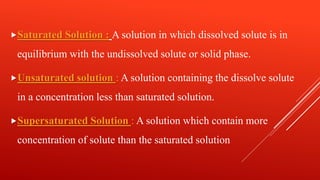
Saturated Solution :A solution in which dissolved solute is in
equilibrium with the undissolved solute or solid phase.
Unsaturated solution : A solution containing the dissolve solute
in a concentration less than saturated solution.
Supersaturated Solution : A solution which contain more
concentration of solute than the saturated solution
8.
SOLUBILITY
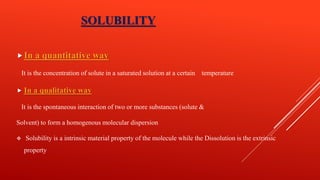
In a quantitativeway
It is the concentration of solute in a saturated solution at a certain temperature
In a qualitative way
It is the spontaneous interaction of two or more substances (solute &
Solvent) to form a homogenous molecular dispersion
Solubility is a intrinsic material property of the molecule while the Dissolution is the extrinsic
property
9.
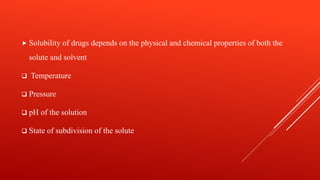
Solubility ofdrugs depends on the physical and chemical properties of both the
solute and solvent
Temperature
Pressure
pH of the solution
State of subdivision of the solute
10.
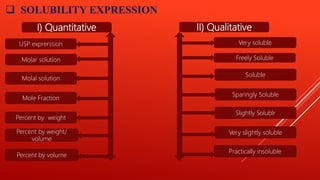
SOLUBILITY EXPRESSION
I)Quantitative II) Qualitative
USP exprerssion
Molar solution
Molal solution
Mole Fraction
Sparingly Soluble
Percent by weight/
volume
Percent by weight
Percent by volume
Soluble
Very soluble
Freely Soluble
Slightly Solublr
Very slightly soluble
Practically insoluble
11.
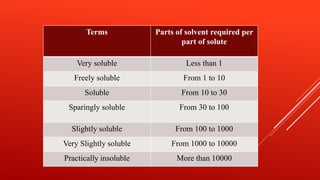
Terms Parts ofsolvent required per
part of solute
Very soluble Less than 1
Freely soluble From 1 to 10
Soluble From 10 to 30
Sparingly soluble From 30 to 100
Slightly soluble From 100 to 1000
Very Slightly soluble From 1000 to 10000
Practically insoluble More than 10000
12.
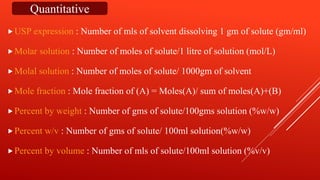
USP expression :Number of mls of solvent dissolving 1 gm of solute (gm/ml)
Molar solution : Number of moles of solute/1 litre of solution (mol/L)
Molal solution : Number of moles of solute/ 1000gm of solvent
Mole fraction : Mole fraction of (A) = Moles(A)/ sum of moles(A)+(B)
Percent by weight : Number of gms of solute/100gms solution (%w/w)
Percent w/v : Number of gms of solute/ 100ml solution(%w/w)
Percent by volume : Number of mls of solute/100ml solution (%v/v)
Quantitative
13.
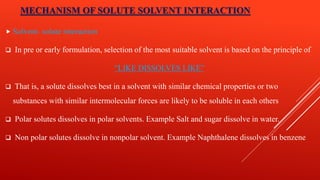
MECHANISM OF SOLUTESOLVENT INTERACTION
Solvent- solute interaction
In pre or early formulation, selection of the most suitable solvent is based on the principle of
“LIKE DISSOLVES LIKE”
That is, a solute dissolves best in a solvent with similar chemical properties or two
substances with similar intermolecular forces are likely to be soluble in each others
Polar solutes dissolves in polar solvents. Example Salt and sugar dissolve in water.
Non polar solutes dissolve in nonpolar solvent. Example Naphthalene dissolves in benzene
14.
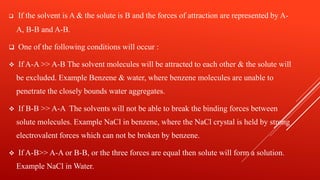
If thesolvent is A & the solute is B and the forces of attraction are represented by A-
A, B-B and A-B.
One of the following conditions will occur :
If A-A >> A-B The solvent molecules will be attracted to each other & the solute will
be excluded. Example Benzene & water, where benzene molecules are unable to
penetrate the closely bounds water aggregates.
If B-B >> A-A The solvents will not be able to break the binding forces between
solute molecules. Example NaCl in benzene, where the NaCl crystal is held by strong
electrovalent forces which can not be broken by benzene.
If A-B>> A-A or B-B, or the three forces are equal then solute will form a solution.
Example NaCl in Water.
15.
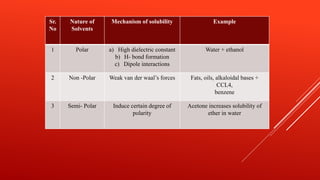
Sr.
No
Nature of
Solvents
Mechanism ofsolubility Example
1 Polar a) High dielectric constant
b) H- bond formation
c) Dipole interactions
Water + ethanol
2 Non -Polar Weak van der waal’s forces Fats, oils, alkaloidal bases +
CCL4,
benzene
3 Semi- Polar Induce certain degree of
polarity
Acetone increases solubility of
ether in water
16.
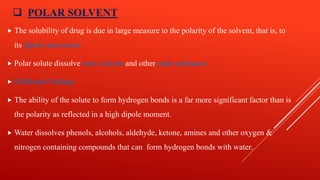
POLAR SOLVENT
The solubility of drug is due in large measure to the polarity of the solvent, that is, to
its dipole movement.
Polar solute dissolve ionic solvent and other polar substance
Hildbrand findings
The ability of the solute to form hydrogen bonds is a far more significant factor than is
the polarity as reflected in a high dipole moment.
Water dissolves phenols, alcohols, aldehyde, ketone, amines and other oxygen &
nitrogen containing compounds that can form hydrogen bonds with water.
17.
• The solubilityof substance also depends on structural features such as the
polar to the non polar group of the molecule.
• Acidic and basic characters also contributes to the interaction in solution.
• As the nitrogen of a nonpolar chain of an aliphatic alcohol increases, the
solubility of the compounds in water decreases.
18.
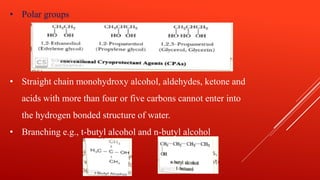
• Polar groups
•Straight chain monohydroxy alcohol, aldehydes, ketone and
acids with more than four or five carbons cannot enter into
the hydrogen bonded structure of water.
• Branching e.g., t-butyl alcohol and n-butyl alcohol
19.
Non-polar solvent
•Non-polar solvents are unable to reduce the attraction between the
ions of strong and weak electrolytes because of the solvent low
dielectric constant.
• The are unable to form hydrogen bonds with non electrolytes(aprotic
solvent).
• Non-polar solute and solvent are miscible due to similar internal
pressure through induced dipole interactions.
• The solute molecules are kept non polar solvent through weak van der
Walls-London type of forces.
• Example: solution of oils& fats in carbon tetrachloride or benzene
• Polyetylene glycol 400 and castor oil
20.
Semi-polar solvents
• Semipolar solvents such as ketones can induce a certain degree of polarity in
non-polar solvent molecule.
• For example, benzene which is readily polarizable, becomes soluble in alcohol
• They can act as a intermediate solvents to bring about miscibility of polar and
non-polar liquids.
• Example: acetone increases solubility of ether in water,
• Propylene glycol has been shown to increases the mutual solubility of water
and peppermint oil and water and benzyl benzoate.