Pharmacognosy –I
Introduction, History, Scope &
Development of Pharmacognosy
Definition :
Pharmacy is the science of drug making / deals with
their procurement (bring about), testing, storage and
conversion into suitable forms ( tablets, capsules,
emulsions etc)
Drug :
Any substance used in the treatment of disease or
diagnosis is known as drug . Diagnosis is the
determination of nature of disease.
Crude drug
It is the simple drug ,crude drugs are plant, animal
and their parts which after collection are subjected only to
drying or making them into transverse or longitudinal
pieces or peeling (stripping off skin or bark).They exist in
natural forms.
Pharmacognosy:
•Pharmacognosy is the science of drugs of biological origin ( plant,
animal, mineral) or The word pharmacognosy was coined in 1815
by
a German Scientist SEYDLER has been derived from two Greek
words , Pharmacon ---- ‘ a drug, gignosco – ‘ acquire the
knowledge of
•Pharmacognosy is the subject of crude drugs obtained
from the plants (vegetable), animal and mineral origin. Or It can
also defined as the objective study of crude drugs of the natural
sources processed scientifically.
•Pharmacognosy is the study of medicinal use of various naturally
occurring drugs its history, sources, distributions, method of
cultivation, active constituents, medicinal uses, identification test,
preservation methods, substituents and adulterants.
HISTORICAL DEVELOPMENT OF PHARMA
COGNOSY
History of pharmacognosy represents the history of pharmacy & medicine.
Pharmacognosy had its origin in the health-related activities of the most
primitive human race of the remote past.
They acquired knowledge of medicinal properties of plants in the following way
a)By guesswork or trial & error
b)While searching for food
c)By superficial resemblance between the plant parts & the affected organs,
that is, by examining the “Signature of Nature”
d)By observing other animals instinctive(natural) discrimination(taste) between
toxic & palatable(edible) plants.
e)By accidental discovery
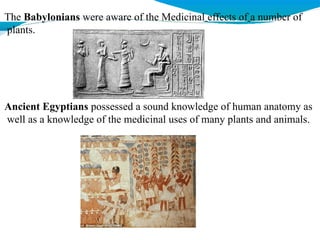
The Babylonians were aware of the Medicinal effects of a number of
plants.
Ancient Egyptians possessed a sound knowledge of human anatomy as
well as a knowledge of the medicinal uses of many plants and animals.
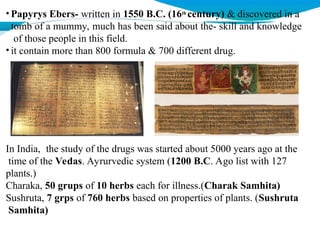
• Papyrys Ebers- written in 1550 B.C. (16th
century) & discovered in a
tomb of a mummy, much has been said about the- skill and knowledge
of those people in this field.
• it contain more than 800 formula & 700 different drug.
In India, the study of the drugs was started about 5000 years ago at the
time of the Vedas. Ayrurvedic system (1200 B.C. Ago list with 127
plants.)
Charaka, 50 grups of 10 herbs each for illness.(Charak Samhita)
Sushruta, 7 grps of 760 herbs based on properties of plants. (Sushruta
Samhita)
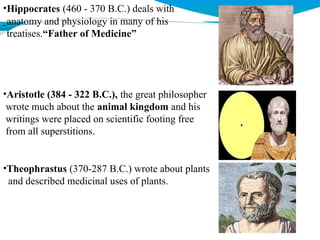
•Hippocrates (460 - 370 B.C.) deals with
anatomy and physiology in many of his
treatises.“Father of Medicine”
•Aristotle (384 - 322 B.C.), the great philosopher
wrote much about the animal kingdom and his
writings were placed on scientific footing free
from all superstitions.
•Theophrastus (370-287 B.C.) wrote about plants
and described medicinal uses of plants.
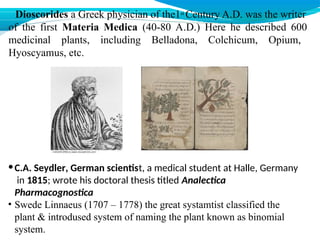
Dioscorides a Greek physician of the1st Century A.D. was the writer
of the first Materia Medica (40-80 A.D.) Here he described 600
medicinal plants, including Belladona, Colchicum, Opium,
Hyoscyamus, etc.
•C.A. Seydler, German scientist, a medical student at Halle, Germany
in 1815; wrote his doctoral thesis titled Analectica
Pharmacognostica
• Swede Linnaeus (1707 – 1778) the great systamtist classified the
plant & introdused system of naming the plant known as binomial
system.
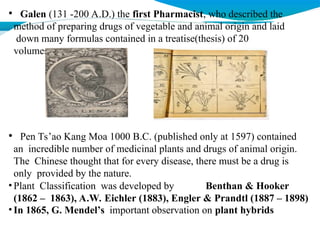
• Galen (131 -200 A.D.) the first Pharmacist, who described the
method of preparing drugs of vegetable and animal origin and laid
down many formulas contained in a treatise(thesis) of 20
volumes.
• Pen Ts’ao Kang Moa 1000 B.C. (published only at 1597) contained
an incredible number of medicinal plants and drugs of animal origin.
The Chinese thought that for every disease, there must be a drug is
only provided by the nature.
• Plant Classification was developed by Benthan & Hooker
(1862 – 1863), A.W. Eichler (1883), Engler & Prandtl (1887 – 1898)
• In 1865, G. Mendel’s important observation on plant hybrids
• Letter, Voehl, Tschirch & others, reported anatomical cheracters
of several powdered drug.
• “An Anatomical Atlas of Powdered & Vegitable Drugs” was
complied by Greenish & Colin”
• In China, medicinal plants uses since 5000 B.C..
• The oldest document “Pentaso” written by Shen nung.
SCOPE OF PHARMACOGNOSY
• Pharmacognosy has broad scope in the field of
pharmacy such as :a
1. ISOLATION OR ANALYSIS OF PHYTOCHEMICAL
:
•
• Eg ; Strong acting substances such as glycosides
from digitalis leaves,
• Alkaloids from the plants of Belladonna,
Hyocyamus, Rauwlofia
• Morphine and other alkaloids from the plant opium
were isolated and clinical uses studied
2. STRUCTURE ACTIVITY RELATIONSHIP :
Eg : Tubocurarine and Toxiferine from
curare plant have muscle relaxant properties
because of quaternary ammonium
groups.
The hypotensive and tranquillizing actions of
reserpine are due to the trimethoxy benzoic
acid
3. DRUGS OBTAIN:ED BY PARTIAL SYNTHESIS OF
NATURAL PRODUCTS:
Eg : Preparation of Steroid hormones from diosgenin by
acetolysis and oxidation and further preparation of
cortisone by microbial reactions.
4. NATURAL PRODUCTS AS MODELS FOR SYNTHESIS OF
NEW DRUGS :
Eg: Morphine is the model of a large group of potent
drugs .
Cocaine for local anaesthetics Atropine for certain
spasmolytics
5. DRUGS OF DIRECT THERAPEUTIC
USES :
•
• Among the natural constituents which even now cannot
be replaced are important group of antibiotics,
steroids, ergot alkaloids, vincristine etc
6. BIOSYNTHETIC PATHWAYS
INVESTIGATION :
•
• Biosynthetic pathways are of primary and
secondary metabolites.
• Some of the important pathways are Clavin ‘s
cycle of photosynthesis,
• Shikimic acid pathway of aromatic
compounds.
•
•
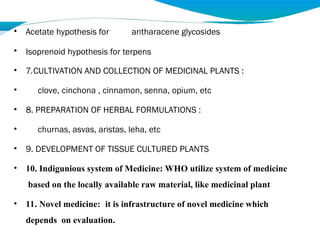
Acetate hypothesis for antharacene glycosides
Isoprenoid hypothesis for terpens
• 7.CULTIVATION AND COLLECTION OF MEDICINAL PLANTS :
• clove, cinchona , cinnamon, senna, opium, etc
• 8. PREPARATION OF HERBAL FORMULATIONS :
• churnas, asvas, aristas, leha, etc
• 9. DEVELOPMENT OF TISSUE CULTURED PLANTS
• 10. Indigunious system of Medicine: WHO utilize system of medicine
based on the locally available raw material, like medicinal plant
• 11. Novel medicine: it is infrastructure of novel medicine which
depends on evaluation.
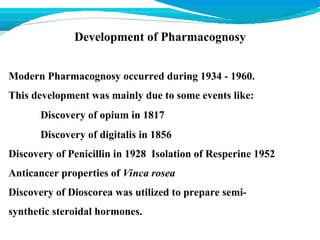
Development of Pharmacognosy
Modern Pharmacognosy occurred during 1934 - 1960.
This development was mainly due to some events like:
Discovery of opium in 1817
Discovery of digitalis in 1856
Discovery of Penicillin in 1928 Isolation of Resperine 1952
Anticancer properties of Vinca rosea
Discovery of Dioscorea was utilized to prepare semi-
synthetic steroidal hormones.
Development of Pharmacognosy
• Pharmacognosy as an applied science.
• It played a crucial role in the development of different disciplines of
science.
• Pharmacognosy is an imp link between Pharmacology and
Medicinal Chemistry
Development of
Pharmacognosy
Natural products got more and more therapeutic importance with
developments like:
Isolation of therapeutically active constituents Their identification
and structure elucidation.
There is close link between structure and Pharmacological action.
Development of
Pharmacognosy
Natural products served the purpose of precursor for synthesis
of several medicinally important compounds.
Some isolated components from plants were made into different
formulations and used as drugs.
Development of Pharmacogno
sy
Step by step processes in biosynthesis of Primary &
Secondary metabolites were presented before the world.
Invention of microscopy and different chemical test reagents.
Development of
Pharmacognosy
Knowledge of
• Plant taxonomy
• Plant breeding (propagation)
• Plant pathology
• Plant genetics
Is helpful in the development of cultivation technology
for medicinal and aromatic plants.
Alternative and Complementary systems
of medicine
(aka folk medicine, traditional medicine)
Ayurveda, Unani, Siddha, Homeopathy,
Chinese medicine Aromatherapy.
Ayurvedic system of medicine
The word ‘veda’ means knowledge. It evolved from 4
Vedas namely:
Rigveda, Samaveda, Yajurveda and
Atharvaveda.
It deals with the diseases, injuries, fertility, sanity and
health.
History of Ayurveda
Texts of Charaka and Sushruta Charaka (1st century
A.D.) wrote Charaka Samhita (samhita- meaning
collection of verses written in Sanskrit). Sushruta (4th
century A.D.) Sushruta Samhita.
2000 plants that were used in healing diseases and
abating symptoms were identified in these books.
Ayurvedic Dosage Forms
Various dosage forms according to its physical status of
product
1.Solid dosage form: Vati, Churna, bhasma, Kshara
2.Semisolid dosage form: Avleha, ghirta
3.Liquid dosage form: Taila, Asava-arista, Arka
Unani System of Medicine
System of medicine which was developed during Arabian
civilization.
In Europe it is known as Arab medicine.
It is based on well-established knowledge and practices
relating to the promotion of positive health and prevention
of diseases.
Traditional medicines in Egypt, Syria, Iraq, Persia, India,
China and other Middle East countries.
The system of medicine was documented in Al-Qanoon, a
medical Bible, by Sheikh Ali Sina (Avicena, 980-1037 AD),
and Razi (Rhazes, 850-923 AD) and in many other books
written by the Unani physicians. The literature of the Unani
system is mostly found in Arabic, Persian and Urdu
languages.
It is also based on use of herbs and minerals.
Basic principle is to treat root cause rather than symptoms.
Homoeopathic System of Medicine
Hahnemann (1790)
Homoeo (similar) pathos (suffering). Based on
law of Simular's,
“Similia Similibus Curantur”
Effect of antimalarial drug cinchona on his
healthy body. Surprisingly,he found symptoms
of malaria developing in him which
disappeared after he discontinued the drug. He
continued his research in that direction by
studying the effect of different substances on
this close friends and relatives and ultimately
published his discovery in 1796.
Theory and Basic Concept
The doctrine of Similia Similibus Curantur (Let
like be treated by like) is the basic foundation of
it.
A tree
cannot
be destroye by
Potencies and Dilution
Sources of Homeopathic medicines
Plant kingdom: Various morphological parts of
plants, fungi, etc. Animal kingdom: Secretion,
saliva, poisons and whole animal, etc. Minerals
and chemicals: Inorganic salts, non-metals, acids
and mixtures etc.
Important Homeopathic drugs and their uses
Allium cepa: Allergies and hay fever
Arnica spp:. Aches, pain
Atropa belladonna: Headache, fever
Borax: Ulcers Calendula: Antiseptic Rauwolfia:
Hypertension
Urtica urens: Burn treatment
Siddha System of Medicine
One of the most ancient recorded herbal systems of medicine,
dating back to pre-Ayurvedic period.
It is believed to be developed with the ancient civilization of
Mohenjodaro hadappa in the Indus valley.
Bogar, a Chinese, who came to India and settled down on the
pazhani hills, is known for his extensive work on alchemy and
medicine.
Siddha Vaidyas have studied thousands of herbs, and have
arrived at tangible solutions for health problems, which are
relevant to modern age.
Theory and Basic Principle s
3 principles vata, pitta, kapha (Triguna).
Treatment
Siddha Vaidya keeps the knowledge of thousands of herbs
and their effectiveness in specific composition and
formulation.
Kashayam (extracts); churnam (powders); tailams (medicated
oils); bhasmam (calx prepared by calcination); ghritam
(medicated ghee);
Kashayam for infants; jaundice; piles
Churnam Panchammruta; kadukai; ashwagandha Lehyam
Amla lehya; ginger lehya; coconut lehya
Traditional Chinese medicine (TC M)
•TCM as a healing system is thousands of
years old.
•A principle of TCM is that the interaction of
people with their environment is most
significant in creating health
•The concept most central to TCM is Qi/chi,
which is
translated as energy.
•Qi represents an invisible flow of energy
that circulates through plants, animals, and
people as well as the earth and sky.
Yin and Yang
•Qi is further viewed as either yin or yang energy.
•Opposites and complementary,
•Good Health is present when they are in balance
in a person and his/her total environment.
•Imbalance of yin and yang is considered to be the
cause of illness.
Aromatherapy
•Can
be
defined
as
the
oils to
maintain
and
promote psychological, and
spiritual
essential
physical,
wellbeing.
•Use of essential oils of plants to treat
symptoms
•Commonly used essential oils in a healthcare
setting are ginger or peppermint for nausea
and lavender or chamomile for insomnia
Aromatherapy uses pure essential oils to balance the
body’s equilibrium and to improve mental and
physical health.
It involves more than fragrance. Plant essential oils have
therapeutic powers in addition to beneficial fragrance,
and have antiseptic action in different degrees.
The natural healing art of aromatherapy is an excellent
way to
promote optimum health and vitality.
It can reduce stress, improve sleep and give you more
energy. It can improve your complexion, treat an
annoying skin itch and eliminate a stomachache.