BIORESOURCES
School of Biological Sciences
NAME: MAWRA GOWHAR
CLASS: MSC-BIORESOURCES
SEMESTER:4th SEMESTER
BATCH:2024
EMAIL:zargarmawra555@g
mail.com
METAGENOMICS AND ITS APPLICATIONS
CONTENTS
• INTRODUCTION
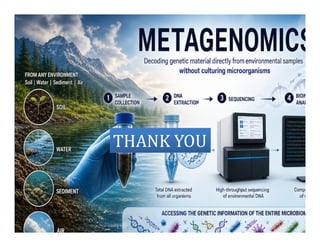
• STEPS IN METAGENOMICS
• TECHNIQUES USED
• APPLICATIONS OF
METAGENOMICS
• REFERENCES
Introduction Of Metagenomics
Metagenomics is a modern branch of
molecular biology and genomics that focuses
on studying the genetic material of
microorganisms directly from environmental
samples such as soil, water, air, and the
human body. Unlike traditional microbiology
methods, which require microorganisms to
be grown in the laboratory, metagenomics
allows scientists to analyze all microbes
present in a sample without culturing them.

• The term metagenomics was first used by Jo
Handelsman, Jan Clardy, M. Goodman, and first
appeared in publication in 1998.
• Most microorganisms in nature cannot be
grown under laboratory conditions. Because of
this limitation, a large portion of microbial
diversity remained unknown for many years.
Metagenomics overcomes this problem by
extracting and analyzing the total DNA from a
sample, providing a more complete picture of
microbial communities and their functions.
CONT……..
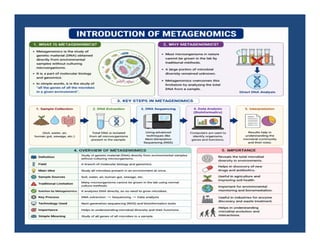
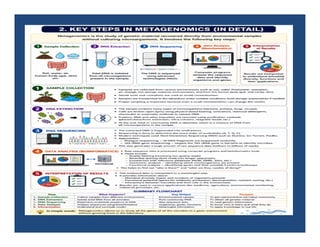
KEY STEPS IN METAGENOMICS
• 1. Sample Collection
• The very beginning of the process is environmental or
biological sample collection. Common sample types for
analysis are soil, water (seawater, pond, river, dirty water),
waste, and decomposing biological materials, feces and
urine.
• Potential biological samples are intestines, gut, stomach,
oral cavity and human skin, etc.
• 2. DNA extraction:
• The genetic material (DNA) is isolated from the collected
sample. This step needs to effectively lyse various cell
types present in the diverse microbial community while
minimizing shearing or degradation of the DNA.
3. DNA Sequencing:
• 3. DNA Sequencing:
• The extracted DNA is then sequenced. There are two main
approaches:
• Targeted Metagenomics (16S/18S rRNA gene
sequencing): This focuses on sequencing specific
phylogenetic marker genes, like the 16S rRNA gene for
bacteria and archaea, or the 18S rRNA gene for eukaryotes.
This provides information about the diversity and relative
abundance of different microbial taxa.
• Whole Metagenome Sequencing (Shotgun
Metagenomics): This involves sequencing all the DNA
in the sample randomly. This approach provides data
not only on microbial diversity but also on the
functional potential of the community (what genes are
present and what they might do), and can even allow
for the reconstruction of complete or near-complete
genomes of uncultured microorganisms.
CONT….
4. Bioinformatics Analysis: This is a substantial step where raw
• 4. Bioinformatics Analysis: This is a substantial step where raw
sequencing data is processed and interpreted:
• Quality Control: Raw reads are checked for quality, and low-quality
sequences, adapters, and contaminants are removed.
• Assembly (for Whole Metagenome Sequencing): Short sequencing
reads are assembled into longer contiguous sequences (contigs) and
potentially scaffolds or even draft genomes.
• Gene Prediction and Annotation: Genes are identified within the
assembled sequences, and their functions are predicted by comparing
them to known gene databases.
• Taxonomic Classification: Sequences are assigned to taxonomic
groups (species, genus, family, etc.) using reference databases.
• Statistical Analysis: Data is analyzed to identify differences in
community composition, gene abundance, or functional pathways
between samples or experimental conditions.
CONT…….
• 5. Data Interpretation and Validation:
The bioinformatics results are interpreted
to draw biological conclusions about the
microbial community's structure, function,
and its interactions within the environment.
This often involves comparing findings with
known biological pathways, ecological
theories, or experimental data, and
sometimes designing further experiments to
validate hypotheses.
CONT……
TECHNIQUES USED
• The primary techniques used in metagenomics:
• 1. Shotgun Metagenomics
• This is the most comprehensive approach. It
involves shearing all the DNA in a sample into
tiny fragments and sequencing them randomly.
• working: Scientists sequence the entire pool of
DNA, providing a snapshot of both the "who"
(taxonomy) and the "what" (functional
potential).
• Best for: Discovering new genes, metabolic
pathways, and reconstructing whole genomes
from complex environments.
• 2. 16S rRNA / Marker Gene Sequencing
• This technique focuses on a specific, highly
conserved gene—most commonly the 16S
ribosomal RNA gene for bacteria and archaea.
• Working: PCR is used to amplify this specific
"barcode" region. Because this gene evolves
very slowly and contains species-specific
variations, it acts as a fingerprint.
• Best for: Taxonomic profiling and
understanding microbial diversity (census-
taking) without needing the full genomic
sequence.
CONT….
• 3. Functional Metagenomics (Activity-
Based)
• Unlike the previous methods which look at
DNA sequences, this technique looks for what
the microbes can actually do.
• Working: DNA fragments from the
environment are inserted into a "host"
bacterium (like E. coli). These host cells are
then screened for new activities, such as
antibiotic resistance or the production of
specific enzymes (like cellulases or lipases).
• Best for: Bioprospecting for new industrial
enzymes or bioactive compounds.
CONT…..
• 4. Sequence-Based Screening
• This bridges the gap between shotgun
sequencing and functional analysis.
• Working: Researchers use known DNA
probes or primers to search metagenomic
libraries for sequences that look similar to
genes of interest (e.g., genes involved in
nitrogen fixation).
• Best for: Finding specific variations of
known gene families.
CONT….
APPLICATIONS OF METAGENOMICS
• 1. Medicine and Human Health
• Metagenomics is the cornerstone of human microbiome
research, helping us understand how microbial
communities influence our health.
• Disease Diagnosis: Identifying shifts in the gut, skin, or
oral microbiome associated with conditions like IBD,
obesity, diabetes, and even neurological disorders.
• Pathogen Detection: Rapidly identifying unknown
infectious agents in clinical samples (like cerebrospinal
fluid or blood) where traditional cultures fail.
• Antimicrobial Resistance (AMR): Mapping the
"resistome"—the collection of antibiotic resistance
genes in a population—to track how resistance spreads
through hospitals and communities.
• 2. Environmental Ecology and Conservation
• This field uses metagenomics to monitor the health
of the planet and the impact of human activity.
• Bioindicators: Using microbial diversity as a
"sensor" for soil health or water quality.
• Biogeochemical Cycling: Understanding how
microbes drive the carbon, nitrogen, and sulfur
cycles, which is critical for climate change modeling.
• Bioremediation: Identifying and utilizing microbes
that can degrade pollutants, such as oil spills, heavy
metals, or plastic waste, in contaminated sites.
CONT…
• 3. Agriculture and Soil Science
• Improving crop yields and sustainability by focusing on
the "rhizosphere" (the soil surrounding plant roots).
• Bio-fertilizers: Identifying microbes that enhance
nutrient uptake (like nitrogen fixation or phosphate
solubilization) to reduce reliance on chemical fertilizers.
• Disease Suppression: Studying soil communities that
naturally protect crops from fungal and bacterial
pathogens.
• Ruminant Health: Analyzing the rumen microbiome of
livestock to improve feed efficiency and reduce methane
emissions.
CONT….
• 4. Biotechnology and Bioprospecting
• Industries look to metagenomics to find "biological
machinery" that has evolved over billions of years.
• Novel Enzymes: Discovering extremophiles
(microbes in extreme heat, salt, or cold) to find heat-
stable enzymes for laundry detergents, food
processing, or biofuel production.
• Natural Products: Searching for "biosynthetic gene
clusters" that could lead to the development of new
antibiotics, antifungals, or anti-cancer drugs.
• Biofuels: Identifying enzymes that can efficiently
break down lignocellulose (plant waste) into
fermentable sugars for ethanol production.
CONT…
REFERENCES
• https://microbenotes.com/metagenomics/
• https://academic.oup.com/gbe/article/18/
3/evag029/8471837?login=false
• https://www.slideshare.net/slideshow/met
agenomics-31731265/31731265
THANK YOU