Overview of Medicines
Regulatory Systems in
the Gulf Region
A D E E P D I V E I N T O T H E R E G U L A T I O N O F M E D I C I N E S A C R O S S T H E G C C
N U S R A T H A N J O O M A B D U L M A J E E D
R E G U L A T O R Y A F F A I R S
Introduction
Introduction to Medicines Regulatory Systems:
Medicines regulatory systems are the legal frameworks that govern the approval,
monitoring, and safety of pharmaceutical products. The Gulf Cooperation Council
(GCC) member states each have their own systems in place for ensuring the safety
and efficacy of medicines available in their markets.
Objective of the Presentation:
To provide an in-depth understanding of how medicines are regulated in
each GCC country, the role of regulatory bodies, how the region is moving
towards harmonization of regulations, and the adoption of digital
submission systems like eCTD
2
The Gulf
Cooperation
Council (GCC)
Overview
What is the GCC?:
The GCC is a political and economic alliance of six Arab
countries: Bahrain, Kuwait, Oman, Qatar, Saudi Arabia, and
the UAE.
It was established in 1981 to promote economic
cooperation, security, and cultural ties among its members.
Importance of Medicines Regulation in the GCC:
The regulation of medicines ensures that only safe and
effective pharmaceutical products are available to the
public, which is crucial for public health, especially in rapidly
developing economies like those in the Gulf
3
Medicines Regulatory
Authorities by Country
4
Saudi Food and Drug
Authority (SFDA) –
Saudi Arabia
Structure:
The SFDA operates under the Ministry of Health in
Saudi Arabia, with departments handling drug
regulation, medical devices, and food safety.
Responsibilities:
• Drug registration and monitoring.
• Ensuring compliance with international
pharmaceutical standards.
• Safety surveillance through post-market
monitoring.
Scope of Activities:
SFDA is involved in regulating all aspects of
pharmaceuticals, including clinical trials, drug
safety, labeling, and the promotion of medicines.
Website: www.sfda.gov.sa
5
Emirates Drug
Establishment
(EDE) – UAE
Structure:
EDE is responsible for the drug regulation and
oversight previously managed by the Ministry of
Health and Prevention (MOHAP). It handles the
registration of pharmaceutical products in the UAE.
Responsibilities:
• Drug registration and monitoring of pharmaceutical
products.
• Ensuring compliance with international standards.
• Regulatory enforcement of safety and efficacy
requirements.
Scope of Activities:
EDE oversees the process of registering and
regulating medicines, ensures their safety, and
coordinates efforts for post-market surveillance.
Websites:
• EDE: www.ede.gov.ae
• MOHAP: www.mohap.gov.ae
6
Qatar Ministry of
Public Health
(MOPH) – Qatar
Structure:
MOPH handles the regulatory affairs of healthcare
services and medicines in Qatar. It oversees the
registration, approval, and surveillance of drugs in
the market.
Responsibilities:
• Drug registration and regulatory oversight.
• Ensuring public health safety through
compliance with international standards.
Scope of Activities:
MOPH is responsible for ensuring safe access to
medicines, including managing clinical trials,
approving new drugs, and post-market monitoring.
Website: www.moph.gov.qa
7
Kuwait Drug and
Food Control
Department
(DFC) – Kuwait
Structure:
The DFC operates under the Ministry of Health in
Kuwait, managing food and drug safety
regulations, including approval and monitoring of
medicines.
Responsibilities:
• Approving the registration of drugs.
• Enforcing regulations on food, drug safety, and
pharmaceutical imports.
Scope of Activities:
DFC manages the entire process from drug
registration to monitoring, ensuring medicines
meet safety standards.
Website: www.dgca.gov.kw
8
Oman Ministry
of Health
(MOH) – Oman
Structure:
The MOH in Oman handles all matters related to
the health sector, including the regulation of
pharmaceuticals and medical devices.
Responsibilities:
• Registration and monitoring of pharmaceuticals.
• Ensuring drug safety and effectiveness in the
market.
Scope of Activities:
MOH is responsible for drug registration, clinical
trials, post-marketing surveillance, and ensuring
compliance with health regulations.
Website: www.moh.gov.om
9
Bahrain National
Health Regulatory
Authority
(NHRA) – Bahrain
Structure:
NHRA is responsible for regulating all healthcare
products, including medicines, medical devices,
and cosmetics in Bahrain.
Responsibilities:
• Drug registration and oversight.
• Ensuring safety, quality, and efficacy of
healthcare products.
Scope of Activities:
NHRA ensures that medicines are safe for public
use by overseeing registration, post-market
surveillance, and compliance with national health
policies.
Website: www.nhra.bh
10
The GCC Health
Ministers Council
(GCC-HMC) –
GCC Region
Structure:
The GCC-HMC is a coordinating body that brings
together the health ministers from all GCC member
states. It focuses on creating common standards
and policies for healthcare, including
pharmaceutical regulations.
Responsibilities:
• Harmonizing pharmaceutical regulatory
processes across GCC countries.
• Coordinating public health initiatives and setting
regional standards.
Scope of Activities:
The council focuses on improving the regulatory
environment in the region, ensuring consistency in
the safety and quality of medicines across member
states.
Website: www.gcc-sg.org
11
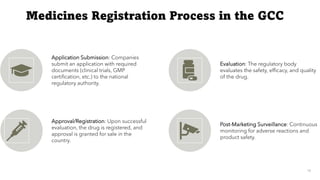
Medicines Registration Process in the GCC
Application Submission: Companies
submit an application with required
documents (clinical trials, GMP
certification, etc.) to the national
regulatory authority.
Evaluation: The regulatory body
evaluates the safety, efficacy, and quality
of the drug.
Approval/Registration: Upon successful
evaluation, the drug is registered, and
approval is granted for sale in the
country.
Post-Marketing Surveillance: Continuous
monitoring for adverse reactions and
product safety.
12
eCTD Submission in
the GCC
What is eCTD?
The electronic Common Technical Document
(eCTD) is an electronic submission format used
for the regulatory submission of information
related to the registration of pharmaceutical
products. It allows companies to submit
documentation electronically, streamlining the
regulatory process.
13
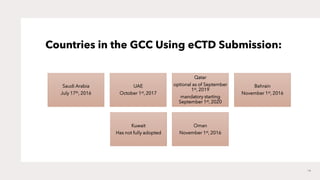
Countries in the GCC Using eCTD Submission:
Saudi Arabia
July 17th, 2016
UAE
October 1st, 2017
Qatar
optional as of September
1st, 2019
mandatory starting
September 1st, 2020
Bahrain
November 1st, 2016
Kuwait
Has not fully adopted
Oman
November 1st, 2016
14
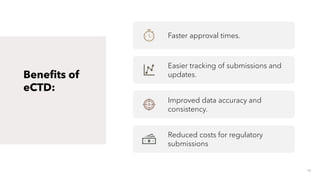
Benefits of
eCTD:
Faster approval times.
Easier tracking of submissions and
updates.
Improved data accuracy and
consistency.
Reduced costs for regulatory
submissions
15
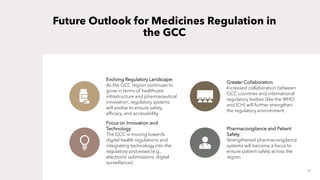
Future Outlook for Medicines Regulation in
the GCC
Evolving Regulatory Landscape:
As the GCC region continues to
grow in terms of healthcare
infrastructure and pharmaceutical
innovation, regulatory systems
will evolve to ensure safety,
efficacy, and accessibility.
Greater Collaboration:
Increased collaboration between
GCC countries and international
regulatory bodies (like the WHO
and ICH) will further strengthen
the regulatory environment.
Focus on Innovation and
Technology:
The GCC is moving towards
digital health regulations and
integrating technology into the
regulatory processes (e.g.,
electronic submissions, digital
surveillance).
Pharmacovigilance and Patient
Safety:
Strengthened pharmacovigilance
systems will become a focus to
ensure patient safety across the
region.
16
Harmonization of Medicines
Regulations in the GCC
GCC’s Efforts to Standardize
Regulations:
The GCC has been working towards
creating a more unified regulatory
framework for medicines, led by the Gulf
Health Ministers Council and GSO.
•Key Milestones:
•Adoption of regional standards for
drug registration.
•Collaborative frameworks for
regulatory bodies to share
information and best practices.
•Alignment of labeling, clinical trials,
and GMP requirements.
•Benefits of Harmonization:
• Streamlined approval processes.
• Reduced costs for multinational
companies.
• Improved access to medicines across
the region. 17
Conclusion
Summary:
Medicines regulation in the GCC is a
critical aspect of public health and
safety. While there are challenges,
ongoing efforts to harmonize
regulations are paving the way for
more efficient and effective
regulatory practices.
Final Thoughts:
Understanding the regulatory
environment in the Gulf region is
essential for pharmaceutical
companies seeking to expand their
presence in these rapidly developing
markets. With continued
collaboration and innovation, the
region’s regulatory systems will
continue to improve.
18
N
U
S
R
A
T
H
A
N
J
O
O
M
A
B
D
U
L
M
A
J
E
E
D