Comprehensive Overview of Legal Procedures for Medical Professionals in India
Detailed insights into India's legal system, criminal and civil cases, key statutes like BNS, BNSS, BSA, and medico-legal responsibilities of doctors in court procedures.
INTRODUCTION
•Doctors are essentialpart and play an important role
in dispensing justice by the Court of law while
dealing with civil or criminal matter affecting life and
social cause.
•In this entire exercise doctors have to appear in
Court of law to give evidence in matters related with
medicolegal issues.
•Therefore, it would be helpful if doctors are
acquainted with law, the legal procedure, the legal
terms and the Court procedures.
3.
LEGAL SYSTEM
•The Constitutionof India is the supreme source of
law in the country.
•The Constitution of India lays down the framework
demarcating fundamental political code, statute
(statutory law), procedures, powers and duties of
government and set out fundamental rights and
duties of citizens of India.
•In India, the basic pattern of legal system consists of
civil law and criminal law and accordingly the cases
are referred as civil case or criminal case.
4.
•The civil lawsor criminal laws and various acts are
called as Statute or Statutory law or codified law.
•Statutes are the laws passed by the Parliament,
State Legislatures and Union Territory Legislatures.
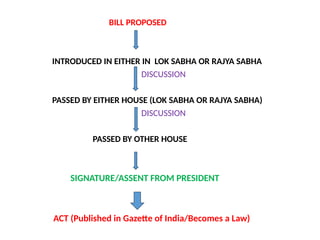
•Law proposals are brought before either house of
the parliament (Lok Sabha or Rajya Sabha) of India
in form of a bill.
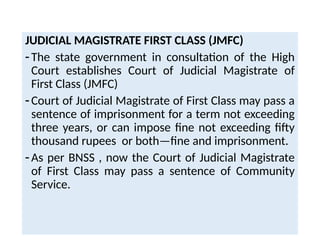
•A bill is a draft of a legislative proposal and is passed
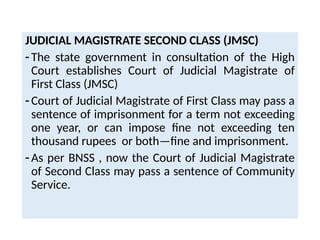
by both houses (Lok Sabha and Rajya Sabha).
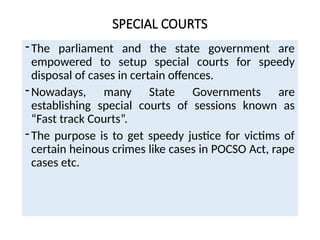
•It is submitted to the President of India. Once the
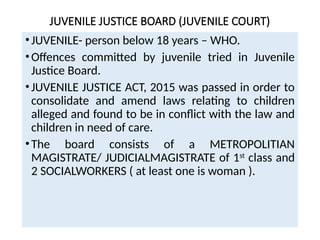
President of India gives assent to this law bill, then
it becomes an Act of Parliament and it is published
in Gazette of India and now, it become codified law
or statute.
5.
BILL PROPOSED
INTRODUCED INEITHER IN LOK SABHA OR RAJYA SABHA
DISCUSSION
PASSED BY EITHER HOUSE (LOK SABHA OR RAJYA SABHA)
DISCUSSION
PASSED BY OTHER HOUSE
SIGNATURE/ASSENT FROM PRESIDENT
ACT (Published in Gazette of India/Becomes a Law)
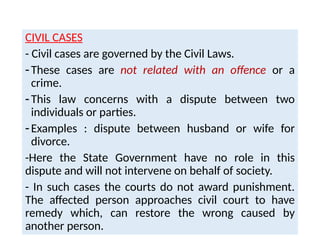
CIVIL CASES
- Civilcases are governed by the Civil Laws.
-These cases are not related with an offence or a
crime.
-This law concerns with a dispute between two
individuals or parties.
-Examples : dispute between husband or wife for
divorce.
-Here the State Government have no role in this
dispute and will not intervene on behalf of society.
- In such cases the courts do not award punishment.
The affected person approaches civil court to have
remedy which, can restore the wrong caused by
another person.
8.
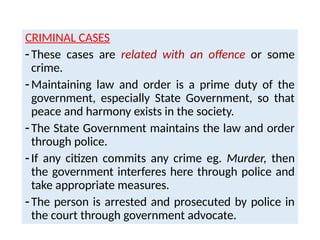
CRIMINAL CASES
-These casesare related with an offence or some
crime.
-Maintaining law and order is a prime duty of the
government, especially State Government, so that
peace and harmony exists in the society.
-The State Government maintains the law and order
through police.
-If any citizen commits any crime eg. Murder, then
the government interferes here through police and
take appropriate measures.
-The person is arrested and prosecuted by police in
the court through government advocate.
9.
- In otherwords, here the case will be heard by the
court and the case will be labelled as “accused person
vs government”.
-Unlike civil law, it is not merely dispute between two
people but the case is related with commission of
crime by one person with another.
-In such cases the court can award punishment or in
some offence, punishment plus fine or only fine
depending upon the nature of an offence.
- Criminal cases are governed by criminal laws like
Bhartiya Nyaya Sanhita (BNS), Bharatiya Nagarik
Suraksha Sanhita (BNSS), Bhartiya Sakshya Adhiniyam
(BSA), etc.
10.
THE BHARATIYA NYAYASANHITA 2023 (BNS 2023)
•The purpose of the BNS is to consolidate and amend
the provisions relating to the offences and
punishment.
•A person who is guilty of any commission of crime
shall be liable to punishment under this Sanhita.
•In this Sanhita, the offences are defined and
thereafter punishments are prescribed for those
offences.
•For example, rape is defined in Section 63 of BNS
2023 and punishment of rape is prescribed in
Section 64, 65 and other Sections and Subsections
of BNS 2023.
•Here the police use these different sections of BNS
to register an offence against the offender and
accordingly prosecuted in the court.
11.
THE BHARTIYA NAGARIKSURAKSHA SANHITA (BNSS 2023)
• The purpose of BNSS 2023 is to consolidate and amend
the law relating to Criminal Procedure.
• The provisions of this Sanhita, other than those relating
to Chapters IX, XI and XII thereof, shall not apply to:
- The State of Nagaland; and
- The tribal areas.
• The Sanhita lays down the procedure for initiating action
against any person accused of criminal offence. This
Sanhita deals with how a criminal case should be
investigated by the Police and how that case should
proceed in the court.
• For example, if a person dies in road traffic accident,
then the inquest panchnama is conducted by Police as
per Section 194 of BNSS for conducting the postmortem
examination.
12.
THE BHARATIYA SAKSHYAADHINIYAM 2023 (BSA 2023)
•The purpose of the BSA 2023 is to consolidate and
to provide general rules and principles of evidence
for fair trial.
•It applies to all judicial proceedings in or before any
Court, including Courts-martial.
•This Adhiniyam deals with collection and
interpretation of evidences as well as evidences
produced before the court.
•For example, (1) collection of blood for DNA analysis
and results obtained of such tests are produced in
the court as evidence or (2) Submission of alleged
weapon used in crime produced in the court as
evidence etc.
13.
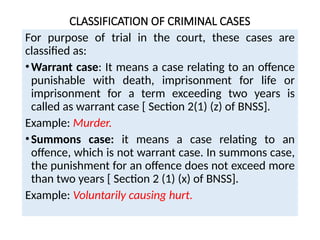
CLASSIFICATION OF CRIMINALCASES
For purpose of trial in the court, these cases are
classified as:
•Warrant case: It means a case relating to an offence
punishable with death, imprisonment for life or
imprisonment for a term exceeding two years is
called as warrant case [ Section 2(1) (z) of BNSS].
Example: Murder.
•Summons case: it means a case relating to an
offence, which is not warrant case. In summons case,
the punishment for an offence does not exceed more
than two years [ Section 2 (1) (x) of BNSS].
Example: Voluntarily causing hurt.
14.
OFFENCES
•Offence means anillegal act or a crime or a criminal
act which is punishable by the law.
•The act may be an act of commission or an act of
omission.
•It is a breach of a law or an illegal act.
•If a person had committed an offence, then he may
be punished as per the nature of an offence.
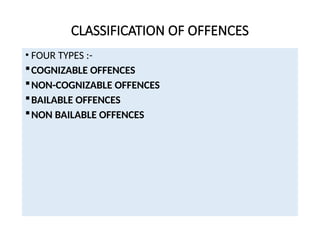
CLASSIFICATION OF OFFENCES
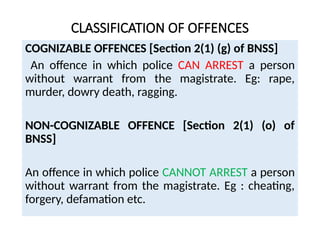
COGNIZABLEOFFENCES [Section 2(1) (g) of BNSS]
An offence in which police CAN ARREST a person
without warrant from the magistrate. Eg: rape,
murder, dowry death, ragging.
NON-COGNIZABLE OFFENCE [Section 2(1) (o) of
BNSS]
An offence in which police CANNOT ARREST a person
without warrant from the magistrate. Eg : cheating,
forgery, defamation etc.
17.
BAILABLE OFFENCE [Section2(1) (c) of BNSS]
•Offence in which court cannot deny bail. Police do not
have the right to keep the accused in custody. Eg :
causing public nuisance (Section 292 BNS), bribery
(Section 173 BNS).
•The accused is released on bail after providing a bond
known as “bail bond” with or without giving sureties.
•The bailable offence is such an offence, punishable
with imprisonment for less than 3 years or with fine
only.
18.
• NON BAILABLEOFFENCES [Section 2(1) (c) of BNSS]
• Serious offences for which a judicial magistrate can
deny bail. Eg : murder, attempt to murder, dowry
death.
•Non bailable offence means an offence, in which,
the grant of bail is not a matter of right. In this
scenario, the accused will have to apply to the court
for the bail. It will be discretion of the court either
to grant bail or not to grant bail.
•Non-bailable offences are the offences, which are
punishable with death, imprisonment of life or
imprisonment for years or more than years.
19.
PUNISHMENTS
•Forfeiture of property.
•Solitaryconfinement.
•Imprisonment for term – month/ years.
•Simple imprisonment.
•Community Service.
•Rigorous imprisonment with hard labour.
•Life imprisonment.
•Death sentence
20.
FIRST INFORMATION REPORT(Section 173, BNSS)
First Information Report(FIR) is the first
information about the commission of a ‘cognizable’
offence, given either by victim or any other person
to the police.
FIR must be lodged as soon as possible, otherwise
accused may get time to destroy evidence.
If a doctor fails to record FIR in case of Rape or
Vitriolage (Acid attack) will be punished under law.
21.
LEGAL PROCEDURES ININDIA
•INQUEST
•Preliminary legal enquiry investigation into cause of
death in cases of SUDDEN , SUSPICIOUS AND
UNNATURAL DEATHS.
•Types of inquest in India : POLICE and MAGISTRATE
INQUEST.
•Other types: - Coroners inquest.
- Medical examiner system.
- Procurator fiscal system.
22.
POLICE INQUEST (Sec 194 BNSS)
•Common type of inquest , Police officer making
inquest is called INVESTIGATING OFFICER.
•When he comes to know of death, he informs the
NEARBY EXECUTIVE MAGISTRATE and moves to the
scene of crime.
•There he makes a report with the help of PANCHAS,
describing the wound marks of injuries, fractures
and in what manner and by what weapon could
these injuries have been inflicted – PANCHNAMA.
•If he finds any foul play, the body is sent for POST
MORTEM EXAMINATION, together with a
requisition and a copy of inquest or the body is
HANDED OVER TO THE RELATIVES for disposal.
23.
SOME INDICATIONS FORPOLICE INQUEST
• homicide
• Sudden death
• Death in custody
• Industrial diseases
• Drugs / poison
• Abortion
• Suicide
• Industrial accidents
• Domestic accidents
• Road accidents
• Infant death
• Operational death
• Allegation of negligence
24.
MAGISTRATE INQUEST (196 BNSS)
•Conducted by District Magistrate, Sub divisional
magistrate or executive magistrate.
•Especially answered by the STATE GOVERNMENT –
collector, deputy collector, Tehsildar.
INDICATIONS
• Death in prison or police custody.
•Death in psychiatric hospital.
•Death due to police firing/ police interrogation.
•Exhumation.
•Dowry death.
25.
OTHER TYPES OFINQUEST
MEDICAL EXAMINER SYSTEM
- conducted in MOST STATES OF USA.
- A medical person is appointed to hold an inquest.
- The medical person usually visit the scene of crime,
and thus is able to gather first hand evidence that is
interpreted in proper perspective owing to his
knowledge of medical science.
- The autopsy is also conducted by him.
- THIS SYSTEM IS FAR BETTER THAN THE OTHER
INQUEST where non medical person conducts the
inquest.
26.
CORONERS INQUEST
- Donein UK , some states of USA and some other
countries.
- NOT IN INDIA.
- Coroner conducts inquest in all UNNATURAL AND
SUSPICIOUS DEATHS.
27.
COURTS OF INDIA
•Supremecourt.
•High court.
•Sessions court.
•Chief judicial magistrate/ chief metropolitan
magistrate.
•Judicial magistrate first class/ metropolitan
magistrate.
•Judicial magistrate second class.
28.
COURTS
•Courts in India– CRIMINAL & CIVIL courts.
CRIMINAL COURTS
A. THE SUPREME COURT –
1) Highest judicial Tribunal in the country. Located
in New Delhi.
2) It supervises all the courts in India.
3) The rulings or judgements delivered by the
supreme court are binding on all the lower courts
in India.
4) No criminal case can be initiated in the supreme
court.
5) It can sustain or alter the punishment awarded by
the lower courts.
29.
B. THE HIGHCOURT :
Generally, they are located in the capital of state and
are the highest tribunal in that state.
Deals with appeal in criminal cases.
It confirms the death sentence awarded by the
sessions court.
30.
C. THE SESSIONSCOURT
Usually located at district headquarters.
The court of sessions is presided over by a senior
judge known as Principal Sessions judge and other
court of sessions are called as Additional Courts of
Sessions.
The sessions court can pass any sentence authorized
by law. However, death sentence by it must be
confirmed by the high court.
The court can pass a sentence of imprisonment up to
years and unlimited fine.
31.
D. MAGISTRATE COURTS
Threetypes: i. CHIEF JUDICIAL MAGISTRATE
ii. JUDICIAL MAGISTRATE FIRST CLASS
iii. JUDICIAL MAGISTRATE SECOND CLASS
32.
CHIEF JUDICIAL MAGISTRATECOURT
- In every district, among the available Judicial
Magistrates of First Class (JMFC), the High court
appoints one of the Judicial Magistrate of First Class
to be the Chief Judicial Magistrate for the district.
- Function of the Chief Judicial Magistrate is to have
general administrative control of the working of
other Judicial Magistrates in the district.
- Chief Judicial Magistrate may pass a sentence of
imprisonment not exceeding seven years.
33.
JUDICIAL MAGISTRATE FIRSTCLASS (JMFC)
-The state government in consultation of the High
Court establishes Court of Judicial Magistrate of
First Class (JMFC)
-Court of Judicial Magistrate of First Class may pass a
sentence of imprisonment for a term not exceeding
three years, or can impose fine not exceeding fifty
thousand rupees or both—fine and imprisonment.
-As per BNSS , now the Court of Judicial Magistrate
of First Class may pass a sentence of Community
Service.
34.
JUDICIAL MAGISTRATE SECONDCLASS (JMSC)
-The state government in consultation of the High
Court establishes Court of Judicial Magistrate of
First Class (JMSC)
-Court of Judicial Magistrate of First Class may pass a
sentence of imprisonment for a term not exceeding
one year, or can impose fine not exceeding ten
thousand rupees or both—fine and imprisonment.
-As per BNSS , now the Court of Judicial Magistrate
of Second Class may pass a sentence of Community
Service.
35.
SPECIAL COURTS
- Theparliament and the state government are
empowered to setup special courts for speedy
disposal of cases in certain offences.
- Nowadays, many State Governments are
establishing special courts of sessions known as
“Fast track Courts”.
- The purpose is to get speedy justice for victims of
certain heinous crimes like cases in POCSO Act, rape
cases etc.
36.
JUVENILE JUSTICE BOARD(JUVENILE COURT)
•JUVENILE- person below 18 years – WHO.
•Offences committed by juvenile tried in Juvenile
Justice Board.
•JUVENILE JUSTICE ACT, 2015 was passed in order to
consolidate and amend laws relating to children
alleged and found to be in conflict with the law and
children in need of care.
•The board consists of a METROPOLITIAN
MAGISTRATE/ JUDICIALMAGISTRATE of 1st
class and
2 SOCIALWORKERS ( at least one is woman ).
MEDICAL EVIDENCE
•Evidence givenby EXPERT WITNESS in medical
sciences is called MEDICAL EVIDENCE.
•3 types : ORAL, DOCUMENTRY AND MATERIAL
EVIDENCE.
1) ORAL EVIDENCE.
2) DOCUMENTARY EVIDENCE : Medical certificates,
medico legal reports, dying declaration and dying
deposition.
3) MATERIAL EVIDENCE : here the RMP is asked to
testify about some object Eg: bullet.
39.
ORAL EVIDENCE
•Refers toa fact that can be seen, heard or perceived
in any other manner, it must be the evidence of that
person who has himself seen, heard or perceived.
•Oral evidence whenever possible must be DIRECT-
Sec 160 IEA.
•It must be the evidence of that person who has
personal knowledge of facts in relation to the
particular incidence , i.e. must be the evidence of the
eye witness.
•It refers to an opinion.
•HEARSAY or INDIRECT EVIDENCE – is the evidence of
a witness who has no personal knowledge.
40.
DOUCUMENTARY EVIDENCE
•MEDICAL CERTIFICATE: certificates issued by RMP
in the course of treatment.
•Refers to ill health, death, vaccination etc.
•If a patient dies due to natural disease, RMP is
legally bound to issue DEATH CERTIFICATE WITHOUT
CHARGING FEES.
•If not sure of the cause of death/suspicious of foul
play- NOT ISSUED.
•Issuing FALSE CERTIFICATE is punishable by Section
234 of BNS.
41.
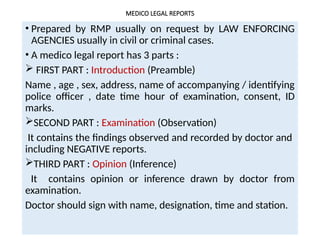
MEDICO LEGAL REPORTS
•Prepared by RMP usually on request by LAW ENFORCING
AGENCIES usually in civil or criminal cases.
• A medico legal report has 3 parts :
FIRST PART : Introduction (Preamble)
Name , age , sex, address, name of accompanying / identifying
police officer , date time hour of examination, consent, ID
marks.
SECOND PART : Examination (Observation)
It contains the findings observed and recorded by doctor and
including NEGATIVE reports.
THIRD PART : Opinion (Inference)
It contains opinion or inference drawn by doctor from
examination.
Doctor should sign with name, designation, time and station.
42.
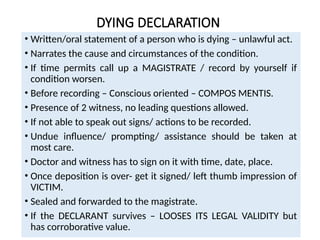
DYING DECLARATION
• Written/oralstatement of a person who is dying – unlawful act.
• Narrates the cause and circumstances of the condition.
• If time permits call up a MAGISTRATE / record by yourself if
condition worsen.
• Before recording – Conscious oriented – COMPOS MENTIS.
• Presence of 2 witness, no leading questions allowed.
• If not able to speak out signs/ actions to be recorded.
• Undue influence/ prompting/ assistance should be taken at
most care.
• Doctor and witness has to sign on it with time, date, place.
• Once deposition is over- get it signed/ left thumb impression of
VICTIM.
• Sealed and forwarded to the magistrate.
• If the DECLARANT survives – LOOSES ITS LEGAL VALIDITY but
has corroborative value.
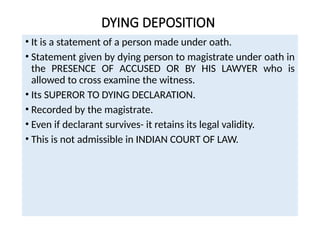
43.
DYING DEPOSITION
• Itis a statement of a person made under oath.
• Statement given by dying person to magistrate under oath in
the PRESENCE OF ACCUSED OR BY HIS LAWYER who is
allowed to cross examine the witness.
• Its SUPEROR TO DYING DECLARATION.
• Recorded by the magistrate.
• Even if declarant survives- it retains its legal validity.
• This is not admissible in INDIAN COURT OF LAW.
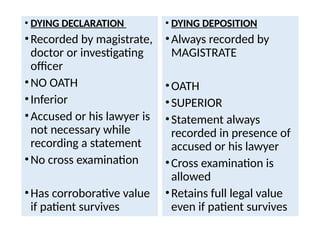
44.
• DYING DECLARATION
•Recordedby magistrate,
doctor or investigating
officer
•NO OATH
•Inferior
•Accused or his lawyer is
not necessary while
recording a statement
•No cross examination
•Has corroborative value
if patient survives
• DYING DEPOSITION
•Always recorded by
MAGISTRATE
•OATH
•SUPERIOR
•Statement always
recorded in presence of
accused or his lawyer
•Cross examination is
allowed
•Retains full legal value
even if patient survives
45.
SUMMONS / SUBPOENA
•Legal invitation/document compelling attendance of a
witness on a particular date, time , place by the court of
law- issued under penalty to give evidence.
• Issued in DUPLICATE , served by the police officer of
court, bears the seal of the court, served personally or
delivered by registered post.
• Once received- attend punctually – give
evidence/produce documents , article.
• Now with enactment of BNSS 2023, a summons can be
served in an electronic form. It can also be an encrypted
or in any other form of electronic communication and
shall bear the image of the seal of Court or digital
signature .
46.
• The witnessmust obey a summons and appear in the court. If
the witness has a valid or urgent reason, he should
communicate to the court, preferably in writing.
• Disobedience of a summons issued by court or intentionally
omits to appear before the Court is an offence. The offence is
punishable under Section 208 of BNS 2023.
• The punishment includes simple imprisonment for a term which
may extend to six months or with fine which may extend to ten
thousand rupees or with both [Section 208(b) of BNS 2023].
• When receiving 2 summons : Criminal > civil
• Higher court> lower court.
• 2 summons of same level, preference is given to the FIRST you
received.
47.
CONDUCT MONEY
• REMUNERATIONfor attending the court in civil courts.
• It is the money paid to a witness in civil cases to meet the
expenses towards travelling to attend the court.
• Given at the time , when summon is been served , if
inadequate/ not paid- inform the court to get it enhanced-
decided by judge.
• SERVED ONLY IN CIVIL COURTS not in criminal courts,
because of the interest of the state in delivering justice.
48.
RECORDING OF EVIDENCEIN A COURT
• OATH : compulsory and hold witness responsible for the
consequence of his evidence. Mandatory above 12 years of
age.
• EXAMINATION IN CHIEF : by the lawyer who has summoned
the witness.
The objective is to present all the facts that are relevant to
the court. No leading questions allowed except WHEN THE
WITNESS IS DECLARED HOSTILE.
In government prosecution cases say for example in homicide
case, the public prosecutor (Government lawyer) first
examines a doctor to elicit the findings of case under inquiry.
49.
• CROSS EXAMINATION: witness questioned by opposite
counsel. Not limited to the fact witness testified, leading
questions allowed, does not have any time limit.
• Objectives of this examination are:
- To elicit facts favourable to his case.
- To test the accuracy of the statements made by the witness.
- To modify or explain what has been said.
- To discredit the witness.
50.
• RE- EXAMINATION: by the lawyer who has summoned him,
to correct any mistake during cross examination , to clarify /
add details to statements made during cross examination.
• Leading questions are not allowed in re-examination.
• No new things or new subject may be introduced by the
witness without the consent of the judge or the defence
lawyer.
51.
• QUESTION BYTHE JUDGE : judge presiding the hearing , at
any stage during recording of evidence can ask question to
clear up any doubts.
• LEAVING THE COURT:-
-- after re-examination witness can step down from witness box
after permitted by the judge.
-- Before leaving the court room, witness must carefully read
his deposition and sign at the bottom of each page and initial
correction, only then he can leave the court room after seeking
permission from the judge .
52.
WITNESS
• A witnessis person who testifies to a fact seen, heard or
perceived.
• Types of Witness :-
a) Common witness – Person who gives evidence about the
facts observed by himself.
b) Expert witness: a person who is qualified experienced in
scientific technical subject and capable of giving opinion
from the facts observed by himself and others. Eg:
Doctors, fingerprint experts, handwriting experts…are
expert witnesses.
53.
HOSTILE WITNESS:
• Awitness willfully conceals truth.
• Tell lies/give false evidence in the court against the party
who summoned him.
• Makes contrary statements of the facts or what he had
already said in the lower courts on previous occasion.
• When declared hostile, leading questions can be asked in the
examination-in-chief by the public prosecutor.
54.
PERJURY
• Perjury meanswillful utterance of falsehood by a witness
under oath.
• After taking Oath, willfully making statements which he
knows or believes to be false.
• Giving false evidence is an offence as defined under Section
227 of BNS 2023.
55.
• A witnessis liable for punishment for “false evidence” under
Section 229 of BNS 2023:
• Whoever, intentionally gives false evidence in any stage of a
judicial proceeding or fabricates false evidence during any
stage of judicial proceeding, shall be punished with
imprisonment of either description for a term which may
extend to seven years and shall also liable to fine which may
extend to ten thousand rupees.
• Whoever, intentionally gives or fabricates false evidence in
any case, other than judicial proceeding, (for example doctor
issuing false medical certificate, fabricating certificate, etc.),
shall be punished with imprisonment of either description
for a term which may extend to three years and shall also
liable to fine which may extend to ten thousand rupees.
56.
• A medicalwitness, seeking to testify in the court, should
bear in mind the solemnity of the occasion and adhere to
some basic principles while giving evidence :
1) PUNCTUALITY AND DEMEANOUR
2) BE FAIR AND FRANK
3) CLARITY OF SUBJECT MATTER
4) SPEAK CLEARLY AND COOLLY BUT NOT COLDLY.
5) GIVE DIRECT ANSWERS WHEREVER POSSIBLE AND
ANSWER ONLY THE QUESTIONED ASKED!
6) NEVER LOSE TEMPER.