Comprehensive Overview of Institutional Review Boards and Research Ethics
Explore the formation, regulations, ethical principles, and operational procedures of Institutional Review Boards (IRBs) with a focus on human subject protection and landmark cases like the Tuskegee Syphilis Study.
Comprehensive Overview of Institutional Review Boards and Research Ethics
1.
1
Institutional Review Boardand Institutional
Ethics Committee
Dr.(Mrs.) Pallavi M.Chaudhari
Associate Professor
Dr.D.Y.Patil College of Pharmacy, Akurdi, Pune
2.
2
What is an
Institutional
ReviewBoard
(IRB)?
An IRB is an appropriately constituted
group that has been formally
designated to review and monitor
research involving human subjects
• ---Approve
• ---Require modification
• ---Disapprove
Each institution may use whatever
name it chooses
Regardless of the name chosen, the
IRB is subject to federal IRB
regulations when research is
reviewed and approved
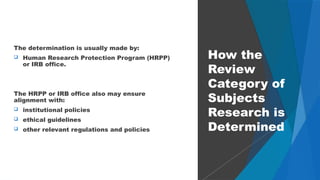
3.
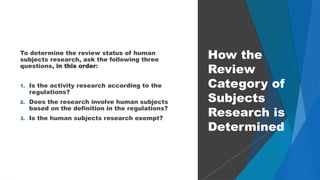
3
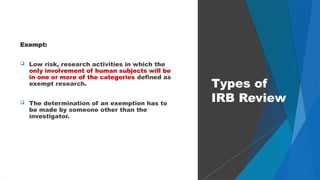
The Tuskegee SyphilisStudy
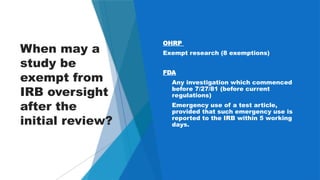
The Tuskegee Syphilis Study was an
unethical research study conducted by
the U.S. Public Health Service (PHS)
from 1932 to 1972 in Tuskegee,
Alabama
It aimed to observe the natural
progression of untreated syphilis in
African American men, but it violated
ethical standards and led to significant
harm
Key Facts About the Study:
Participants: 600 Black men (399 with
syphilis, 201 without syphilis)
Deception: Researchers did not inform
participants they had syphilis and falsely told
them they were receiving treatment for "bad
blood“
Withheld Treatment: Even after penicillin
became the standard treatment for syphilis in
1947, researchers denied treatment to
participants to continue observing disease
progression
Harm Caused: Many men died, suffered
severe health issues, and unknowingly passed
syphilis to their spouses and children
Syphilis is a sexually transmitted infection (STI)
caused by bacteria, Treponema pallidum, that
can be treated with antibiotics, and if left
untreated, it can lead to serious health problems
4.
4
The Tuskegee SyphilisStudy
Ethical Violations:
Lack of informed consent
Deception about the true
nature of the study
Withholding effective
treatment
Targeting a vulnerable
population
Exposure & Aftermath:
The study was exposed in 1972
by a journalist, leading to public
outrage
The U.S. government ended the
study and provided medical
care to survivors
In 1997, President Bill Clinton
issued a formal apology on
behalf of the U.S. government
5.
5
The Tuskegee SyphilisStudy
Impact on Research Ethics:
Led to the creation of the National Research
Act (1974) and Institutional Review Boards (IRBs)
Inspired The Belmont Report (1979), outlining
ethical principles for human research
Increased awareness and regulations to
protect human research subjects
7
When and howwere IRB’s formed?
The National Research Act was passed by Congress in 1974. The Act established the existence of
IRBs to review biomedical and behavioral research involving human subjects.
The Act also created the National Commission for the Protection of Human Subjects of Biomedical
and Behavioral Research.
This Commission was tasked in identifying the basic ethical principles involving human subjects
research.
The Commission published The Belmont Report in 1978.
Reference: Research Ethics: Institutional Review Board (IRB) Office - Northwestern University
8.
8
When and howwere IRB’s formed?
The National Research Act (Public Law 93-348) was a U.S. law passed
in 1974 to establish ethical guidelines for research involving human
subjects
It was enacted in response to ethical concerns raised by past
research abuses, such as the Tuskegee Syphilis Study
The Belmont Report is a foundational document in research ethics,
published in 1979 by the National Commission for the Protection of
Human Subjects of Biomedical and Behavioural Research
It was created in response to unethical research practices, such as
the Tuskegee Syphilis Study, and provides ethical principles and
guidelines for conducting research involving human subjects
9.
9
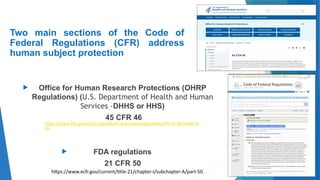
Two main sectionsof the Code of
Federal Regulations (CFR) address
human subject protection
Office for Human Research Protections (OHRP
Regulations) (U.S. Department of Health and Human
Services -DHHS or HHS)
45 CFR 46
FDA regulations
21 CFR 50
https://www.hhs.gov/ohrp/regulations-and-policy/regulations/45-cfr-46/index.ht
ml
https://www.ecfr.gov/current/title-21/chapter-I/subchapter-A/part-50
10.
10
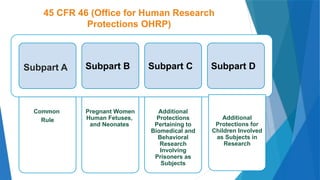
45 CFR 46(Office for Human Research
Protections OHRP)
Subpart A
Common
Rule
Subpart B
Pregnant Women
Human Fetuses,
and Neonates
Subpart C
Additional
Protections
Pertaining to
Biomedical and
Behavioral
Research
Involving
Prisoners as
Subjects
Additional Protections Pertaining
Subpart D
Additional
Protections for
Children Involved
as Subjects in
Research
11.
11
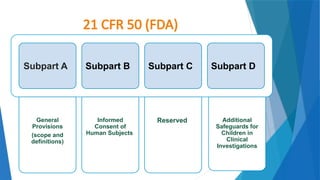
21 CFR 50(FDA)
Subpart A
General
Provisions
(scope and
definitions)
Subpart B
Informed
Consent of
Human Subjects
Subpart C
Reserved
Additional Protections Pertaining
to Biomedical and Behavioral
Additional Protections Pertaining
to Biomedical and Behavioral
Research Involving Prisoners as
Subjects
Pertaining to Biomedical and
Behavioral Research Involving
Prisoners as Subjects
Subpart D
Additional
Safeguards for
Children in
Clinical
Investigations
13
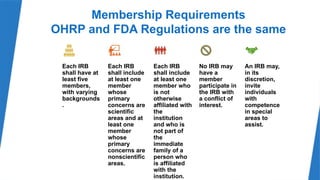
Membership Requirements
OHRP andFDA Regulations are the same
Each IRB
shall have at
least five
members,
with varying
backgrounds
.
Each IRB
shall include
at least one
member
whose
primary
concerns are
scientific
areas and at
least one
member
whose
primary
concerns are
nonscientific
areas.
Each IRB
shall include
at least one
member who
is not
otherwise
affiliated with
the
institution
and who is
not part of
the
immediate
family of a
person who
is affiliated
with the
institution.
No IRB may
have a
member
participate in
the IRB with
a conflict of
interest.
An IRB may,
in its
discretion,
invite
individuals
with
competence
in special
areas to
assist.
14.
14
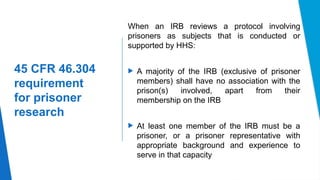
45 CFR 46.304
requirement
forprisoner
research
When an IRB reviews a protocol involving
prisoners as subjects that is conducted or
supported by HHS:
A majority of the IRB (exclusive of prisoner
members) shall have no association with the
prison(s) involved, apart from their
membership on the IRB
At least one member of the IRB must be a
prisoner, or a prisoner representative with
appropriate background and experience to
serve in that capacity
15.
15
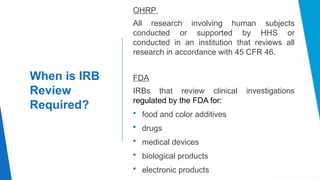
When is IRB
Review
Required?
OHRP
Allresearch involving human subjects
conducted or supported by HHS or
conducted in an institution that reviews all
research in accordance with 45 CFR 46.
FDA
IRBs that review clinical investigations
regulated by the FDA for:
food and color additives
drugs
medical devices
biological products
electronic products
16.
16
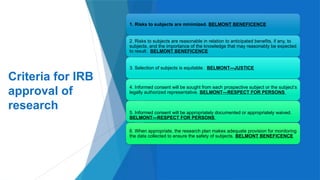
Criteria for IRB
approvalof
research
1. Risks to subjects are minimized. BELMONT BENEFICENCE
2. Risks to subjects are reasonable in relation to anticipated benefits, if any, to
subjects, and the importance of the knowledge that may reasonably be expected
to result. BELMONT BENEFICENCE
3. Selection of subjects is equitable. BELMONT---JUSTICE
4. Informed consent will be sought from each prospective subject or the subject’s
legally authorized representative. BELMONT—RESPECT FOR PERSONS
5. Informed consent will be appropriately documented or appropriately waived.
BELMONT—RESPECT FOR PERSONS
6. When appropriate, the research plan makes adequate provision for monitoring
the data collected to ensure the safety of subjects. BELMONT BENEFICENCE
17.
17
Criteria for
IRB
approval of
research
(cont.)
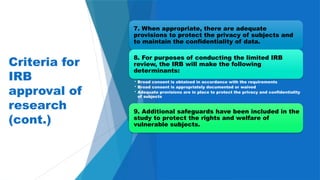
7.When appropriate, there are adequate
provisions to protect the privacy of subjects and
to maintain the confidentiality of data.
8. For purposes of conducting the limited IRB
review, the IRB will make the following
determinants:
• Broad consent is obtained in accordance with the requirements
• Broad consent is appropriately documented or waived
• Adequate provisions are in place to protect the privacy and confidentiality
of subjects
9. Additional safeguards have been included in the
study to protect the rights and welfare of
vulnerable subjects.
18.
18
Local vs Non-localIRB Review
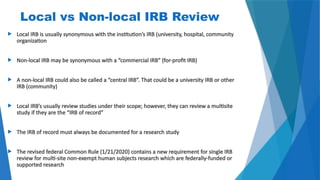
Local IRB is usually synonymous with the institution’s IRB (university, hospital, community
organization
Non-local IRB may be synonymous with a “commercial IRB” (for-profit IRB)
A non-local IRB could also be called a “central IRB”. That could be a university IRB or other
IRB (community)
Local IRB’s usually review studies under their scope; however, they can review a multisite
study if they are the “IRB of record”
The IRB of record must always be documented for a research study
The revised federal Common Rule (1/21/2020) contains a new requirement for single IRB
review for multi-site non-exempt human subjects research which are federally-funded or
supported research
19.
19
Transferring IRB Oversight
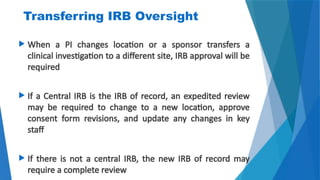
When a PI changes location or a sponsor transfers a
clinical investigation to a different site, IRB approval will be
required
If a Central IRB is the IRB of record, an expedited review
may be required to change to a new location, approve
consent form revisions, and update any changes in key
staff
If there is not a central IRB, the new IRB of record may
require a complete review
20.
20
IRB Authority
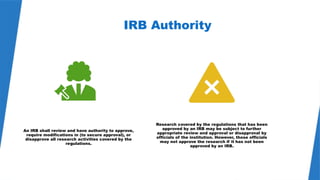
An IRBshall review and have authority to approve,
require modifications in (to secure approval), or
disapprove all research activities covered by the
regulations.
Research covered by the regulations that has been
approved by an IRB may be subject to further
appropriate review and approval or disapproval by
officials of the institution. However, those officials
may not approve the research if it has not been
approved by an IRB.
21.
21
IRB
Communication
with PI,
Sponsor, Study
Team
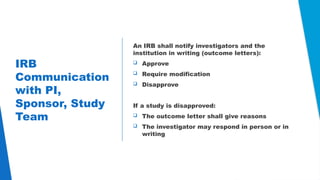
AnIRB shall notify investigators and the
institution in writing (outcome letters):
Approve
Require modification
Disapprove
If a study is disapproved:
The outcome letter shall give reasons
The investigator may respond in person or in
writing
22.
22
Suspension or
Termination of
IRBApproval
of Research
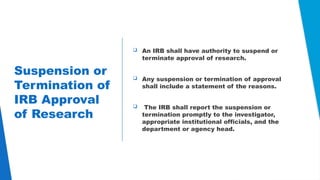
An IRB shall have authority to suspend or
terminate approval of research.
Any suspension or termination of approval
shall include a statement of the reasons.
The IRB shall report the suspension or
termination promptly to the investigator,
appropriate institutional officials, and the
department or agency head.
23.
23
IRB Record-
keeping and
Reports
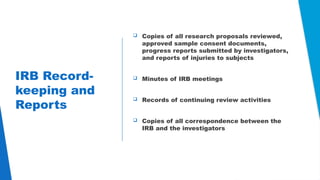
Copies of all research proposals reviewed,
approved sample consent documents,
progress reports submitted by investigators,
and reports of injuries to subjects
Minutes of IRB meetings
Records of continuing review activities
Copies of all correspondence between the
IRB and the investigators
24.
24
IRB Record-
keeping and
Reports
(cont.)
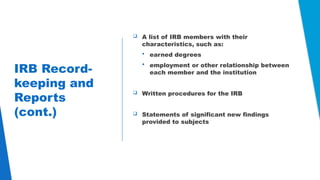
A list of IRB members with their
characteristics, such as:
earned degrees
employment or other relationship between
each member and the institution
Written procedures for the IRB
Statements of significant new findings
provided to subjects
25.
25
IRB Record-
keeping and
Reports
(cont.)
The records shall be retained for at least 3
years after completion of the research
The records shall be accessible for inspection
and copying by authorized representatives of
the Food and Drug Administration at
reasonable times and in a reasonable manner.
The Food and Drug Administration may refuse
to consider a clinical investigation if the
institution or the IRB refuses to allow an
inspection
26.
26
Exempt
Expedited
Full Committee Review or Full Board
Review
Types of
Categorical
Review for
Human
Subjects
Research
27.
27
Three types ofIRB review
Exempt Review (No risk)
Expedited Review
(Minimal risk)
Full Board Review
(More than minimal
risk)
28.
28
Three types ofIRB review
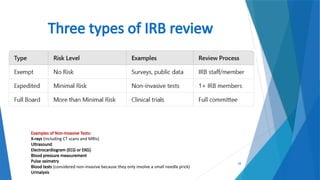
Examples of Non-Invasive Tests:
X-rays (including CT scans and MRIs)
Ultrasound
Electrocardiogram (ECG or EKG)
Blood pressure measurement
Pulse oximetry
Blood tests (considered non-invasive because they only involve a small needle prick)
Urinalysis
29.
29
The determination isusually made by:
Human Research Protection Program (HRPP)
or IRB office.
The HRPP or IRB office also may ensure
alignment with:
institutional policies
ethical guidelines
other relevant regulations and policies
How the
Review
Category of
Subjects
Research is
Determined
30.
30
To determine thereview status of human
subjects research, ask the following three
questions, in this order:
1. Is the activity research according to the
regulations?
2. Does the research involve human subjects
based on the definition in the regulations?
3. Is the human subjects research exempt?
How the
Review
Category of
Subjects
Research is
Determined
31.
31
Exempt:
Low risk,research activities in which the
only involvement of human subjects will be
in one or more of the categories defined as
exempt research.
The determination of an exemption has to
be made by someone other than the
investigator.
Types of
IRB Review
32.
32
When may a
studybe
exempt from
IRB oversight
after the
initial review?
OHRP
Exempt research (8 exemptions)
FDA
a. Any investigation which commenced
before 7/27/81 (before current
regulations)
b. Emergency use of a test article,
provided that such emergency use is
reported to the IRB within 5 working
days.
33.
33
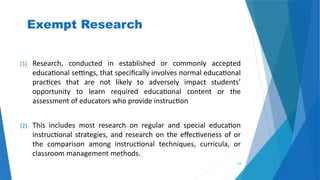
Exempt Research
(1) Research,conducted in established or commonly accepted
educational settings, that specifically involves normal educational
practices that are not likely to adversely impact students’
opportunity to learn required educational content or the
assessment of educators who provide instruction
(2) This includes most research on regular and special education
instructional strategies, and research on the effectiveness of or
the comparison among instructional techniques, curricula, or
classroom management methods.
34.
34
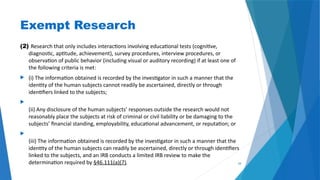
Exempt Research
(2) Researchthat only includes interactions involving educational tests (cognitive,
diagnostic, aptitude, achievement), survey procedures, interview procedures, or
observation of public behavior (including visual or auditory recording) if at least one of
the following criteria is met:
(i) The information obtained is recorded by the investigator in such a manner that the
identity of the human subjects cannot readily be ascertained, directly or through
identifiers linked to the subjects;
(ii) Any disclosure of the human subjects’ responses outside the research would not
reasonably place the subjects at risk of criminal or civil liability or be damaging to the
subjects’ financial standing, employability, educational advancement, or reputation; or
(iii) The information obtained is recorded by the investigator in such a manner that the
identity of the human subjects can readily be ascertained, directly or through identifiers
linked to the subjects, and an IRB conducts a limited IRB review to make the
determination required by §46.111(a)(7).
35.
35
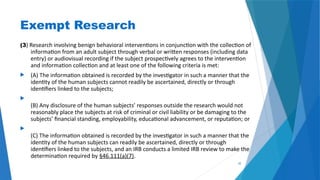
Exempt Research
(3) Researchinvolving benign behavioral interventions in conjunction with the collection of
information from an adult subject through verbal or written responses (including data
entry) or audiovisual recording if the subject prospectively agrees to the intervention
and information collection and at least one of the following criteria is met:
(A) The information obtained is recorded by the investigator in such a manner that the
identity of the human subjects cannot readily be ascertained, directly or through
identifiers linked to the subjects;
(B) Any disclosure of the human subjects’ responses outside the research would not
reasonably place the subjects at risk of criminal or civil liability or be damaging to the
subjects’ financial standing, employability, educational advancement, or reputation; or
(C) The information obtained is recorded by the investigator in such a manner that the
identity of the human subjects can readily be ascertained, directly or through
identifiers linked to the subjects, and an IRB conducts a limited IRB review to make the
determination required by §46.111(a)(7).
36.
36
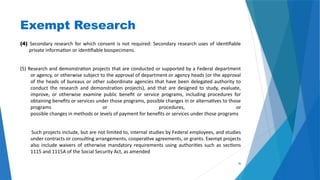
Exempt Research
(4) Secondaryresearch for which consent is not required: Secondary research uses of identifiable
private information or identifiable biospecimens.
(5) Research and demonstration projects that are conducted or supported by a Federal department
or agency, or otherwise subject to the approval of department or agency heads (or the approval
of the heads of bureaus or other subordinate agencies that have been delegated authority to
conduct the research and demonstration projects), and that are designed to study, evaluate,
improve, or otherwise examine public benefit or service programs, including procedures for
obtaining benefits or services under those programs, possible changes in or alternatives to those
programs or procedures, or
possible changes in methods or levels of payment for benefits or services under those programs
Such projects include, but are not limited to, internal studies by Federal employees, and studies
under contracts or consulting arrangements, cooperative agreements, or grants. Exempt projects
also include waivers of otherwise mandatory requirements using authorities such as sections
1115 and 1115A of the Social Security Act, as amended
37.
37
Exempt Research
(6) Tasteand food quality evaluation and consumer acceptance studies:
• If wholesome foods without additives are consumed, or
• If a food is consumed that contains a food ingredient at or below the
level and for a use found to be safe, or agricultural chemical or
environmental contaminant at or below the level found to be safe, by the
Food and Drug Administration or approved by the Environmental
Protection Agency or the Food Safety and Inspection Service of the U.S.
Department of Agriculture.
38.
38
Exempt Research
(7) Storageor maintenance for secondary research for which broad
consent is required: Storage or maintenance of identifiable private
information or identifiable biospecimens for potential secondary
research use if an IRB conducts a limited IRB review and makes the
determinations required by §46.111(a)(8).
(8) Secondary research for which broad consent is required: Research
involving the use of identifiable private information or identifiable
biospecimens for secondary research use.
39.
39
Expedited:
Not greaterthan minimal risk
Involves only procedures listed in one or
more of the expedited categories of the
federal regulations
Needs IRB review and approval
Types of
IRB Review
40.
40
Definition of MinimalRisk
45 CFR 46 and 21 CFR 56
Definitions are the same for
minimal risk.
Minimal risk means that the
probability and magnitude of
harm or discomfort anticipated in
the research are not greater in
and of themselves than those
ordinarily encountered in daily
life or during the performance of
routine physical or psychological
examinations or tests.
41.
41
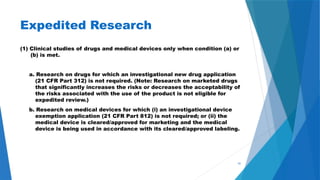
Expedited Research
(1) Clinicalstudies of drugs and medical devices only when condition (a) or
(b) is met.
a. Research on drugs for which an investigational new drug application
(21 CFR Part 312) is not required. (Note: Research on marketed drugs
that significantly increases the risks or decreases the acceptability of
the risks associated with the use of the product is not eligible for
expedited review.)
b. Research on medical devices for which (i) an investigational device
exemption application (21 CFR Part 812) is not required; or (ii) the
medical device is cleared/approved for marketing and the medical
device is being used in accordance with its cleared/approved labeling.
42.
42
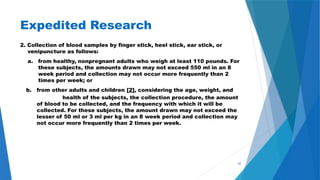
Expedited Research
2. Collectionof blood samples by finger stick, heel stick, ear stick, or
venipuncture as follows:
a. from healthy, nonpregnant adults who weigh at least 110 pounds. For
these subjects, the amounts drawn may not exceed 550 ml in an 8
week period and collection may not occur more frequently than 2
times per week; or
b. from other adults and children [2], considering the age, weight, and
health of the subjects, the collection procedure, the amount
of blood to be collected, and the frequency with which it will be
collected. For these subjects, the amount drawn may not exceed the
lesser of 50 ml or 3 ml per kg in an 8 week period and collection may
not occur more frequently than 2 times per week.
43.
43
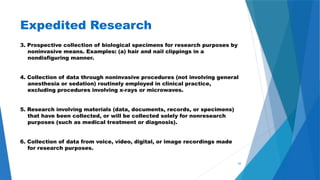
Expedited Research
3. Prospectivecollection of biological specimens for research purposes by
noninvasive means. Examples: (a) hair and nail clippings in a
nondisfiguring manner.
4. Collection of data through noninvasive procedures (not involving general
anesthesia or sedation) routinely employed in clinical practice,
excluding procedures involving x-rays or microwaves.
5. Research involving materials (data, documents, records, or specimens)
that have been collected, or will be collected solely for nonresearch
purposes (such as medical treatment or diagnosis).
6. Collection of data from voice, video, digital, or image recordings made
for research purposes.
44.
44
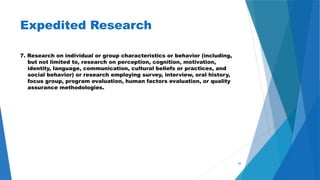
Expedited Research
7. Researchon individual or group characteristics or behavior (including,
but not limited to, research on perception, cognition, motivation,
identity, language, communication, cultural beliefs or practices, and
social behavior) or research employing survey, interview, oral history,
focus group, program evaluation, human factors evaluation, or quality
assurance methodologies.
45.
45
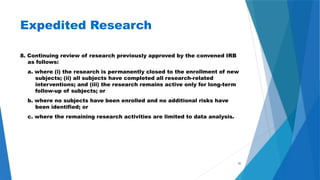
Expedited Research
8. Continuingreview of research previously approved by the convened IRB
as follows:
a. where (i) the research is permanently closed to the enrollment of new
subjects; (ii) all subjects have completed all research-related
interventions; and (iii) the research remains active only for long-term
follow-up of subjects; or
b. where no subjects have been enrolled and no additional risks have
been identified; or
c. where the remaining research activities are limited to data analysis.
46.
46
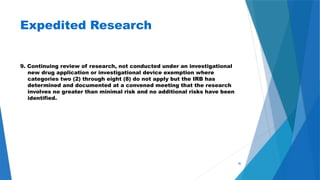
Expedited Research
9. Continuingreview of research, not conducted under an investigational
new drug application or investigational device exemption where
categories two (2) through eight (8) do not apply but the IRB has
determined and documented at a convened meeting that the research
involves no greater than minimal risk and no additional risks have been
identified.
47.
47
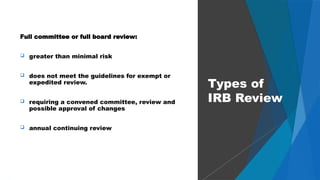
Full committee orfull board review:
greater than minimal risk
does not meet the guidelines for exempt or
expedited review.
requiring a convened committee, review and
possible approval of changes
annual continuing review
Types of
IRB Review
48.
48
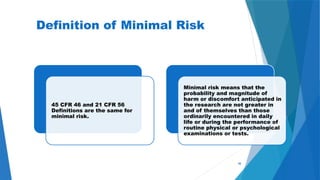
Definition of MinimalRisk
45 CFR 46 and 21 CFR 56
Definitions are the same for
minimal risk.
Minimal risk means that the
probability and magnitude of
harm or discomfort anticipated in
the research are not greater in
and of themselves than those
ordinarily encountered in daily
life or during the performance of
routine physical or psychological
examinations or tests.
49.
49
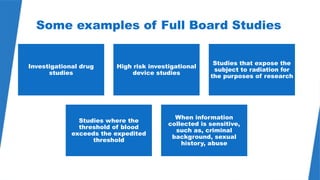
Some examples ofFull Board Studies
Investigational drug
studies
High risk investigational
device studies
Studies that expose the
subject to radiation for
the purposes of research
Studies where the
threshold of blood
exceeds the expedited
threshold
When information
collected is sensitive,
such as, criminal
background, sexual
history, abuse
50.
50
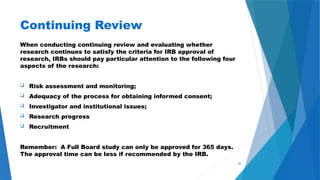
Continuing Review
When conductingcontinuing review and evaluating whether
research continues to satisfy the criteria for IRB approval of
research, IRBs should pay particular attention to the following four
aspects of the research:
Risk assessment and monitoring;
Adequacy of the process for obtaining informed consent;
Investigator and institutional issues;
Research progress
Recruitment
Remember: A Full Board study can only be approved for 365 days.
The approval time can be less if recommended by the IRB.
51.
51
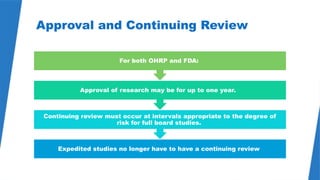
Approval and ContinuingReview
Expedited studies no longer have to have a continuing review
Continuing review must occur at intervals appropriate to the degree of
risk for full board studies.
Approval of research may be for up to one year.
For both OHRP and FDA:
52.
52
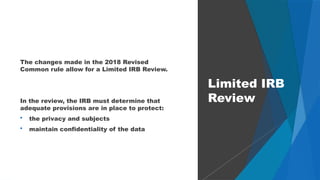
The changes madein the 2018 Revised
Common rule allow for a Limited IRB Review.
In the review, the IRB must determine that
adequate provisions are in place to protect:
the privacy and subjects
maintain confidentiality of the data
Limited IRB
Review
53.
53
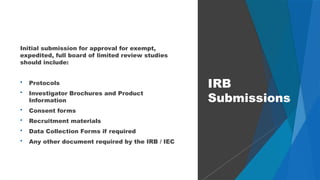
Initial submission forapproval for exempt,
expedited, full board of limited review studies
should include:
Protocols
Investigator Brochures and Product
Information
Consent forms
Recruitment materials
Data Collection Forms if required
Any other document required by the IRB / IEC
IRB
Submissions
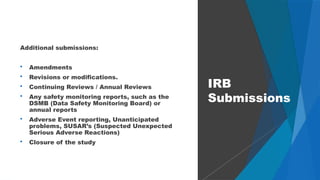
54.
54
Additional submissions:
Amendments
Revisions or modifications.
Continuing Reviews / Annual Reviews
Any safety monitoring reports, such as the
DSMB (Data Safety Monitoring Board) or
annual reports
Adverse Event reporting, Unanticipated
problems, SUSAR’s (Suspected Unexpected
Serious Adverse Reactions)
Closure of the study
IRB
Submissions
#2 An IRB is an appropriately constituted group that has been formally designated to review and monitor research involving human subjects. In accordance with federal regulations, an IRB has the authority to approve, require modifications in (to secure approval), or disapprove research. This group review serves an important role in the protection of the rights and welfare of human research subjects.
"IRB" is a generic term used by FDA (and HHS) to refer to a group whose function is to review research to assure the protection of the rights and welfare of the human subjects. Each institution may use whatever name it chooses. Regardless of the name chosen, the IRB is subject to federal IRB regulations when research is reviewed and approved.
So the Power Broker in an institution is the IRB. It is not the sole department or entity regarding research authority, but the federal regulations empower the IRB to assess, request alteration of a project or disapprove a project in order to protect human subjects.
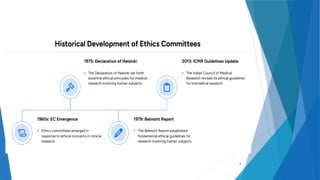
#7 The National Research Act was passed by Congress in 1974 after the unethical U.S. Public Health Service Syphilis Study at Tuskegee ended.
It also created the National Commission for the Protection of Human Subjects of Biomedical and Behavioral Research.
The Commission was tasked in identifying the basic ethical principles that should underlie the conduct of biomedical and behavioral research involving human subjects and it was tasked to develop guidelines to assure that such research is conducted in accordance with those principles.
The Commission published The Belmont Report in 1978, which sets forth basic ethical principles for the conduct of research involving human subjects. Those principles, respect for persons, beneficence, and justice.
#9 Here is A quick review of our 3rd Session when we looked broadly at OHRP and FDA regulations. OHRP regulations which stands for Office of Human Subjects Protections. Sometimes the code 45 CFR 46 is referred to as DHHS (Department of Health and Human Services or HHS (Health and Human Services) regulations.
FDA or Food and Drug Administration regulations are found at 21 CFR 50.
#10 Let’s go back a minute and examine the subparts of 45 CFR 46. A review: Subpart A is the Common Rule where scope, definitions, Exempt research regulations can be found, IRB membership and other functions, operations, and review of research. Expedited categories of research are defined here, and more items which we will discuss later in this presentation. Subpart B is for “Babies”: Pregnant Women Human Fetuses, and Neonates. Subpart C: Remember “Convicts” or protections for Prisoners……And Subpart D---remember “Dependents” for the regulations for Children.
There is a Subpart E in the regulations and it pertains to the Registration of Institutional Review Boards.
#11 In contrast, The FDA regulations at 21 CFR 50 are different. Subpart A gives general provisions such as scope and definitions. Subpart B contains the regulations regarding informed consent, Subpart C is reserved---no regulations are in the section and subpart D are the regulations governing safeguards for Children in Clinical investigations.
The regulations for Institutional Review Boards or Institutional Ethics Committee are not in this section of the FDA regs.
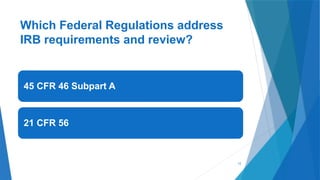
#12 So here they are---the regulations governing IRB requirements and review are 45 CFR 46 Subpart A and 21 CFR 56. The FDA regulations at 21 CFR 56 are new to us---we haven’t discussed those thus far.
#13 OHRP and FDA membership requirements are the same. Know this information. There will most likely be questions on the exam about this subject.
Each IRB shall have at least five members, with varying backgrounds to promote complete and adequate review of research activities commonly conducted by the institution. So varying backgrounds may mean ministers, teachers, rabbis, attorneys, etc.
Each IRB shall include at least one member whose primary concerns are in scientific areas and at least one member whose primary concerns are in nonscientific areas. So what would that look like---a nurse (scientific background) and an attorney (non scientific member).
Each IRB shall include at least one member who is not otherwise affiliated with the institution and who is not part of the immediate family of a person who is affiliated with the institution. So---a community advocate of some type---maybe, Director of the YMCA would fulfill that role or maybe, a person who has been in a research study or has had a family member who has participated in a research study would be good candidates.
No IRB may have a member participate in the IRB’s initial or continuing review of any project in which the member has a conflicting interest, except to provide information requested by the IRB. So if you have an IRB member who is also a researcher (and you want experienced researchers on your committee) and his or her protocol is up for review at a meeting, that person has to recuse themselves and exit the meeting when that study is being discussed. Prior to exiting the discussion, he or she could answer any questions that the committee may have regarding that study.
Lastly, an IRB may, at its discretion, invite individuals with competence in special areas to assist in the review of issues that require expertise beyond or in addition to that available on the IRB. These individuals may not vote with the IRB. An example of this would be---if you had a study that involved pancreatic cancer and you had no on your committee that could review this protocol with an in-depth understanding of the risks for the subjects, then the IRB could ask for an outside consultant to review the research and provide an opinion. However, that consultant would not be allowed to vote on whether the study was approved or not.
#15 When is IRB Review Required?
OHRP
All research involving human subjects conducted or supported by HHS or conducted in an institution that agrees to assume responsibility for the research in accordance with 45 CFR 46 regardless of the source of funding. I think that most of the persons attending this class are at institutions where that is the case.
FDA
IRBs that review clinical investigations regulated by the FDA under sections of the Food and Drug Cosmetic Act, as well as. clinical investigations that support applications for research or marketing permits for products regulated by the FDA.
#16 Here is what the IRB has to look at for each study that is approved----the criteria.
1. Risks to subjects are minimized. This the Belmont principle of Beneficence---that the Benefits outweigh the Risks. That is the Definition of the Benefit to Risk Ratio. I used to think it was some kind of numerical ratio. Not so---just do the benefits of participating in the study outweigh the risks.
2. Risks to subjects are reasonable in relation to anticipated benefits, if any, to subjects, and the importance of the knowledge that may reasonably be expected to result. In evaluating risks and benefits, the IRB should consider only those risks and benefits that may result from the research (as distinguished from risks and benefits of therapies subjects would receive even if not participating in the research). Again the Belmont principle is BELMONT BENEFICENCE.
(3) Selection of subjects is equitable. In making this assessment the IRB should take into account the purposes of the research and the setting in which the research will be conducted. The IRB should be particularly cognizant of the special problems of research that involves a category of subjects who are vulnerable to coercion or undue influence, such as children, prisoners, individuals with impaired decision-making capacity, or economically or educationally disadvantaged persons.
(4) Informed consent will be sought from each prospective subject or the subject’s legally authorized representative. The is the BELMONT principle —RESPECT FOR PERSONS
Informed consent will be appropriately documented or appropriately waived.
6. When appropriate, the research plan makes adequate provision for monitoring the data collected to ensure the safety of subjects such as a SAFETY AND MONITORING PLAN, Data Monitoring Plan or use of a DSMB (Data Safety Monitoring Board-- which represents the Belmont principle of Beneficence.
#17 And More criteria.
7. When appropriate there are adequate provisions to the protect privacy and confidentiality Belmont principle of Respect for Persons
8. For purposes of conducting the limited IRB review, the IRB will review the listed determinants on this slide. We will talk about Broad consent a bit more later. Limited IRB review is a process that is required only for certain exemptions, and does not require an IRB to consider all of the IRB approval criteria. In limited IRB review, the IRB must determine that certain conditions, which are specified in the regulations, are met. And, again, the conditions are listed in this slice.
9. Additional safeguards have been included in the study to protect the rights and welfare of vulnerable subjects. For example, what additional protections will be put into place if children are included in the study. That protection might be that older children are subjects in the first part of the study, then the inclusion of younger and then younger and then younger subjects are included as time shows that the drug is safe for use in the older previous group.
#18 Along with the revised common rule in 2018—that went into effect in 2020) also came sweeping reform regarding IRB review. Prior to this revision, a study that had multiple sites would have multiple IRB reviews (each site would have to get their own IRB approval). In that 2018 reform, all studies receiving federal funding are required to have single IRB review. This review may be at one university or institution, or the single site review may occur at a commercial IRB like Western IRB or Schulmann (those are two common commercial IRB’s).
So let’s review he key points of local vs non-local IRB review---READ the Slide.
#19 So what occurs when a study has a transfer of IRB oversight? Read the slide.
#20 What is an IRB’s authority? An IRB can approve, request changes in an application (sometimes these are referred to as corrective actions or provisos). Or the study can be disapproved.
A study can undergo the scrutiny of institutional officials after approved by an IRB. An institutional official can disapprove a study if the IRB approves it (let’s say the PI is under reprimand for some kind of misconduct). However, if an IRB disapproves a study, an institutional official can not reverse that decision and approve it. This may be a test question on the exam.
#21 Let’s talk about IRB communication.
An IRB must notify investigators and the institution in writing of its decision to approve or disapprove the proposed research activity, or of modifications required to secure IRB approval of the research activity. If the IRB decides to disapprove a research activity, it will include in its written notification a statement of the reasons for its decision and give the investigator an opportunity to respond in person or in writing. This communication is in the form of “outcome letters”.
If an IRB disapproves a study, the outcome letter should state the reasons. The investigator could appeal but the IRB has the ultimate decision.
#22 An IRB has the authority to suspend or terminate approval of research that is not being conducted in accordance with the IRB’s requirements or that has been associated with unexpected serious harm to subjects.
Any suspension or termination of approval shall include a statement of the reasons for the IRB’s action and shall be reported promptly to the investigator, appropriate institutional officials, and the department or agency head, such as the funder like NIH, Department of Defense, etc.
#23
The IRB has to keep massive amounts of records.
(1) Copies of all research proposals reviewed, scientific evaluations, if any, that accompany the proposals, approved sample consent documents, progress reports submitted by investigators, and reports of injuries to subjects.
(2) Minutes of IRB meetings which shall be in sufficient detail to show attendance at the meetings; actions taken by the IRB; the vote on these actions including the number of members voting for, against, and abstaining; the basis for requiring changes in or disapproving research; and a written summary of the discussion of controversial issues and their resolution.
(3) Records of continuing review activities.
(4) Copies of all correspondence between the IRB and the investigators.
#24
More records that the IRB must keep:
(5) A list of IRB members identified by name; earned degrees; representative capacity; indications of experience such as board certifications, licenses, etc., sufficient to describe each member's chief anticipated contributions to IRB deliberations; and any employment or other relationship between each member and the institution; for example: full-time employee, part-time employee, a member of governing panel or board, stockholder, paid or unpaid consultant.
(6) Written procedures for the IRB----so Standard Operating Procedures.
7. Statements of significant new findings provided to subjects---such as adverse event notifications and reconsenting as a result of notification of adverse event notification.
#25 More Record keeping:
The records ( this is a requirement by the federal regulations) shall be retained for at least 3 years after completion of the research.
Those records shall be accessible for inspection and copying by authorized representatives such as the Food and Drug Administration. And they do ask for those during an audie.
(c) The Food and Drug Administration may refuse to consider a clinical investigation if the institution or the IRB that reviewed the investigation refuses to allow an inspection under this section.
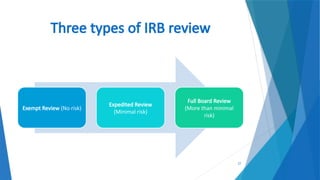
#26 There are three kinds of review for Human Subjects research: Exempt, Expedited, and Full committee or full board review.
#29 How is the review category determined?
The determination of review status is usually made by an institution’s Human Research Protection Program (HRPP) or IRB office.
In addition to applying the Common Rule’s basic protections for human subjects in research, the HRPP or IRB office also may ensure that the activity aligns with institutional policies, ethical guidelines, and other regulations and policies that might be relevant.
#30 To determine the review status of human subjects research, the reviewer must ask the following three questions, in this order:
Is the activity research according to the regulations? Does it meet the OHRP and / or FDA definitions for research. Make sure you know those definitions.
Does the research involve human subjects based on the definitions in the regulations? Make sure you know the definition of Human Subjects---both OHRP and Fda.
Is the human subjects research exempt? We will go over the exempt regulations later.
#31 The types of IRB review: Exempt, Expedited, and Full Board Review.
What is exempt research?
Low risk, research activities in which the only involvement of human subjects will be in one or more of the categories defined as exempt research. We will review those next.
The determination of an exemption has to be made by someone other than the investigator. It could be a department chair. The determination could be a person designated by the IRB (an experienced reviewer). It could be a sub-committee of the IRB. The institution will determine the procedures. Why does it have to be done by someone other than the investigator----because the investigator can’t grade his/her own paper. A person free from bias must make this determination.
#32 Exempt does not mean exempt from the federal regulations---it means exempt from IRB further review after the determination of exempt status occurs.
So when may IRB Review be Exempt?
Any investigation which commenced before 7/27/81 (before current regulations)
Emergency use of a test article, provided that such emergency use is reported to the IRB within 5 working days.
#33 We are going to read the actual Exempt research regulations now.
The first category.
Research, conducted in established or commonly accepted educational settings, that specifically involves normal educational practices that are not likely to adversely impact students’ opportunity to learn required educational content or the assessment of educators who provide instruction. This includes most research on regular and special education instructional strategies, and research on the effectiveness of or the comparison among instructional techniques, curricula, or classroom management methods.
An example of this kind of research would be an instructor who want to assess the effectiveness of a teaching method which is traditionally used.
#34 Read the slide;
An example of this kind of research would be a survey where subjects are asked their opinions about joining a research study. Sometimes focus groups would fall into this category.
#35 Read the slide.
An example of this research would be adults who are in a research study about video gaming. The PI wants to observe the affects of lighting on performance.
#36 Read number 4. An example of this research would be where a subject agrees to participate in a repository----a Collection of data or specimens in an initial research study. Down the road, an investigator wants to use this repository for research.
Number 5----I am only going to read a part of this one-----Research and demonstration projects that are conducted or supported by a federal department of agency. An example of this may be utilization of CDC data regarding COVID.
#37 (6) Taste and food quality evaluation and consumer acceptance studies if the foods are wholesome and safe.
#38 7 and 8 pertain to secondary research (Secondary research means the use of data or biospecimens collected from a previously approved study). Broad consent is when a subjects gives permission for the information or specimen to be used in the future and understands how it will be used.
#40 This brings our discussion to the definition of minimal risk.
45 CFR 46 and 21 CFR 56 Definitions are the same for minimal risk.
Minimal risk means that the probability and magnitude of harm or discomfort anticipated in the research are not greater in and of themselves than those ordinarily encountered in daily life or during the performance of routine physical or psychological examinations or tests.
#41 Again---we have to read the regulations.
Clinical studies of drugs and medical devices only when condition (a) or (b) is met.
A or b is when a New drug application or and investigational device application is not required. So the drug or device that is being studied is already FDA approved.
#42 The 2nd category of expedited review pertains to blood collection.
Read the slide.
#44 Read number 7: An example of this kind of study would possibly be a weight loss study where the food intake and exercise done is being observed. No new intervention techniques are being used.
#45 Read the slide. This category is for Full Board studies that are in the last phases (such as data collection of long term follow-up, data analysis. Or possibly when there have been no subjects enrolled in a study.
#48 Let’s go back to our definition of Minimal Risk. Read the minimal risk definition.
#50 A full board study can only be approved for one year (365 days). So when the study is up for continuing review or reapproval, the IRB needs to review the following: Risk assessment and monitoring;
Adequacy of the process for obtaining informed consent; Investigator and institutional issues; Research progress; Recruitment
#51 Just to emphasize because this may be a test question. Read the slide.
#52 Let’s talk about Limited IRB review.
The revision to the Common rule in 2018 allows for a Limited IRB Review. Different institutions will have different procedures for how this occurs. The main review points are that provisions are in place to protect the privacy and subjects. Data must be maintained in a confidential manner.
#53 What do you have to include in your IRB submissions:
Read the slide.
#54 There are additional submissions that will occur after the initial submission for IRB approval. They include: Read the slide.