Haematinics
Dr. Nikhilkumar S Sakle
Assistant Professor
Department of Pharmacology
Y. B. Chavan College of pharmacy, Aurangabad
1
• These are substances required in the formation of blood, and
are used for treatment of anaemias
2
Deficiency
• IRON
• Folic Acid
• Vitamin B12 (Cynocobalamin)
3
IRON
• Total body iron in an adult is 2.5–5 g (average 3.5 g).
• It is more in men (50 mg/kg) than in women (38 mg/kg).
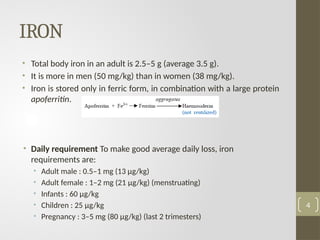
• Iron is stored only in ferric form, in combination with a large protein
apoferritin.
• Daily requirement To make good average daily loss, iron
requirements are:
• Adult male : 0.5–1 mg (13 μg/kg)
• Adult female : 1–2 mg (21 μg/kg) (menstruating)
• Infants : 60 μg/kg
• Children : 25 μg/kg
• Pregnancy : 3–5 mg (80 μg/kg) (last 2 trimesters)
4
Dietary sources of iron
• Rich : Liver, egg yolk, oyster, dry beans, dry fruits, wheat germ,
yeast.
• Medium : Meat, chicken, fish, spinach, banana, apple.
• Poor : Milk and its products, root vegetables.
5
Intestinal absorption, transport, utilization
and storage of iron
6
Factors facilitating iron
absorption
• 1. Acid: by favouring dissolution and reduction of ferric iron.
• 2. Reducing substances: ascorbic acid, amino acids containing
SH radical. These agents reduce ferric iron and form
absorbable complexes.
• 3. Meat: by increasing HCl secretion and providing haeme
iron.
7
Factors impeding iron
absorption
• 1. Alkalies (antacids) render iron insoluble, oppose its
reduction.
• 2. Phosphates (rich in egg yolk)
• 3. Phytates (in maize, wheat)
• 4. Tetracyclines
• 5. Presence of other foods in the stomach.
8
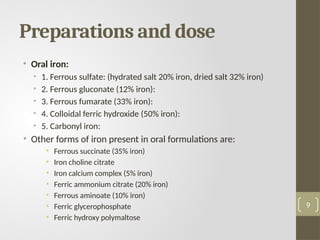
Preparations and dose
• Oral iron:
• 1. Ferrous sulfate: (hydrated salt 20% iron, dried salt 32% iron)
• 2. Ferrous gluconate (12% iron):
• 3. Ferrous fumarate (33% iron):
• 4. Colloidal ferric hydroxide (50% iron):
• 5. Carbonyl iron:
• Other forms of iron present in oral formulations are:
• Ferrous succinate (35% iron)
• Iron choline citrate
• Iron calcium complex (5% iron)
• Ferric ammonium citrate (20% iron)
• Ferrous aminoate (10% iron)
• Ferric glycerophosphate
• Ferric hydroxy polymaltose
9
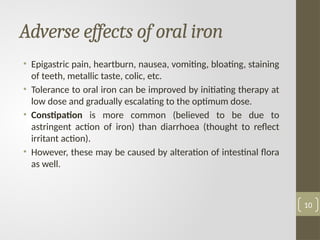
Adverse effects of oral iron
• Epigastric pain, heartburn, nausea, vomiting, bloating, staining
of teeth, metallic taste, colic, etc.
• Tolerance to oral iron can be improved by initiating therapy at
low dose and gradually escalating to the optimum dose.
• Constipation is more common (believed to be due to
astringent action of iron) than diarrhoea (thought to reflect
irritant action).
• However, these may be caused by alteration of intestinal flora
as well.
10
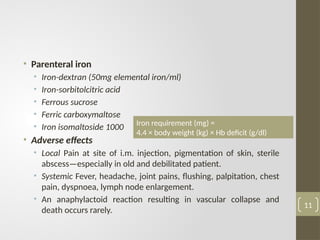
• Parenteral iron
• Iron-dextran (50mg elemental iron/ml)
• Iron-sorbitolcitric acid
• Ferrous sucrose
• Ferric carboxymaltose
• Iron isomaltoside 1000
• Adverse effects
• Local Pain at site of i.m. injection, pigmentation of skin, sterile
abscess—especially in old and debilitated patient.
• Systemic Fever, headache, joint pains, flushing, palpitation, chest
pain, dyspnoea, lymph node enlargement.
• An anaphylactoid reaction resulting in vascular collapse and
death occurs rarely.
11
Iron requirement (mg) =
4.4 × body weight (kg) × Hb deficit (g/dl)
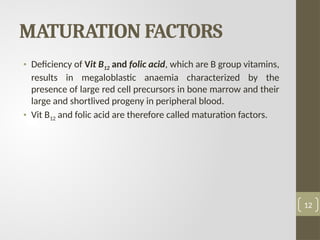
MATURATION FACTORS
• Deficiency of Vit B12 and folic acid, which are B group vitamins,
results in megaloblastic anaemia characterized by the
presence of large red cell precursors in bone marrow and their
large and shortlived progeny in peripheral blood.
• Vit B12 and folic acid are therefore called maturation factors.
12
Vitamin B12 (Cynocobalamin)
• Cyanocobalamin and hydroxocobalamin are complex cobalt
containing compounds present in the diet and referred to as
Vit B12.
13
Dietary sources
• Liver, kidney, sea fish, egg yolk, meat, cheese are the main vit
B12 containing constituents of diet.
• The only vegetable source is legumes (pulses) which get it
from microorganisms harboured in their root nodules.
• Vit B12 is synthesized by the colonic microflora, but this is not
available for absorption in man. The commercial source is
Streptomyces griseus; as a byproduct of streptomycin industry.
• Daily requirement 1–3 μg, pregnancy and lactation 3–5 μg.
14
Deficiency
• Vit B12 deficiency occurs due to:
• 1. Addisonian pernicious anaemia: is an autoimmune disorder
which results in destruction of gastric parietal cells → absence of
intrinsic factor in gastric juice (along with achlorhydria) → inability
to absorb Vit B12.It is rare in India.
• 2. Other causes of gastric mucosal damage, e.g. chronic gastritis,
gastric carcinoma, gastrectomy, etc.
• 3. Malabsorption (damaged intestinal mucosa), bowel resection,
inflammatory bowel disease.
• 4. Consumption of Vit B12 by abnormal flora in intestine (blind loop
syndrome) or fish tape worm.
• 5. Nutritional deficiency: is a less common cause; may occur in
strict vegetarians.
• 6. Increased demand: pregnancy, infancy.
15
Manifestations of deficiency are:
• (a) Megaloblastic anaemia (generally the first manifestation),
neutrophils with hypersegmented nuclei, giant platelets.
• (b) Glossitis, g.i. disturbances: damage to epithelial structures.
• (c) Neurological: subacute combined degeneration of spinal
cord; peripheral neuritis—diminished vibration and position
sense, paresthesias, depressed stretch reflexes; mental
changes—poor memory, mood changes, hallucinations, etc.
are late effects.
16
Preparations, dose,
administration
• Cyanocobalamin: 35 μg/5 ml liq.
• Hydroxocobalamin: 500 μg, 1000 μg inj.
• Methylcobalamin (methyl B12)
• Adverse effects
• Even large doses of vit B12 are quite safe. Allergic reactions
have occurred on injection, probably due to contaminants.
Anaphylactoid reactions (probably to sulfite contained in the
formulation) have occurred on i.v. injection: this route should
never be employed.
17
Uses
• 1. Treatment of vit B12 deficiency:
• 2. Prophylaxis: needs to be given only when there are definite
predisposing factors for development of deficiency (see
above).
• 3. Mega doses of vit B12 have been used in neuropathies,
psychiatric disorders, cutaneous sarcoid and as a general tonic
to allay fatigue, improve growth—value is questionable.
• 4. Tobacco amblyopia: hydroxocobalamin is of some benefit—
it probably traps cyanide derived from tobacco to form
cyanocobalamin.
18
Folic Acid
• It occurs as yellow crystals which are insoluble in water, but its
sodium salt is freely water soluble.
• Dietary sources:
• Liver, green leafy vegetables (spinach), egg, meat, milk. It is
synthesized by gut flora, but this is largely unavailable for
absorption.
• Daily requirement:
• an adult is < 0.1 mg but dietary allowance of 0.2 mg/day is
recommended. During pregnancy, lactation or any condition of
high metabolic activity, 0.8 mg/day is considered appropriate
19
Metabolic functions
• Folic acid is inactive as such and is reduced to the coenzyme
form in two steps: FA → DHFA → THFA by folate reductase
(FRase) and dihydrofolate reductase (DHFRase).
• THFA mediates a number of reactions by carrying a methyl
group as an adduct
• 1. Conversion of homocysteine to methionine:
• 2. Generation of thymidylate, an essential constituent of DNA:
• 3. Conversion of serine to glycine:
• 4. Purine synthesis:
• 5. Generation and utilization of ‘formate pool’.
• 6. Histidine metabolism:
20
Deficiency
• Folate deficiency occurs due to:
• (a) Inadequate dietary intake
• (b) Malabsorption:
• (c) Biliary fistula; bile containing folate for recirculation is drained.
• (d) Chronic alcoholism:
• (e) Increased demand:
• (f) Drug induced:
21
Preparations and dose
• Folic acid:
• FOLVITE, FOLITAB 5 mg tab; Liquid oral preparations and
injectables are available only in combination formulation (see
Tables 43-1 and 67-2). Oral therapy is adequate except when
malabsorption is present or in severely ill patient—given i.m.
• Dose: therapeutic 2 to 5 mg/day, prophylactic 0.5 mg/day.
• Folinic acid:
22
Uses
• 1. Megaloblastic anaemias:
• 2. Prophylaxis:
• 3. Methotrexate toxicity:
• 4. Citrovorum factor rescue:
• 5. To enhance anticancer efficacy of 5-fluorouracil (5-FU):
23
ERYTHROPOIETIN
• Erythropoietin (EPO) is a sialoglycoprotein hormone (MW
34000) produced by peritubular cells of the kidney that is
essential for normal erythropoiesis.
• Anaemia and hypoxia are sensed by kidney cells and induce
rapid secretion of EPO → acts on erythroid marrow and:
• (a) Stimulates proliferation of colony forming cells of the
erythroid series.
• (b) Induces haemoglobin formation and erythroblast maturation.
• (c) Releases reticulocytes in the circulation.
24
• The recombinant human erythropoietin (Epoetin α, β) is
administered by i.v. or s.c. injection and has a plasma t½ of 6–
10 hr, but action lasts several days.
25