Comprehensive Overview of Haematinics and Anaemia Management
2.
HAEMATINICS
Haematinics or haematinicagents are those substances
which are required for the formation of blood.
They are essential for the treatment of anaemia.
Essential Haematinics
Iron
Vitamin B₁₂
Folic Acid
ANAEMIA
Anaemia is a condition in which there is a low blood level,
mainly due to a decrease in blood or a deficiency of factors
required for normal red blood cell formation.
3.
Reasons Behind Anaemia
1.Blood Loss
Blood loss may be: Acute & Chronic
Examples:
Trauma
Haemorrhage
2. Defects in RBC Formation
Anaemia may occur due to a defect in the formation of red blood cells.
3. Deficiency of Essential Factors
Deficiency of essential factors such as:
Iron
Vitamin B₁₂
Folic acid
may result in anaemia.
4.
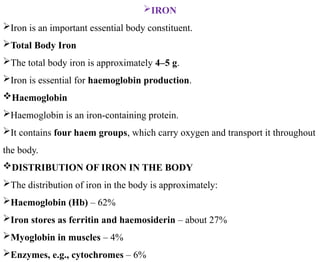
IRON
Iron is animportant essential body constituent.
Total Body Iron
The total body iron is approximately 4–5 g.
Iron is essential for haemoglobin production.
Haemoglobin
Haemoglobin is an iron-containing protein.
It contains four haem groups, which carry oxygen and transport it throughout
the body.
DISTRIBUTION OF IRON IN THE BODY
The distribution of iron in the body is approximately:
Haemoglobin (Hb) – 62%
Iron stores as ferritin and haemosiderin – about 27%
Myoglobin in muscles – 4%
Enzymes, e.g., cytochromes – 6%
5.
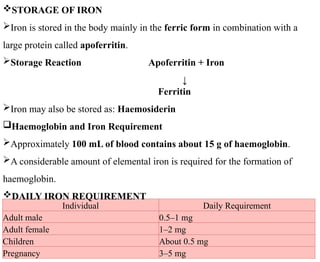
Individual Daily Requirement
Adultmale 0.5–1 mg
Adult female 1–2 mg
Children About 0.5 mg
Pregnancy 3–5 mg
STORAGE OF IRON
Iron is stored in the body mainly in the ferric form in combination with a
large protein called apoferritin.
Storage Reaction Apoferritin + Iron
↓
Ferritin
Iron may also be stored as: Haemosiderin
Haemoglobin and Iron Requirement
Approximately 100 mL of blood contains about 15 g of haemoglobin.
A considerable amount of elemental iron is required for the formation of
haemoglobin.
DAILY IRON REQUIREMENT
6.
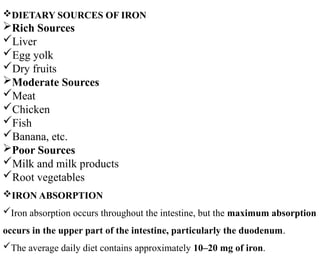
DIETARY SOURCES OFIRON
Rich Sources
Liver
Egg yolk
Dry fruits
Moderate Sources
Meat
Chicken
Fish
Banana, etc.
Poor Sources
Milk and milk products
Root vegetables
IRON ABSORPTION
Iron absorption occurs throughout the intestine, but the maximum absorption
occurs in the upper part of the intestine, particularly the duodenum.
The average daily diet contains approximately 10–20 mg of iron.
7.
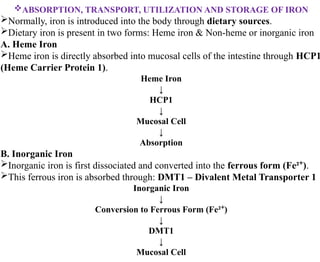
ABSORPTION, TRANSPORT, UTILIZATIONAND STORAGE OF IRON
Normally, iron is introduced into the body through dietary sources.
Dietary iron is present in two forms: Heme iron & Non-heme or inorganic iron
A. Heme Iron
Heme iron is directly absorbed into mucosal cells of the intestine through HCP1
(Heme Carrier Protein 1).
Heme Iron
↓
HCP1
↓
Mucosal Cell
↓
Absorption
B. Inorganic Iron
Inorganic iron is first dissociated and converted into the ferrous form (Fe² )
⁺ .
This ferrous iron is absorbed through: DMT1 – Divalent Metal Transporter 1
Inorganic Iron
↓
Conversion to Ferrous Form (Fe² )
⁺
↓
DMT1
↓
Mucosal Cell
8.
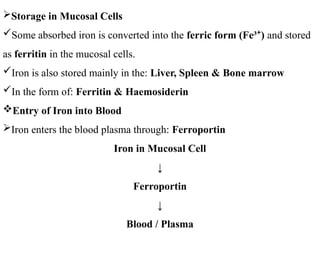
Storage in MucosalCells
Some absorbed iron is converted into the ferric form (Fe³ )
⁺ and stored
as ferritin in the mucosal cells.
Iron is also stored mainly in the: Liver, Spleen & Bone marrow
In the form of: Ferritin & Haemosiderin
Entry of Iron into Blood
Iron enters the blood plasma through: Ferroportin
Iron in Mucosal Cell
↓
Ferroportin
↓
Blood / Plasma
9.
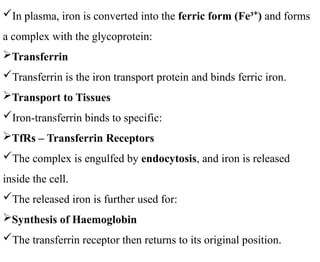
In plasma, ironis converted into the ferric form (Fe³ )
⁺ and forms
a complex with the glycoprotein:
Transferrin
Transferrin is the iron transport protein and binds ferric iron.
Transport to Tissues
Iron-transferrin binds to specific:
TfRs – Transferrin Receptors
The complex is engulfed by endocytosis, and iron is released
inside the cell.
The released iron is further used for:
Synthesis of Haemoglobin
The transferrin receptor then returns to its original position.
10.
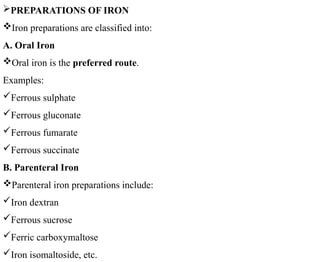
PREPARATIONS OF IRON
Ironpreparations are classified into:
A. Oral Iron
Oral iron is the preferred route.
Examples:
Ferrous sulphate
Ferrous gluconate
Ferrous fumarate
Ferrous succinate
B. Parenteral Iron
Parenteral iron preparations include:
Iron dextran
Ferrous sucrose
Ferric carboxymaltose
Iron isomaltoside, etc.
11.
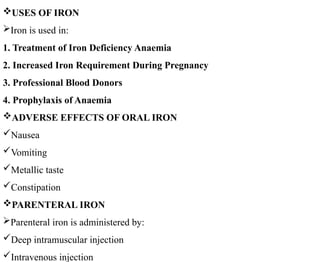
USES OF IRON
Ironis used in:
1. Treatment of Iron Deficiency Anaemia
2. Increased Iron Requirement During Pregnancy
3. Professional Blood Donors
4. Prophylaxis of Anaemia
ADVERSE EFFECTS OF ORAL IRON
Nausea
Vomiting
Metallic taste
Constipation
PARENTERAL IRON
Parenteral iron is administered by:
Deep intramuscular injection
Intravenous injection
12.
Indications
Parenteral iron maybe given when:
The patient is unable to absorb oral iron
There is severe iron deficiency
There is chronic bleeding
Oral iron is not tolerated
Adverse Effects
Headache
Joint pain
Palpitations
Nausea
Pain at the injection site
Pigmentation or skin discoloration
13.
IRON POISONING
Iron poisoningmay occur due to an overdose of iron.
It is most commonly seen in: Infants & Young children
Symptoms
Vomiting
Abdominal pain
Diarrhoea
Drowsiness, etc.
Treatment
1. Gastric Lavage
Gastric lavage may be performed with sodium bicarbonate
2. Antidote
Desferrioxamine acts by binding iron and reducing its toxic effects.
ABSORPTION OF VITAMINB₁₂
Vitamin B is absorbed in the intestine with the help of:
₁₂
Intrinsic Factor
Intrinsic factor is produced by the parietal cells of the stomach.
After absorption, vitamin B is transported into the blood by:
₁₂
Transcobalamin
It is then transported to:
Liver
Erythropoietic tissues
FUNCTIONS OF VITAMIN B₁₂
Vitamin B is essential for:
₁₂
Normal DNA synthesis
Normal maturation and production of red blood cells
Vitamin B is involved in the conversion of methyl-tetrahydrofolic acid into
₁₂
tetrahydrofolic acid, which subsequently participates in DNA synthesis.
16.
CAUSES OF VITAMINB DEFICIENCY
₁₂
Vitamin B deficiency may occur due to:
₁₂
Chronic gastritis
Gastric mucosal damage
Nutritional deficiency
Increased demand during pregnancy
PREPARATIONS OF VITAMIN B₁₂
Vitamin B may be administered through:
₁₂
Intramuscular injection
Subcutaneous injection
Preparations include:
Cyanocobalamin
Hydroxocobalamin
17.
FOLIC ACID
Folic acidis also known chemically as: Pteroyl Glutamic Acid (PGA)
It consists of:
Pteridine
Para-aminobenzoic acid (PABA)
Glutamic acid
SOURCES OF FOLIC ACID
Liver
Green vegetables
DAILY REQUIREMENT OF FOLIC ACID
The daily requirement is approximately: 0.2 mg/day
ABSORPTION OF FOLIC ACID
Folic acid is absorbed mainly through: Duodenum & Jejunum
18.
FUNCTION OF FOLICACID
Folic acid is essential for: DNA Synthesis
Folic Acid
↓
Dihydrofolic Acid
↓
Tetrahydrofolic Acid
↓
DNA Synthesis
CAUSES OF FOLIC ACID DEFICIENCY
Folic acid deficiency may occur due to:
Inadequate dietary intake
Malabsorption
Increased requirements
Drug-induced deficiency
Examples of drugs causing deficiency: Phenytoin & Phenobarbitone.
19.
PREPARATIONS OF FOLICACID
Folic acid
Folinic acid
USES OF FOLIC ACID
Treatment of megaloblastic anaemia
Folic acid deficiency
During pregnancy
During lactation
During growth in infants
ERYTHROPOIETIN (EPO)
Erythropoietin is a hormone secreted by the peritubular cells of the kidney.
It stimulates the bone marrow and increases the production of:
Red Blood Cells (RBCs)
It also helps in the survival and protection of RBCs.
20.
Erythropoietin Secretion
Anaemia /Hypoxia
↓
Kidney
↓
Release of EPO
↓
Stimulation of Bone Marrow
↓
Increased RBC Production
USES OF ERYTHROPOIETIN
Chronic renal failure
Acute renal conditions, as mentioned in the notes
Zidovudine-induced anaemia in AIDS patients
ADVERSE EFFECTS OF ERYTHROPOIETIN
Sudden increase in haematocrit
Increased blood viscosity
Hypertensive episodes
 Most read
 Most read
 Most read