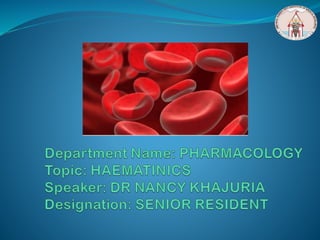
Comprehensive Overview of Haematinics and Anaemia Management
Detailed insights into haematinics, types of anaemia, iron metabolism, vitamin B12 and B9 roles, erythropoietin function, and treatment approaches for anaemia.
• HAEMATINICS aresubstances required in the
formation of blood, and are used for treatment of
anaemias.
• Anaemia occurs when the balance between
production and destruction of RBCs is disturbed by:
(a) Blood loss (acute or chronic)
3
INTRODUCTION
4.
Cont
(b) Impaired redcell formation due to:
• Deficiency of essential factors, i.e. iron, vitamin B12
& folic acid.
• Bone marrow depression (hypoplastic
anaemia), erythropoietin deficiency.
(c) Increased destruction of RBCs (haemolytic
anaemia)
4
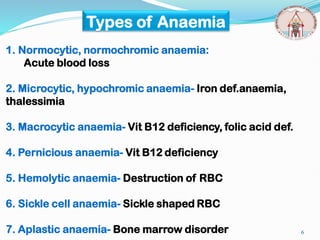
1. Normocytic, normochromicanaemia:
Acute blood loss
2. Microcytic, hypochromic anaemia- Iron def.anaemia,
thalessimia
3. Macrocytic anaemia- Vit B12 deficiency, folic acid def.
4. Pernicious anaemia- Vit B12 deficiency
5. Hemolytic anaemia- Destruction of RBC
6. Sickle cell anaemia- Sickle shaped RBC
7. Aplastic anaemia- Bone marrow disorder 6
Types of Anaemia
7.
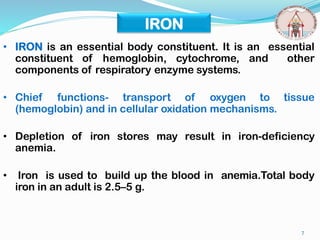
• IRON isan essential body constituent. It is an essential
constituent of hemoglobin, cytochrome, and other
components of respiratory enzyme systems.
• Chief functions- transport of oxygen to tissue
(hemoglobin) and in cellular oxidation mechanisms.
• Depletion of iron stores may result in iron-deficiency
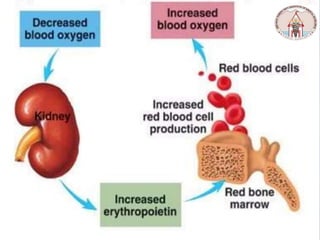
anemia.
• Iron is used to build up the blood in anemia.Total body
iron in an adult is 2.5–5 g.
7
IRON
8.
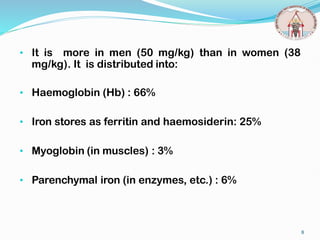
• It ismore in men (50 mg/kg) than in women (38
mg/kg). It is distributed into:
• Haemoglobin (Hb) : 66%
• Iron stores as ferritin and haemosiderin: 25%
• Myoglobin (in muscles) : 3%
• Parenchymal iron (in enzymes, etc.) : 6%
8
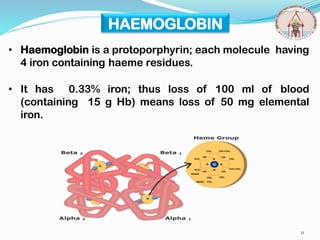
• Haemoglobin isa protoporphyrin; each molecule having
4 iron containing haeme residues.
• It has 0.33% iron; thus loss of 100 ml of blood
(containing 15 g Hb) means loss of 50 mg elemental
iron.
11
HAEMOGLOBIN
12.
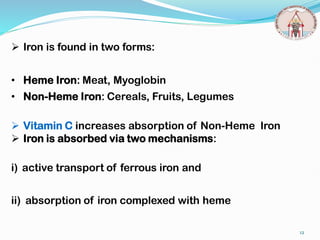
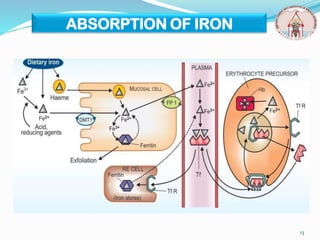
Iron isfound in two forms:
• Heme Iron: Meat, Myoglobin
• Non-Heme Iron: Cereals, Fruits, Legumes
Vitamin C increases absorption of Non-Heme Iron
Iron is absorbed via two mechanisms:
i) active transport of ferrous iron and
ii) absorption of iron complexed with heme
12
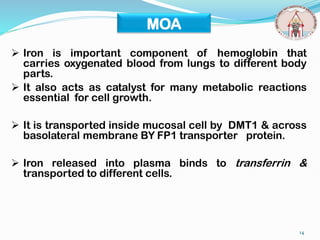
Iron isimportant component of hemoglobin that
carries oxygenated blood from lungs to different body
parts.
It also acts as catalyst for many metabolic reactions
essential for cell growth.
It is transported inside mucosal cell by DMT1 & across
basolateral membrane BY FP1 transporter protein.
Iron released into plasma binds to transferrin &
transported to different cells.
14
MOA
• The preferredroute of iron administration is oral.
• Ferrous sulfate: (hydrated salt 20% iron, dried salt 32%
iron)
• Ferrous gluconate (12% iron)
• Ferrous fumarate (33% iron)
16
ORAL IRON
17.
Dose: 200 mgelemental iron (infants and children 3–
5 mg/kg) TDS Absorption is much better in empty
stomach.
Adverse effects- Gastric Irritation, Constipation,
staining of teeth, Metallic taste
17
18.
18
Iron therapy byinjection is indicated only when:
1.Oral iron is not tolerated: bowel upset is too much.
2.Failure to absorb oral iron: inflammatory bowel disease.
3.Non-compliance to oral iron.
4.In presence of severe deficiency with chronic bleeding.
5.Along with erythropoietin.
• IRON DEXTRAN
• IRON SUCROSE, DOSE: 75mg i.m (Max 100mg i.m.)
PARENTERAL IRON
19.
ACUTE IRON POISONING
•It occurs mostly in infants and children: 10–20 iron tablets
or equivalent of the liquid preparation (> 60 mg/kg iron)
may cause serious toxicity in them.
• Manifestations are vomiting, abdominal pain,
haematemesis, diarrhoea, lethargy, cyanosis,
dehydration, acidosis, convulsions; finally shock,
cardiovascular collapse and death.
19
PARENTERAL IRON
20.
20
Toprevent further absorptionof iron from gut:
(a)Induce vomiting or perform gastric lavage
(a) Give egg yolk and milk orally: to complex iron.
To bind and remove iron already absorbed
Desferrioxamine (an iron chelating agent) is the drug of
choice.
21.
It shouldbe injected i.m. (preferably) 0.5–1 g (50
mg/kg) repeated 4–12 hourly as required, or i.v. (if
shock is present) 10–15 mg/kg/hour; max 75 mg/kg in
a day till serum iron falls below 300 μg/dl.
21
It occurs asred crystals synthesized in nature only by
microorganisms; plants and animals acquire it from
them.
• MOA: Vitamin B12 is essential constituents of the
human diet, being necessary for DNA synthesis and
consequently for cell proliferation.
23
VITAMIN B12
24.
• Vitamin B12is important in the normal functioning
of the nervous system due to its role in the synthesis
of myelin and in the maturation of developing red
blood cells in the bone marrow.
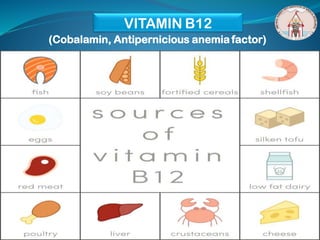
• Dietary sources Liver, kidney, sea fish, egg yolk,
meat, cheese, legumes, etc.
• Daily requirement 1–3 μg, pregnancy and lactation
3–5 μg.
24
25.
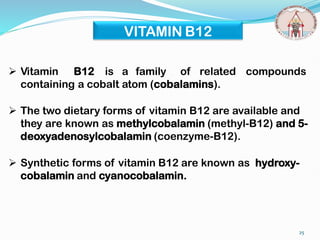
Vitamin B12is a family of related compounds
containing a cobalt atom (cobalamins).
The two dietary forms of vitamin B12 are available and
they are known as methylcobalamin (methyl-B12) and 5-
deoxyadenosylcobalamin (coenzyme-B12).
Synthetic forms of vitamin B12 are known as hydroxy-
cobalamin and cyanocobalamin.
25
VITAMIN B12
26.
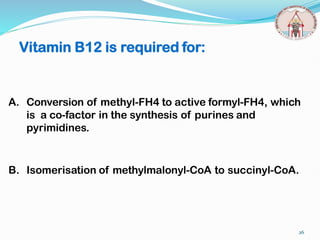
Vitamin B12 isrequired for:
26
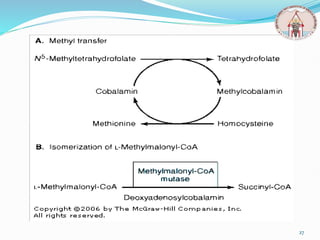
A. Conversion of methyl-FH4 to active formyl-FH4, which
is a co-factor in the synthesis of purines and
pyrimidines.
B. Isomerisation of methylmalonyl-CoA to succinyl-CoA.
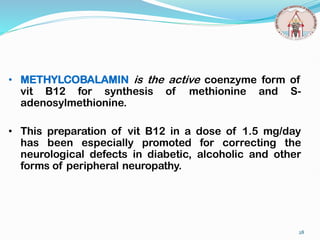
• METHYLCOBALAMIN isthe active coenzyme form of
vit B12 for synthesis of methionine and S-
adenosylmethionine.
• This preparation of vit B12 in a dose of 1.5 mg/day
has been especially promoted for correcting the
neurological defects in diabetic, alcoholic and other
forms of peripheral neuropathy.
28
29.
• Indications:
a) Megaloblasticanemia
b) Neurologic syndrome associated with
cobalamin deficiency
c) Pernicious anemia
d) Treatment of vit B12 deficiency
29
Folate deficiency occursdue to:
(a)Inadequate dietary intake
(b) Malabsorption: especially involving upper intestine—
coeliac disease, tropical sprue, regional ileitis, etc.
(c)Biliary fistula; bile containing folate for recirculation is
drained.
32
33.
(a) Chronic alcoholism:intake of folate is generally
poor.
(b) Increased demand: pregnancy, lactation, rapid
growth periods, haemolytic anaemia and other
diseases.
(c) Drug induced: prolonged therapy with
anticonvulsants (phenytoin, phenobarbitone,
primidone) and oralcontraceptives— interfere with
absorption and storage of folate.
33
34.
34
Manifestations of deficiencyare:
(i) Megaloblastic anaemia, indistinguishable from that due
to vit B12 deficiency.
(ii)Epithelial damage: glossitis, enteritis, diarrhoea,
steatorrhoea.
(iii) Neural tube defects, including spina bifida in the
offspring, due to maternal folate deficiency.
35.
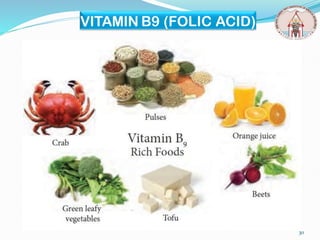
Sources : yeast, liver , green vegetables, fruits , nuts and
cereals
Daily requirements : Adult: 50 mcg/ day Pregnant
women : 100-200 mcg / day
Lactating women : 100-200 mcg / day
Dose: Therapeutic 2 to 5 mg/day, prophylactic 0.5
mg/day.
35
36.
Indications:
Treat magaloblastic anemiadue to folate deficiency
Pregnant women
Premature infants
Patients with hemolytic anemia
Methotrexate toxicity
Citrovorum factor rescue
Enhance anticancer efficacy of 5-fluorouracil
With anticonvulsant drugs
36
37.
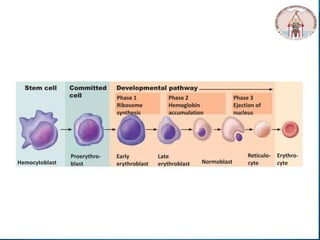
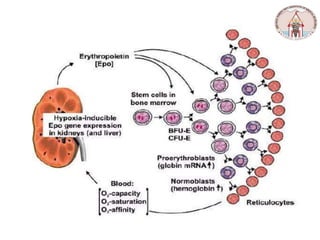
ERYTHROPOIETIN is aglycoprotein, normally made by
the kidneys, that regulates red blood cell proliferation and
differentiation in bone marrow.
(a)Stimulates proliferation of colony forming cells.
(
37
ERYTHROPOIETIN
38.
(b) Induceshaemoglobin formation &
erythroblast
maturation.
(c) Releases reticulocytes in the circulation.
The recombinant human erythropoietin (Epoetin α, β)
is administered 25–100 U/kg by i.v. or s.c. injection 3
times a week.
38
43.
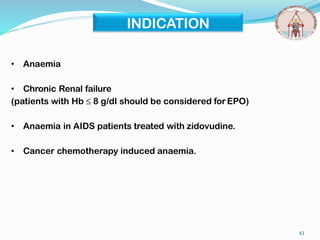
• Anaemia
• ChronicRenal failure
(patients with Hb ≤ 8 g/dl should be considered for EPO)
• Anaemia in AIDS patients treated with zidovudine.
• Cancer chemotherapy induced anaemia.
43
INDICATION
44.
44
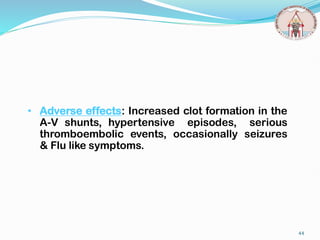
• Adverse effects:Increased clot formation in the
A-V shunts, hypertensive episodes, serious
thromboembolic events, occasionally seizures
& Flu like symptoms.