GLUCOSE HOMEOSTASIS
Prof Dr Viyatprajna Acharya MD, PhD
Medical Biochemistry
The learner will be able to:
• Definition of glucose homeostasis
• Sources of Blood Glucose
• Hormonal Regulation
• Fed vs Fasting State
• Feedback mechanisms
• Pathophysiology links
• Clinical scenarios
Specific Learning Objectives
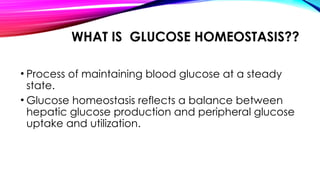
WHAT IS GLUCOSE HOMEOSTASIS??
• Process of maintaining blood glucose at a steady
state.
• Glucose homeostasis reflects a balance between
hepatic glucose production and peripheral glucose
uptake and utilization.
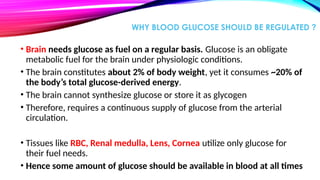
WHY BLOOD GLUCOSE SHOULD BE REGULATED ?
• Brain needs glucose as fuel on a regular basis. Glucose is an obligate
metabolic fuel for the brain under physiologic conditions.
• The brain constitutes about 2% of body weight, yet it consumes ~20% of
the body’s total glucose-derived energy.
• The brain cannot synthesize glucose or store it as glycogen
• Therefore, requires a continuous supply of glucose from the arterial
circulation.
• Tissues like RBC, Renal medulla, Lens, Cornea utilize only glucose for
their fuel needs.
• Hence some amount of glucose should be available in blood at all times
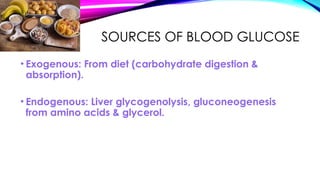
SOURCES OF BLOOD GLUCOSE
• Exogenous: From diet (carbohydrate digestion &
absorption).
• Endogenous: Liver glycogenolysis, gluconeogenesis
from amino acids & glycerol.
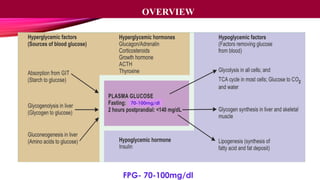
OVERVIEW
FPG- 70-100mg/dl
70-100mg/dl
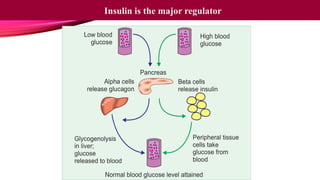
Insulin is the major regulator
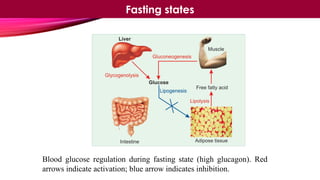
Blood glucose regulation during fasting state (high glucagon). Red
arrows indicate activation; blue arrow indicates inhibition.
Fasting states
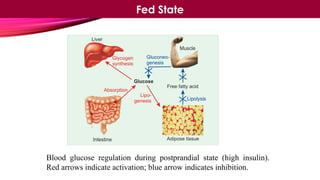
Blood glucose regulation during postprandial state (high insulin).
Red arrows indicate activation; blue arrow indicates inhibition.
Fed State
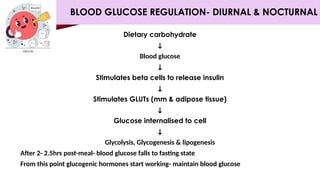
BLOOD GLUCOSE REGULATION- DIURNAL & NOCTURNAL
Dietary carbohydrate
↓
Blood glucose
↓
Stimulates beta cells to release insulin
↓
Stimulates GLUTs (mm & adipose tissue)
↓
Glucose internalised to cell
↓
Glycolysis, Glycogenesis & lipogenesis
After 2- 2.5hrs post-meal- blood glucose falls to fasting state
From this point glucogenic hormones start working- maintain blood glucose
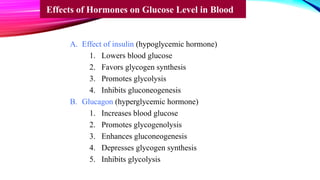
A. Effect of insulin (hypoglycemic hormone)
1. Lowers blood glucose
2. Favors glycogen synthesis
3. Promotes glycolysis
4. Inhibits gluconeogenesis
B. Glucagon (hyperglycemic hormone)
1. Increases blood glucose
2. Promotes glycogenolysis
3. Enhances gluconeogenesis
4. Depresses glycogen synthesis
5. Inhibits glycolysis
Effects of Hormones on Glucose Level in Blood
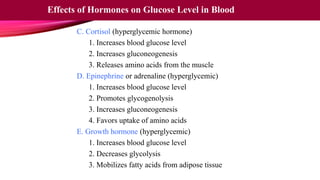
C. Cortisol (hyperglycemic hormone)
1. Increases blood glucose level
2. Increases gluconeogenesis
3. Releases amino acids from the muscle
D. Epinephrine or adrenaline (hyperglycemic)
1. Increases blood glucose level
2. Promotes glycogenolysis
3. Increases gluconeogenesis
4. Favors uptake of amino acids
E. Growth hormone (hyperglycemic)
1. Increases blood glucose level
2. Decreases glycolysis
3. Mobilizes fatty acids from adipose tissue
Effects of Hormones on Glucose Level in Blood
INSULIN
OTHER HORMONES
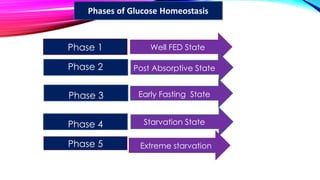
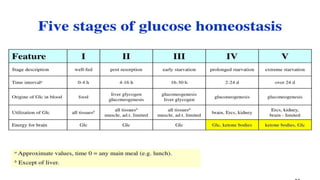
Phase 1
Phase 3
Phase 2
Phase 4
Well FED State
Post Absorptive State
Early Fasting State
Starvation State
Phase 5 Extreme starvation
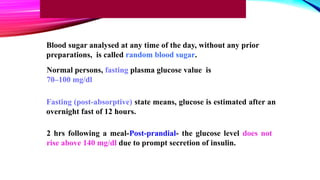
Normal persons, fasting plasma glucose value is
70–100 mg/dl
Fasting (post-absorptive) state means, glucose is estimated after an
overnight fast of 12 hours.
2 hrs following a meal-Post-prandial- the glucose level does not
rise above 140 mg/dl due to prompt secretion of insulin.
Blood sugar analysed at any time of the day, without any prior
preparations, is called random blood sugar.
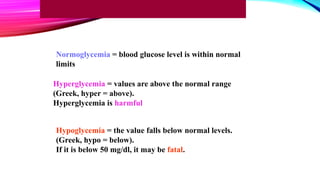
Normoglycemia = blood glucose level is within normal
limits
Hyperglycemia = values are above the normal range
(Greek, hyper = above).
Hyperglycemia is harmful
Hypoglycemia = the value falls below normal levels.
(Greek, hypo = below).
If it is below 50 mg/dl, it may be fatal.
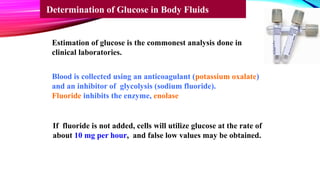
Estimation of glucose is the commonest analysis done in
clinical laboratories.
Blood is collected using an anticoagulant (potassium oxalate)
and an inhibitor of glycolysis (sodium fluoride).
Fluoride inhibits the enzyme, enolase
If fluoride is not added, cells will utilize glucose at the rate of
about 10 mg per hour, and false low values may be obtained.
Determination of Glucose in Body Fluids
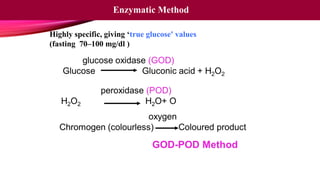
Highly specific, giving ‘true glucose' values
(fasting 70–100 mg/dl )
Enzymatic Method
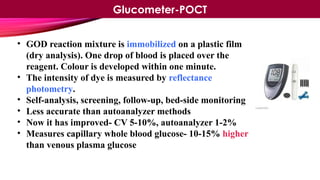
• GOD reaction mixture is immobilized on a plastic film
(dry analysis). One drop of blood is placed over the
reagent. Colour is developed within one minute.
• The intensity of dye is measured by reflectance
photometry.
• Self-analysis, screening, follow-up, bed-side monitoring
• Less accurate than autoanalyzer methods
• Now it has improved- CV 5-10%, autoanalyzer 1-2%
• Measures capillary whole blood glucose- 10-15% higher
than venous plasma glucose
Glucometer-POCT
The test done about 2 hr after a good meal is called post-
prandial (Latin, after food) blood sugar.
The ability of a person to metabolize a given load of glucose is
glucose tolerance.
Tolerating glucose
Sugar estimated in the early morning, before taking any
breakfast (12 hr fasting) is called fasting blood sugar.
• It is artificial, because in day-to-day life, such a large
quantity of glucose does not enter into blood.
• However, the GTT is well-standardised ; highly useful to
diagnose diabetes mellitus in doubtful cases.
• Indications:
a. Symptoms and signs suggestive of DM but FPG level
inconclusive (100-126mg/dl)
b. During pregnancy- excessive weight gain with h/o large baby
or miscarriage
c. To rule out benign renal glucosuria
d. Fluctuating FBS
e. PPBS lower than FBS
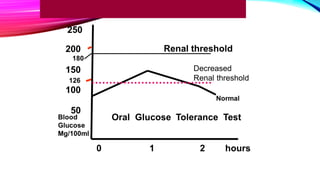
Oral Glucose Tolerance Test (OGTT)
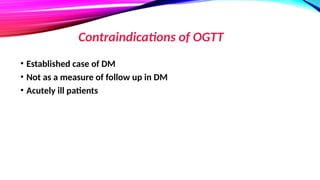
Contraindications of OGTT
• Established case of DM
• Not as a measure of follow up in DM
• Acutely ill patients
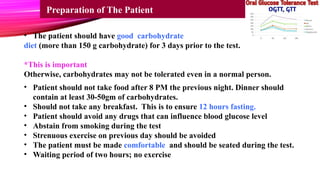
• The patient should have good carbohydrate
diet (more than 150 g carbohydrate) for 3 days prior to the test.
*This is important
Otherwise, carbohydrates may not be tolerated even in a normal person.
Preparation of The Patient
• Patient should not take food after 8 PM the previous night. Dinner should
contain at least 30-50gm of carbohydrates.
• Should not take any breakfast. This is to ensure 12 hours fasting.
• Patient should avoid any drugs that can influence blood glucose level
• Abstain from smoking during the test
• Strenuous exercise on previous day should be avoided
• The patient must be made comfortable and should be seated during the test.
• Waiting period of two hours; no exercise
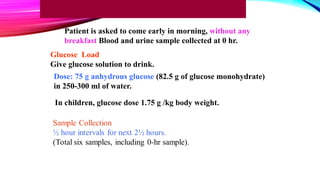
Glucose Load
Give glucose solution to drink.
Patient is asked to come early in morning, without any
breakfast Blood and urine sample collected at 0 hr.
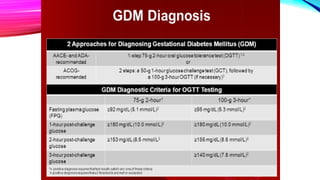
Dose: 75 g anhydrous glucose (82.5 g of glucose monohydrate)
in 250-300 ml of water.
In children, glucose dose 1.75 g /kg body weight.
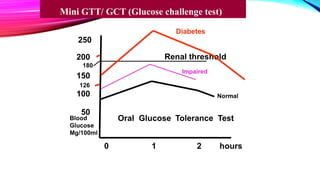
Mini GTT/ GCT (Glucose challenge test)
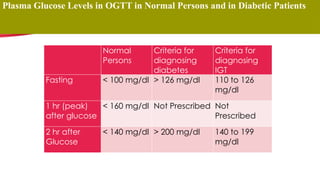
Normal
Persons
Criteria for
diagnosing
diabetes
Criteria for
diagnosing
IGT
Fasting < 100 mg/dl > 126 mg/dl 110 to 126
mg/dl
1 hr (peak)
after glucose
< 160 mg/dl Not Prescribed Not
Prescribed
2 hr after
Glucose
< 140 mg/dl > 200 mg/dl 140 to 199
mg/dl
Plasma Glucose Levels in OGTT in Normal Persons and in Diabetic Patients
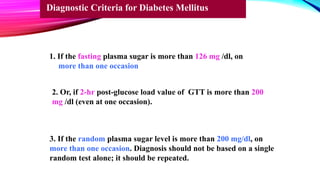
1. If the fasting plasma sugar is more than 126 mg /dl, on
more than one occasion
2. Or, if 2-hr post-glucose load value of GTT is more than 200
mg /dl (even at one occasion).
3. If the random plasma sugar level is more than 200 mg/dl, on
more than one occasion. Diagnosis should not be based on a single
random test alone; it should be repeated.
Diagnostic Criteria for Diabetes Mellitus
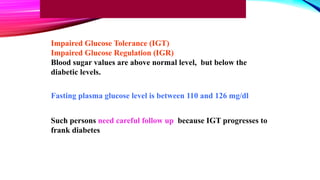
Impaired Glucose Tolerance (IGT)
Impaired Glucose Regulation (IGR)
Blood sugar values are above normal level, but below the
diabetic levels.
Fasting plasma glucose level is between 110 and 126 mg/dl
Such persons need careful follow up because IGT progresses to
frank diabetes
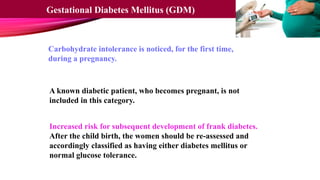
Carbohydrate intolerance is noticed, for the first time,
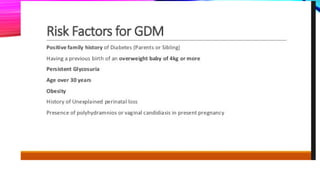
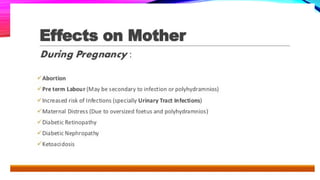
during a pregnancy.
A known diabetic patient, who becomes pregnant, is not
included in this category.
Increased risk for subsequent development of frank diabetes.
After the child birth, the women should be re-assessed and
accordingly classified as having either diabetes mellitus or
normal glucose tolerance.
Gestational Diabetes Mellitus (GDM)
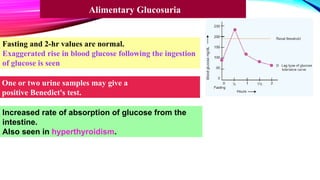
Fasting and 2-hr values are normal.
Exaggerated rise in blood glucose following the ingestion
of glucose is seen
Increased rate of absorption of glucose from the
intestine.
Also seen in hyperthyroidism.
One or two urine samples may give a
positive Benedict's test.
Alimentary Glucosuria
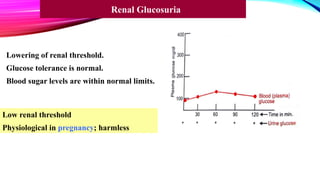
Lowering of renal threshold.
Glucose tolerance is normal.
Blood sugar levels are within normal limits.
Low renal threshold
Physiological in pregnancy; harmless
Renal Glucosuria
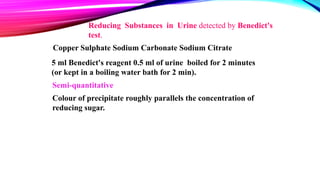
5 ml Benedict's reagent 0.5 ml of urine boiled for 2 minutes
(or kept in a boiling water bath for 2 min).
Reducing Substances in Urine detected by Benedict's
test.
Copper Sulphate Sodium Carbonate Sodium Citrate
Semi-quantitative
Colour of precipitate roughly parallels the concentration of
reducing sugar.
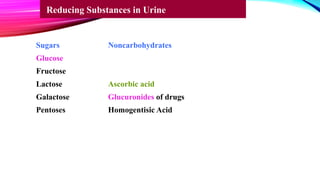
Sugars Noncarbohydrates
Glucose
Fructose
Lactose Ascorbic acid
Galactose Glucuronides of drugs
Pentoses Homogentisic Acid
Reducing Substances in Urine
Hyperglycemia is harmful; but hypoglycemia is
fatal. A fall in plasma glucose <50 mg/dL is life-
threatening.
Causes of hypoglycemia:
 Overdose of insulin: This is the most common cause.
• „Postprandial hypoglycemia: 2–3 hours after a meal,
transient hypoglycemia is seen in some persons. This is
due to oversecretion of insulin.
• „Insulinoma: Insulin secreting tumors
Hypoglycemia
Blood glucose monthly
Lipid profile once in a year
Cholesterol, LDL, HDL, Triglycerides
Micro albuminuria once in a year
Serum creatinine once in a year
Glycated Hb monthly
Laboratory Tests in Proven Diabetics
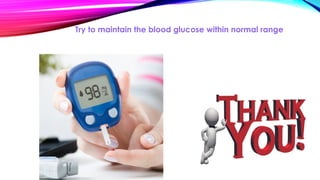
Try to maintain the blood glucose within normal range
FOR MORE PPT ON MEDICAL BIOCHEMISTRY
www.drvpacharya.com