1
FIBRINOLYTICS
(THROMBOLYTICS)
Dr. Nikhilkumar S Sakle
Assistant Professor
Department of Pharmacology
Y. B. Chavan College of Pharmacy, Aurangabad
2
 These are drugs used to lyse thrombi/clot to
recanalize occluded blood vessels (mainly
coronary artery).
 They are therapeutic rather than prophylactic
and work by activating the natural fibrinolytic
system.
3
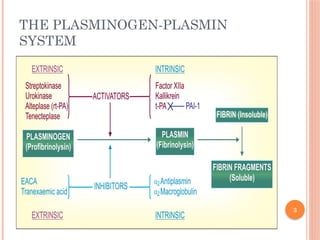
THE PLASMINOGEN-PLASMIN
SYSTEM
4
 In general, venous thrombi are lysed more easily
by fibrinolytics than arterial, and recent thrombi
respond better.
 They have little effect on thrombi > 3 days old.
 The clinically important fibrinolytics are:
 Streptokinase
 Alteplase (rt-PA)
 Urokinase
 Reteplase
 Tenecteplase
5
STREPTOKINASE (STK)
 It is obtained from β haemolytic Streptococci group
C, it is the first fibrinolytic drug to be used clinically.
 Streptokinase is inactive as such; combines with
circulating plasminogen molecules to form an activator
complex which then causes limited proteolysis of other
plasminogen molecules to generate the active enzyme
plasmin. Stk. is non-fibrin specific, i.e. activates both
circulating as well as fibrin bound plasminogen.
 For MI: 7.5–15 lac IU infused i.v. over 1 hr.
 For deep vein thrombosis and pulmonary
embolism: 2.5 lac IU loading dose over ½–1 hr,
followed by 1 lac IU/hr for 24 hr.
6
UROKINASE
 It is an enzyme isolated from human urine; but
commercially prepared from cultured human kidney cells.
 It activates plasminogen directly.
 It is nonantigenic.
 Fever occurs during treatment, but hypotension and
allergic phenomena are rare.
 Urokinase is Indicated in patients in whom streptokinase
has been given for an earlier episode, but is seldom used
now.
 For MI: 2.5 lac IU i.v. over 10 min followed by 5 lac IU over
next 60 min (stop in between if full recanalization occurs) or
6000 IU/min for upto 2 hr.
 For venous thrombosis and pulmonary embolism: 4400
IU/kg over 10 min i.v. followed by 4400 IU/kg/hr for 12 hr.
7
ALTEPLASE (RECOMBINANT
TISSUE PLASMINOGEN
ACTIVATOR (RT-PA)
 Produced by recombinant DNA technology from human
tissue culture.
 It is moderately specific for fibrin-bound plasminogen,
so that circulating fibrinogen is lowered only by ~ 50%.
 It is rapidly cleared by liver and inactivated by
plasminogen activator inhibitor-1 (PAI-1).
 The plasma t½ is 4–8 min.
 Because of the short t½, it needs to be given by slow i.v.
infusion and often requires heparin coadministration.
 It is non-antigenic, but nausea, mild hypotension and
fever may occur.
 It is expensive.
8
RETEPLASE
 It is a nonglycosylated deletion mutant of rt.PA
produced by recombinant technology in which some
amino acids of native t-PA are missing.
 This change makes it longer acting, but somewhat
less selective for fibrin bound plasminogen.
 It is cleared by both liver and kidney with an
effective t½ of 13–16 min.
 The longer action permits a double bolus i.v.
administration of 18 mg (10U) over 2 min each 30
min apart in cases of STEMI and in PE.
 Dose adjustment is needed in liver and kidney
damage.
9
TENECTEPLASE
 This genetically engineered substitution mutant of native
t-PA has higher fibrin selectivity, slower plasma
clearance (longer duration of action) and resistance to
inhibition by PAI-1.
 It is the only fibrinolytic agent that can be injected i.v. as a
single bolus dose over 10 sec, while alteplase requires 90 min
infusion and reteplase needs 2 injections at 30 min interval.
 This feature makes it possible to institute fibrinolytic
therapy immediately on diagnosis of STEMI, even during
transport of the patient to the hospital. Several randomized
multicentric trials have assessed its efficacy in STEMI and
found it to be at least equally efficacious to alteplase.
 Risk of noncerebral bleeding was found to be lower with
tenecteplase in the ASSENT-2 trial, but cranial bleeding
incidence was similar.
10
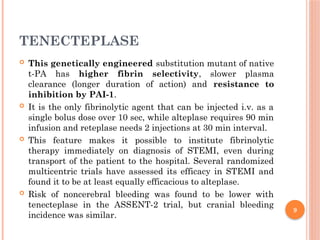
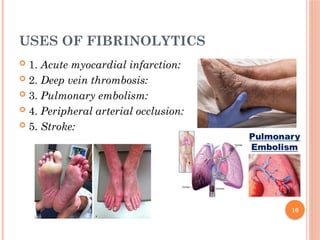
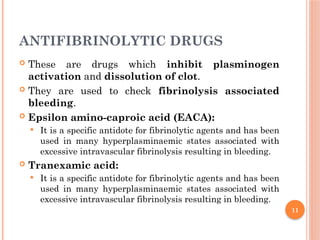
USES OF FIBRINOLYTICS
 1. Acute myocardial infarction:
 2. Deep vein thrombosis:
 3. Pulmonary embolism:
 4. Peripheral arterial occlusion:
 5. Stroke:
11
ANTIFIBRINOLYTIC DRUGS
 These are drugs which inhibit plasminogen
activation and dissolution of clot.
 They are used to check fibrinolysis associated
bleeding.
 Epsilon amino-caproic acid (EACA):
 It is a specific antidote for fibrinolytic agents and has been
used in many hyperplasminaemic states associated with
excessive intravascular fibrinolysis resulting in bleeding.
 Tranexamic acid:
 It is a specific antidote for fibrinolytic agents and has been
used in many hyperplasminaemic states associated with
excessive intravascular fibrinolysis resulting in bleeding.
12
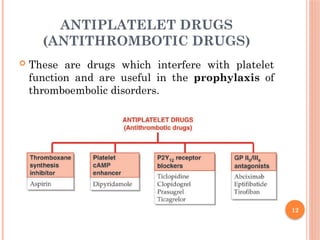
ANTIPLATELET DRUGS
(ANTITHROMBOTIC DRUGS)
 These are drugs which interfere with platelet
function and are useful in the prophylaxis of
thromboembolic disorders.
13
 Platelets express several glycoprotein (GP) integrin receptors
on their surface. Reactive proteins like collagen and von
Willebrand factor (vWF) are exposed when there is damage to
vascular endothelium, and they react respectively with platelet
GPIa and GPIb receptors. This results in platelet activation and
release of proaggregatory and vasoconstrictor mediators like
TXA2, ADP and 5-HT.
 The platelet GPIIb/ IIIa receptor undergoes a conformational
change favouring binding of fibrinogen and vWF that crosslink
platelets inducing aggregation and anchorage to vessel wall/other
surfaces. Thus, a ‘platelet plug’ is formed. In veins, due to
sluggish blood flow, a fibrinous tail is formed which traps RBCs
‘the red tail’. In arteries, platelet mass is the main constituent of
the thrombus.
 Antiplatelet drugs are, therefore, more useful in arterial
thrombosis, while anticoagulants are more effective in venous
thrombosis.
14
ASPIRIN
 It acetylates and inhibits the enzyme COX1 and
TX-synthase—inactivating them irreversibly.
 TXA2 formation is suppressed at very low doses.
 Effect of daily doses cumulates and it has now
been shown that doses as low as 40 mg/day have
an effect on platelet aggregation.
 At higher doses (> 900 mg/day) may decrease
both TXA2 and PGI2 production.
15
DIPYRIDAMOLE
 It inhibits phosphodiesterase as well as blocks
uptake of adenosine to increase platelet cAMP
which in turn potentiates PGI2 and interferes with
aggregation.
 Levels of TXA2 or PGI2, are not altered, but platelet
survival time reduced by disease is normalized.
 Dipyridamole alone has little clinically significant
effect, but improves the response to warfarin, along
with which it is used to decrease the incidence of
thromboembolism in patients with prosthetic heart
valves.
 Dipyridamole has also been used to enhance the
antiplatelet action of aspirin.
16
TICLOPIDINE
 Alters surface receptors on platelets and inhibits
ADP as well as fibrinogen-induced platelet
aggregation.
 The Gi coupled P2Y12 (also labelled P2YAC) type
of purinergic receptors- activation of platelets is
interfered. (it causes irreversible blockade of
P2Y12 receptors)
 Side effects:
 Diarrhoea, vomiting, abdominal pain, headache,
tinnitus, skin rash. Serious adverse effects are
bleeding, neutropenia, thrombocytopenia, haemolysis
and jaundice. Several fatalities have occurred
17
CLOPIDOGREL
 Congener of ticlopidine.
 Irreversibly inhibit platelet function.
 Combination of clopidogrel and aspirin is
synergistic in preventing ischaemic episodes.
 Clopidogrel is also a prodrug. - CYP2C19
 It is a slow acting drug; antiplatelet action takes
about 4 hours to start and develops over days.
18
PRASUGREL
 This is the latest, most potent and faster
acting P2Y12 purinergic receptor blocker.
19
GLYCOPROTEIN (GP) IIB/IIIA RECEPTOR
ANTAGONISTS
 Act by blocking the key receptor involved in
platelet aggregation.
 GP IIb/IIIa is an adhesive receptor (integrin) on
platelet surface.
 Abciximab It is the Fab fragment of a chimeric
monoclonal antibody
 Eptifibatide It is a synthetic cyclic peptide
 Tirofiban It is a synthetic cyclic peptide
20
USES OF ANTIPLATELET DRUGS
 1. Coronary artery disease
 2. Acute coronary syndromes (ACSs)
 3. Cerebrovascular disease
 4. Prosthetic heart valves and arteriovenous
shunts
 5. Venous thromboembolism
 6. Peripheral vascular disease