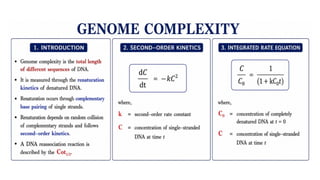
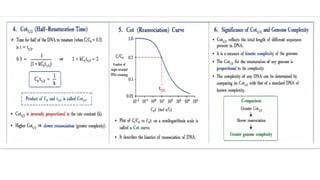
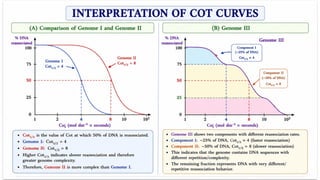
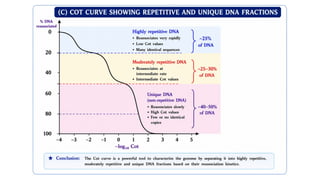
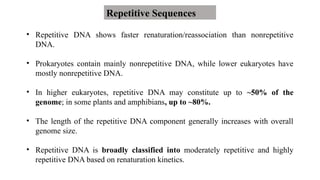
• Repetitive DNAshows faster renaturation/reassociation than nonrepetitive
DNA.
• Prokaryotes contain mainly nonrepetitive DNA, while lower eukaryotes have
mostly nonrepetitive DNA.
• In higher eukaryotes, repetitive DNA may constitute up to ~50% of the
genome; in some plants and amphibians, up to ~80%.
• The length of the repetitive DNA component generally increases with overall
genome size.
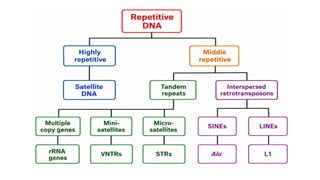
• Repetitive DNA is broadly classified into moderately repetitive and highly
repetitive DNA based on renaturation kinetics.
Repetitive Sequences
10.
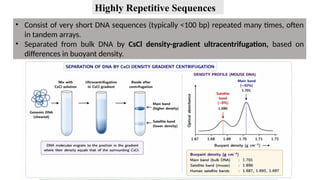
• Consist ofvery short DNA sequences (typically <100 bp) repeated many times, often
in tandem arrays.
• Separated from bulk DNA by CsCl density-gradient ultracentrifugation, based on
differences in buoyant density.
Highly Repetitive Sequences
12.
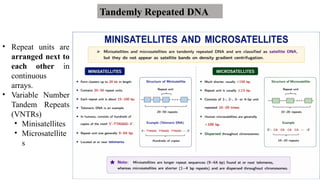
Tandemly Repeated DNA
•Repeat units are
arranged next to
each other in
continuous
arrays.
• Variable Number
Tandem Repeats
(VNTRs)
• Minisatellites
• Microsatellite
s
13.
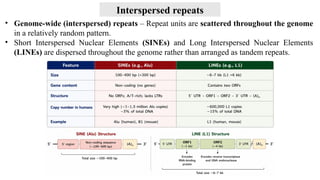
• Genome-wide (interspersed)repeats – Repeat units are scattered throughout the genome
in a relatively random pattern.
• Short Interspersed Nuclear Elements (SINEs) and Long Interspersed Nuclear Elements
(LINEs) are dispersed throughout the genome rather than arranged as tandem repeats.
Interspersed repeats
14.
Chromatin
• Complex combinationof DNA and proteins that makes up chromosomes.
• The major proteins associated with chromatin are histone proteins, although
several other chromosomal proteins also play important roles.
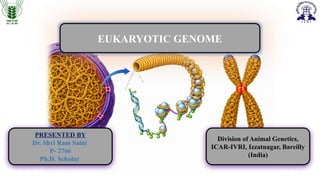
EUKARYOTIC GENOME COMPOSITION
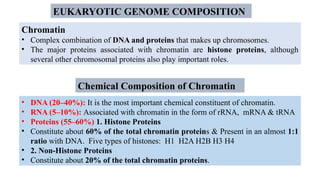
• DNA (20–40%): It is the most important chemical constituent of chromatin.
• RNA (5–10%): Associated with chromatin in the form of rRNA, mRNA & tRNA
• Proteins (55–60%) 1. Histone Proteins
• Constitute about 60% of the total chromatin proteins & Present in an almost 1:1
ratio with DNA. Five types of histones: H1 H2A H2B H3 H4
• 2. Non-Histone Proteins
• Constitute about 20% of the total chromatin proteins.
Chemical Composition of Chromatin
15.
Models of ChromatinOrganization
• Multi-strand model
• Folded fiber model
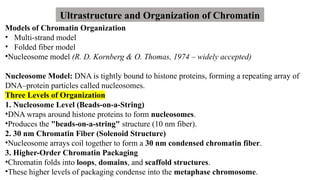
•Nucleosome model (R. D. Kornberg & O. Thomas, 1974 – widely accepted)
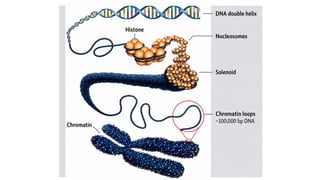
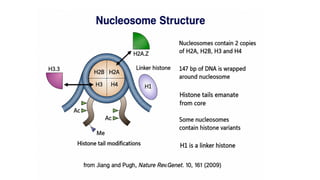
Nucleosome Model: DNA is tightly bound to histone proteins, forming a repeating array of
DNA–protein particles called nucleosomes.
Three Levels of Organization
1. Nucleosome Level (Beads-on-a-String)
•DNA wraps around histone proteins to form nucleosomes.
•Produces the "beads-on-a-string" structure (10 nm fiber).
2. 30 nm Chromatin Fiber (Solenoid Structure)
•Nucleosome arrays coil together to form a 30 nm condensed chromatin fiber.
3. Higher-Order Chromatin Packaging
•Chromatin folds into loops, domains, and scaffold structures.
•These higher levels of packaging condense into the metaphase chromosome.
Ultrastructure and Organization of Chromatin
18.
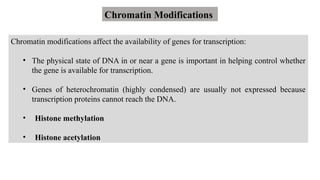
Chromatin Modifications
Chromatin modificationsaffect the availability of genes for transcription:
• The physical state of DNA in or near a gene is important in helping control whether
the gene is available for transcription.
• Genes of heterochromatin (highly condensed) are usually not expressed because
transcription proteins cannot reach the DNA.
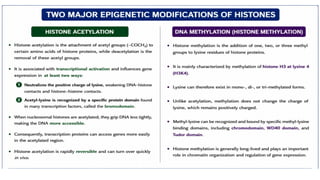
• Histone methylation
• Histone acetylation
Editor's Notes
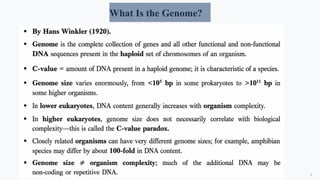
#2 It includes: Structural Genes
code for proteins or functional RNAs.
DNA segments : mRNA, tRNA, rRNA , snRNA, scRNA
Functional (Regulatory) Sequences: Control gene expression.
Include regulatory elements : Promoters, Enhancers, Operators Initiation sites, Terminators
Non-functional DNA Sequences
Include: Introns & Repetitive DNA
DNA replication Gene regulation Chromosome organization
Occupy a large portion of the eukaryotic genome.
#9 Eukaryotic chromosomes exhibit complex genome organization, characterized by the presence of repetitive DNA sequences.
Tandem repeats are sequences arranged next to each other in repeated arrays. They include multiple-copy genes such as rRNA genes, minisatellites, and microsatellites. Minisatellites are also called VNTRs, while microsatellites are commonly referred to as STRs.
In humans, Alu is a common example of a SINE, while L1, or LINE-1, is the major example of a LINE.
So, in simple terms, repetitive DNA is classified according to how frequently the sequences are repeated and whether the repeats occur together or are dispersed throughout the genome.”
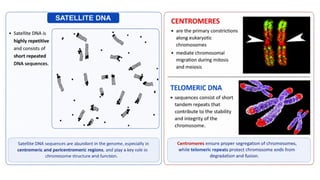
#10 Satellite DNA is generally not transcribed and is commonly found in heterochromatin, especially near centromeric regions.
Alphoid DNA is a human satellite DNA found in centromeric regions.
Buoyant density is the equilibrium density at which a DNA molecule forms a band in a CsCl density gradient.