Comprehensive Overview of Environment, Natural Resources, and Sustainable Development
Explore the interconnection between environment and life, types of natural resources, environmental challenges, conservation methods, and sustainable development goals for a greener future.
Environment and OurLife
• Interconnection: Environment affects all aspects of life; our activities also impact it.
• Dependence: Humans rely on forests, rivers, grasslands, and seas for water, fuel, and
food.
• Web of Life: All living beings form a community that sustains life.
• School Environment:
• Physical: Buildings, classrooms, library, labs, garden, playground.
• Socio cultural
‑ : Teaching climate, student activities, inclusivity, discipline, respect,
3.
Society and Environment
•People live together in villages, cities, states, and countries forming a society.
• Society interacts with the environment and also changes it.
• This interaction sometimes affects ecological balance.
• Population growth and economic activities lead to environmental destruction.
• Industrial development and intensive agriculture consume large amounts of
natural resources — water, minerals, petroleum products, wood, etc.
4.
Natural Resources
Definition: Anynatural or artificial substance, energy, or organism used by humans for welfare.
Dependence: Humans and other life forms rely on freely existing natural elements for survival.
Examples: Water, land, soil, rocks, forests, animals, fossil fuels, minerals.
Usage: Used for survival and functioning — directly or indirectly.
Direct Benefits: Forests provide food, biomass, health, recreation, and comfort.
Indirect Benefits: Regulate climate, prevent floods, protect from storms, aid nutrient cycling.
Artificial Resources: Developed by humans — biogas, thermal electricity, plastics.
Forms: Solid, liquid, or gas; organic or inorganic; metallic or non metallic.
‑
5.
Types of Resources
(i)Land Resources
• Used for production, residence, and recreation.
• A finite resource used for agricultural and non agricultural purposes (e.g.,
‑
infrastructure development).
(ii) Forest Resources
• Forests are self sustaining communities
‑ of trees.
• Provide wood for furniture, tools, bridges, boats, etc.
• Source of energy for cooking and warmth.
• Forests supply tannins, gums, drugs, spices, waxes, honey, horns, musk, ivory,
hides, etc.
(iii) Water Resources
• Cover three quarters of Earth’s surface
‑ .
• Essential for life; includes rivers, lakes, oceans, underground aquifers.
• Vital for agriculture, industry, household, recreation, and environment.
6.
(iv) Mineral Resources
•Naturally occurring deposits in Earth’s crust (solid, liquid, or gas).
• Extraction and conversion into useful materials can be profitable.
Non renewable: include
‑ : Metals: iron, copper, aluminum
Non metals :
‑ salt, gypsum, clay, sand,
phosphates
(v) Food Resources Provide food for organisms.
• Plants serve as food for herbivores and omnivores.
• Animals and birds are food sources for carnivores and omnivores.
• Agriculture is the main source of plant food for humans.
(vi) Energy Resources Produce heat, power, movement, and electricity.
Five main sources: 1. Nuclear fusion in the Sun (solar energy)
2. Gravity (Earth and Moon) 3. Nuclear fission reactions
4. Energy from Earth’s interior 5. Energy stored in chemical bonds
Most energy today comes from fossil fuels.
7.
Classification of NaturalResources
(a) Inexhaustible Resources: Cannot be exhausted by human use.
Examples: solar radiation, wind power, water power, tidal power.
(b)Exhaustible Resources: Available in limited quantities, can be depleted by continuous use.
Example: coal — limited stock may run out if overused.
(c) Renewable Resources: Constantly available or can be replaced/recovered
(e.g., water, vegetative lands).
Some take many years to form, so not all are easily renewable.
Examples: hydropower, solar, wind, geothermal energy.
(d) Non renewable Resources:
‑ Cannot be easily replaced once destroyed.
Examples: fossil fuels, minerals.
• Form naturally through processes like the rock cycle, taking thousands of years.
• Include inorganic resources from non living things — minerals, wind, land, soil, rocks.
‑
8.
Non- Renewable andRenewable Resources
Definition: Resources that cannot be easily replaced once used.
Examples: Coal: Cheap fuel used in power houses, factories, and homes.
• Petroleum: Includes petrol, diesel, mineral oils; used in vehicles and furnaces.
• LPG: Made from petroleum gas; used for cooking and vehicles.
• Natural Gas: Formed by decomposition of dead plants and animals; used as CNG.
• Nuclear Plants: Provide nuclear energy for electricity; risky if accidents occur.
• Minerals: Gold, bauxite, mica, iron ore; mining causes earth damage.
‑
Non renewable Resources
‑
9.
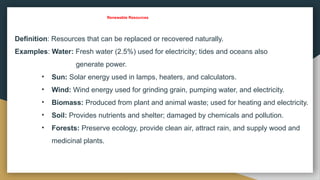
Renewable Resources
Definition: Resourcesthat can be replaced or recovered naturally.
Examples: Water: Fresh water (2.5%) used for electricity; tides and oceans also
generate power.
• Sun: Solar energy used in lamps, heaters, and calculators.
• Wind: Wind energy used for grinding grain, pumping water, and electricity.
• Biomass: Produced from plant and animal waste; used for heating and electricity.
• Soil: Provides nutrients and shelter; damaged by chemicals and pollution.
• Forests: Preserve ecology, provide clean air, attract rain, and supply wood and
medicinal plants.
10.
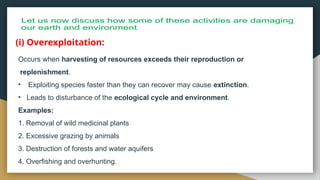
Occurs when harvestingof resources exceeds their reproduction or
replenishment.
• Exploiting species faster than they can recover may cause extinction.
• Leads to disturbance of the ecological cycle and environment.
Examples:
1. Removal of wild medicinal plants
2. Excessive grazing by animals
3. Destruction of forests and water aquifers
4. Overfishing and overhunting.
(i) Overexploitation:
11.
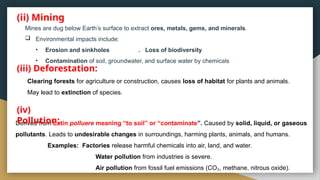
(ii) Mining
Mines aredug below Earth’s surface to extract ores, metals, gems, and minerals.
Environmental impacts include:
• Erosion and sinkholes . Loss of biodiversity
• Contamination of soil, groundwater, and surface water by chemicals
Clearing forests for agriculture or construction, causes loss of habitat for plants and animals.
May lead to extinction of species.
(iii) Deforestation:
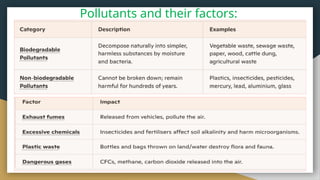
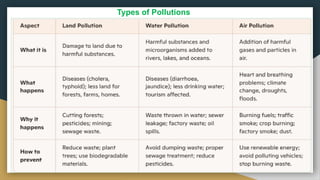
Derived from Latin polluere meaning “to soil” or “contaminate”. Caused by solid, liquid, or gaseous
pollutants. Leads to undesirable changes in surroundings, harming plants, animals, and humans.
Examples: Factories release harmful chemicals into air, land, and water.
Water pollution from industries is severe.
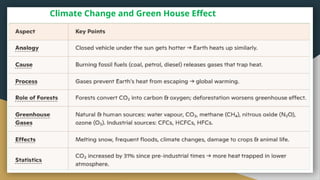
Air pollution from fossil fuel emissions (CO , methane, nitrous oxide).
₂
(iv)
Pollution:
Conserving Natural Resources(Session 2)
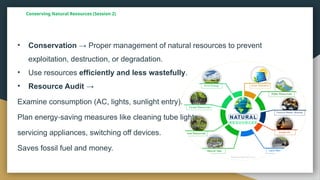
• Conservation → Proper management of natural resources to prevent
exploitation, destruction, or degradation.
• Use resources efficiently and less wastefully.
• Resource Audit →
Examine consumption (AC, lights, sunlight entry).
Plan energy saving measures like cleaning tube lights,
‑
servicing appliances, switching off devices.
Saves fossil fuel and money.
21.
Soil Conservation
• Maintainfertility → Add manure/fertilizers,
crop rotation.
• Control grazing → Allow grazing only in
specified areas.
• Reforestation → Plant trees/vegetation to
reduce erosion.
• Terracing → Divide slopes into flat fields to
control water run off.
‑
• Contour ploughing →
Plough at right angles to slope → traps water,
checks erosion.
Water Conservation
•Vegetation → Holds water in soil, recharges groundwater.
•Dams/reservoirs → Regulate water supply, generate
hydroelectricity.
•Sewage treatment → Release only clear water into
rivers.
•Industrial waste treatment → Prevent chemical/thermal
pollution.
•Judicious use → Careful daily use of water.
•Rainwater harvesting → Store rainwater, recharge
groundwater.
•Watershed management → Soil & water management
with vegetative cover.
22.
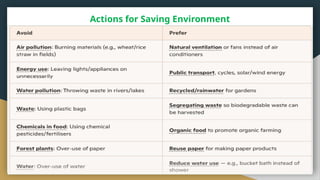
• Switch offlights, fans, TV, appliances when not in use.
• Use tube lights/energy efficient bulbs.
‑
• Keep bulbs/tubes clean → improves lighting 10–20%.
• Use pressure cooker; keep vessels covered.
• Use ACs, geysers, heaters only when necessary.
• Don’t keep refrigerator door open long.
• Prefer solar cooker/pressure cooker.
• Travel by bus or carpool instead of alone.
Energy Conservation 🔋
• Store food in
warehouses/refrigerators.
• Preserve food to prevent spoilage
by bacteria/microorganisms.
Food Conservation 🍲
🌳 Forest Conservation
• Retain existing forests or create new ones.
• Community participation is essential for
success
23.
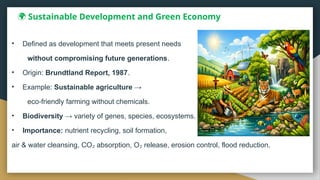
🌍 Sustainable Developmentand Green Economy
• Defined as development that meets present needs
without compromising future generations.
• Origin: Brundtland Report, 1987.
• Example: Sustainable agriculture →
eco friendly farming without chemicals.
‑
• Biodiversity → variety of genes, species, ecosystems.
• Importance: nutrient recycling, soil formation,
air & water cleansing, CO absorption, O release, erosion control, flood reduction.
₂ ₂
24.
Features of Sustainable
Development:
•Reduce excessive resource use.
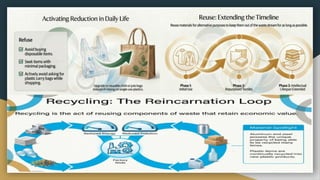
• Recycle and reuse waste.
• Scientific management of renewable resources.
• Plant more trees, add green patches.
• Use biodegradable materials.
• Adopt eco friendly technologies.
‑
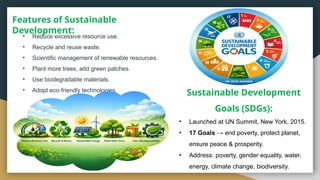
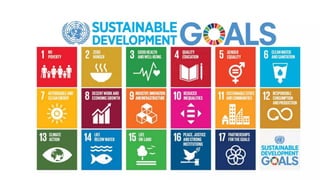
• Launched at UN Summit, New York, 2015.
• 17 Goals → end poverty, protect planet,
ensure peace & prosperity.
• Address: poverty, gender equality, water,
energy, climate change, biodiversity.
Sustainable Development
Goals (SDGs):
25.
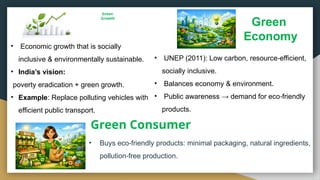
Green
Growth
• Buys ecofriendly products: minimal packaging, natural ingredients,
‑
pollution free production.
‑
Green
Economy
Green Consumer
• Economic growth that is socially
inclusive & environmentally sustainable.
• India’s vision:
poverty eradication + green growth.
• Example: Replace polluting vehicles with
efficient public transport.
• UNEP (2011): Low carbon, resource efficient,
‑
socially inclusive.
• Balances economy & environment.
• Public awareness → demand for eco friendly
‑
products.
26.
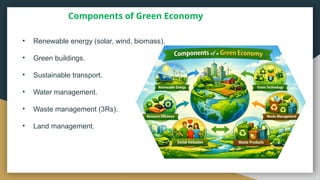
Components of GreenEconomy
• Renewable energy (solar, wind, biomass).
• Green buildings.
• Sustainable transport.
• Water management.
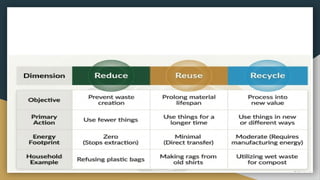
• Waste management (3Rs).
• Land management.
27.
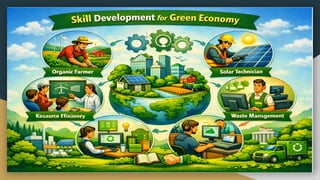
Skill Development forGreen Economy
• India must expand access to food, energy, water, and essential goods.
Aim: Reduce poverty and Promote Sustainable Development.
• Green skill development ensures transition to a green economy.
• Green jobs exist in business, nonprofit, government, and education.
• Some jobs need specific green skills:
• Organic farmer → knowledge of organic crop cultivation.
• Solar technician/engineer → skills for design, installation, maintenance of solar
panels.
• Other jobs contribute indirectly (e.g., graphic designer, cashier in green companies).
• Green skills help match supply and demand for sustainable employment.
29.
Green Skills
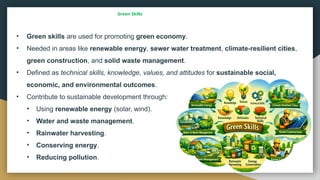
• Greenskills are used for promoting green economy.
• Needed in areas like renewable energy, sewer water treatment, climate resilient cities
‑ ,
green construction, and solid waste management.
• Defined as technical skills, knowledge, values, and attitudes for sustainable social,
economic, and environmental outcomes.
• Contribute to sustainable development through:
• Using renewable energy (solar, wind).
• Water and waste management.
• Rainwater harvesting.
• Conserving energy.
• Reducing pollution.
30.
Knowledge and SkillsNeeded for Managing Resources and Supporting Efficiency
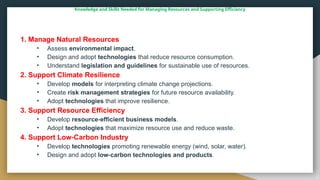
1. Manage Natural Resources
• Assess environmental impact.
• Design and adopt technologies that reduce resource consumption.
• Understand legislation and guidelines for sustainable use of resources.
2. Support Climate Resilience
• Develop models for interpreting climate change projections.
• Create risk management strategies for future resource availability.
• Adopt technologies that improve resilience.
3. Support Resource Efficiency
• Develop resource efficient business models
‑ .
• Adopt technologies that maximize resource use and reduce waste.
4. Support Low Carbon Industry
‑
• Develop technologies promoting renewable energy (wind, solar, water).
• Design and adopt low carbon technologies and products
‑ .
31.
Green Jobs –Meaning & Sectors
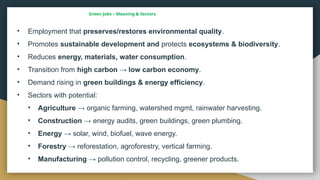
• Employment that preserves/restores environmental quality.
• Promotes sustainable development and protects ecosystems & biodiversity.
• Reduces energy, materials, water consumption.
• Transition from high carbon → low carbon economy.
• Demand rising in green buildings & energy efficiency.
• Sectors with potential:
• Agriculture → organic farming, watershed mgmt, rainwater harvesting.
• Construction → energy audits, green buildings, green plumbing.
• Energy → solar, wind, biofuel, wave energy.
• Forestry → reforestation, agroforestry, vertical farming.
• Manufacturing → pollution control, recycling, greener products.
32.
Green Projects
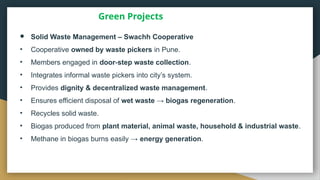
● SolidWaste Management – Swachh Cooperative
• Cooperative owned by waste pickers in Pune.
• Members engaged in door step waste collection
‑ .
• Integrates informal waste pickers into city’s system.
• Provides dignity & decentralized waste management.
• Ensures efficient disposal of wet waste → biogas regeneration.
• Recycles solid waste.
• Biogas produced from plant material, animal waste, household & industrial waste.
• Methane in biogas burns easily → energy generation.
33.
Modern Chulha &Biotoilet
1. Modern DEEP Chulha (Society of Development & Environment Protection)
• Biomass stove reduces wood use by 50%.
• Cuts smoke by 80% → less environmental & health problems.
• Trains masons & welders → employment & entrepreneurship.
• Adopted in 35,000 households (Solan, Himachal Pradesh).
2. Biotoilet (Green Solution Foundation)
• Eco friendly sanitation for villages & slums & Uses
‑ bio digester tank with aerobic bacteria
‑ .
• Converts waste into water for flushing/irrigation.
Benefits:💧 Water conservation (less flushing). 🚰 Efficient sewage system.
🌍 Reduced soil & water contamination. 🩺 Fewer diseases due to hygienic sanitation.