Comprehensive Overview of Engineering Materials: Metals, Steels, and Cast Irons
Detailed exploration of engineering materials including classification, properties, and applications of metals, ferrous and non-ferrous steels, alloy steels, stainless steels, and various types of cast irons.
Engineering Materials
www.nitdelhi.ac.in
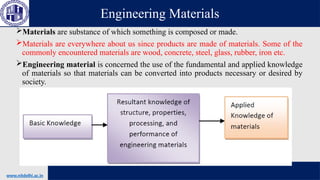
Materials aresubstance of which something is composed or made.
Materials are everywhere about us since products are made of materials. Some of the
commonly encountered materials are wood, concrete, steel, glass, rubber, iron etc.
Engineering material is concerned the use of the fundamental and applied knowledge
of materials so that materials can be converted into products necessary or desired by
society.
4.
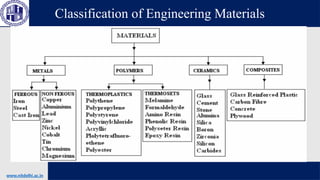
Classification of EngineeringMaterials
www.nitdelhi.ac.in
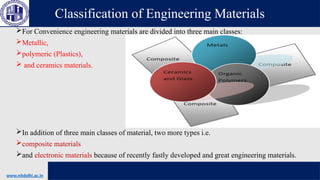
For Convenience engineering materials are divided into three main classes:
Metallic,
polymeric (Plastics),
and ceramics materials.
In addition of three main classes of material, two more types i.e.
composite materials
and electronic materials because of recently fastly developed and great engineering materials.
Metal
www.nitdelhi.ac.in
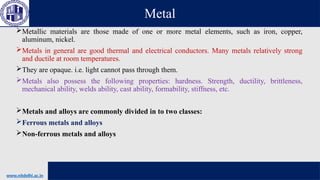
Metallic materials arethose made of one or more metal elements, such as iron, copper,
aluminum, nickel.
Metals in general are good thermal and electrical conductors. Many metals relatively strong
and ductile at room temperatures.
They are opaque. i.e. light cannot pass through them.
Metals also possess the following properties: hardness. Strength, ductility, brittleness,
mechanical ability, welds ability, cast ability, formability, stiffness, etc.
Metals and alloys are commonly divided in to two classes:
Ferrous metals and alloys
Non-ferrous metals and alloys
7.
Ferrous Metals
www.nitdelhi.ac.in
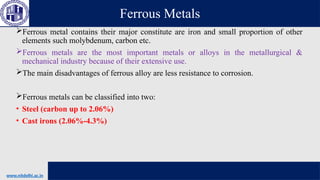
Ferrous metalcontains their major constitute are iron and small proportion of other
elements such molybdenum, carbon etc.
Ferrous metals are the most important metals or alloys in the metallurgical &
mechanical industry because of their extensive use.
The main disadvantages of ferrous alloy are less resistance to corrosion.
Ferrous metals can be classified into two:
• Steel (carbon up to 2.06%)
• Cast irons (2.06%-4.3%)
8.
Plain Carbon Steel
www.nitdelhi.ac.in
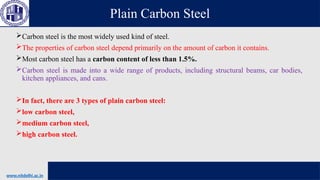
Carbonsteel is the most widely used kind of steel.
The properties of carbon steel depend primarily on the amount of carbon it contains.
Most carbon steel has a carbon content of less than 1.5%.
Carbon steel is made into a wide range of products, including structural beams, car bodies,
kitchen appliances, and cans.
In fact, there are 3 types of plain carbon steel:
low carbon steel,
medium carbon steel,
high carbon steel.
9.
Low Carbon Steel
www.nitdelhi.ac.in
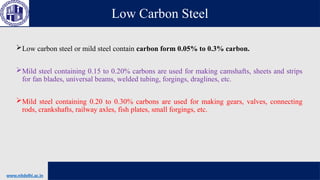
Lowcarbon steel or mild steel contain carbon form 0.05% to 0.3% carbon.
Mild steel containing 0.15 to 0.20% carbons are used for making camshafts, sheets and strips
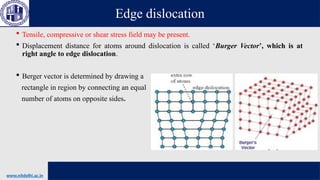
for fan blades, universal beams, welded tubing, forgings, draglines, etc.
Mild steel containing 0.20 to 0.30% carbons are used for making gears, valves, connecting
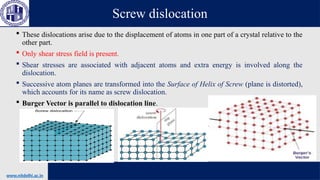
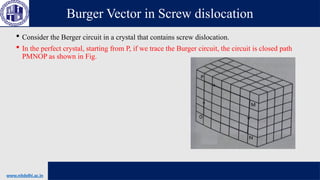
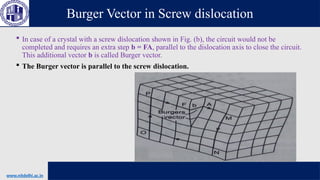
rods, crankshafts, railway axles, fish plates, small forgings, etc.
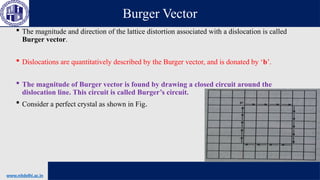
10.
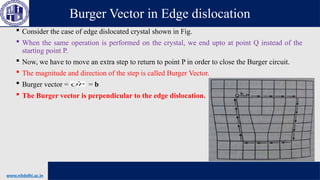
Medium Carbon Steel
www.nitdelhi.ac.in
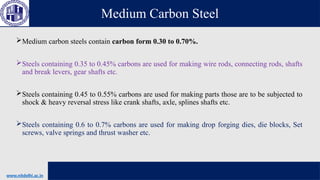
Mediumcarbon steels contain carbon form 0.30 to 0.70%.
Steels containing 0.35 to 0.45% carbons are used for making wire rods, connecting rods, shafts
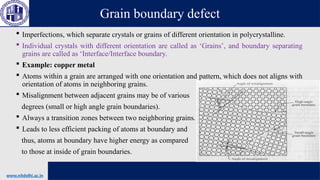
and break levers, gear shafts etc.
Steels containing 0.45 to 0.55% carbons are used for making parts those are to be subjected to
shock & heavy reversal stress like crank shafts, axle, splines shafts etc.
Steels containing 0.6 to 0.7% carbons are used for making drop forging dies, die blocks, Set
screws, valve springs and thrust washer etc.
11.
High Carbon Steel
www.nitdelhi.ac.in
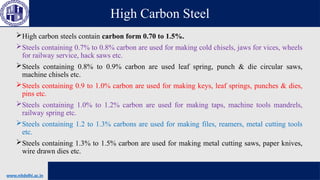
Highcarbon steels contain carbon form 0.70 to 1.5%.
Steels containing 0.7% to 0.8% carbon are used for making cold chisels, jaws for vices, wheels
for railway service, hack saws etc.
Steels containing 0.8% to 0.9% carbon are used leaf spring, punch & die circular saws,
machine chisels etc.
Steels containing 0.9 to 1.0% carbon are used for making keys, leaf springs, punches & dies,
pins etc.
Steels containing 1.0% to 1.2% carbon are used for making taps, machine tools mandrels,
railway spring etc.
Steels containing 1.2 to 1.3% carbons are used for making files, reamers, metal cutting tools
etc.
Steels containing 1.3% to 1.5% carbon are used for making metal cutting saws, paper knives,
wire drawn dies etc.
12.
Alloy Steel
www.nitdelhi.ac.in
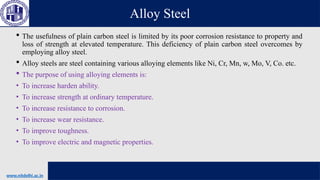
Theusefulness of plain carbon steel is limited by its poor corrosion resistance to property and
loss of strength at elevated temperature. This deficiency of plain carbon steel overcomes by
employing alloy steel.
Alloy steels are steel containing various alloying elements like Ni, Cr, Mn, w, Mo, V, Co. etc.
The purpose of using alloying elements is:
• To increase harden ability.
• To increase strength at ordinary temperature.
• To increase resistance to corrosion.
• To increase wear resistance.
• To improve toughness.
• To improve electric and magnetic properties.
13.
Classification of alloysteel
www.nitdelhi.ac.in
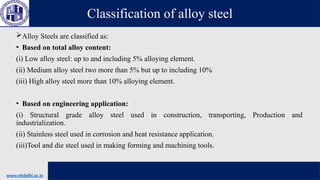
Alloy Steels are classified as:
• Based on total alloy content:
(i) Low alloy steel: up to and including 5% alloying element.
(ii) Medium alloy steel two more than 5% but up to including 10%
(iii) High alloy steel more than 10% alloying element.
• Based on engineering application:
(i) Structural grade alloy steel used in construction, transporting, Production and
industrialization.
(ii) Stainless steel used in corrosion and heat resistance application.
(iii)Tool and die steel used in making forming and machining tools.
14.
Stainless steel
www.nitdelhi.ac.in
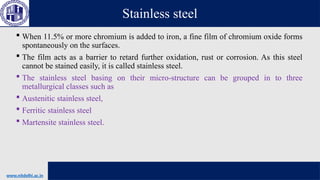
When11.5% or more chromium is added to iron, a fine film of chromium oxide forms
spontaneously on the surfaces.
The film acts as a barrier to retard further oxidation, rust or corrosion. As this steel
cannot be stained easily, it is called stainless steel.
The stainless steel basing on their micro-structure can be grouped in to three
metallurgical classes such as
Austenitic stainless steel,
Ferritic stainless steel
Martensite stainless steel.
15.
Austenitic stainless steel
www.nitdelhi.ac.in
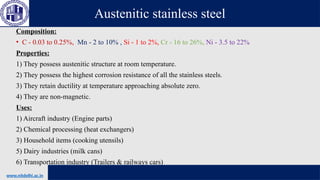
Composition:
•C - 0.03 to 0.25%, Mn - 2 to 10% , Si - 1 to 2%, Cr - 16 to 26%, Ni - 3.5 to 22%
Properties:
1) They possess austenitic structure at room temperature.
2) They possess the highest corrosion resistance of all the stainless steels.
3) They retain ductility at temperature approaching absolute zero.
4) They are non-magnetic.
Uses:
1) Aircraft industry (Engine parts)
2) Chemical processing (heat exchangers)
3) Household items (cooking utensils)
5) Dairy industries (milk cans)
6) Transportation industry (Trailers & railways cars)
16.
Ferritic stainless steel
www.nitdelhi.ac.in
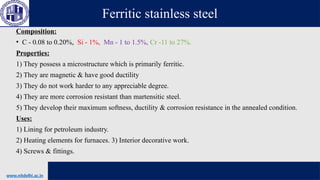
Composition:
•C - 0.08 to 0.20%, Si - 1%, Mn - 1 to 1.5%, Cr -11 to 27%.
Properties:
1) They possess a microstructure which is primarily ferritic.
2) They are magnetic & have good ductility
3) They do not work harder to any appreciable degree.
4) They are more corrosion resistant than martensitic steel.
5) They develop their maximum softness, ductility & corrosion resistance in the annealed condition.
Uses:
1) Lining for petroleum industry.
2) Heating elements for furnaces. 3) Interior decorative work.
4) Screws & fittings.
17.
Martensitic stainless steel
www.nitdelhi.ac.in
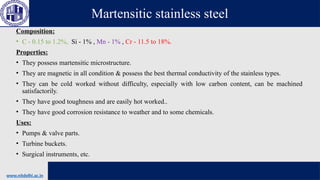
Composition:
•C - 0.15 to 1.2%, Si - 1% , Mn - 1% , Cr - 11.5 to 18%.
Properties:
• They possess martensitic microstructure.
• They are magnetic in all condition & possess the best thermal conductivity of the stainless types.
• They can be cold worked without difficulty, especially with low carbon content, can be machined
satisfactorily.
• They have good toughness and are easily hot worked..
• They have good corrosion resistance to weather and to some chemicals.
Uses:
• Pumps & valve parts.
• Turbine buckets.
• Surgical instruments, etc.
18.
Cast iron
www.nitdelhi.ac.in
Castirons - iron alloys containing between 2.06 to 4.3% of carbon.
Cast iron make excellent casting alloys since they are easily melted, are very fluid in the liquid
state, do not form undesirable surface films when poured.
Cast iron solidifies with slight to moderate shrinkage during casting and cooling.
The wide industrial use of cast irons is due to mainly to their comparatively low cost and
versatile engineering properties.
19.
Types of castirons
www.nitdelhi.ac.in
White cast iron
Grey cast iron
Malleable cast iron
Ductile cast iron
20.
White cast iron
www.nitdelhi.ac.in
Carbon content is 1.75 - 2.3%
It is formed when much of the carbon in a molten cast iron forms iron carbide instead of
graphite upon solidification.
White cast irons are so called because they fracture to produce a white or bright crystalline
fractured surface.
Properties of cast iron:
• Hard, brittle
• Shows a “white” crystalline fractured surface
• Excellent wear resistance
• High compressive stress
Applications of white cast irons:
• Brake shoes, Crushers, Pump impellers etc.
21.
Grey cast iron
www.nitdelhi.ac.in
Carbon content is 3.0 - 3.5%
Characteristics of grey cast iron:
• Cheap
• Low melting point
• Excellent bearing properties
• Excellent damping properties
• Excellent wear resistance
• Can be heat treated
Applications of grey cast irons:
• Gears
• Flywheels
• Water pipes, engine cylinders, brake discs
22.
Malleable cast iron
www.nitdelhi.ac.in
Carbon content is 2.0 - 2.6%
Malleable cast irons are first cast as white cast iron that contains large amount of iron carbide
and no graphite.
To produce a malleable iron structure, cold white iron castings are heated in a malleablizing
furnace to dissociate the iron carbide of white iron to graphite and iron.
Properties of malleable cast iron:
• Malleable cast irons have good ductility and machinability.
• Ferritic malleable cast irons are more ductile and less strong and hard, than pearlitic malleable
cast irons.
Applications of malleable cast irons:
• Parts of power train of vehicles
• Bearing caps
• Steering gear housings.
23.
Ductile cast iron
www.nitdelhi.ac.in
Carbon content is 3 - 4%
Ductile cast iron combines the processing advantage of gray cast iron with the engineering
advantages of steel.
Properties:
Ductile iron has good fluidity and castability, excellent machinability and good wear
resistance.
Ductile cast irons possess high ductility, good fatigue strength; wear resistance, shock
resistance and high modulus of elasticity.
Applications of ductile cast irons:
• Automotive engine crankshafts
• Heavy duty gears.
• Military and railroad vehicles.
24.
Wrought iron
www.nitdelhi.ac.in
Itis the purest iron which contains at least 99.5% iron but may contain upto 99.9% iron.
The wrought iron is produced from pig iron by re-melting it in the puddling furnace of
reverberatory type.
The wrought iron is a tough, malleable and ductile material.
It can be easily forged or welded. It is used for chains, crane hooks, railway couplings, water
and steam pipes.
25.
Polymeric Materials
www.nitdelhi.ac.in
Polymeric materialsconsist of organic long molecular chain or networks. Structurally,
most polymeric materials are non-crystalline in nature.
Polymeric materials are poor conductors of electricity. Some of these materials are
good insulators and are used for electrical insulative applications.
In general, polymeric materials have low density and relatively low softening
decomposition temperature.
26.
Ceramic Materials
www.nitdelhi.ac.in
Ceramic materialsare inorganic materials which consist of metallic and non-metallic elements
chemically bonded together.
Ceramic materials can be crystalline, non crystalline, or mixture of both. Most ceramic
materials high hardness and high temperature strength but tend to have mechanically
brittleness.
Advantage of ceramic materials are light weight, high strength, and hardness, good heat and
wear resistance, reduced friction, insulative properties.
The insulative property along with the high heat and wear resistance of many ceramics make
them useful for furnaces lining for high temperature of liquid metals such as steel.
27.
Composite Materials
www.nitdelhi.ac.in
Composite materialsare a mixture of two or more materials.
Most composite materials consist of a selected filler or reinforced material and a
compatible risen binder to obtain the specific characteristics and properties desired.
Usually, the components do not dissolve in each other and can be physically identified
by an interface between the components.
Composites can be of many types. Some of the predominant types are fibrous
(composed of fibers in a matrix) and particulate (composed of particle in a matrix).
It can be used widely for transport equipments due to light weight and excellent
corrosion resistant.
28.
Electronic Materials
www.nitdelhi.ac.in
Electronic materialsare not major type of materials by volume but are an extremely
important type of materials for advanced engineering technology.
The most important electronic materials is pure silicon which is modified in various
ways to change its electrical characteristics.
29.
Crystalline Materials
www.nitdelhi.ac.in
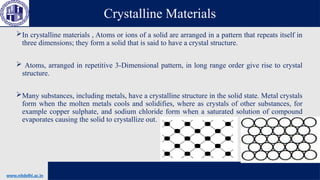
In crystallinematerials , Atoms or ions of a solid are arranged in a pattern that repeats itself in
three dimensions; they form a solid that is said to have a crystal structure.
Atoms, arranged in repetitive 3-Dimensional pattern, in long range order give rise to crystal
structure.
Many substances, including metals, have a crystalline structure in the solid state. Metal crystals
form when the molten metals cools and solidifies, where as crystals of other substances, for
example copper sulphate, and sodium chloride form when a saturated solution of compound
evaporates causing the solid to crystallize out.
30.
Characteristics of CrystallineSolids
www.nitdelhi.ac.in
Crystalline solids have definite characteristic geometrical shape.
Crystalline solids have sharp characteristic melting point.
Crystalline solids have definite and characteristic heat of fusion.
Crystalline solids produce pieces with plain and smooth surface when cut with a tool of sharp
edge.
Crystalline solids are anisotropic in nature.
Crystalline solids are true solid.
Constituent particles of crystalline solids are arranged in long range order.
31.
Types of CrystallineSolids
www.nitdelhi.ac.in
1. Molecular Solids:
Solids are having molecules as their constituent particles are called Molecular solids.
Example: Hydrogen (H2), Chlorine(Cl2), Water(H2O), HCl, solid carbon dioxide(CO2),
sucrose(C12H22O11), etc.
2. Metallic Solids:
All metals are referred as Metallic solids. Their constituent particles are positive ions. These
positive ions are surrounded by free moving electrons.
Example: Iron (Fe), Aluminium (Al), etc.
32.
Types of CrystallineSolids
www.nitdelhi.ac.in
3. Covalent Solids:
Crystalline solids are formed by non-metals because of formation of covalent bonds between the
adjacent molecules throughout the crystal. These are also known as Network Solids. These are also
called giant molecules.
Examples: Diamond, Graphite, Silicon carbide, etc.
4. Ionic Solids:
Solids, in which ions are the constituent particles, are called ionic solids. These solids are formed
because of three dimensional arrangements of cations and anions bound together with strong
electrostatic forces.
Ionic solid made up of positive & negative ions. These ions are held together by electrostatic
interaction of oppositely charged ions. This electrostatic force of attraction between cation of anion is
called Ionic bond.
Examples: NaCl, the Na+Cl– ion are held by electrostatic force & compound is ionic.
33.
Non Crystalline Materials
www.nitdelhi.ac.in
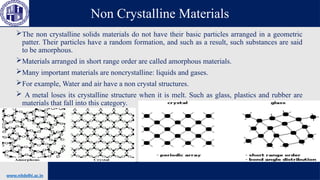
Thenon crystalline solids materials do not have their basic particles arranged in a geometric
patter. Their particles have a random formation, and such as a result, such substances are said
to be amorphous.
Materials arranged in short range order are called amorphous materials.
Many important materials are noncrystalline: liquids and gases.
For example, Water and air have a non crystal structures.
A metal loses its crystalline structure when it is melt. Such as glass, plastics and rubber are
materials that fall into this category.
34.
Characteristics of NonCrystalline Materials
www.nitdelhi.ac.in
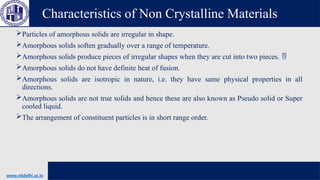
Particles of amorphous solids are irregular in shape.
Amorphous solids soften gradually over a range of temperature.
Amorphous solids produce pieces of irregular shapes when they are cut into two pieces.
Amorphous solids do not have definite heat of fusion.
Amorphous solids are isotropic in nature, i.e. they have same physical properties in all
directions.
Amorphous solids are not true solids and hence these are also known as Pseudo solid or Super
cooled liquid.
The arrangement of constituent particles is in short range order.
35.
Metal Crystal Structure
www.nitdelhi.ac.in
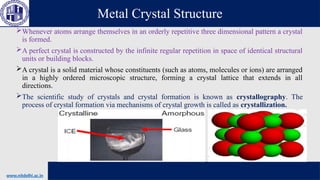
Wheneveratoms arrange themselves in an orderly repetitive three dimensional pattern a crystal
is formed.
A perfect crystal is constructed by the infinite regular repetition in space of identical structural
units or building blocks.
A crystal is a solid material whose constituents (such as atoms, molecules or ions) are arranged
in a highly ordered microscopic structure, forming a crystal lattice that extends in all
directions.
The scientific study of crystals and crystal formation is known as crystallography. The
process of crystal formation via mechanisms of crystal growth is called as crystallization.
36.
Various Terms inCrystal Structure
www.nitdelhi.ac.in
1. Crystal: It is a solid composed of atoms, ions, or molecules arranged in a pattern that is
repeated in three dimensions.
2. The unit cell: It is a structural unit or building block that can describe the crystal structure.
repetition of the unit cell generates the entire crystal.
3. Crystalline structure: A regular three dimensional patterns of atoms or ions in space.
4. Space lattice: a three dimensional array of points each of which has identical surroundings.
37.
Various Terms inCrystal Structure
www.nitdelhi.ac.in
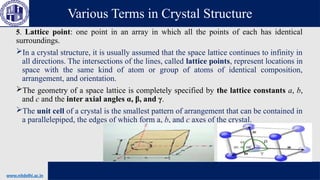
5. Lattice point: one point in an array in which all the points of each has identical
surroundings.
In a crystal structure, it is usually assumed that the space lattice continues to infinity in
all directions. The intersections of the lines, called lattice points, represent locations in
space with the same kind of atom or group of atoms of identical composition,
arrangement, and orientation.
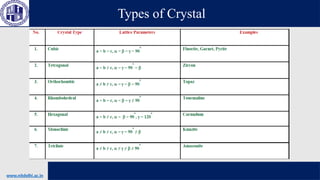
The geometry of a space lattice is completely specified by the lattice constants a, b,
and c and the inter axial angles α, β, and γ.
The unit cell of a crystal is the smallest pattern of arrangement that can be contained in
a parallelepiped, the edges of which form a, b, and c axes of the crystal.
Crystal System
www.nitdelhi.ac.in
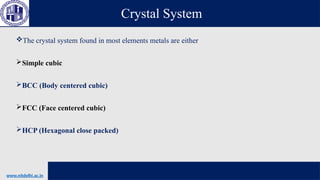
The crystalsystem found in most elements metals are either
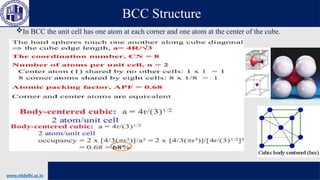
Simple cubic
BCC (Body centered cubic)
FCC (Face centered cubic)
HCP (Hexagonal close packed)
40.
Simple Cubic Structure
www.nitdelhi.ac.in
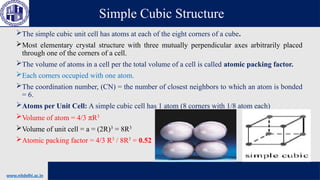
Thesimple cubic unit cell has atoms at each of the eight corners of a cube.
Most elementary crystal structure with three mutually perpendicular axes arbitrarily placed
through one of the corners of a cell.
The volume of atoms in a cell per the total volume of a cell is called atomic packing factor.
Each corners occupied with one atom.
The coordination number, (CN) = the number of closest neighbors to which an atom is bonded
= 6.
Atoms per Unit Cell: A simple cubic cell has 1 atom (8 corners with 1/8 atom each)
Volume of atom = 4/3 πR3
Volume of unit cell = a = (2R)3
= 8R3
Atomic packing factor = 4/3 R3
/ 8R3
= 0.52
FCC Structure
www.nitdelhi.ac.in
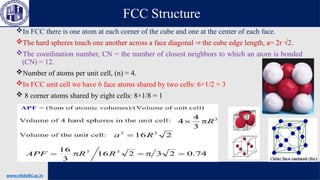
In FCCthere is one atom at each corner of the cube and one at the center of each face.
The hard spheres touch one another across a face diagonal the cube edge length, a= 2r √2
⇒ .
The coordination number, CN = the number of closest neighbors to which an atom is bonded
(CN) = 12.
Number of atoms per unit cell, (n) = 4.
In FCC unit cell we have 6 face atoms shared by two cells: 6×1/2 = 3
8 corner atoms shared by eight cells: 8×1/8 = 1
43.
HCP Structure
www.nitdelhi.ac.in
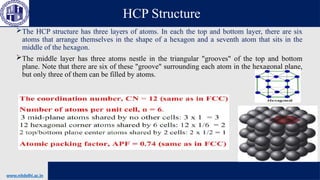
The HCPstructure has three layers of atoms. In each the top and bottom layer, there are six
atoms that arrange themselves in the shape of a hexagon and a seventh atom that sits in the
middle of the hexagon.
The middle layer has three atoms nestle in the triangular "grooves" of the top and bottom
plane. Note that there are six of these "groove" surrounding each atom in the hexagonal plane,
but only three of them can be filled by atoms.
44.
Miller indices
www.nitdelhi.ac.in
A systemof notation is required to identify particular directions or planes to characterize the
arrangement of atoms in a unit cell.
Formulas involving Miller indices are very similar to related formulas from analytical
geometry-simple to use.
Use of reciprocals avoids the complication of infinite intercepts.
Specifying dimensions in unit cell terms means that the same label can be applied to any plane
with a similar stacking pattern, regardless of the crystal class of the crystal. Plane (111) always
steps the same way regardless of crystal system.
45.
Miller indices-Direction
www.nitdelhi.ac.in
Avector of convenient length is placed parallel to the required direction.
The length of the vector projection on each of three axes are measured in terms of unit cell
dimensions.
These three numbers are made to smallest integer values, known as indices, by multiplying or
dividing by a common factor.
The three indices are enclosed in square brackets, [uvw].
A family of directions is represented by <uvw>.
46.
Miller indices-Plane
www.nitdelhi.ac.in
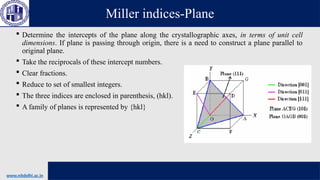
Determinethe intercepts of the plane along the crystallographic axes, in terms of unit cell
dimensions. If plane is passing through origin, there is a need to construct a plane parallel to
original plane.
Take the reciprocals of these intercept numbers.
Clear fractions.
Reduce to set of smallest integers.
The three indices are enclosed in parenthesis, (hkl).
A family of planes is represented by {hkl}
47.
Miller indices-Useful conventions
www.nitdelhi.ac.in
If a plane is parallel to an axis, its intercept is at infinity and its Miller index will be zero
Never alter negative numbers. This implies symmetry that the crystal may not have! Use bar
over the number to represent negative numbers.
A plane or direction of family is not necessarily parallel to other planes or directions in the
same family.
The smaller the Miller index, more nearly parallel the plane to that axis, and vice versa.
Multiplying or dividing a Miller index by constant has no effect on the orientation of the plane.
When the integers used in the Miller indices contain more than one digit, the indices must be
separated by commas. E.g.: (3,10,13)
48.
Miller indices (hkl)
www.nitdelhi.ac.in
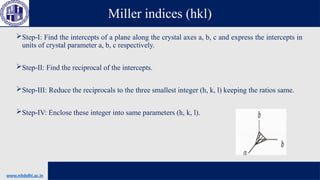
StepI: Find the intercepts of a plane along the crystal axes a, b, c and express the intercepts in
‐
units of crystal parameter a, b, c respectively.
Step II: Find the reciprocal of the intercepts.
‐
Step III: Reduce the reciprocals to the three smallest integer (h, k, l) keeping the ratios same.
‐
Step IV: Enclose these integer into same parameters (h, k, l).
‐
49.
Numerical
www.nitdelhi.ac.in
Example:
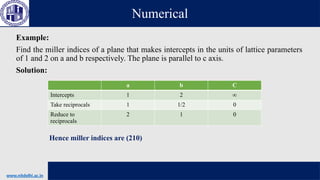
Find the millerindices of a plane that makes intercepts in the units of lattice parameters
of 1 and 2 on a and b respectively. The plane is parallel to c axis.
Solution:
Hence miller indices are (210)
a b C
Intercepts 1 2 ∞
Take reciprocals 1 1/2 0
Reduce to
reciprocals
2 1 0
50.
Crystal Imperfections
www.nitdelhi.ac.in
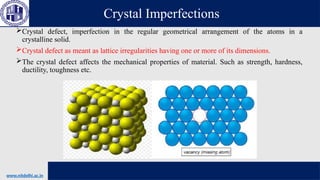
Crystal defect,imperfection in the regular geometrical arrangement of the atoms in a
crystalline solid.
Crystal defect as meant as lattice irregularities having one or more of its dimensions.
The crystal defect affects the mechanical properties of material. Such as strength, hardness,
ductility, toughness etc.
Point Defect
www.nitdelhi.ac.in
Thepoint defects are zero-dimensional defects.
When an atom is missing or an atom is in an irregular place in the lattice structure, the
corresponding defects are known as point defects.
A point defect produces strain in a small volume of the crystal surrounding the crystal, but does
not affect the perfections distant parts of the crystal.
In general, point defects occur in metallic and ionic crystals.
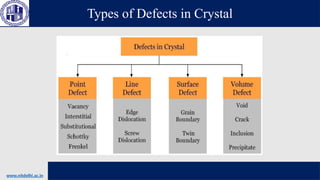
Point defects are of following types:
(1) Vacancies
(2) Interstitial defects
(3) Substitutional defects
(4) Frenkel’s defect
(5) Schottky’s defect
53.
Point Defect
www.nitdelhi.ac.in
Vacancy:
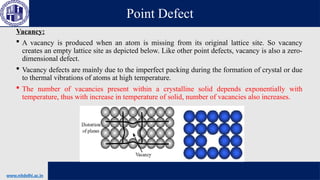
Avacancy is produced when an atom is missing from its original lattice site. So vacancy
creates an empty lattice site as depicted below. Like other point defects, vacancy is also a zero-
dimensional defect.
Vacancy defects are mainly due to the imperfect packing during the formation of crystal or due
to thermal vibrations of atoms at high temperature.
The number of vacancies present within a crystalline solid depends exponentially with
temperature, thus with increase in temperature of solid, number of vacancies also increases.
54.
Point Defect
www.nitdelhi.ac.in
Interstitial defects:
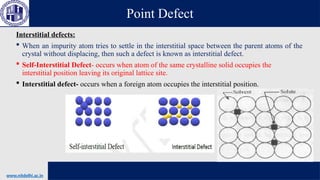
When an impurity atom tries to settle in the interstitial space between the parent atoms of the
crystal without displacing, then such a defect is known as interstitial defect.
Self-Interstitial Defect- occurs when atom of the same crystalline solid occupies the
interstitial position leaving its original lattice site.
Interstitial defect- occurs when a foreign atom occupies the interstitial position.
55.
Point Defect
www.nitdelhi.ac.in
Substitutional defects:
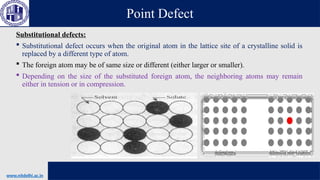
Substitutional defect occurs when the original atom in the lattice site of a crystalline solid is
replaced by a different type of atom.
The foreign atom may be of same size or different (either larger or smaller).
Depending on the size of the substituted foreign atom, the neighboring atoms may remain
either in tension or in compression.
56.
Point Defect
www.nitdelhi.ac.in
Schottky defects:
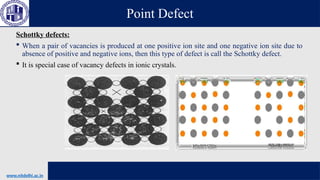
When a pair of vacancies is produced at one positive ion site and one negative ion site due to
absence of positive and negative ions, then this type of defect is call the Schottky defect.
It is special case of vacancy defects in ionic crystals.
57.
Point Defect
www.nitdelhi.ac.in
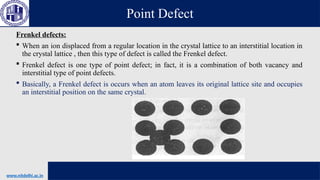
Frenkel defects:
When an ion displaced from a regular location in the crystal lattice to an interstitial location in
the crystal lattice , then this type of defect is called the Frenkel defect.
Frenkel defect is one type of point defect; in fact, it is a combination of both vacancy and
interstitial type of point defects.
Basically, a Frenkel defect is occurs when an atom leaves its original lattice site and occupies
an interstitial position on the same crystal.
58.
Line Defects (Onedimensional defects)
www.nitdelhi.ac.in
A dislocation is a one-dimensional defect around which some of the atoms are misaligned”.
Thus, dislocations refer to a linear disturbance of the atomic arrangement in a crystal.
Dislocations are generated in crystals due to growth accidents, thermal stress, phase transformation
etc.
They can be observed in crystalline materials with the help of electron microscope.
Defect is known as ‘dislocation’ and boundary is known as ‘Dislocation Line’
Region near dislocation, where distortion is extremely large is called ‘Core of Dislocation’.
59.
Edge dislocation
www.nitdelhi.ac.in
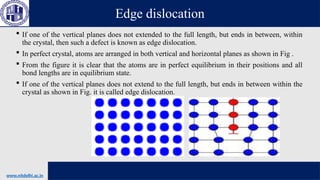
Ifone of the vertical planes does not extended to the full length, but ends in between, within
the crystal, then such a defect is known as edge dislocation.
In perfect crystal, atoms are arranged in both vertical and horizontal planes as shown in Fig .
From the figure it is clear that the atoms are in perfect equilibrium in their positions and all
bond lengths are in equilibrium state.
If one of the vertical planes does not extend to the full length, but ends in between within the
crystal as shown in Fig. it is called edge dislocation.
60.
Edge dislocation
www.nitdelhi.ac.in
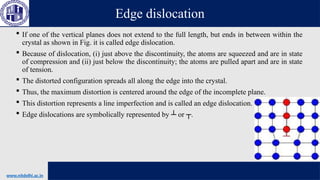
Ifone of the vertical planes does not extend to the full length, but ends in between within the
crystal as shown in Fig. it is called edge dislocation.
Because of dislocation, (i) just above the discontinuity, the atoms are squeezed and are in state
of compression and (ii) just below the discontinuity; the atoms are pulled apart and are in state
of tension.
The distorted configuration spreads all along the edge into the crystal.
Thus, the maximum distortion is centered around the edge of the incomplete plane.
This distortion represents a line imperfection and is called an edge dislocation.
Edge dislocations are symbolically represented by ┴ or ┬.
61.
Edge dislocation
www.nitdelhi.ac.in
Tensile,compressive or shear stress field may be present.
Displacement distance for atoms around dislocation is called ‘Burger Vector’, which is at
right angle to edge dislocation.
Berger vector is determined by drawing a
rectangle in region by connecting an equal
number of atoms on opposite sides.
62.
Screw dislocation
www.nitdelhi.ac.in
Thesedislocations arise due to the displacement of atoms in one part of a crystal relative to the
other part.
Only shear stress field is present.
Shear stresses are associated with adjacent atoms and extra energy is involved along the
dislocation.
Successive atom planes are transformed into the Surface of Helix of Screw (plane is distorted),
which accounts for its name as screw dislocation.
Burger Vector is parallel to dislocation line.
63.
Burger Vector
www.nitdelhi.ac.in
Themagnitude and direction of the lattice distortion associated with a dislocation is called
Burger vector.
Dislocations are quantitatively described by the Burger vector, and is donated by ‘b’.
The magnitude of Burger vector is found by drawing a closed circuit around the
dislocation line. This circuit is called Burger’s circuit.
Consider a perfect crystal as shown in Fig.
64.
Burger Vector inEdge dislocation
www.nitdelhi.ac.in
Consider the case of edge dislocated crystal shown in Fig.
When the same operation is performed on the crystal, we end upto at point Q instead of the
starting point P.
Now, we have to move an extra step to return to point P in order to close the Burger circuit.
The magnitude and direction of the step is called Burger Vector.
Burger vector = = b
The Burger vector is perpendicular to the edge dislocation.
65.
Burger Vector inScrew dislocation
www.nitdelhi.ac.in
Consider the Berger circuit in a crystal that contains screw dislocation.
In the perfect crystal, starting from P, if we trace the Burger circuit, the circuit is closed path
PMNOP as shown in Fig.
66.
Burger Vector inScrew dislocation
www.nitdelhi.ac.in
In case of a crystal with a screw dislocation shown in Fig. (b), the circuit would not be
completed and requires an extra step b = FA, parallel to the dislocation axis to close the circuit.
This additional vector b is called Burger vector.
The Burger vector is parallel to the screw dislocation.
67.
Surface Defects
www.nitdelhi.ac.in
Theseare two-dimensional defects.
The regions of distortions that lie about a surface having a thickness of few atomic diameters are
known as surface defects.
Surface defects are two-dimensional defects that separate two regions of the crystal.
Surface imperfections are metastable imperfections.
There are two types of surface defects:
1. Grain boundary defect
2. Twin boundary defect
68.
Grain boundary defect
www.nitdelhi.ac.in
Imperfections, which separate crystals or grains of different orientation in polycrystalline.
Individual crystals with different orientation are called as ‘Grains’, and boundary separating
grains are called as ‘Interface/Interface boundary.
Example: copper metal
Atoms within a grain are arranged with one orientation and pattern, which does not aligns with
orientation of atoms in neighboring grains.
Misalignment between adjacent grains may be of various
degrees (small or high angle grain boundaries).
Always a transition zones between two neighboring grains.
Leads to less efficient packing of atoms at boundary and
thus, atoms at boundary have higher energy as compared
to those at inside of grain boundaries.
69.
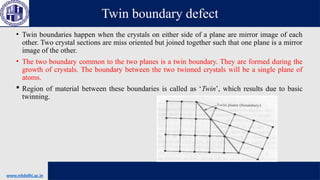
Twin boundary defect
www.nitdelhi.ac.in
•Twin boundaries happen when the crystals on either side of a plane are mirror image of each
other. Two crystal sections are miss oriented but joined together such that one plane is a mirror
image of the other.
• The two boundary common to the two planes is a twin boundary. They are formed during the
growth of crystals. The boundary between the two twinned crystals will be a single plane of
atoms.
Region of material between these boundaries is called as ‘Twin’, which results due to basic
twinning.
70.
Silicate structures
www.nitdelhi.ac.in
Silicatesare salts containing anions of silicon (Si) and oxygen. There are many types of
silicates, because the silicon-to-oxygen ratio can vary widely.
In all silicates, however, silicon atoms are found at the centres of tetrahedrons with oxygen
atoms at the corners. The silicon is always tetravalent (i.e., has an oxidation state of +4).
The variation in the silicon-to-oxygen ratio occurs because the silicon-oxygen tetrahedrons
may exist as discrete, independent units or may share oxygen atoms at corners, edges, or in
rarer instances faces in several ways.
Thus, the silicon-to-oxygen ratio varies according to the extent to which the oxygen atoms are
shared by silicon atoms as the tetrahedrons are linked together.
71.
Building block ofsilicate minerals
www.nitdelhi.ac.in
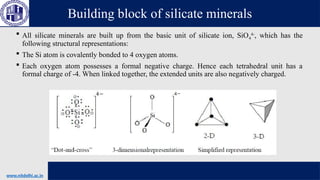
All silicate minerals are built up from the basic unit of silicate ion, SiO4
4-
, which has the
following structural representations:
The Si atom is covalently bonded to 4 oxygen atoms.
Each oxygen atom possesses a formal negative charge. Hence each tetrahedral unit has a
formal charge of -4. When linked together, the extended units are also negatively charged.
72.
Importance of someof the silicate minerals
www.nitdelhi.ac.in
(a) Silicates:
(i) Asbestos (double chains or sheets):
Asbestos is an excellent thermal insulator that is non combustible, acid-resistant, and strong.
In the past, it was used extensively in construction work to make cement floor tiles, roof covers
and ducts.
It can also be woven into fabric to make fire resistant blankets.
Its use has been decreased greatly in recent years because inhalation of small asbestos fibres
during mining and manufacturing or during the removal of frayed and crumbled building
materials can cause the lung disease called asbestosis.
73.
Importance of someof the silicate minerals
www.nitdelhi.ac.in
(ii) Talc (sheets):
The common use of talc crystals is to make talcum powder which is a soft and fine powder to
make one’s skin feel smooth and dry.
Its resistance to heat and electricity makes it ideal for surfacing benches and switchboards.
It is also an important filler for paint and rubber.
(iii) Quartz (three-dimensional network):
The hardness of quartz is widely made use of in construction work as sandstones. Quartz/silica
tubing are used for high temperature heating.
Quartz possesses piezoelectric property which enables it to make crystal oscillators used in
watches and electronic circuits and also as pressure sensor in electronic balances.
Quartz is also widely used in jewellery and ornamental decorations.
74.
Importance of someof the silicate minerals
www.nitdelhi.ac.in
(b) Alumino-silicates:
(i) Feldspar (three-dimensional network):
In glassmaking, feldspar provides alumina for improving hardness, durability, and resistance to
chemical corrosion.
In ceramics, feldspar is used as a flux, lowering the vitrifying temperature of a ceramic body
during firing and forming a glassy phase.
(ii) Mica (sheets):
Mica possesses excellent electrical insulation and is widely used in electronic products such as
capacitors, washers for transistors and radar high tension coils.
It also has excellent heat insulation and is used in soldering irons and jet engines.