Sanjivani Rural Education Society’s
Sanjivani College of Engineering, Kopargaon-423603
(An Autonomous Institute Affiliated to Savitribai Phule Pune University, Pune)
NAAC ‘A’ Grade Accredited, ISO 9001:2015 Certified
Department of Mechanical Engineering
Subject : Electric Vehicle Design
Class : T.Y. Mechanical
Subject Code : ME 311D
Unit 2 : Introduction to Electric and Hybrid
Vehicle
By
V. P. Bhaurkar
Department of Mechanical Engineering
2026 – 27 (sem - 5)
V. P. Bhaurkar EV (T. Y. Mechanical)
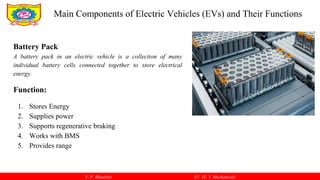
Battery Pack
A battery pack in an electric vehicle is a collection of many
individual battery cells connected together to store electrical
energy.
Function:
1. Stores Energy
2. Supplies power
3. Supports regenerative braking
4. Works with BMS
5. Provides range
Main Components of Electric Vehicles (EVs) and Their Functions
V. P. Bhaurkar EV (T. Y. Mechanical)
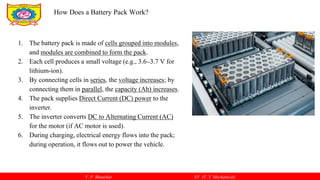
1. The battery pack is made of cells grouped into modules,
and modules are combined to form the pack.
2. Each cell produces a small voltage (e.g., 3.6–3.7 V for
lithium-ion).
3. By connecting cells in series, the voltage increases; by
connecting them in parallel, the capacity (Ah) increases.
4. The pack supplies Direct Current (DC) power to the
inverter.
5. The inverter converts DC to Alternating Current (AC)
for the motor (if AC motor is used).
6. During charging, electrical energy flows into the pack;
during operation, it flows out to power the vehicle.
How Does a Battery Pack Work?
V. P. Bhaurkar EV (T. Y. Mechanical)
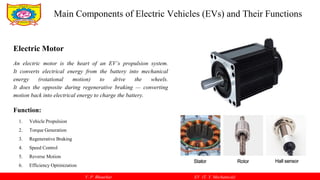
Electric Motor
An electric motor is the heart of an EV’s propulsion system.
It converts electrical energy from the battery into mechanical
energy (rotational motion) to drive the wheels.
It does the opposite during regenerative braking — converting
motion back into electrical energy to charge the battery.
Function:
1. Vehicle Propulsion
2. Torque Generation
3. Regenerative Braking
4. Speed Control
5. Reverse Motion
6. Efficiency Optimization
Main Components of Electric Vehicles (EVs) and Their Functions
V. P. Bhaurkar EV (T. Y. Mechanical)
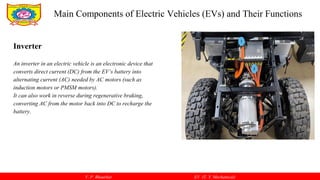
Inverter
An inverter in an electric vehicle is an electronic device that
converts direct current (DC) from the EV’s battery into
alternating current (AC) needed by AC motors (such as
induction motors or PMSM motors).
It can also work in reverse during regenerative braking,
converting AC from the motor back into DC to recharge the
battery.
Main Components of Electric Vehicles (EVs) and Their Functions
V. P. Bhaurkar EV (T. Y. Mechanical)
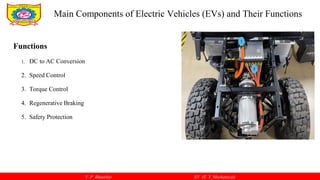
Functions
1. DC to AC Conversion
2. Speed Control
3. Torque Control
4. Regenerative Braking
5. Safety Protection
Main Components of Electric Vehicles (EVs) and Their Functions
V. P. Bhaurkar EV (T. Y. Mechanical)
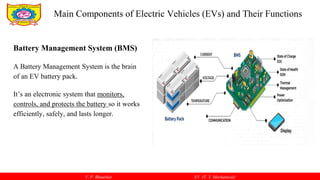
Battery Management System (BMS)
A Battery Management System is the brain
of an EV battery pack.
It’s an electronic system that monitors,
controls, and protects the battery so it works
efficiently, safely, and lasts longer.
Main Components of Electric Vehicles (EVs) and Their Functions
V. P. Bhaurkar EV (T. Y. Mechanical)
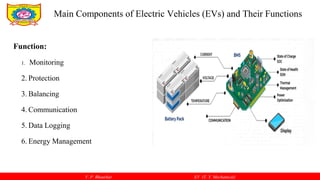
Function:
1. Monitoring
2. Protection
3. Balancing
4. Communication
5. Data Logging
6. Energy Management
Main Components of Electric Vehicles (EVs) and Their Functions
V. P. Bhaurkar EV (T. Y. Mechanical)
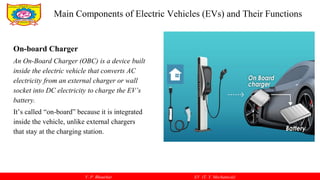
On-board Charger
An On-Board Charger (OBC) is a device built
inside the electric vehicle that converts AC
electricity from an external charger or wall
socket into DC electricity to charge the EV’s
battery.
It’s called “on-board” because it is integrated
inside the vehicle, unlike external chargers
that stay at the charging station.
Main Components of Electric Vehicles (EVs) and Their Functions
V. P. Bhaurkar EV (T. Y. Mechanical)
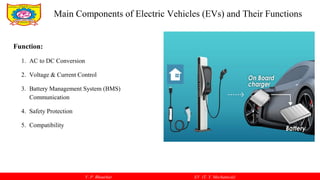
Function:
1. AC to DC Conversion
2. Voltage & Current Control
3. Battery Management System (BMS)
Communication
4. Safety Protection
5. Compatibility
Main Components of Electric Vehicles (EVs) and Their Functions
V. P. Bhaurkar EV (T. Y. Mechanical)
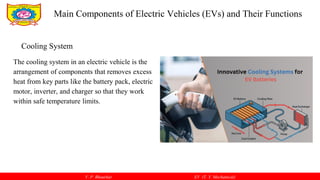
Cooling System
The cooling system in an electric vehicle is the
arrangement of components that removes excess
heat from key parts like the battery pack, electric
motor, inverter, and charger so that they work
within safe temperature limits.
Main Components of Electric Vehicles (EVs) and Their Functions
V. P. Bhaurkar EV (T. Y. Mechanical)
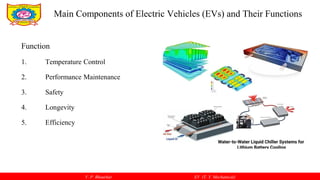
Function
1. Temperature Control
2. Performance Maintenance
3. Safety
4. Longevity
5. Efficiency
Main Components of Electric Vehicles (EVs) and Their Functions
V. P. Bhaurkar AI and ML (T. Y. Mechanical)
Thank You !