Comprehensive Overview of Electric Vehicle Components and Technologies
Explore key components, types, charging methods, and battery technologies of electric vehicles, including BEVs, HEVs, FCEVs, and hybrid variants, with insights into regenerative braking and thermal management systems.
Comprehensive Overview of Electric Vehicle Components and Technologies
2.
Ameyzingg Engineers @ameyzingg_engineers
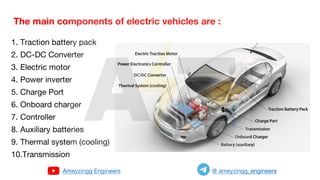
The main components of electric vehicles are :
1. Traction battery pack
2. DC-DC Converter
3. Electric motor
4. Power inverter
5. Charge Port
6. Onboard charger
7. Controller
8. Auxiliary batteries
9. Thermal system (cooling)
10.Transmission
3.
Ameyzingg Engineers @ameyzingg_engineers
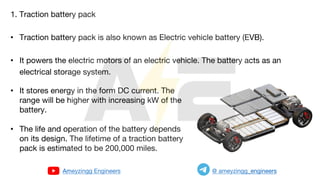
• It stores energy in the form DC current. The
range will be higher with increasing kW of the
battery.
• The life and operation of the battery depends
on its design. The lifetime of a traction battery
pack is estimated to be 200,000 miles.
1. Traction battery pack
• Traction battery pack is also known as Electric vehicle battery (EVB).
• It powers the electric motors of an electric vehicle. The battery acts as an
electrical storage system.
4.
Ameyzingg Engineers @ameyzingg_engineers
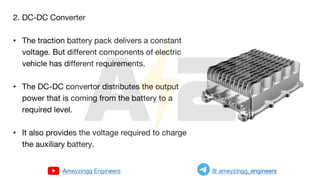
2. DC-DC Converter
• The traction battery pack delivers a constant
voltage. But different components of electric
vehicle has different requirements.
• The DC-DC convertor distributes the output
power that is coming from the battery to a
required level.
• It also provides the voltage required to charge
the auxiliary battery.
5.
Ameyzingg Engineers @ameyzingg_engineers
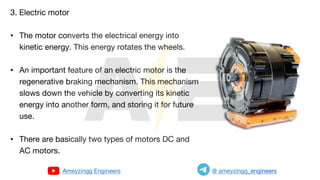
3. Electric motor
• The motor converts the electrical energy into
kinetic energy. This energy rotates the wheels.
• An important feature of an electric motor is the
regenerative braking mechanism. This mechanism
slows down the vehicle by converting its kinetic
energy into another form, and storing it for future
use.
• There are basically two types of motors DC and
AC motors.
6.
Ameyzingg Engineers @ameyzingg_engineers
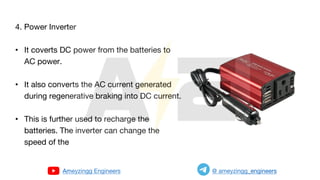
4. Power Inverter
• It coverts DC power from the batteries to
AC power.
• It also converts the AC current generated
during regenerative braking into DC current.
• This is further used to recharge the
batteries. The inverter can change the
speed of the
7.
Ameyzingg Engineers @ameyzingg_engineers
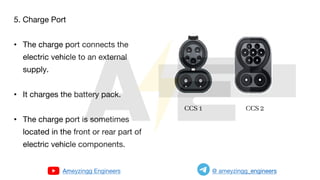
5. Charge Port
• The charge port connects the
electric vehicle to an external
supply.
• It charges the battery pack.
• The charge port is sometimes
located in the front or rear part of
electric vehicle components.
8.
Ameyzingg Engineers @ameyzingg_engineers
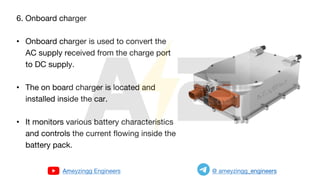
6. Onboard charger
• Onboard charger is used to convert the
AC supply received from the charge port
to DC supply.
• The on board charger is located and
installed inside the car.
• It monitors various battery characteristics
and controls the current flowing inside the
battery pack.
9.
Ameyzingg Engineers @ameyzingg_engineers
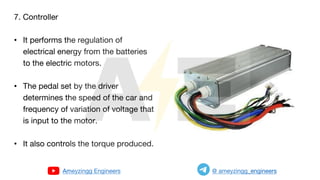
7. Controller
• It performs the regulation of
electrical energy from the batteries
to the electric motors.
• The pedal set by the driver
determines the speed of the car and
frequency of variation of voltage that
is input to the motor.
• It also controls the torque produced.
10.
Ameyzingg Engineers @ameyzingg_engineers
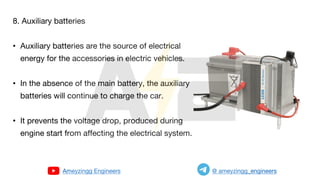
8. Auxiliary batteries
• Auxiliary batteries are the source of electrical
energy for the accessories in electric vehicles.
• In the absence of the main battery, the auxiliary
batteries will continue to charge the car.
• It prevents the voltage drop, produced during
engine start from affecting the electrical system.
11.
Ameyzingg Engineers @ameyzingg_engineers
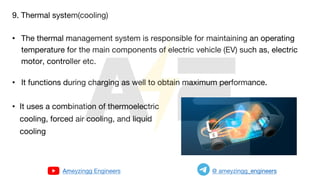
9. Thermal system(cooling)
• The thermal management system is responsible for maintaining an operating
temperature for the main components of electric vehicle (EV) such as, electric
motor, controller etc.
• It functions during charging as well to obtain maximum performance.
• It uses a combination of thermoelectric
cooling, forced air cooling, and liquid
cooling
12.
Ameyzingg Engineers @ameyzingg_engineers
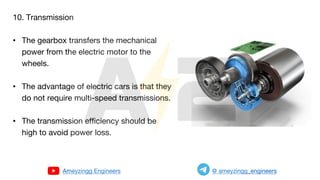
10. Transmission
• The gearbox transfers the mechanical
power from the electric motor to the
wheels.
• The advantage of electric cars is that they
do not require multi-speed transmissions.
• The transmission efficiency should be
high to avoid power loss.
13.
Ameyzingg Engineers @ameyzingg_engineers
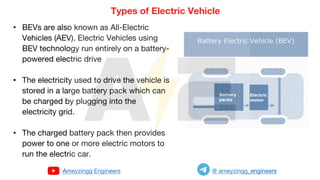
• BEVs are also known as All-Electric
Vehicles (AEV). Electric Vehicles using
BEV technology run entirely on a battery-
powered electric drive
• The electricity used to drive the vehicle is
stored in a large battery pack which can
be charged by plugging into the
electricity grid.
• The charged battery pack then provides
power to one or more electric motors to
run the electric car.
Types of Electric Vehicle
14.
Ameyzingg Engineers @ameyzingg_engineers
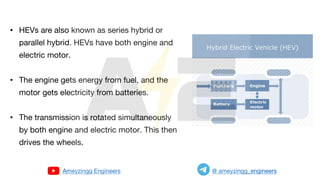
• HEVs are also known as series hybrid or
parallel hybrid. HEVs have both engine and
electric motor.
• The engine gets energy from fuel, and the
motor gets electricity from batteries.
• The transmission is rotated simultaneously
by both engine and electric motor. This then
drives the wheels.
15.
Ameyzingg Engineers @ameyzingg_engineers
The main types of hybrid vehicles include:
1. Parallel Hybrid Electric Vehicles (PHEVs): In parallel hybrid vehicles, both the
internal combustion engine (ICE) and the electric motor are mechanically connected
to the wheels and can propel the vehicle independently or together.
2. Series Hybrid Electric Vehicles (SHEVs): Series hybrid vehicles use the internal
combustion engine (ICE) solely to generate electricity, which is then used to power
the electric motor that drives the wheels. The ICE does not directly provide
propulsion to the wheels.
3. Power-Split Hybrid Electric Vehicles (PSHEVs)
4. Mild Hybrid Electric Vehicles (MHEVs)
16.
Ameyzingg Engineers @ameyzingg_engineers
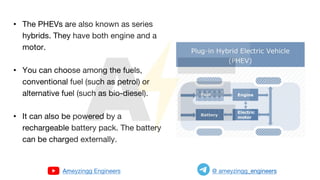
• The PHEVs are also known as series
hybrids. They have both engine and a
motor.
• You can choose among the fuels,
conventional fuel (such as petrol) or
alternative fuel (such as bio-diesel).
• It can also be powered by a
rechargeable battery pack. The battery
can be charged externally.
17.
Ameyzingg Engineers @ameyzingg_engineers
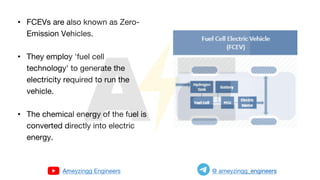
• FCEVs are also known as Zero-
Emission Vehicles.
• They employ 'fuel cell
technology' to generate the
electricity required to run the
vehicle.
• The chemical energy of the fuel is
converted directly into electric
energy.
18.
Ameyzingg Engineers @ameyzingg_engineers
Types of chargers :
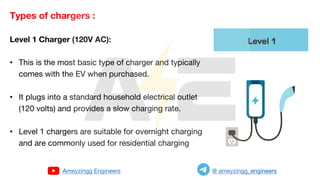
Level 1 Charger (120V AC):
• This is the most basic type of charger and typically
comes with the EV when purchased.
• It plugs into a standard household electrical outlet
(120 volts) and provides a slow charging rate.
• Level 1 chargers are suitable for overnight charging
and are commonly used for residential charging
19.
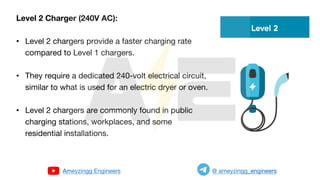
Level 2 Charger(240V AC):
• Level 2 chargers provide a faster charging rate
compared to Level 1 chargers.
• They require a dedicated 240-volt electrical circuit,
similar to what is used for an electric dryer or oven.
• Level 2 chargers are commonly found in public
charging stations, workplaces, and some
residential installations.
Ameyzingg Engineers @ ameyzingg_engineers
20.
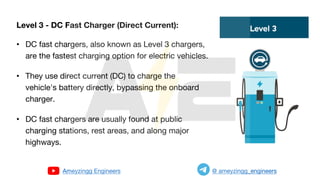
Level 3 -DC Fast Charger (Direct Current):
• DC fast chargers, also known as Level 3 chargers,
are the fastest charging option for electric vehicles.
• They use direct current (DC) to charge the
vehicle's battery directly, bypassing the onboard
charger.
• DC fast chargers are usually found at public
charging stations, rest areas, and along major
highways.
Ameyzingg Engineers @ ameyzingg_engineers
21.
Ameyzingg Engineers @ameyzingg_engineers
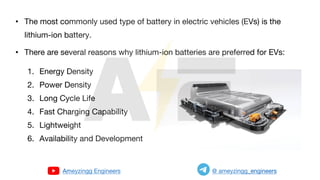
• The most commonly used type of battery in electric vehicles (EVs) is the
lithium-ion battery.
• There are several reasons why lithium-ion batteries are preferred for EVs:
1. Energy Density
2. Power Density
3. Long Cycle Life
4. Fast Charging Capability
5. Lightweight
6. Availability and Development
22.
Ameyzingg Engineers @ameyzingg_engineers
• This is the e-AMRIT (Accelerated e-Mobility Revolution for India's
Transportation) portal for creating awareness about electric mobility in India.
• The portal aims to serve as a ‘one-stop site’ to provide all the information
related to the adoption of electric vehicles in India.
• e-AMRIT is the result of a joint initiative between NITI Aayog and the UK
Government.
23.
Ameyzingg Engineers @ameyzingg_engineers
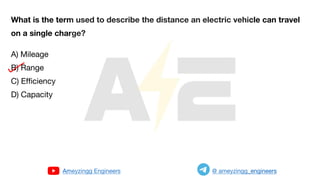
What is the term used to describe the distance an electric vehicle can travel
on a single charge?
A) Mileage
B) Range
C) Efficiency
D) Capacity
24.
Ameyzingg Engineers @ameyzingg_engineers
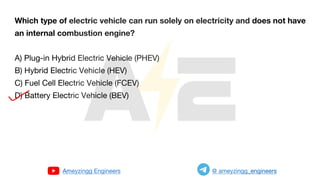
Which type of electric vehicle can run solely on electricity and does not have
an internal combustion engine?
A) Plug-in Hybrid Electric Vehicle (PHEV)
B) Hybrid Electric Vehicle (HEV)
C) Fuel Cell Electric Vehicle (FCEV)
D) Battery Electric Vehicle (BEV)
25.
Ameyzingg Engineers @ameyzingg_engineers
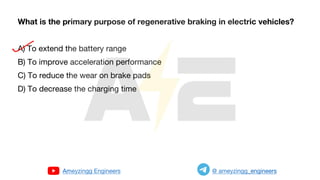
What is the primary purpose of regenerative braking in electric vehicles?
A) To extend the battery range
B) To improve acceleration performance
C) To reduce the wear on brake pads
D) To decrease the charging time
26.
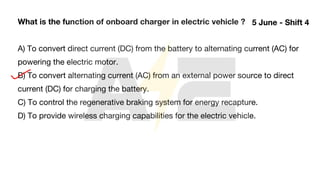
What is thefunction of onboard charger in electric vehicle ?
A) To convert direct current (DC) from the battery to alternating current (AC) for
powering the electric motor.
B) To convert alternating current (AC) from an external power source to direct
current (DC) for charging the battery.
C) To control the regenerative braking system for energy recapture.
D) To provide wireless charging capabilities for the electric vehicle.
5 June - Shift 4
27.
Ameyzingg Engineers @ameyzingg_engineers
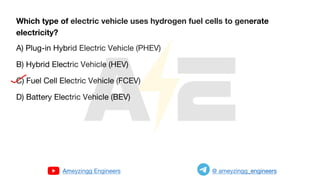
Which type of electric vehicle uses hydrogen fuel cells to generate
electricity?
A) Plug-in Hybrid Electric Vehicle (PHEV)
B) Hybrid Electric Vehicle (HEV)
C) Fuel Cell Electric Vehicle (FCEV)
D) Battery Electric Vehicle (BEV)
28.
Ameyzingg Engineers @ameyzingg_engineers
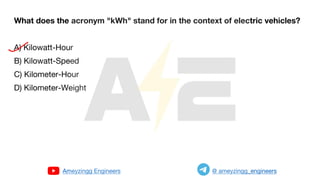
What does the acronym "kWh" stand for in the context of electric vehicles?
A) Kilowatt-Hour
B) Kilowatt-Speed
C) Kilometer-Hour
D) Kilometer-Weight
29.
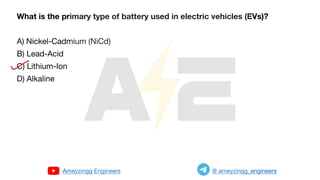
What is theprimary type of battery used in electric vehicles (EVs)?
A) Nickel-Cadmium (NiCd)
B) Lead-Acid
C) Lithium-Ion
D) Alkaline
Ameyzingg Engineers @ ameyzingg_engineers
30.
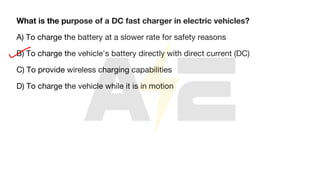
What is thepurpose of a DC fast charger in electric vehicles?
A) To charge the battery at a slower rate for safety reasons
B) To charge the vehicle's battery directly with direct current (DC)
C) To provide wireless charging capabilities
D) To charge the vehicle while it is in motion
31.
Ameyzingg Engineers @ameyzingg_engineers
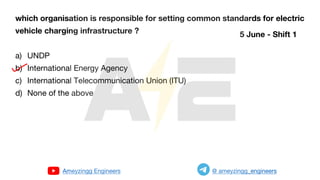
which organisation is responsible for setting common standards for electric
vehicle charging infrastructure ?
a) UNDP
b) International Energy Agency
c) International Telecommunication Union (ITU)
d) None of the above
5 June - Shift 1
32.
Ameyzingg Engineers @ameyzingg_engineers
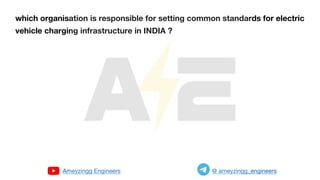
which organisation is responsible for setting common standards for electric
vehicle charging infrastructure in INDIA ?
Ameyzingg Engineers @ameyzingg_engineers
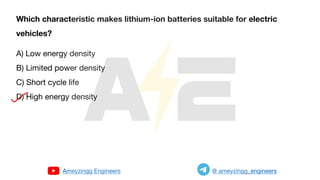
Which characteristic makes lithium-ion batteries suitable for electric
vehicles?
A) Low energy density
B) Limited power density
C) Short cycle life
D) High energy density