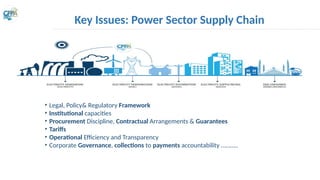
Comprehensive Overview of CPPA-G and Pakistan's Competitive Power Market Evolution
An in-depth presentation on CPPA-G's role, market structure, CTBCM features, wholesale market design, and power sector reforms in Pakistan's electricity trading landscape.
INTRODUCTION
Central Power PurchasingAgency (CPPA-G)-
Company incorporated under the Companies
Ordinance, 1984
Wholly owned by the Government of Pakistan
Since June 2015, CPPA-G has assumed the business
of National Transmission and Dispatch Company
pertaining to the market operations
Presently functioning as the Market Operator in
accordance with Rule-5 of the NEPRA Market
Rules, 2015.
3.
To become aworld-class power Market
Operator by providing the optimum
environment for trading electricity in the
Pakistani Power Market.
www.cppa.gov.pk
Vision
4.
To achieve ourvision, we are determined to become one of
the best-run public organizations in the world, a place where
people love to work, developing capacity of stakeholders and
providing systems, tools, and processes for enabling a
transparent and competitive power market. During the
transition period, however, our company will also procure the
required energy on behalf of the Distribution Companies for
retail sales to their customers transparently and efficiently.
www.cppa.gov.pk
Mission
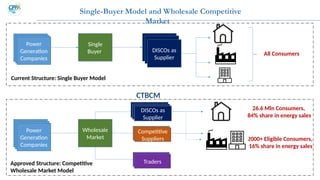
Single-Buyer Model andWholesale Competitive
Market
Single
Buyer DISCOs as
Supplier
All Consumers
Power
Generation
Companies
Wholesale
Market
Traders
Competitive
Suppliers
26.6 Mln Consumers,
84% share in energy sales
2000+ Eligible Consumers,
16% share in energy sales
Current Structure: Single Buyer Model
Approved Structure: Competitive
Wholesale Market Model
CTBCM
DISCOs as
Supplier
Power
Generation
Companies
Power
Generation
Companies
DISCOs as
Supplier
Competitive
Suppliers
Traders
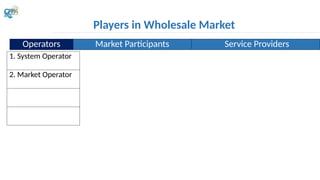
11.
Players in WholesaleMarket
1. System Operator
2. Market Operator
Operators Market Participants Service Providers
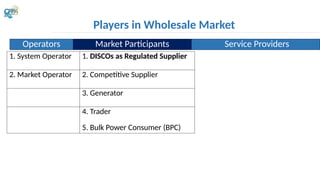
12.
Players in WholesaleMarket
1. System Operator 1. DISCOs as Regulated Supplier
2. Market Operator 2. Competitive Supplier
3. Generator
4. Trader
5. Bulk Power Consumer (BPC)
Operators Market Participants Service Providers
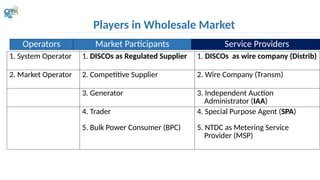
13.
Players in WholesaleMarket
1. System Operator 1. DISCOs as Regulated Supplier 1. DISCOs as wire company (Distrib)
2. Market Operator 2. Competitive Supplier 2. Wire Company (Transm)
3. Generator 3. Independent Auction
Administrator (IAA)
4. Trader
5. Bulk Power Consumer (BPC)
4. Special Purpose Agent (SPA)
5. NTDC as Metering Service
Provider (MSP)
Operators Market Participants Service Providers
14.
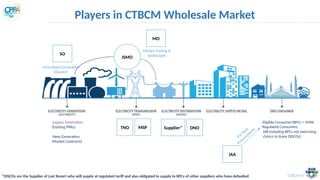
Players in CTBCMWholesale Market
ISMO
> 1MW
Centralized Generation
Dispatch
- Eligible Consumer/BPCs > 1MW
-Legacy Generation
(Existing PPAs)
-New Generation
(Market Contracts)
Market Trading &
Settlement
SO
MO
TNO
Competition
IAA
DNO
MSP Supplier*
CTBCM Features
*DISCOs are the Supplier of Last Resort who will supply at regulated tariff and also obligated to supply to BPCs of other suppliers who have defaulted
- Regulated Consumers
(All including BPCs not exercising
choice to leave DISCOs)
For New
Procurem
ents
15.
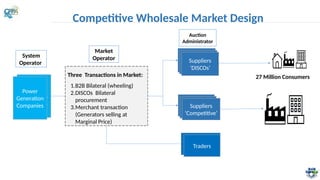
Competitive Wholesale MarketDesign
Power
Generation
Companies
Three Transactions in Market:
1.B2B Bilateral (wheeling)
2.DISCOs Bilateral
procurement
3.Merchant transaction
(Generators selling at
Marginal Price)
Traders
27 Million Consumers
DISCOs as
Supplier
Power
Generation
Companies
Suppliers
‘DISCOs’
Competitive
Suppliers
Traders
Competitive
Suppliers
Suppliers
‘Competitive’
System
Operator
Market
Operator
Auction
Administrator
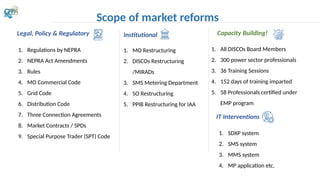
Scope of marketreforms
Legal, Policy & Regulatory Institutional Capacity Building!
IT Interventions
1. Regulations by NEPRA
2. NEPRA Act Amendments
3. Rules
4. MO Commercial Code
5. Grid Code
6. Distribution Code
7. Three Connection Agreements
8. Market Contracts / SPDs
9. Special Purpose Trader (SPT) Code
1. MO Restructuring
2. DISCOs Restructuring
/MIRADs
3. SMS Metering Department
4. SO Restructuring
5. PPIB Restructuring for IAA
1. All DISCOs Board Members
2. 300 power sector professionals
3. 36 Training Sessions
4. 152 days of training imparted
5. 58 Professionals certified under
EMP program
1. SDXP system
2. SMS system
3. MMS system
4. MP application etc.
18.
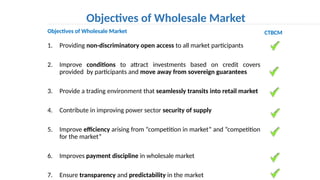
1. Providing non-discriminatoryopen access to all market participants
2. Improve conditions to attract investments based on credit covers
provided by participants and move away from sovereign guarantees
3. Provide a trading environment that seamlessly transits into retail market
4. Contribute in improving power sector security of supply
5. Improve efficiency arising from “competition in market” and “competition
for the market”
6. Improves payment discipline in wholesale market
7. Ensure transparency and predictability in the market
Objectives of Wholesale Market
Objectives of Wholesale Market CTBCM
19.
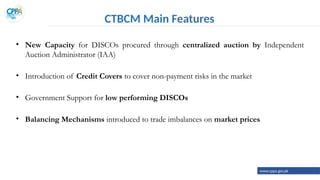
CTBCM Main Features
•New Capacity for DISCOs procured through centralized auction by Independent
Auction Administrator (IAA)
• Introduction of Credit Covers to cover non-payment risks in the market
• Government Support for low performing DISCOs
• Balancing Mechanisms introduced to trade imbalances on market prices
www.cppa.gov.pk
20.
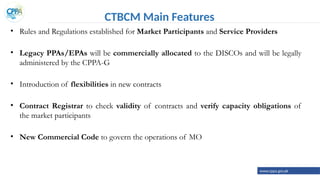
CTBCM Main Features
•Rules and Regulations established for Market Participants and Service Providers
• Legacy PPAs/EPAs will be commercially allocated to the DISCOs and will be legally
administered by the CPPA-G
• Introduction of flexibilities in new contracts
• Contract Registrar to check validity of contracts and verify capacity obligations of
the market participants
• New Commercial Code to govern the operations of MO
www.cppa.gov.pk
www.cppa.gov.pk
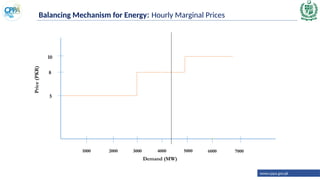
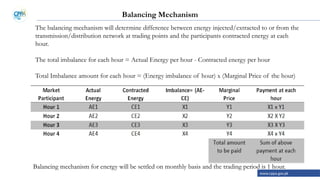
Balancing Mechanism
The balancingmechanism will determine difference between energy injected/extracted to or from the
transmission/distribution network at trading points and the participants contracted energy at each
hour.
The total imbalance for each hour = Actual Energy per hour - Contracted energy per hour
Total Imbalance amount for each hour = (Energy imbalance of hour) x (Marginal Price of the hour)
Balancing mechanism for energy will be settled on monthly basis and the trading period is 1 hour.
23.
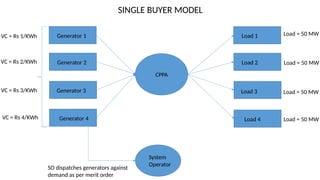
Generator 1
Generator 2
Generator3
Generator 4
VC = Rs 1/KWh
VC = Rs 2/KWh
VC = Rs 3/KWh
VC = Rs 4/KWh
CPPA
Load 1
Load 2
Load 3
Load 4
Load = 50 MW
Load = 50 MW
Load = 50 MW
Load = 50 MW
System
Operator
SO dispatches generators against
demand as per merit order
SINGLE BUYER MODEL
24.
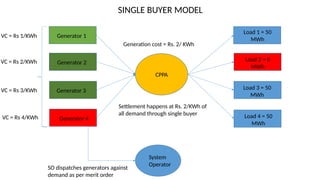
Generator 1
Generator 2
Generator3
Generator 4
VC = Rs 1/KWh
VC = Rs 2/KWh
VC = Rs 3/KWh
VC = Rs 4/KWh
CPPA
Load 1 = 50
MWh
Load 2 = 0
MWh
Load 3 = 50
MWh
Load 4 = 50
MWh
System
Operator
SO dispatches generators against
demand as per merit order
Generation cost = Rs. 2/ KWh
Settlement happens at Rs. 2/KWh of
all demand through single buyer
SINGLE BUYER MODEL
25.
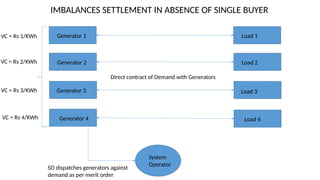
Generator 1
Generator 2
Generator3
Generator 4
VC = Rs 1/KWh
VC = Rs 2/KWh
VC = Rs 3/KWh
VC = Rs 4/KWh
Load 1
Load 2
Load 3
Load 4
Load = 50 MW
Load = 50 MW
Load = 50 MW
Load = 50 MW
System
Operator
SO dispatches generators against
demand as per merit order
Direct contract of Demand with Generators
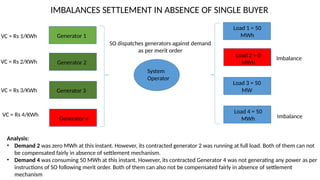
IMBALANCES SETTLEMENT IN ABSENCE OF SINGLE BUYER
26.
Generator 1
Generator 2
Generator3
Generator 4
VC = Rs 1/KWh
VC = Rs 2/KWh
VC = Rs 3/KWh
VC = Rs 4/KWh
Load 1 = 50
MWh
Load 2 = 0
MWh
Load 3 = 50
MW
Load 4 = 50
MWh
System
Operator
SO dispatches generators against demand
as per merit order
Imbalance
Imbalance
Analysis:
• Demand 2 was zero MWh at this instant. However, its contracted generator 2 was running at full load. Both of them can not
be compensated fairly in absence of settlement mechanism.
• Demand 4 was consuming 50 MWh at this instant. However, its contracted Generator 4 was not generating any power as per
instructions of SO following merit order. Both of them can also not be compensated fairly in absence of settlement
mechanism
IMBALANCES SETTLEMENT IN ABSENCE OF SINGLE BUYER
27.
Payment @
4/KWh
Generator 1
Generator2
Generator 3
Generator 4
Load 1 = 50
MWh
Load 2 = 0
MWh
Load 3 = 50
MW
Load 4 = 50
MWh
Market
Operator
Imbalance
Imbalance
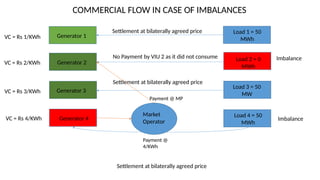
COMMERCIAL FLOW IN CASE OF IMBALANCES
Settlement at bilaterally agreed price
No Payment by VIU 2 as it did not consume
Settlement at bilaterally agreed price
VC = Rs 1/KWh
VC = Rs 2/KWh
VC = Rs 3/KWh
VC = Rs 4/KWh
Payment @ MP
Settlement at bilaterally agreed price
28.
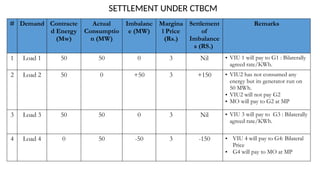
SETTLEMENT UNDER CTBCM
#Demand Contracte
d Energy
(Mw)
Actual
Consumptio
n (MW)
Imbalanc
e (MW)
Margina
l Price
(Rs.)
Settlement
of
Imbalance
s (RS.)
Remarks
1 Load 1 50 50 0 3 Nil • VIU 1 will pay to G1 : Bilaterally
agreed rate/KWh.
2 Load 2 50 0 +50 3 +150 • VIU2 has not consumed any
energy but its generator run on
50 MWh.
• VIU2 will not pay G2
• MO will pay to G2 at MP
3 Load 3 50 50 0 3 Nil • VIU 3 will pay to G3 : Bilaterally
agreed rate/KWh.
4 Load 4 0 50 -50 3 -150 • VIU 4 will pay to G4: Bilateral
Price
• G4 will pay to MO at MP
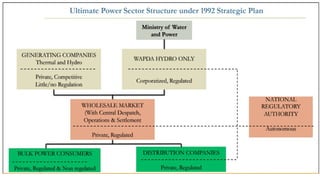
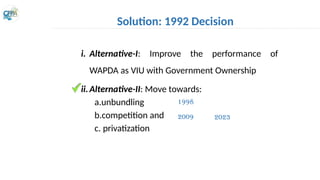
i. Alternative-I: Improvethe performance of
WAPDA as VIU with Government Ownership
ii.Alternative-II: Move towards:
a.unbundling
b.competition and
c. privatization
Solution: 1992 Decision
1998
2009 2023
33.
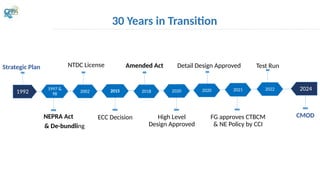
30 Years inTransition
2002 2018 2020
1997 &
98
2015 2020
1992
Strategic Plan
NEPRA Act
& De-bundling
NTDC License Amended Act
High Level
Design Approved
2021 2024
Test Run
ECC Decision
Detail Design Approved
FG approves CTBCM
& NE Policy by CCI
2022
CMOD
34.
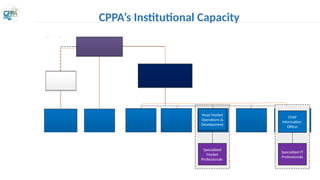
CPPA’s Institutional Capacity
HeadMarket
Operations &
Development
Specialized
Market
Professionals
Chief
Information
Officer
Specialized IT
Professionals
35.
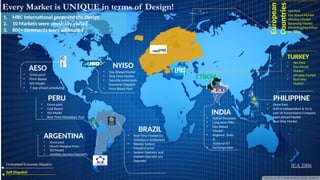
TURKEY
• Net Pool
•Day Ahead
Market
• Intraday Market
• Real time
Market
INDIA
PHILIPPINE
• Gross Pool
• IMO is independent & SO is
part of Transmission Company
• Hour Ahead Market
• Real time Market
BRAZIL
• Real Time Market for
Imbalance Settlement
• Weekly System
Marginal price
• System Operator and
Market Operator are
Separate
ARGENTINA
• Gross pool
• Hourly Marginal Price
• ISO Model
• Ancillary Services Payments
PERU
• Gross pool
• Cost Based
• ISO Model
• Real Time Mandatory Pool
European
Countries
• Hybrid Structure
• Long term PPAs
• Day Ahead
Market
• Regional ,State
&
National SO
• Exchange exist
• Net Pool
• Day Ahead Market
• Intraday Market
• Balancing Market
• EPEXSPOT/Nord Pool
Exchange
Every Market is UNIQUE in terms of Design!
AESO
• Gross pool
• Price Based
• ISO Model
• 7 day ahead scheduling
NYISO
• Day Ahead Market
• Real Time Market
• Security constraints
Economic Dispatch
• Price Based Pool
1. MRC International proposed the Design
2. 10 Markets were physically visited
3. 800+ comments were addressed
Self Dispatch
Centralized Economic Dispatch
CTBCM
IEA 2006
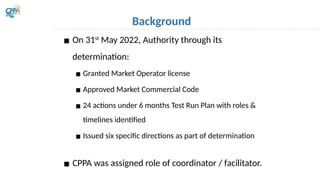
Background
▪ On 31st
May2022, Authority through its
determination:
▪ Granted Market Operator license
▪ Approved Market Commercial Code
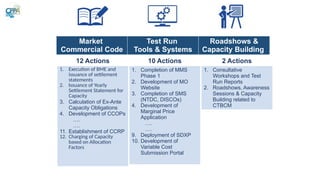
▪ 24 actions under 6 months Test Run Plan with roles &
timelines identified
▪ Issued six specific directions as part of determination
▪ CPPA was assigned role of coordinator / facilitator.
38.
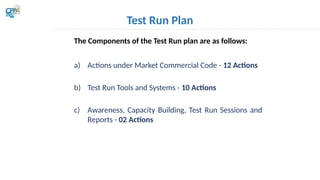
Test Run Plan
TheComponents of the Test Run plan are as follows:
a) Actions under Market Commercial Code - 12 Actions
b) Test Run Tools and Systems - 10 Actions
c) Awareness, Capacity Building, Test Run Sessions and
Reports - 02 Actions
39.
Market
Commercial Code
Test Run
Tools& Systems
Roadshows &
Capacity Building
12 Actions
1. Execution of BME and
issuance of settlement
statements
2. Issuance of Yearly
Settlement Statement for
Capacity
3. Calculation of Ex-Ante
Capacity Obligations
4. Development of CCOPs
….
….
11. Establishment of CCRP
12. Charging of Capacity
based on Allocation
Factors
10 Actions
1. Completion of MMS
Phase 1
2. Development of MO
Website
3. Completion of SMS
(NTDC, DISCOs)
4. Development of
Marginal Price
Application
….
….
9. Deployment of SDXP
10. Development of
Variable Cost
Submission Portal
2 Actions
1. Consultative
Workshops and Test
Run Reports
2. Roadshows, Awareness
Sessions & Capacity
Building related to
CTBCM
40.
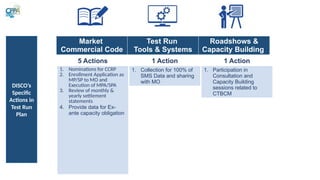
Market
Commercial Code
Test Run
Tools& Systems
Roadshows &
Capacity Building
5 Actions
1. Nominations for CCRP
2. Enrollment Application as
MP/SP to MO and
Execution of MPA/SPA
3. Review of monthly &
yearly settlement
statements
4. Provide data for Ex-
ante capacity obligation
1 Action
1. Collection for 100% of
SMS Data and sharing
with MO
1 Action
1. Participation in
Consultation and
Capacity Building
sessions related to
CTBCM
DISCO’s
Specific
Actions in
Test Run
Plan
41.
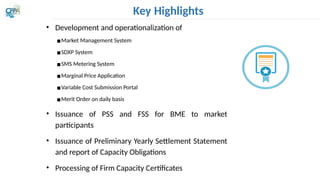
Key Highlights
• Developmentand operationalization of
▪Market Management System
▪SDXP System
▪SMS Metering System
▪Marginal Price Application
▪Variable Cost Submission Portal
▪Merit Order on daily basis
• Issuance of PSS and FSS for BME to market
participants
• Issuance of Preliminary Yearly Settlement Statement
and report of Capacity Obligations
• Processing of Firm Capacity Certificates
Secured
Metering
System
Marginal
Price
Application
42.
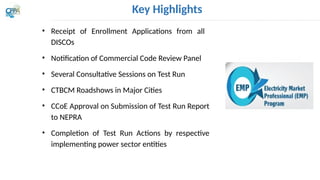
Key Highlights
• Receiptof Enrollment Applications from all
DISCOs
• Notification of Commercial Code Review Panel
• Several Consultative Sessions on Test Run
• CTBCM Roadshows in Major Cities
• CCoE Approval on Submission of Test Run Report
to NEPRA
• Completion of Test Run Actions by respective
implementing power sector entities
43.
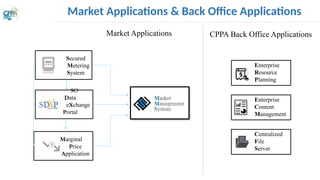
Market Applications &Back Office Applications
Secured
Metering
System
SO
Data
eXchange
Portal
Marginal
Price
Application
Enterprise
Content
Management
Enterprise
Resource
Planning
Centralized
File
Server
Market Applications CPPA Back Office Applications
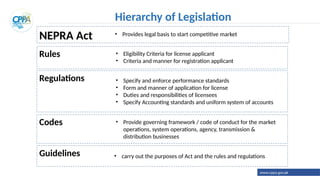
Hierarchy of Legislation
NEPRAAct
Rules • Eligibility Criteria for license applicant
• Criteria and manner for registration applicant
Regulations • Specify and enforce performance standards
• Form and manner of application for license
• Duties and responsibilities of licensees
• Specify Accounting standards and uniform system of accounts
Codes • Provide governing framework / code of conduct for the market
operations, system operations, agency, transmission &
distribution businesses
Guidelines • carry out the purposes of Act and the rules and regulations
• Provides legal basis to start competitive market
www.cppa.gov.pk
46.
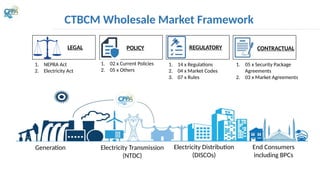
CTBCM Wholesale MarketFramework
LEGAL POLICY CONTRACTUAL
REGULATORY
1. NEPRA Act
2. Electricity Act
1. 02 x Current Policies
2. 05 x Others
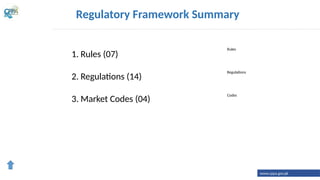
1. 14 x Regulations
2. 04 x Market Codes
3. 07 x Rules
1. 05 x Security Package
Agreements
2. 03 x Market Agreements
Generation Electricity Transmission
(NTDC)
Electricity Distribution
(DISCOs)
End Consumers
including BPCs
47.
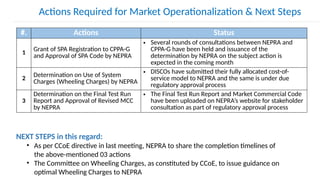
NEXT STEPS inthis regard:
• As per CCoE directive in last meeting, NEPRA to share the completion timelines of
the above-mentioned 03 actions
• The Committee on Wheeling Charges, as constituted by CCoE, to issue guidance on
optimal Wheeling Charges to NEPRA
Actions Required for Market Operationalization & Next Steps
#. Actions Status
1
Grant of SPA Registration to CPPA-G
and Approval of SPA Code by NEPRA
• Several rounds of consultations between NEPRA and
CPPA-G have been held and issuance of the
determination by NEPRA on the subject action is
expected in the coming month
2
Determination on Use of System
Charges (Wheeling Charges) by NEPRA
• DISCOs have submitted their fully allocated cost-of-
service model to NEPRA and the same is under due
regulatory approval process
3
Determination on the Final Test Run
Report and Approval of Revised MCC
by NEPRA
• The Final Test Run Report and Market Commercial Code
have been uploaded on NEPRA’s website for stakeholder
consultation as part of regulatory approval process
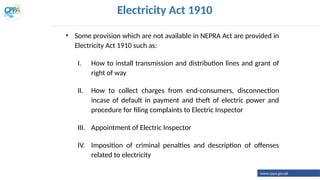
Electricity Act 1910
•Some provision which are not available in NEPRA Act are provided in
Electricity Act 1910 such as:
I. How to install transmission and distribution lines and grant of
right of way
II. How to collect charges from end-consumers, disconnection
incase of default in payment and theft of electric power and
procedure for filing complaints to Electric Inspector
III. Appointment of Electric Inspector
IV. Imposition of criminal penalties and description of offenses
related to electricity
www.cppa.gov.pk
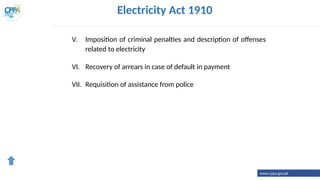
51.
Electricity Act 1910
V.Imposition of criminal penalties and description of offenses
related to electricity
VI. Recovery of arrears in case of default in payment
VII. Requisition of assistance from police
www.cppa.gov.pk
52.
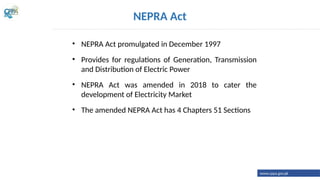
NEPRA Act
• NEPRAAct promulgated in December 1997
• Provides for regulations of Generation, Transmission
and Distribution of Electric Power
• NEPRA Act was amended in 2018 to cater the
development of Electricity Market
• The amended NEPRA Act has 4 Chapters 51 Sections
www.cppa.gov.pk
53.
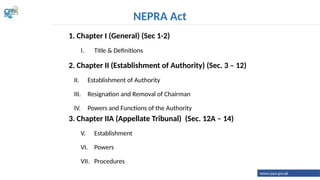
1. Chapter I(General) (Sec 1-2)
I. Title & Definitions
2. Chapter II (Establishment of Authority) (Sec. 3 – 12)
II. Establishment of Authority
III. Resignation and Removal of Chairman
IV. Powers and Functions of the Authority
3. Chapter IIA (Appellate Tribunal) (Sec. 12A – 14)
V. Establishment
VI. Powers
VII. Procedures
NEPRA Act
www.cppa.gov.pk
54.
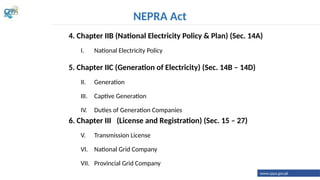
4. Chapter IIB(National Electricity Policy & Plan) (Sec. 14A)
I. National Electricity Policy
5. Chapter IIC (Generation of Electricity) (Sec. 14B – 14D)
II. Generation
III. Captive Generation
IV. Duties of Generation Companies
6. Chapter III (License and Registration) (Sec. 15 – 27)
V. Transmission License
VI. National Grid Company
VII. Provincial Grid Company
NEPRA Act
www.cppa.gov.pk
55.
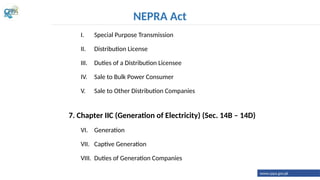
I. Special PurposeTransmission
II. Distribution License
III. Duties of a Distribution Licensee
IV. Sale to Bulk Power Consumer
V. Sale to Other Distribution Companies
7. Chapter IIC (Generation of Electricity) (Sec. 14B – 14D)
VI. Generation
VII. Captive Generation
VIII. Duties of Generation Companies
NEPRA Act
www.cppa.gov.pk
56.
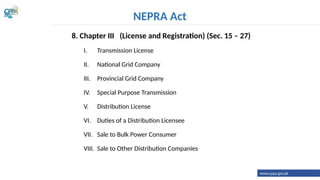
8. Chapter III(License and Registration) (Sec. 15 – 27)
I. Transmission License
II. National Grid Company
III. Provincial Grid Company
IV. Special Purpose Transmission
V. Distribution License
VI. Duties of a Distribution Licensee
VII. Sale to Bulk Power Consumer
VIII. Sale to Other Distribution Companies
NEPRA Act
www.cppa.gov.pk
57.
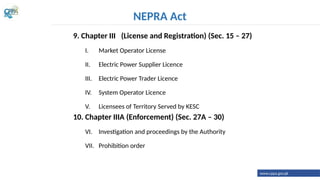
9. Chapter III(License and Registration) (Sec. 15 – 27)
I. Market Operator License
II. Electric Power Supplier Licence
III. Electric Power Trader Licence
IV. System Operator Licence
V. Licensees of Territory Served by KESC
10. Chapter IIIA (Enforcement) (Sec. 27A – 30)
VI. Investigation and proceedings by the Authority
VII. Prohibition order
NEPRA Act
www.cppa.gov.pk
58.
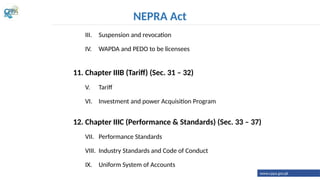
III. Suspension andrevocation
IV. WAPDA and PEDO to be licensees
11. Chapter IIIB (Tariff) (Sec. 31 – 32)
V. Tariff
VI. Investment and power Acquisition Program
12. Chapter IIIC (Performance & Standards) (Sec. 33 – 37)
VII. Performance Standards
VIII. Industry Standards and Code of Conduct
IX. Uniform System of Accounts
NEPRA Act
www.cppa.gov.pk
59.
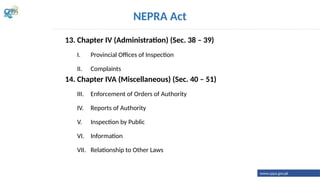
13. Chapter IV(Administration) (Sec. 38 – 39)
I. Provincial Offices of Inspection
II. Complaints
14. Chapter IVA (Miscellaneous) (Sec. 40 – 51)
III. Enforcement of Orders of Authority
IV. Reports of Authority
V. Inspection by Public
VI. Information
VII. Relationship to Other Laws
NEPRA Act
www.cppa.gov.pk
60.
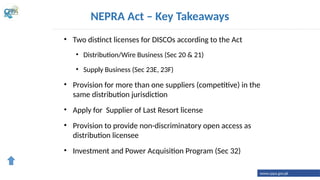
• Two distinctlicenses for DISCOs according to the Act
• Distribution/Wire Business (Sec 20 & 21)
• Supply Business (Sec 23E, 23F)
• Provision for more than one suppliers (competitive) in the
same distribution jurisdiction
• Apply for Supplier of Last Resort license
• Provision to provide non-discriminatory open access as
distribution licensee
• Investment and Power Acquisition Program (Sec 32)
NEPRA Act – Key Takeaways
www.cppa.gov.pk
61.
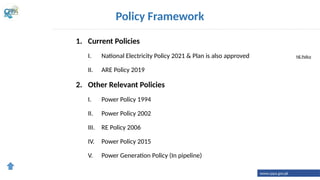
1. Current Policies
I.National Electricity Policy 2021 & Plan is also approved
II. ARE Policy 2019
2. Other Relevant Policies
I. Power Policy 1994
II. Power Policy 2002
III. RE Policy 2006
IV. Power Policy 2015
V. Power Generation Policy (In pipeline)
Policy Framework
www.cppa.gov.pk
NE Policy
62.
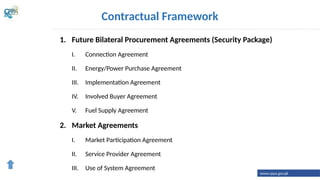
Contractual Framework
1. FutureBilateral Procurement Agreements (Security Package)
I. Connection Agreement
II. Energy/Power Purchase Agreement
III. Implementation Agreement
IV. Involved Buyer Agreement
V. Fuel Supply Agreement
2. Market Agreements
I. Market Participation Agreement
II. Service Provider Agreement
III. Use of System Agreement
www.cppa.gov.pk
63.
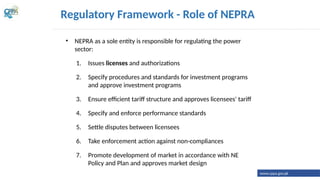
• NEPRA asa sole entity is responsible for regulating the power
sector:
1. Issues licenses and authorizations
2. Specify procedures and standards for investment programs
and approve investment programs
3. Ensure efficient tariff structure and approves licensees' tariff
4. Specify and enforce performance standards
5. Settle disputes between licensees
6. Take enforcement action against non-compliances
7. Promote development of market in accordance with NE
Policy and Plan and approves market design
Regulatory Framework - Role of NEPRA
www.cppa.gov.pk
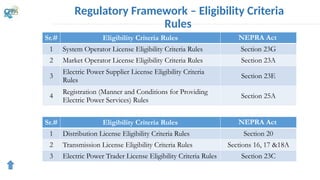
Regulatory Framework –Eligibility Criteria
Rules
Sr.# Eligibility Criteria Rules NEPRA Act
1 System Operator License Eligibility Criteria Rules Section 23G
2 Market Operator License Eligibility Criteria Rules Section 23A
3
Electric Power Supplier License Eligibility Criteria
Rules
Section 23E
4
Registration (Manner and Conditions for Providing
Electric Power Services) Rules
Section 25A
Sr.# Eligibility Criteria Rules NEPRA Act
1 Distribution License Eligibility Criteria Rules Section 20
2 Transmission License Eligibility Criteria Rules Sections 16, 17 &18A
3 Electric Power Trader License Eligibility Criteria Rules Section 23C
66.
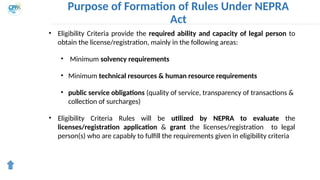
Purpose of Formationof Rules Under NEPRA
Act
• Eligibility Criteria provide the required ability and capacity of legal person to
obtain the license/registration, mainly in the following areas:
• Minimum solvency requirements
• Minimum technical resources & human resource requirements
• public service obligations (quality of service, transparency of transactions &
collection of surcharges)
• Eligibility Criteria Rules will be utilized by NEPRA to evaluate the
licenses/registration application & grant the licenses/registration to legal
person(s) who are capably to fulfill the requirements given in eligibility criteria
67.
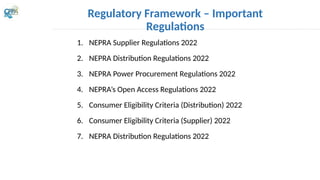
1. NEPRA SupplierRegulations 2022
2. NEPRA Distribution Regulations 2022
3. NEPRA Power Procurement Regulations 2022
4. NEPRA’s Open Access Regulations 2022
5. Consumer Eligibility Criteria (Distribution) 2022
6. Consumer Eligibility Criteria (Supplier) 2022
7. NEPRA Distribution Regulations 2022
Regulatory Framework – Important
Regulations
Editor's Notes
#3 Before going into market structure in Pakistan lets discuss background that world wide markets k,,,,,,,,,,in the last century the world witnessed an exponential growth in systems and technologies using this advancement the trading in electricity has advanced to a stage where every consumer has the choice to select his own power supplier.
However, with the introduction of competition, consumers now have the opportunity to choose their electricity supplier from multiple providers. In the past, the electricity market might have been dominated by a single buyer or a monopoly, where consumers had limited choices and prices were set by the sole provider.
"Why is competition important in markets, such as the electricity sector? What are the benefits of moving from a single buyer model to embracing competition?“
"Why is competition crucial? It drives innovation, lowers prices, and gives consumers more choices. Transitioning to competition in the electricity market empowers consumers, encourages efficiency, and fosters innovation.“suppliers must offer competitive prices to attract customers. This results in downward pressure on prices, ultimately benefiting consumers with lower electricity bills. Suppliers are encouraged to find creative solutions to meet consumer needs and differentiate themselves in the market.
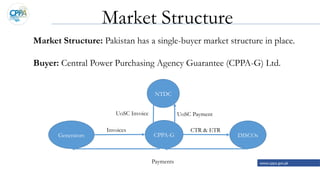
Two important parts of this change are Contractual Transmission Rights (CTR) and Energy Trading Rights (ETR). These help CPPA (Central Power Purchasing Agency) and NTDC (National Transmission and Dispatch Company) manage electricity better.
ETR is the cost per unit of energy (kWh) that distribution companies pay for the electricity they actually use.
CTR is the cost per unit of capacity (kW) that distribution companies pay for the ability to access electricity as needed.
These rates ensure that generation companies are compensated fairly for both the energy they produce and their readiness to supply power whenever it’s needed.
#4 Before going into market structure in Pakistan lets discuss background that world wide markets k,,,,,,,,,,in the last century the world witnessed an exponential growth in systems and technologies using this advancement the trading in electricity has advanced to a stage where every consumer has the choice to select his own power supplier.
However, with the introduction of competition, consumers now have the opportunity to choose their electricity supplier from multiple providers. In the past, the electricity market might have been dominated by a single buyer or a monopoly, where consumers had limited choices and prices were set by the sole provider.
"Why is competition important in markets, such as the electricity sector? What are the benefits of moving from a single buyer model to embracing competition?“
"Why is competition crucial? It drives innovation, lowers prices, and gives consumers more choices. Transitioning to competition in the electricity market empowers consumers, encourages efficiency, and fosters innovation.“suppliers must offer competitive prices to attract customers. This results in downward pressure on prices, ultimately benefiting consumers with lower electricity bills. Suppliers are encouraged to find creative solutions to meet consumer needs and differentiate themselves in the market.
Two important parts of this change are Contractual Transmission Rights (CTR) and Energy Trading Rights (ETR). These help CPPA (Central Power Purchasing Agency) and NTDC (National Transmission and Dispatch Company) manage electricity better.
ETR is the cost per unit of energy (kWh) that distribution companies pay for the electricity they actually use.
CTR is the cost per unit of capacity (kW) that distribution companies pay for the ability to access electricity as needed.
These rates ensure that generation companies are compensated fairly for both the energy they produce and their readiness to supply power whenever it’s needed.
#5 Before going into market structure in Pakistan lets discuss background that world wide markets k,,,,,,,,,,in the last century the world witnessed an exponential growth in systems and technologies using this advancement the trading in electricity has advanced to a stage where every consumer has the choice to select his own power supplier.
However, with the introduction of competition, consumers now have the opportunity to choose their electricity supplier from multiple providers. In the past, the electricity market might have been dominated by a single buyer or a monopoly, where consumers had limited choices and prices were set by the sole provider.
"Why is competition important in markets, such as the electricity sector? What are the benefits of moving from a single buyer model to embracing competition?“
"Why is competition crucial? It drives innovation, lowers prices, and gives consumers more choices. Transitioning to competition in the electricity market empowers consumers, encourages efficiency, and fosters innovation.“suppliers must offer competitive prices to attract customers. This results in downward pressure on prices, ultimately benefiting consumers with lower electricity bills. Suppliers are encouraged to find creative solutions to meet consumer needs and differentiate themselves in the market.
Two important parts of this change are Contractual Transmission Rights (CTR) and Energy Trading Rights (ETR). These help CPPA (Central Power Purchasing Agency) and NTDC (National Transmission and Dispatch Company) manage electricity better.
ETR is the cost per unit of energy (kWh) that distribution companies pay for the electricity they actually use.
CTR is the cost per unit of capacity (kW) that distribution companies pay for the ability to access electricity as needed.
These rates ensure that generation companies are compensated fairly for both the energy they produce and their readiness to supply power whenever it’s needed.
#7 Before going into market structure in Pakistan lets discuss background that world wide markets k,,,,,,,,,,in the last century the world witnessed an exponential growth in systems and technologies using this advancement the trading in electricity has advanced to a stage where every consumer has the choice to select his own power supplier.
However, with the introduction of competition, consumers now have the opportunity to choose their electricity supplier from multiple providers. In the past, the electricity market might have been dominated by a single buyer or a monopoly, where consumers had limited choices and prices were set by the sole provider.
"Why is competition important in markets, such as the electricity sector? What are the benefits of moving from a single buyer model to embracing competition?“
"Why is competition crucial? It drives innovation, lowers prices, and gives consumers more choices. Transitioning to competition in the electricity market empowers consumers, encourages efficiency, and fosters innovation.“suppliers must offer competitive prices to attract customers. This results in downward pressure on prices, ultimately benefiting consumers with lower electricity bills. Suppliers are encouraged to find creative solutions to meet consumer needs and differentiate themselves in the market.
Two important parts of this change are Contractual Transmission Rights (CTR) and Energy Trading Rights (ETR). These help CPPA (Central Power Purchasing Agency) and NTDC (National Transmission and Dispatch Company) manage electricity better.
ETR is the cost per unit of energy (kWh) that distribution companies pay for the electricity they actually use.
CTR is the cost per unit of capacity (kW) that distribution companies pay for the ability to access electricity as needed.
These rates ensure that generation companies are compensated fairly for both the energy they produce and their readiness to supply power whenever it’s needed.
#9 Conditions:
1) Technology (SCADA, metering infrastructure, billing systems);
Liquidity in market; maturity of Suppliers, Traders, Market Operators, Regulator,
Technological changes and other market conditions like market coming to equilibrium… etc.
#10 Talking Points:
Now we will compare the current single buyer model with the proposed model of the competitive wholesale market:
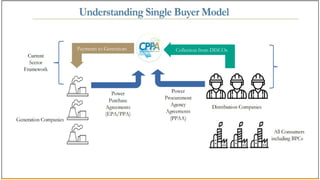
Under the existing Single-buyer model, CPPA-G as a single buyer contracts the generation capacity on behalf of DISCOs. Hence, CPPA-G is the main interface between generators and DISCO in terms of procuring power, negotiating and managing contracts and performing invoicing and settlements. (Go to the link)
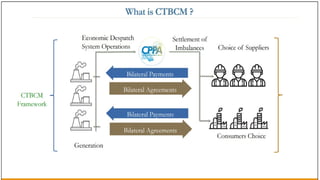
Under the competitive wholesale market model, CPPA-G will no longer be involved in procuring capacity for DISCOs and sign contracts on behalf of DISCOs, all the contracts will be signed directly among generators and DISCOs.
CTBCM is wholesale market design as given by ECC. NEPRA Act provides a legal framework and CTBCM is detailed design that enables trading within that framework.
In wholesale market, bulk volumes are traded, and therefore, large consumers will have choice to purchase from any supplier. In CTBCM generators will be centrally dispatched and the SO will establish the Marginal Clearing Price (MCP) or market index. Mechanism will be available for allowing trade between traders, suppliers, consumers and generators.
There are 2000 Bulk consumers representing 16% sales volume
#11 Explain Examples of Suppliers, Traders and BPC on the Board
SO:Manages the real-time operation of the electricity grid, ensuring reliability and stability by dispatching generation and balancing supply and demand.
Market operator: Facilitates the trading of electricity in wholesale markets, ensuring fairness and efficiency by overseeing transactions, setting prices, and enforcing market rules.
#13 IAA: Facilitates competitive auctions for the procurement of additional capacity or energy in the electricity market
Ensures transparency, fairness, and efficiency in the auction process, allowing market participants to bid for resources in a competitive and non-discriminatory manner
-Legacy Generation (Existing PPAs)
Bilateral contracting with strategic power projects
service provider includes all players which enabled the trade in the market but do not have a commercial interest in the market such as transmission distribution companies into
#14 - SO and MO are technical and commercial pillars of wholesale market
- Focus more on Participants and MO
#16 Tell them 80% of cost is generation (it’s procurement surplus/deficit, contracts nature, operations)
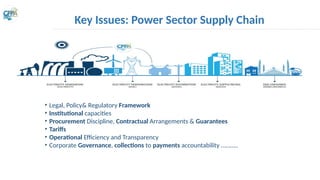
For any power sector in-order to achieve, the Energy Trilma of Affordability, Availablity and Financial self sustainability, its important that its framework is well current and aligned…..
Same key issues that existed 3 decades back
[ASK A QUESTION: WHAT DO WE UNDERSTAND FROM MARKET STRUCTURE], draw on board and then go to next slide and relate to decision taken
next slide
#18 Lets talk about the salient features of the upcoming wholesale market regarding how the trading will be conducted.
#19 Credibility of the market Operator is of paramount importance therefore its independence is key to achieve the goals of the market, otherwise no body would trust the market
The System Operator is the backbone of the market and therefore must be strenthegned to improve its operations
Dispatch will be converted to tool based instead of manual operations
To kill the boom and bust cycles, capacity obligations are introduced to procure sufficient capacity
IAA will be created to facilitate discos in new procurements
Transactions in the market will be covered through credit covers
Govt support will be available for some weaker discos until these are reformed
As in all competitive electicity markets, there are always imbalances between the committed quatitites and actual quantities. So balancing mechansims have been deveised to setle these imbalances on market prices
#20 Predictability, clarity and alighment of legal and policy framework is very important, therefore new rules and regualtiosn will be established
One of the most important aspect in any transition is the integration of the legacy contracts into the market. There are 6 to 8 methods and we have analysed all in detail. And the practical solution for paksistan is the commercial allocation to all discos.
New contracts will be much more flexible
#21 Mention
section 14 b & d
Rule 7 and 10 of Licensing rules
NTDC’s License
Grid Code
#29 7 min on why we are doing this and when this decision was taken….
#30 Conditions:
1) Technology (SCADA, metering infrastructure, billing systems);
Liquidity in market; maturity of Suppliers, Traders, Market Operators, Regulator,
Technological changes and other market conditions like market coming to equilibrium… etc.
#31 Tell them 80% of cost is generation (it’s procurement surplus/deficit, contracts nature, operations)
For any power sector in-order to achieve, the Energy Trilma of Affordability, Availablity and Financial self sustainability, its important that its framework is well current and aligned…..
Same key issues that existed 3 decades back
[ASK A QUESTION: WHAT DO WE UNDERSTAND FROM MARKET STRUCTURE], draw on board and then go to next slide and relate to decision taken
next slide
#32 - Decision on Market Structure
Strategic Plan 1992 provided a roadmap to move towards unbundling, competition and privatization
Multi buyer market is a pre condition to privatization for Governance improvement
All efficiencies and WE ARE EXAPNDING AND attraction of private capital will come through operationalizing a transparent, credible and well functioning wholesale market.
#46 Differentiate between Law, Policy, Regulations and Contracts
Answer why legal, policy, regulatory framework is important (from planning of assets, to procurement of power, to charging of consumers, and meeting the reliability and quality standards) all details are part of this framework
Spend 2 min on NEPRA Act
Give Example of their application in the power sector at the start of this slide
ASK A QUESTION [WHOSE ROLE IS TO WORK WITH CEO AND BOARD SO THAT XXXX]Include Role of MIRAD in the talk