Comprehensive Overview of Coagulants and Anticoagulants in Pharmacology
1.
Dr. Nikhilkumar SSakle
Assistant Professor
Department of Pharmacology
Y. B. Chavan College of pharmacy,Aurangabad.
Coagulants and Anticoagulants
2.
COAGULANTS
These aresubstances which promote coagulation, and are
indicated in haemorrhagic states.
Fresh whole blood or plasma provide all the factors needed
for coagulation and are the best therapy for deficiency of any
clotting factor; also they act immediately.
VITAMIN K
Itis a fat-soluble dietary principle required for the synthesis
of clotting factors.
Daily requirement:
It is uncertain, because a variable amount of menaquinone (vit K2)
produced by colonic bacteria becomes available. Even 3–10
g/day external source may be sufficient. However, the total
μ
requirement of an adult has been estimated to be 50–100
g/day
μ
5.
Action
Vit Kacts as a cofactor at a late stage in the synthesis by
liver of coagulation proteins— prothrombin, factors VII,
IX and X. The vit K dependent change ( carboxylation of
γ
glutamate residues of these zymogen proteins) confers on
them the capacity to bind Ca2+ and to get bound to
phospholipid surfaces—properties essential for participation
in the coagulation cascade.
6.
Utilization
Fat-soluble formsof vit K are absorbed from the
intestine via lymph and require bile salts for absorption, while
water-soluble forms are absorbed directly into portal blood.
An active transport process in the jejunum has been
demonstrated for K1, while K2 and K3 are absorbed by
simple diffusion. Vit K is only temporarily concentrated in
liver, but there are no significant stores in the body.
7.
Deficiency
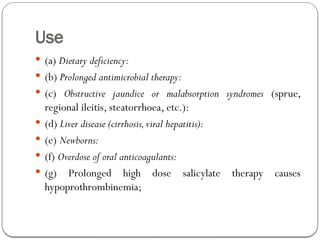
Deficiency ofvit K occurs due to liver disease, obstructive
jaundice, malabsorption, long-term antimicrobial therapy
which alters intestinal flora.
However, deficient diet is rarely responsible.
The most important manifestation is bleeding tendency due
to lowering of the levels of prothrombin and other clotting
factors in blood. Haematuria is usually first to occur; other
common sites of bleeding are g.i.t., nose and under the skin
—ecchymoses.
8.
Adverse effects
Phytonadioneinjected i.m. or given orally hardly
produces any adverse effect; allergic reactions are rare.
Severe anaphylactoid reactions can occur on i.v. injection of
emulsified formulation; this route should not be used.
LOCAL HAEMOSTATICS (STYPTICS)
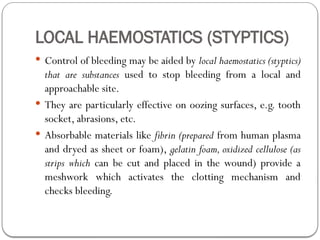
Control of bleeding may be aided by local haemostatics (styptics)
that are substances used to stop bleeding from a local and
approachable site.
They are particularly effective on oozing surfaces, e.g. tooth
socket, abrasions, etc.
Absorbable materials like fibrin (prepared from human plasma
and dryed as sheet or foam), gelatin foam, oxidized cellulose (as
strips which can be cut and placed in the wound) provide a
meshwork which activates the clotting mechanism and
checks bleeding.
11.
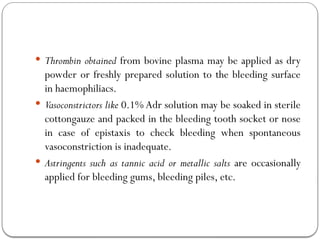
Thrombin obtainedfrom bovine plasma may be applied as dry
powder or freshly prepared solution to the bleeding surface
in haemophiliacs.
Vasoconstrictors like 0.1% Adr solution may be soaked in sterile
cottongauze and packed in the bleeding tooth socket or nose
in case of epistaxis to check bleeding when spontaneous
vasoconstriction is inadequate.
Astringents such as tannic acid or metallic salts are occasionally
applied for bleeding gums, bleeding piles, etc.
12.
ANTICOAGULANTS
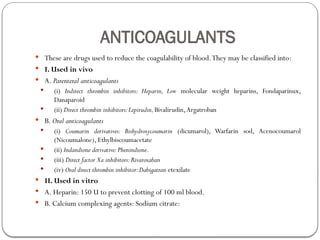
These aredrugs used to reduce the coagulability of blood.They may be classified into:
I. Used in vivo
A. Parenteral anticoagulants
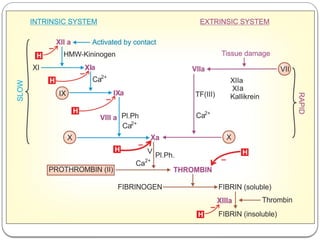
(i) Indirect thrombin inhibitors: Heparin, Low molecular weight heparins, Fondaparinux,
Danaparoid
(ii) Direct thrombin inhibitors:Lepirudin,Bivalirudin,Argatroban
B. Oral anticoagulants
(i) Coumarin derivatives: Bishydroxycoumarin (dicumarol), Warfarin sod, Acenocoumarol
(Nicoumalone), Ethylbiscoumacetate
(ii) Indandione derivative:Phenindione.
(iii) Direct factor Xa inhibitors:Rivaroxaban
(iv) Oral direct thrombin inhibitor:Dabigatran etexilate
II. Used in vitro
A. Heparin: 150 U to prevent clotting of 100 ml blood.
B. Calcium complexing agents: Sodium citrate:
13.
HEPARIN
Heparin isa non-uniform mixture of straight chain
mucopolysaccharides with MW 10,000 to 20,000.
Heparin is present in all tissues containing mast cells; richest
sources are lung, liver and intestinal mucosa.
Commercially it is produced from ox lung and pig intestinal
mucosa.
Dosage
Heparin isconventionally given i.v. in a bolus dose of 5,000–10,000
U (children 50–100 U/kg), followed by continuous infusion of 750–
1000 U/hr. Intermittent i.v. bolus doses of UFH are no longer
recommended. The rate of infusion is controlled by aPTT
measurement which is kept at 50–80 sec. or 1.5–2.5 times the
patient’s pretreatment value. If this test is not available, whole blood
clotting time should be measured and kept at ~2 times the normal
value.
Deep s.c. injection of 10,000–20,000 U every 8–12 hrs can be given
if i.v. infusion is not possible. Needle used should be fine and trauma
should be minimum to avoid haematoma formation. Haematomas are
more common with i.m. injection—this route should not be used.
17.
Low dose(s.c.) regimen 5000 U is injected s.c. every 8–12
hours, started before surgery and continued for 7–10 days or
till the patient starts moving about.This regimen has been
found to prevent postoperative deep vein thrombosis without
increasing surgical bleeding. It also does not prolong aPTT or
clotting time. However, it should not be used in case of
neurosurgery or when spinal anaesthesia is to be given.The
patients should not be receiving aspirin or oral
anticoagulants. It is ineffective in high-risk situations, e.g. hip
joint or pelvic surgery.
Contraindications
1. Bleedingdisorders, history of heparin induced
thrombocytopenia.
2. Severe hypertension (risk of cerebral haemorrhage), threatened
abortion, piles, g.i. ulcers (risk of aggravated bleeding).
3. Subacute bacterial endocarditis (risk of embolism), large
malignancies (risk of bleeding in the central necrosed area of the
tumour), tuberculosis (risk of hemoptysis).
4. Ocular and neurosurgery, lumbar puncture.
5. Chronic alcoholics, cirrhosis, renal failure.
6. Aspirin and other antiplatelet drugs should be used very
cautiously during heparin therapy.
20.
Low molecular weight(LMW) heparins
Heparin has been fractionated into LMW forms (MW 3000–7000) by
different techniques.
LMW heparins have a different anticoagulant profile; i.e. selectively inhibit
factor Xa with little effect on IIa.
They act only by inducing conformational change in AT III and not by
providing a scaffolding for interaction ofAT III with thrombin.
As a result, LMW heparins have smaller effect on aPTT and whole blood
clotting time than unfractionated heparin (UFH) relative to antifactor Xa
activity.
Also, they have lesser antiplatelet action—less interference with
haemostasis.
Thrombocytopenia is less frequent.
A lower incidence of haemorrhagic complications
21.
Indications
1. Prophylaxisof deep vein thrombosis and pulmonary
embolism in high-risk patients undergoing surgery; stroke or
other immobilized patients.
2.Treatment of established deep vein thrombosis.
3. Unstable angina and MI: they have largely replaced
continuous infusion of UFH.
4. To maintain patency of cannulae and shunts in dialysis
patients.
22.
HEPARIN ANTAGONIST
Protaminesulfate:
It is a strongly basic, low molecular weight protein obtained
from the sperm of certain fish.
Given i.v. it neutralises heparin
1 mg is needed for every 100 U of heparin.
For the treatment of heparin induced bleeding.
23.
ORAL ANTICOAGULANTS
Actionand mechanismWarfarin and its congeners act as anticoagulants only in
vivo, not in vitro.
This is so because they act indirectly by interfering with the synthesis of vit K
dependent clotting factors in liver.
They apparently behave as competitive antagonists of vit K and lower the
plasma levels of functional clotting factors in a dose-dependent manner.
They inhibit the enzyme vit K epoxide reductase (VKOR) and interfere with
regeneration of the active hydroquinone form of vit K which acts as a cofactor
for the enzyme -glutamyl carboxylase that carries out the final step of
γ γ
carboxylating glutamate residues of prothrombin and factorsVII, IX and X.
This carboxylation is essential for the ability of the clotting factors to bind
Ca2+ and to get bound to phospholipid surfaces, necessary for the coagulation
sequence to proceed
24.
Adverse effects
Bleedingas a result of extension of the desired
pharmacological action is the most important problem
causing ecchymosis, epistaxis, hematuria, bleeding in the
g.i.t. Intracranial or other internal haemorrhages may even
be fatal.
Bleeding is more likely if therapy is not properly monitored,
or when INR exceeds 4, or interacting
drugs/contraindications are present
25.
Dose regulation
Thedose of oral anticoagulant must be individualised by
repeated measurement of prothrombin time; the aim is to
achieve a therapeutic effect without unduly increasing the
chances of bleeding
26.
Factors enhancing effect
Debility, malnutrition, malabsorption and prolonged
antibiotic therapy: the supply of vit K to liver is reduced in
these conditions.
Liver disease, chronic alcoholism: synthesis of clotting factors
may be deficient.
Hyperthyroidism: the clotting factors are degraded faster.
Newborns: have low levels of vit K and clotting factors (there
should be no need of these drugs in neonates anyway).
27.
Factors decreasing effect
Pregnancy: plasma level of clotting factors is higher.
Nephrotic syndrome: drug bound to plasma protein is lost in
urine.
Genetic warfarin resistance: the affinity of warfarin (as well
as of vit K epoxide) to bind to the reductase (VKOR)
enzyme, which generates the active vit K hydroquinone, is
low. Dose of oral anticoagulant is 4–5 times higher.
28.
Contraindications
Oral anticoagulantsshould not be used during pregnancy.
Warfarin given in early pregnancy increases birth defects,
especially skeletal abnormalities. It can produce foetal
warfarin syndrome—hypoplasia of nose, eye socket, hand
bones, and growth retardation. Given later in pregnancy, it
can cause CNS defects, foetal haemorrhage, foetal death and
accentuates neonatal hypoprothrombinemia.