Comprehensive Overview of Coagulants and Anticoagulants in Blood Clotting
Detailed insights into blood coagulation mechanisms, pathways, coagulation factors, vitamin K role, and anticoagulant drugs including heparin, warfarin, and direct inhibitors.
Comprehensive Overview of Coagulants and Anticoagulants in Blood Clotting
2.
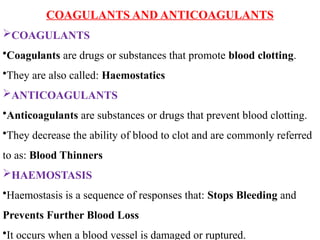
COAGULANTS AND ANTICOAGULANTS
COAGULANTS
•Coagulantsare drugs or substances that promote blood clotting.
•They are also called: Haemostatics
ANTICOAGULANTS
•Anticoagulants are substances or drugs that prevent blood clotting.
•They decrease the ability of blood to clot and are commonly referred
to as: Blood Thinners
HAEMOSTASIS
•Haemostasis is a sequence of responses that: Stops Bleeding and
Prevents Further Blood Loss
•It occurs when a blood vessel is damaged or ruptured.
3.
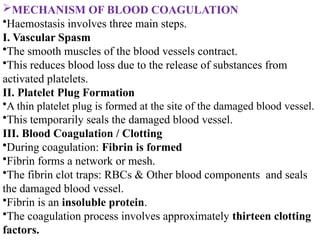
MECHANISM OF BLOODCOAGULATION
•Haemostasis involves three main steps.
I. Vascular Spasm
•The smooth muscles of the blood vessels contract.
•This reduces blood loss due to the release of substances from
activated platelets.
II. Platelet Plug Formation
•A thin platelet plug is formed at the site of the damaged blood vessel.
•This temporarily seals the damaged blood vessel.
III. Blood Coagulation / Clotting
•During coagulation: Fibrin is formed
•Fibrin forms a network or mesh.
•The fibrin clot traps: RBCs & Other blood components and seals
the damaged blood vessel.
•Fibrin is an insoluble protein.
•The coagulation process involves approximately thirteen clotting
factors.
4.
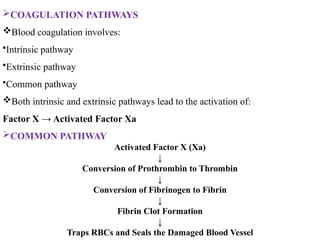
COAGULATION PATHWAYS
Blood coagulationinvolves:
•Intrinsic pathway
•Extrinsic pathway
•Common pathway
Both intrinsic and extrinsic pathways lead to the activation of:
Factor X → Activated Factor Xa
COMMON PATHWAY
Activated Factor X (Xa)
↓
Conversion of Prothrombin to Thrombin
↓
Conversion of Fibrinogen to Fibrin
↓
Fibrin Clot Formation
↓
Traps RBCs and Seals the Damaged Blood Vessel
5.
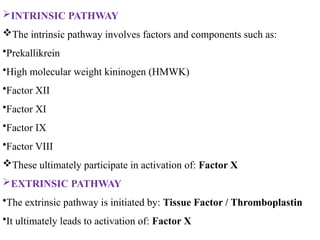
INTRINSIC PATHWAY
The intrinsicpathway involves factors and components such as:
•Prekallikrein
•High molecular weight kininogen (HMWK)
•Factor XII
•Factor XI
•Factor IX
•Factor VIII
These ultimately participate in activation of: Factor X
EXTRINSIC PATHWAY
•The extrinsic pathway is initiated by: Tissue Factor / Thromboplastin
•It ultimately leads to activation of: Factor X
6.
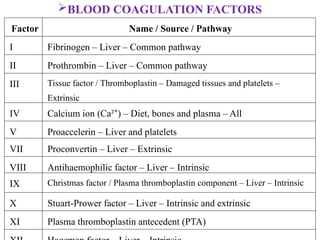
Factor Name /Source / Pathway
I Fibrinogen – Liver – Common pathway
II Prothrombin – Liver – Common pathway
III Tissue factor / Thromboplastin – Damaged tissues and platelets –
Extrinsic
IV Calcium ion (Ca² ) – Diet, bones and plasma – All
⁺
V Proaccelerin – Liver and platelets
VII Proconvertin – Liver – Extrinsic
VIII Antihaemophilic factor – Liver – Intrinsic
IX Christmas factor / Plasma thromboplastin component – Liver – Intrinsic
X Stuart-Prower factor – Liver – Intrinsic and extrinsic
XI Plasma thromboplastin antecedent (PTA)
BLOOD COAGULATION FACTORS
7.
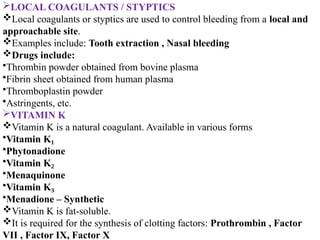
LOCAL COAGULANTS /STYPTICS
Local coagulants or styptics are used to control bleeding from a local and
approachable site.
Examples include: Tooth extraction , Nasal bleeding
Drugs include:
•Thrombin powder obtained from bovine plasma
•Fibrin sheet obtained from human plasma
•Thromboplastin powder
•Astringents, etc.
VITAMIN K
Vitamin K is a natural coagulant. Available in various forms
•Vitamin K₁
•Phytonadione
•Vitamin K₂
•Menaquinone
•Vitamin K₃
•Menadione – Synthetic
Vitamin K is fat-soluble.
It is required for the synthesis of clotting factors: Prothrombin , Factor
VII , Factor IX, Factor X
8.
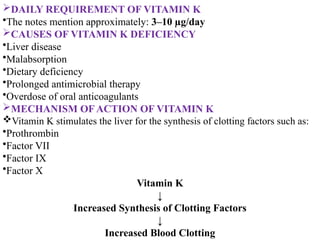
DAILY REQUIREMENT OFVITAMIN K
•The notes mention approximately: 3–10 µg/day
CAUSES OF VITAMIN K DEFICIENCY
•Liver disease
•Malabsorption
•Dietary deficiency
•Prolonged antimicrobial therapy
•Overdose of oral anticoagulants
MECHANISM OF ACTION OF VITAMIN K
Vitamin K stimulates the liver for the synthesis of clotting factors such as:
•Prothrombin
•Factor VII
•Factor IX
•Factor X
Vitamin K
↓
Increased Synthesis of Clotting Factors
↓
Increased Blood Clotting
9.
USES OF VITAMINK
Prophylaxis and prevention of bleeding
To increase blood clotting
Dose:- Approximately: 5–10 mg/day
ANTICOAGULANTS
Anticoagulants are drugs that:
•Prevent blood coagulation
•Decrease the ability of blood to clot
•Are also called blood thinners
Unwanted blood clotting may be harmful and can result in:
•Blockage of blood vessels
•Reduced blood supply
Anticoagulants are therefore used in conditions
involving abnormal or excessive clot formation
10.
CLASSIFICATION OF ANTICOAGULANTS
A.PARENTERALANTICOAGULANTS
1. Indirect Thrombin Inhibitors
•Heparin
•Danaparoid
•Fondaparinux
B. ORALANTICOAGULANTS
1. Vitamin K Antagonist
•Warfarin
2. Direct Thrombin Inhibitors
•Lepirudin
•Argatroban
•Dabigatran etexilate
3. Direct Inhibitor of Activated Factor X
•Rivaroxaban
11.
HEPARIN
Heparin is obtainedmainly from animal tissues.
It is a mixture of: Mucopolysaccharides
Its molecular weight is approximately: 10,000–20,000
Heparin is found in the mast cells of: Lungs, Liver, Intestinal
mucosa
Commercial heparin is commonly obtained from: Ox lungs, Pig
intestinal mucosa
MECHANISM OF ACTION OF HEPARIN
Heparin
↓
Plasma Antithrombin III
↓
Heparin–Antithrombin Complex
↓
Binding and Inactivation of Clotting Factors
The complex inhibits clotting factors such as: Thrombin (IIa), Xa,
Ixa, Xia, XIIa
This results in: Reduced Blood Clotting
12.
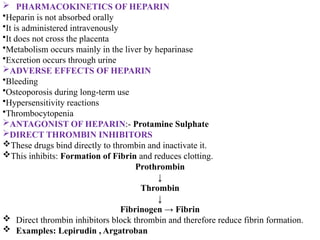
PHARMACOKINETICS OFHEPARIN
•Heparin is not absorbed orally
•It is administered intravenously
•It does not cross the placenta
•Metabolism occurs mainly in the liver by heparinase
•Excretion occurs through urine
ADVERSE EFFECTS OF HEPARIN
•Bleeding
•Osteoporosis during long-term use
•Hypersensitivity reactions
•Thrombocytopenia
ANTAGONIST OF HEPARIN:- Protamine Sulphate
DIRECT THROMBIN INHIBITORS
These drugs bind directly to thrombin and inactivate it.
This inhibits: Formation of Fibrin and reduces clotting.
Prothrombin
↓
Thrombin
↓
Fibrinogen → Fibrin
Direct thrombin inhibitors block thrombin and therefore reduce fibrin formation.
Examples: Lepirudin , Argatroban
13.
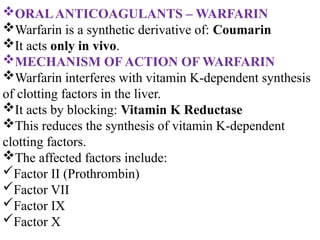
ORALANTICOAGULANTS – WARFARIN
Warfarinis a synthetic derivative of: Coumarin
It acts only in vivo.
MECHANISM OF ACTION OF WARFARIN
Warfarin interferes with vitamin K-dependent synthesis
of clotting factors in the liver.
It acts by blocking: Vitamin K Reductase
This reduces the synthesis of vitamin K-dependent
clotting factors.
The affected factors include:
Factor II (Prothrombin)
Factor VII
Factor IX
Factor X
14.
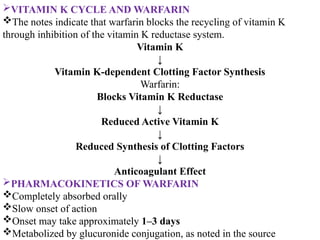
VITAMIN K CYCLEAND WARFARIN
The notes indicate that warfarin blocks the recycling of vitamin K
through inhibition of the vitamin K reductase system.
Vitamin K
↓
Vitamin K-dependent Clotting Factor Synthesis
Warfarin:
Blocks Vitamin K Reductase
↓
Reduced Active Vitamin K
↓
Reduced Synthesis of Clotting Factors
↓
Anticoagulant Effect
PHARMACOKINETICS OF WARFARIN
Completely absorbed orally
Slow onset of action
Onset may take approximately 1–3 days
Metabolized by glucuronide conjugation, as noted in the source
15.
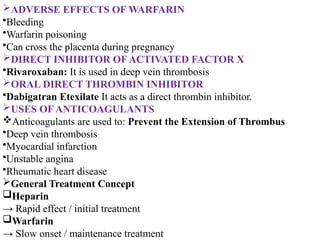
ADVERSE EFFECTS OFWARFARIN
•Bleeding
•Warfarin poisoning
•Can cross the placenta during pregnancy
DIRECT INHIBITOR OF ACTIVATED FACTOR X
•Rivaroxaban: It is used in deep vein thrombosis
ORAL DIRECT THROMBIN INHIBITOR
•Dabigatran Etexilate It acts as a direct thrombin inhibitor.
USES OF ANTICOAGULANTS
Anticoagulants are used to: Prevent the Extension of Thrombus
•Deep vein thrombosis
•Myocardial infarction
•Unstable angina
•Rheumatic heart disease
General Treatment Concept
Heparin
→ Rapid effect / initial treatment
Warfarin
→ Slow onset / maintenance treatment
 Most read
 Most read
 Most read