Comprehensive Overview of Chemical Plaque Control in Periodontology
Explore chemical plaque control methods, history, mechanisms, classifications, active agents, and clinical applications for effective oral biofilm management and periodontal health.
Comprehensive Overview of Chemical Plaque Control in Periodontology
1.
CHEMICAL PLAQUE CONTROL
Presentedby: Dr. Janardhana Amaranath BJ
Department of Periodontology
Rama Dental College Hospital and Research Centre
2.
2
CONTENTS
INTRODUCTION
HISTORY
OBJECTIVES
MECHANISM OF ACTION
CLASSIFICATION OF CHEMICAL PLAQUE CONTROL
EVALUATION OF ACTIVITY OF AGENTS FOR CHEMICAL BIOFILM CONTROL
ACTIVE AGENTS
NATURAL PRODUCTS
DELIVERY FORMATES
CLINICAL INDICATIONS FOR CHEMICAL PLAQUE CONTROL:SELECTION OF AGENTS
CONCLUSION
REFERENCES
3.
3
Plaque controlis defined as the removal of microbial plaque and food debris from the oral cavity..
Plaque management consists of the use of mechanical procedures and chemical agents that retard the formation
of plaque.
Mechanical methods of plaque prevention include (toothbrushing, flossing, interdental aids) to reduce
microbial plaque accumulation and prevent periodontal diseases. Chemical plaque agents including
mouthrinses, dentifrices(Toothpastes & toothpowder), gels, Sprays, oral irrigants, Chewing gums & varnices
other local delivery systems.
The most effective method of plaque control at present appears to be mechanical plaque control.
Chemical plaque regulation was used only as an extension and not as a replacement to the mechanical means.
Further improve the performance of plaque management programs using anti-plaque agents as an adjuvant to
mechanical plaque control.
INTRODUCTION
4.
4
Chemical plaquecontrol may be necessary in those subjects who are unable to properly control
supragingival biofilm with mechanical devices.
Use of chemical products reduce the amount of biofilm and disrupt its structure, allowing for a more
effective action of the chemical formulations .
Adjunctive use may be more relevant than sole use, since most chemical agents are only able to act against
the most external parts of the biofilm.
Some agents have demonstrated some capacity for penetration, such as chlorhexidine (CHX) (Netuschil et
al. 1995) and essential oils (Pan et al. 1999, 2000; Fine et al. 2001).
The use of chemical formulations (especially antiseptics) to control plaque and gingivitis.
5.
5
HISTORY OF CHEMICALPLAQUE CONTROL
First chemical used for plaque removal were dentifrices which have been used in conjunction with chemical
aids for centuries.
Hippocrates (460-377) was the first who recommend the use of dentrifices.
Egyptian used tooth powders or pastes to clean their teeth.
12th
century, Saint Hildegard Von Bingen, a German Philospher advised mouth rinses with pure cold water to
prevent plaque and tartar formation.
Chemical plaque control agents which are popularly known today as Mouthwashes began in late 1800s.
First toothpaste was made by Dr. Washington Sheffield in 1892.
Chlorhexidine was discovered in the1950s by the imperial Chemical Industries, Ltd (Manchester, UK) it was
introduced as disinfectant and topical antiseptic in 1954.
Loe and Schiott (1970) were first to demonstrate the antiplaque property of CHX.
6.
6
OBJECTIVES
Prevention andtreatment of gingivitis.
Prevention of Periodontal disease progression
Reduction of microbial plaque accumulation
Assistance in maintaining oral hygiene when mechanical methods are inadequate
7.
7
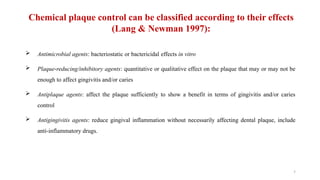
Chemical plaque controlcan be classified according to their effects
(Lang & Newman 1997):
Antimicrobial agents: bacteriostatic or bactericidal effects in vitro
Plaque reducing/inhibitory agents
‐ : quantitative or qualitative effect on the plaque that may or may not be
enough to affect gingivitis and/or caries
Antiplaque agents: affect the plaque sufficiently to show a benefit in terms of gingivitis and/or caries
control
Antigingivitis agents: reduce gingival inflammation without necessarily affecting dental plaque, include
anti inflammatory drugs.
‐
8.
8
Ideal Features
Chemical agentfor plaque control have been proposed by different authors
(Loesche 1976; van der Ouderaa 1991; Baker 1993; Fischmann 1994)
Specificity: Agents and formulations for chemical plaque control should demonstrate a wide spectrum of action,
including against bacteria, viruses, and yeasts.
Efficacy:Antimicrobial capacity must be demonstrated against microorganisms implicated in gingivitis and
periodontitis, in both in vitro and in vivo studies. Although bactericidal effects may be only achieved at high dosages,
antimicrobial effects should also be present at lower dosages (FDI Commission 2002.)
Substantivity Substantivity has been defined as the duration of the antimicrobial action in vivo (FDI Commission
2002) and as a measurement of the contact time between the agent and the substrate in a defined medium. According
to their substantivity, agents have been divided into three distinct generations (Kornman 1986)
9.
9
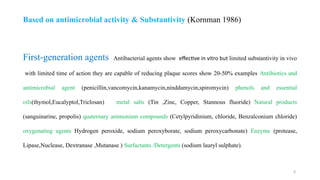
First generation agents
‐Antibacterial agents show effective in vitro but limited substantivity in vivo
with limited time of action they are capable of reducing plaque scores show 20-50% examples Antibiotics and
antimicrobial agent (penicillin,vancomycin,kanamycin,ninddamycin,spiromycin) phenols and essential
oils(thymol,Eucalyptol,Triclosan) metal salts (Tin ,Zinc, Copper, Stannous fluoride) Natural products
(sanguinarine, propolis) quaternary ammonium compounds (Cetylpyridinium, chloride, Benzalconium chloride)
oxygenating agents Hydrogen peroxide, sodium peroxyborate, sodium peroxycarbonate) Enzyme (protease,
Lipase,Nuclease, Dextranase ,Mutanase ) Surfactants /Detergents (sodium lauryl sulphate).
Based on antimicrobial activity & Substantivity (Kornman 1986)
10.
10
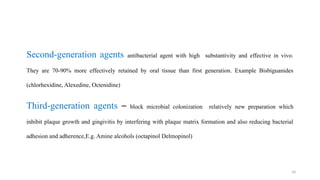
Second generation agents
‐antibacterial agent with high substantivity and effective in vivo.
They are 70-90% more effectively retained by oral tissue than first generation. Example Bisbiguanides
(chlorhexidine, Alexedine, Octenidine)
Third generation agents
‐ – block microbial colonization relatively new preparation which
inhibit plaque growth and gingivitis by interfering with plaque matrix formation and also reducing bacterial
adhesion and adherence,E.g. Amine alcohols (octapinol Delmopinol)
11.
11
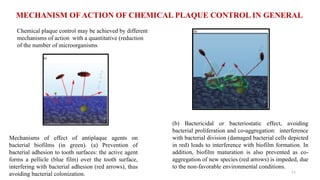
MECHANISM OF ACTIONOF CHEMICAL PLAQUE CONTROL IN GENERAL
Chemical plaque control may be achieved by different
mechanisms of action with a quantitative (reduction
of the number of microorganisms
(b) Bactericidal or bacteriostatic effect, avoiding
bacterial proliferation and co aggregation: interference
‐
with bacterial division (damaged bacterial cells depicted
in red) leads to interference with biofilm formation. In
addition, biofilm maturation is also prevented as co‐
aggregation of new species (red arrows) is impeded, due
to the non favorable
‐ environmental conditions.
Mechanisms of effect of antiplaque agents on
bacterial biofilms (in green). (a) Prevention of
bacterial adhesion to tooth surfaces: the active agent
forms a pellicle (blue film) over the tooth surface,
interfering with bacterial adhesion (red arrows), thus
avoiding bacterial colonization.
12.
12
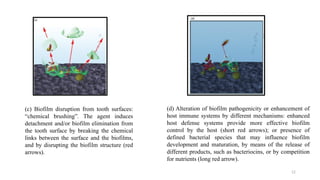
(c) Biofilm disruptionfrom tooth surfaces:
“chemical brushing”. The agent induces
detachment and/or biofilm elimination from
the tooth surface by breaking the chemical
links between the surface and the biofilms,
and by disrupting the biofilm structure (red
arrows).
(d) Alteration of biofilm pathogenicity or enhancement of
host immune systems by different mechanisms: enhanced
host defense systems provide more effective biofilm
control by the host (short red arrows); or presence of
defined bacterial species that may influence biofilm
development and maturation, by means of the release of
different products, such as bacteriocins, or by competition
for nutrients (long red arrow).
13.
13
EVALUATION OF ACTIVITYOF AGENTS FOR
CHEMICAL BIOFILM CONTROL
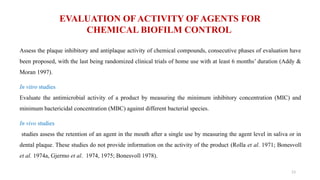
Assess the plaque inhibitory and antiplaque activity of chemical compounds, consecutive phases of evaluation have
been proposed, with the last being randomized clinical trials of home use with at least 6 months’ duration (Addy &
Moran 1997).
In vitro studies
Evaluate the antimicrobial activity of a product by measuring the minimum inhibitory concentration (MIC) and
minimum bactericidal concentration (MBC) against different bacterial species.
In vivo studies
studies assess the retention of an agent in the mouth after a single use by measuring the agent level in saliva or in
dental plaque. These studies do not provide information on the activity of the product (Rolla et al. 1971; Bonesvoll
et al. 1974a, Gjermo et al. 1974, 1975; Bonesvoll 1978).
14.
14
ACTIVE AGENTS
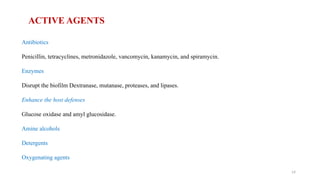
Antibiotics
Penicillin, tetracyclines,metronidazole, vancomycin, kanamycin, and spiramycin.
Enzymes
Disrupt the biofilm Dextranase, mutanase, proteases, and lipases.
Enhance the host defenses
Glucose oxidase and amyl glucosidase.
Amine alcohols
Detergents
Oxygenating agents
15.
15
Metal salts
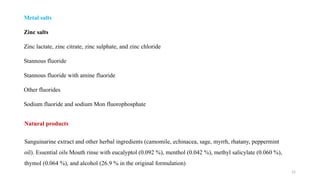
Zinc salts
Zinclactate, zinc citrate, zinc sulphate, and zinc chloride
Stannous fluoride
Stannous fluoride with amine fluoride
Other fluorides
Sodium fluoride and sodium Mon fluorophosphate
Natural products
Sanguinarine extract and other herbal ingredients (camomile, echinacea, sage, myrrh, rhatany, peppermint
oil). Essential oils Mouth rinse with eucalyptol (0.092 %), menthol (0.042 %), methyl salicylate (0.060 %),
thymol (0.064 %), and alcohol (26.9 % in the original formulation)
16.
16
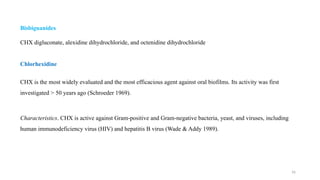
Bisbiguanides
CHX digluconate, alexidinedihydrochloride, and octenidine dihydrochloride
Chlorhexidine
CHX is the most widely evaluated and the most efficacious agent against oral biofilms. Its activity was first
investigated > 50 years ago (Schroeder 1969).
Characteristics. CHX is active against Gram positive and Gram negative bacteria, yeast, and viruses, including
‐ ‐
human immunodeficiency virus (HIV) and hepatitis B virus (Wade & Addy 1989).
17.
17
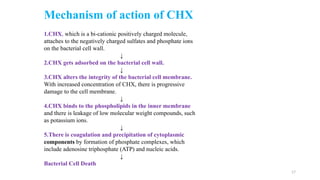
Mechanism of actionof CHX
1.CHX, which is a bi-cationic positively charged molecule,
attaches to the negatively charged sulfates and phosphate ions
on the bacterial cell wall.
↓
2.CHX gets adsorbed on the bacterial cell wall.
↓
3.CHX alters the integrity of the bacterial cell membrane.
With increased concentration of CHX, there is progressive
damage to the cell membrane.
↓
4.CHX binds to the phospholipids in the inner membrane
and there is leakage of low molecular weight compounds, such
as potassium ions.
↓
5.There is coagulation and precipitation of cytoplasmic
components by formation of phosphate complexes, which
include adenosine triphosphate (ATP) and nucleic acids.
↓
Bacterial Cell Death
18.
18
Mouth washes
Tooth pastes
Gels
Sprays
Irrigation
Chlorhexidine can be delivered in the form of
19.
19
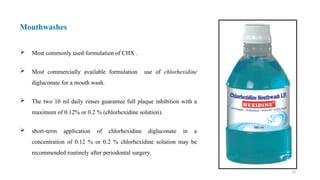
Most commonlyused formulation of CHX .
Most commercially available formulation use of chlorhexidine
digluconate for a mouth wash.
The two 10 ml daily rinses guarantee full plaque inhibition with a
maximum of 0.12% or 0.2 % (chlorhexidine solution).
short-term application of chlorhexidine digluconate in a
concentration of 0.12 % or 0.2 % chlorhexidine solution may be
recommended routinely after periodontal surgery.
Mouthwashes
20.
20
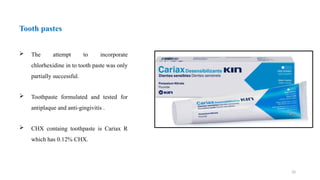
The attemptto incorporate
chlorhexidine in to tooth paste was only
partially successful.
Toothpaste formulated and tested for
antiplaque and anti-gingivitis .
CHX containg toothpaste is Cariax R
which has 0.12% CHX.
Tooth pastes
21.
21
Gels
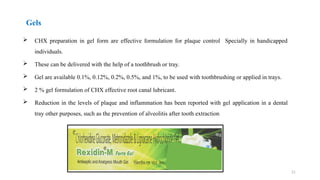
CHX preparationin gel form are effective formulation for plaque control Specially in handicapped
individuals.
These can be delivered with the help of a toothbrush or tray.
Gel are available 0.1%, 0.12%, 0.2%, 0.5%, and 1%, to be used with toothbrushing or applied in trays.
2 % gel formulation of CHX effective root canal lubricant.
Reduction in the levels of plaque and inflammation has been reported with gel application in a dental
tray other purposes, such as the prevention of alveolitis after tooth extraction
22.
22
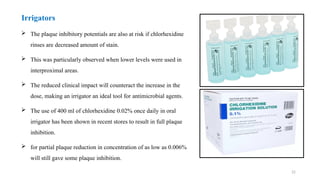
The plaqueinhibitory potentials are also at risk if chlorhexidine
rinses are decreased amount of stain.
This was particularly observed when lower levels were used in
interproximal areas.
The reduced clinical impact will counteract the increase in the
dose, making an irrigator an ideal tool for antimicrobial agents.
The use of 400 ml of chlorhexidine 0.02% once daily in oral
irrigator has been shown in recent stores to result in full plaque
inhibition.
for partial plaque reduction in concentration of as low as 0.006%
will still gave some plaque inhibition.
Irrigators
23.
23
Chewing gums
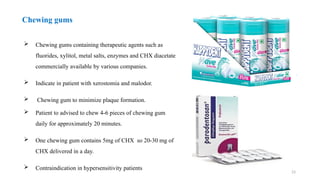
Chewinggums containing therapeutic agents such as
fluorides, xylitol, metal salts, enzymes and CHX diacetate
commercially available by various companies.
Indicate in patient with xerostomia and malodor.
Chewing gum to minimize plaque formation.
Patient to advised to chew 4-6 pieces of chewing gum
daily for approximately 20 minutes.
One chewing gum contains 5mg of CHX so 20-30 mg of
CHX delivered in a day.
Contraindication in hypersensitivity patients
24.
24
Sprays
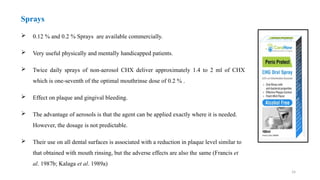
0.12 %and 0.2 % Sprays are available commercially.
Very useful physically and mentally handicapped patients.
Twice daily sprays of non-aerosol CHX deliver approximately 1.4 to 2 ml of CHX
which is one-seventh of the optimal mouthrinse dose of 0.2 % .
Effect on plaque and gingival bleeding.
The advantage of aerosols is that the agent can be applied exactly where it is needed.
However, the dosage is not predictable.
Their use on all dental surfaces is associated with a reduction in plaque level similar to
that obtained with mouth rinsing, but the adverse effects are also the same (Francis et
al. 1987b; Kalaga et al. 1989a)
25.
25
Limitations of CHXlong term use (Schiøtt
‐ et al.1970, 1976).
Increase in calculus formation (Yates et al. 1993)
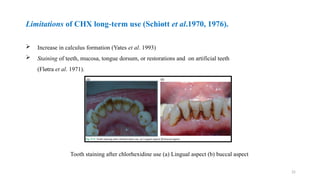
Staining of teeth, mucosa, tongue dorsum, or restorations and on artificial teeth
(Fløtra et al. 1971).
Tooth staining after chlorhexidine use (a) Lingual aspect (b) buccal aspect
26.
26
Hypersensitivity reaction(Beaudouin et al. 2004)
Neurosensory deafness if the product is placed in the middle ear (Aursnes 1982)
Taste alterations (Marinone & Savoldi 2000; Breslin & Tharp 2001)
Uni or bi lateral parotid swelling (Fløtra
‐ ‐ et al. 1971; van der Weijden et al.2010)
Mucosal erosion (Almqvist & Luthman 1988)
Healing process alterations.
28
Mouth rinses
Mouth rinsesare formulated with different ingredients
Colourings.
Flavourings
preservatives (sodium benzoate)
Stabilizers
active agents
29.
29
Dentifrices
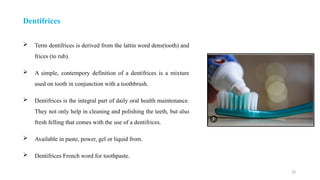
Term dentifricesis derived from the lattin word dens(tooth) and
frices (to rub).
A simple, contempory definition of a dentifrices is a mixture
used on tooth in conjunction with a toothbrush.
Dentifrices is the integral part of daily oral health maintenance.
They not only help in cleaning and polishing the teeth, but also
fresh felling that comes with the use of a dentifrices.
Available in paste, power, gel or liquid from.
Dentifrices French word for toothpaste.
30.
30
Dentifrices
Ingredients in adentifrice formulation are:
• Abrasives dental plaque and stain removal.(Paraskevas et al. 2006). The most common abrasives are calcium
carbonate, alumina, dicalcium phosphate, and silica.
• Detergents The most widely used is SLS, which provides some antimicrobial action (Jenkins et al. 1991),
although no evidence is available to support its effectiveness in plaque removal.
• Thickeners These include silica and gums, and they influence the viscosity of the toothpaste.
• Sweeteners such as sodium saccharin.
• Humectants These prevent the toothpaste from drying up; glycerine and sorbitol are the most commonly
used.
• Flavorings such as mint and strawberry.
• Colouring agents titanium oxide and chlorophyll
• Active agents including fluorides, triclosan, CHX (with some difficulties in the formulation, due to its
interference with anionic detergents and with flavorings), CPC, and other active agents (anticalculus agents,
whitening products, desensitizing agents)
31.
31
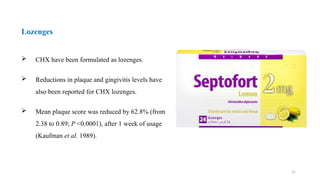
CHX havebeen formulated as lozenges.
Reductions in plaque and gingivitis levels have
also been reported for CHX lozenges.
Mean plaque score was reduced by 62.8% (from
2.38 to 0.89; P <0.0001), after 1 week of usage
(Kaufman et al. 1989).
Lozenges
32.
32
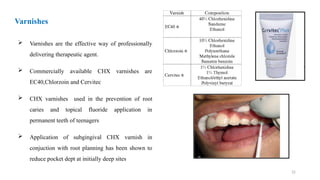
Varnishes arethe effective way of professionally
delivering therapeutic agent.
Commercially available CHX varnishes are
EC40,Chlorzoin and Cervitec
CHX varnishes used in the prevention of root
caries and topical fluoride application in
permanent teeth of teenagers
Application of subgingival CHX varnish in
conjuction with root planning has been shown to
reduce pocket dept at initially deep sites
Varnishes
33.
33
CHX is alsoformulated in sustained release devices designed with a therapeutic
‐
purpose:
Chips
Gels
Xanthan gels
Sustained release devices
‐
34.
34
Different clinical situations,depending on the duration of product usage and the main objective of the intervention,
are considered:
Single use.
Short term use (either with a preventive or a therapeutic aim).
‐
Long-term use (either with a preventive or a therapeutic aim).
Single use
To decrease of the bacterial load.
To decrease the risk of bacteremia.
To decrease the risk of infection of the surgical area.
Clinical indications for chemical plaque control:
Selection of agents
35.
35
After scaling androot planning or periodontal surgery
Prevention of postsurgical infection
Short term use for the prevention
‐ of dental biofilm formation
36.
36
Patients with intermaxillaryfixations
After bone fractures or after orthognathic or cosmetic maxillary surgeries when no mechanical hygiene is
possible, CHX mouth rinses have been shown to be useful in biofilm formation prevention (Nash & Addy 1979).
Patients with mucosal or gingival acute infections
In these patients, pain precludes mechanical hygiene and CHX mouth rinses may be useful in biofilm formation
prevention (Eley1999).
37.
37
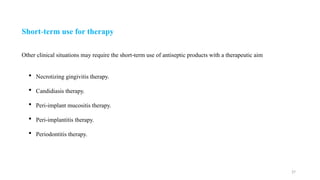
Other clinical situationsmay require the short term use of antiseptic products with a therapeutic aim
‐
Necrotizing gingivitis therapy.
Candidiasis therapy.
Peri implant mucositis therapy.
‐
Peri implantitis therapy.
‐
Periodontitis therapy.
Short term use for therapy
‐
38.
38
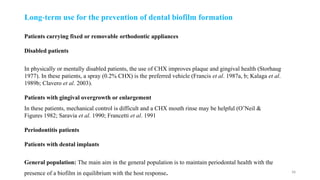
Patients carrying fixedor removable orthodontic appliances
Disabled patients
In physically or mentally disabled patients, the use of CHX improves plaque and gingival health (Storhaug
1977). In these patients, a spray (0.2% CHX) is the preferred vehicle (Francis et al. 1987a, b; Kalaga et al.
1989b; Clavero et al. 2003).
Patients with gingival overgrowth or enlargement
In these patients, mechanical control is difficult and a CHX mouth rinse may be helpful (O’Neil &
Figures 1982; Saravia et al. 1990; Francetti et al. 1991
Periodontitis patients
Patients with dental implants
General population: The main aim in the general population is to maintain periodontal health with the
presence of a biofilm in equilibrium with the host response.
Long term use for the prevention
‐ of dental biofilm formation
39.
39
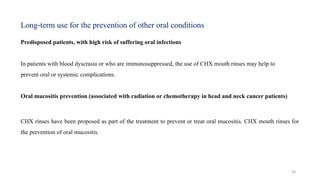
Predisposed patients, withhigh risk of suffering oral infections
In patients with blood dyscrasia or who are immunosuppressed, the use of CHX mouth rinses may help to
prevent oral or systemic complications.
Oral mucositis prevention (associated with radiation or chemotherapy in head and neck cancer patients)
CHX rinses have been proposed as part of the treatment to prevent or treat oral mucositis. CHX mouth rinses for
the prevention of oral mucositis.
Long term use for the prevention
‐ of other oral conditions
40.
40
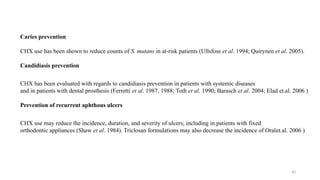
Caries prevention
CHX usehas been shown to reduce counts of S. mutans in at risk patients (Ullsfoss
‐ et al. 1994; Quirynen et al. 2005).
Candidiasis prevention
CHX has been evaluated with regards to candidiasis prevention in patients with systemic diseases
and in patients with dental prosthesis (Ferretti et al. 1987, 1988; Toth et al. 1990; Barasch et al. 2004; Elad et.al. 2006 )
Prevention of recurrent aphthous ulcers
CHX use may reduce the incidence, duration, and severity of ulcers, including in patients with fixed
orthodontic appliances (Shaw et al. 1984). Triclosan formulations may also decrease the incidence of Oralet.al. 2006 )
41.
41
Oral malodorindication for the use of mouth rinses.
Chemical plaque control agents such as CHX, essential oils, triclosan etc reduce the volatile
sulfur-producing bacteria in oral cavity thus reducing oral malodor.
Agent must be differentiated from mouth fresheners which do not kill the microorganism causing
malodor.
Halitosis therapy
42.
42
chemical plaquecontrol agents act as useful adjuvants for achieving the desired results.
Antimicrobial and antiplaque agents in dentifrices and oral rinses act in several ways to reduce or
remove dental biofilms and inhibit bacterial growth..
Conclusion
#2
Dental plaque is defined clinically as a structured , resilient , yellow –greyish substance that adheres tenaciously to the intraoral hard surfaces , including removable and fixed restorations .
Supragingival plaque and tooth-associated plaque are critical in calculus formation and root caries ,whereas tissue –associated subgingival plaque is important in the tissue destruction that characterizes different forms of periodontitis .
#3 Chemical plaque control is the adjunct to mechanical plaque control and cannot eliminate plaque when used as a monotherapy.
triclosanboth antibacterial and antiinflammatory properties. plaque control –is defined as the removal of microbial plaque and food debris from the oral cavity.
#4 Supragingival plaque and tooth-associated plaque are critical in calculus formation and root caries ,whereas tissue –associated subgingival plaque is important in the tissue destruction that characterizes different forms of periodontitis .
#7 in vivo means studies conducted inside a living organism, while in vitro means experiments performed outside a living organism (like in a test tube or petri dish)
#8 substantivity is the ability of an antiseptic or medication to adhere to oral tissues (like teeth, gums, and the tongue) and release slowly over time, providing prolonged protection against bacteria.
The property of chemical agent to be retained by oral surfaces and gradually released into oral fluids over many hours is is defined as substantivity.
#10 Chlorhexidine: A bis-biaguanide antiseptic agent used to prevent colonization and kill or inhibit microorganism on surface of skin, mucous membrane and teeth. Chlorhexidine-( MOA)Inhibits sugar transport, acid production, amino acid uptake, polysaccharide synthesis, bacterial membrane functions, protease activity. Enzymes- Mutanase, dextranase, amyloglucosidaseglucose oxidase (MOA)-Inhibit plaque biofilm matrix formation by degradation of bacterial polysaccharides, bacterial glycolysis by boosting salivary peroxidase system. Essential oil extracts Menthol, thymol, eucalyptol, methyl salicylate(MOA) Inhibit acid production, bacterial growth reduces lipopolysaccharide
#14 CLASSES OF SOME COMMONLY AVAILABLE ANTIMICROBIAL AGENTS, WITH EXAMPLES, USED FOR PLAQUE CONTROL
Class of Agent Bisbiguanide Chlorhexidine Mouthwash
Detergent Sodium lauryl sulfate Mouthwash and toothpaste
Enzyme Mutanase/glucanase; Toothpaste Amyloglucosidase/glucose oxidase Toothpaste
#15 CLASSES OF SOME COMMONLY AVAILABLE ANTIMICROBIAL AGENTS, WITH EXAMPLES, USED FOR PLAQUE CONTROLClass of Agent Example Main Delivery Vehicle1)Bisbiguanide Chlorhexidine Mouthwash“2)Detergent Sodium lauryl sulfate Mouthwash and toothpaste3) Enzyme Mutanase/glucanase; Toothpaste Amyloglucosidase/glucose oxidase Toothpaste 4)Essential oils" Thymol; eucalyptol Mouthwash 5)Metal ions Zinc; copper; stannous Toothpaste and mouthwash 6)Plant extracts Sanguinarine Mouthwash and toothpaste(Sanguinarine commonly used antiplaque and anti-gingivitis natural product ) 7)Phenols Triclosan Toothpaste and mouthwash8) Quaternary ammonium compounds Cetylpyridinium chloride Mouthwash Hexetidine Mouthwash
#16 Chemical structure 1,6 bis -4 chloro,phenyldiguanidohexane . CHX made of 2 symmetrical chlorophenol rings (4 chlorophenyl ) and 2 biguanide.
#20 Partially successful due to cationic nature which can be bind to the component in the toothpaste It is most likely that the added chlorhexidine may be inactivated by flavoring agents
#25 Staining is caused by interaction or precipitation of dietary chromogens with locally absorbed CHX. The CHX can react with polyphenols in dietary substances to produce staing a/c to first mechanism breakdown of chlorhexidine in the oral cavity resulted in the formation of parachloroaniline which propose to cause staining other mechanism reduced bacterial activitydue to CHX which resulted in partly metabolized sugars which broken down and then degraded over time to produce brown colored compounds
#26 (Burning sensation painful desquamative lesion on oral mucosa have been reported the reason for oral lesion seems to be precipitation of the mucin layer with a resultant reduction in its lubricating effect .these reaction are dose dependent and resolve after the cessation of the drug) .increased calculus formation exact mechanism not known however local change in ph resulting from adsorption of the cationic agent per se and marked impact on bacterial integrity seems to possible causes.unilateral or bilateral swelling – involment of viral infection (parotitis )in connection with CHX mouth rinses .
#31 Lozenges are solid dosage forms that are intended to be dissolved or disintegrated slowly in the mouth.
#33 effect of chlorhexidine in solution and in a sustained-release device as an intracanal medication. Hollow cylindrical dentine specimens prepared from bovine incisors were incubated with Streptococcus faecalis for a period of 3 weeks. The intracanal medicaments tested were 0.2% chlorhexidine gluconate solution (CM), chlorhexidine in a sustained-release device (1.2 mg) (SRD), camphorated paramonochlorophenol (CMCP), and a control (no medication). Each medicament was introduced into the lumen of one dentine specimen and incubated for 5 min. 24 h,48 h or 7 days at 3 7°C. The bacteriological samples were taken by shaving the dentine inside the lumen with dental burs ranging in size from ISO 023–033.
#34 Bacteremia refers to viable bacteria in the blood . Alveolitis, or dry socket, is inflammation of the alveolar socket.
#42 Bacteriocins are defined as ribosomally synthesized antibacterial peptides/proteins that either kill or inhibit the growth of closely related bacteria.