Comprehensive Overview of Chassis and Frame Design in Automobiles
Detailed exploration of chassis and frame types, functions, materials, and design considerations in automotive engineering for mechanical engineering students.
This presentation covers the detailed discussion on chassis, frames, their types, working, construction, materials, limitations.
Comprehensive Overview of Chassis and Frame Design in Automobiles
1.
Sanjivani Rural EducationSociety’s
Sanjivani College of Engineering, Kopargaon-423603
(An Autonomous Institute Affiliated to Savitribai Phule Pune University, Pune)
NAAC ‘A’ Grade Accredited, ISO 9001:2015 Certified
Department of Mechanical Engineering
Subject : Electric Vehicle Design
Class : T.Y. Mechanical
Subject Code : ME 311D
Unit 1 : Introduction to Automobile Engineering
By
V. P. Bhaurkar
Department of Mechanical Engineering
2026 – 27 (sem - 5)
2.
V. P. BhaurkarAI and ML (T. Y. Mechanical)
Chassis and Frame in Automobiles
Introduction
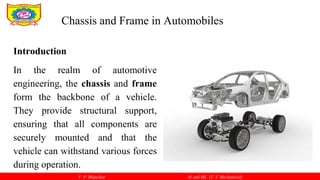
In the realm of automotive
engineering, the chassis and frame
form the backbone of a vehicle.
They provide structural support,
ensuring that all components are
securely mounted and that the
vehicle can withstand various forces
during operation.
3.
V. P. BhaurkarAI and ML (T. Y. Mechanical)
Chassis and Frame in Automobiles
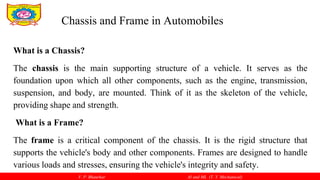
What is a Chassis?
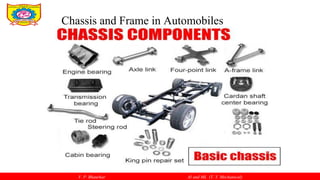
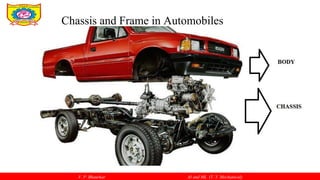
The chassis is the main supporting structure of a vehicle. It serves as the
foundation upon which all other components, such as the engine, transmission,
suspension, and body, are mounted. Think of it as the skeleton of the vehicle,
providing shape and strength.
What is a Frame?
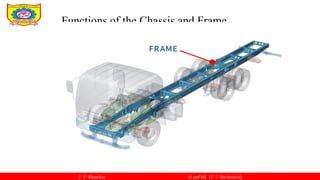
The frame is a critical component of the chassis. It is the rigid structure that
supports the vehicle's body and other components. Frames are designed to handle
various loads and stresses, ensuring the vehicle's integrity and safety.
4.
V. P. BhaurkarAI and ML (T. Y. Mechanical)
Chassis and Frame in Automobiles
5.
V. P. BhaurkarAI and ML (T. Y. Mechanical)
Chassis and Frame in Automobiles
6.
V. P. BhaurkarAI and ML (T. Y. Mechanical)
Chassis and Frame in Automobiles
7.
V. P. BhaurkarAI and ML (T. Y. Mechanical)
Chassis and Frame in Automobiles
8.
V. P. BhaurkarAI and ML (T. Y. Mechanical)
Functions of the Chassis and Frame
9.
V. P. BhaurkarAI and ML (T. Y. Mechanical)
Functions of the Chassis and Frame
a) Support: They support the weight of the vehicle, including passengers
and cargo.
b) Strength: Provide the necessary strength to withstand dynamic forces
during acceleration, braking, and cornering.
c) Flexibility: Allow for slight flexing to absorb shocks from road
irregularities.
d) Safety: Designed to protect occupants by absorbing impact energy
during collisions.
10.
V. P. BhaurkarAI and ML (T. Y. Mechanical)
Functions of the Chassis and Frame
e) Structural Support: Provide a rigid platform for mounting various
components.
f) Load Bearing: Carry the weight of the vehicle, passengers, and cargo.
g) Impact Absorption: Absorb and dissipate energy during collisions to
protect occupants.
h) Maintain Alignment: Ensure proper alignment of wheels and
suspension for optimal handling.
11.
V. P. BhaurkarAI and ML (T. Y. Mechanical)
Types of Frames
12.
V. P. BhaurkarAI and ML (T. Y. Mechanical)
Types of Frames
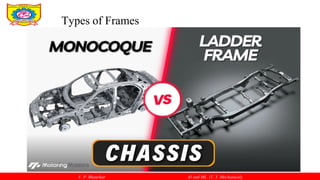
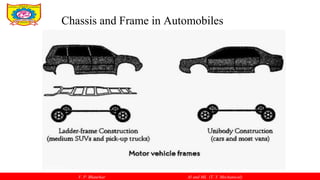
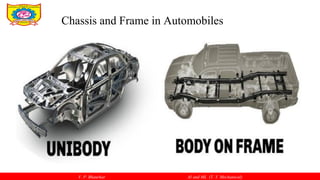
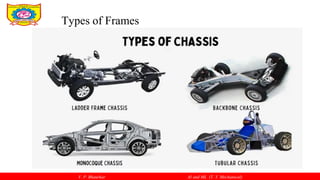
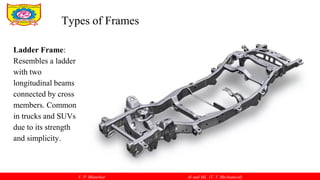
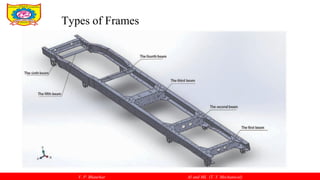
Ladder Frame:
Resembles a ladder
with two
longitudinal beams
connected by cross
members. Common
in trucks and SUVs
due to its strength
and simplicity.
13.
V. P. BhaurkarAI and ML (T. Y. Mechanical)
Types of Frames
14.
V. P. BhaurkarAI and ML (T. Y. Mechanical)
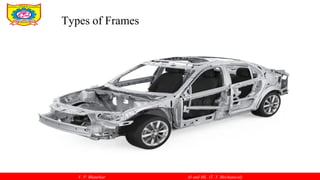
Types of Frames
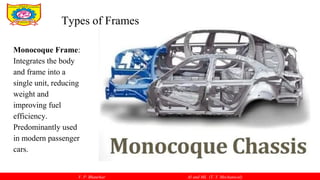
Monocoque Frame:
Integrates the body
and frame into a
single unit, reducing
weight and
improving fuel
efficiency.
Predominantly used
in modern passenger
cars.
15.
V. P. BhaurkarAI and ML (T. Y. Mechanical)
Types of Frames
16.
V. P. BhaurkarAI and ML (T. Y. Mechanical)
Types of Frames
17.
V. P. BhaurkarAI and ML (T. Y. Mechanical)
Types of Frames
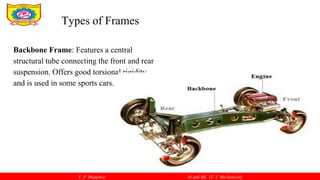
Backbone Frame: Features a central
structural tube connecting the front and rear
suspension. Offers good torsional rigidity
and is used in some sports cars.
18.
V. P. BhaurkarAI and ML (T. Y. Mechanical)
Types of Frames
19.
V. P. BhaurkarAI and ML (T. Y. Mechanical)
Types of Frames
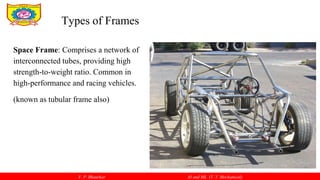
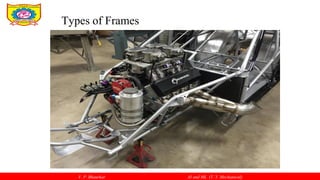
Space Frame: Comprises a network of
interconnected tubes, providing high
strength-to-weight ratio. Common in
high-performance and racing vehicles.
(known as tubular frame also)
20.
V. P. BhaurkarAI and ML (T. Y. Mechanical)
Types of Frames
21.
V. P. BhaurkarAI and ML (T. Y. Mechanical)
Materials Used in Frames
a) Steel: Offers high strength and durability; widely used in traditional frames.
b) Aluminum: Lightweight and corrosion-resistant; used to improve fuel efficiency.
c) Carbon Fiber: Extremely lightweight and strong; used in high-performance and
luxury vehicles.
22.
V. P. BhaurkarAI and ML (T. Y. Mechanical)
Design Considerations
a) Strength and Rigidity: Must withstand various forces without excessive deformation.
b) Weight: Lighter frames improve fuel efficiency but must not compromise safety.
c) Manufacturing Cost: Materials and design complexity affect production costs.
23.
V. P. BhaurkarAI and ML (T. Y. Mechanical)
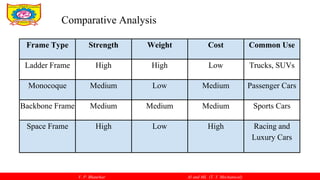
Comparative Analysis
Frame Type Strength Weight Cost Common Use
Ladder Frame High High Low Trucks, SUVs
Monocoque Medium Low Medium Passenger Cars
Backbone Frame Medium Medium Medium Sports Cars
Space Frame High Low High Racing and
Luxury Cars
 Most read
 Most read