Comprehensive Overview of Carbohydrates: Structure, Function, and Nutrition
Explore carbohydrate types, digestion, metabolism, dietary sources, and health benefits, emphasizing energy roles and nutritional recommendations for balanced intake.
Comprehensive Overview of Carbohydrates: Structure, Function, and Nutrition
1.
CARBOHYDRATES
An Introduction toStructure, Function & Nutrition
Biology & Nutrition Fundamentals
Amit Kumar Singh
Assistant Professor
Department of Medical Laboratory Science
Chandigarh University
2.
What Are Carbohydrates?
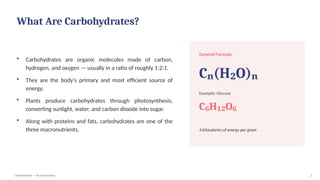
•Carbohydrates are organic molecules made of carbon,
hydrogen, and oxygen — usually in a ratio of roughly 1:2:1.
• They are the body's primary and most efficient source of
energy.
• Plants produce carbohydrates through photosynthesis,
converting sunlight, water, and carbon dioxide into sugar.
• Along with proteins and fats, carbohydrates are one of the
three macronutrients.
General Formula
C (H O)
ₙ ₂ ₙ
Example: Glucose
C H O
₆ ₁₂ ₆
4 kilocalories of energy per gram
Carbohydrates — An Introduction 2
3.
Three Classes ofCarbohydrates
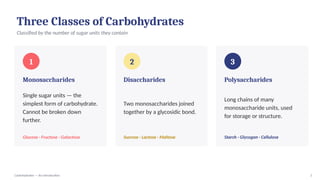
Classified by the number of sugar units they contain
1
Monosaccharides
Single sugar units — the
simplest form of carbohydrate.
Cannot be broken down
further.
Glucose · Fructose · Galactose
2
Disaccharides
Two monosaccharides joined
together by a glycosidic bond.
Sucrose · Lactose · Maltose
3
Polysaccharides
Long chains of many
monosaccharide units, used
for storage or structure.
Starch · Glycogen · Cellulose
Carbohydrates — An Introduction 3
4.
Monosaccharides — TheSimple Sugars
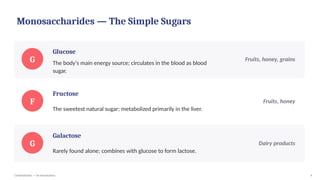
G
Glucose
The body's main energy source; circulates in the blood as blood
sugar.
Fruits, honey, grains
F
Fructose
The sweetest natural sugar; metabolized primarily in the liver.
Fruits, honey
G
Galactose
Rarely found alone; combines with glucose to form lactose.
Dairy products
Carbohydrates — An Introduction 4
5.
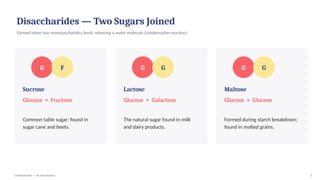
Disaccharides — TwoSugars Joined
Formed when two monosaccharides bond, releasing a water molecule (condensation reaction)
G F
Sucrose
Glucose + Fructose
Common table sugar; found in
sugar cane and beets.
G G
Lactose
Glucose + Galactose
The natural sugar found in milk
and dairy products.
G G
Maltose
Glucose + Glucose
Formed during starch breakdown;
found in malted grains.
Carbohydrates — An Introduction 5
6.
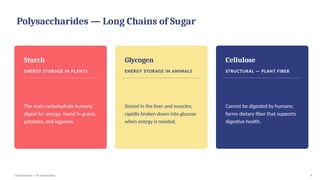
Polysaccharides — LongChains of Sugar
Starch
ENERGY STORAGE IN PLANTS
The main carbohydrate humans
digest for energy; found in grains,
potatoes, and legumes.
Glycogen
ENERGY STORAGE IN ANIMALS
Stored in the liver and muscles;
rapidly broken down into glucose
when energy is needed.
Cellulose
STRUCTURAL — PLANT FIBER
Cannot be digested by humans;
forms dietary fiber that supports
digestive health.
Carbohydrates — An Introduction 6
7.
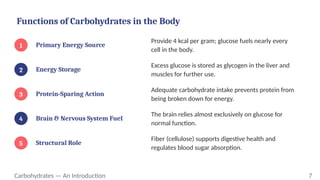
Functions of Carbohydratesin the Body
1 Primary Energy Source
Provide 4 kcal per gram; glucose fuels nearly every
cell in the body.
2 Energy Storage
Excess glucose is stored as glycogen in the liver and
muscles for further use.
3 Protein-Sparing Action
Adequate carbohydrate intake prevents protein from
being broken down for energy.
4 Brain & Nervous System Fuel
The brain relies almost exclusively on glucose for
normal function.
5 Structural Role
Fiber (cellulose) supports digestive health and
regulates blood sugar absorption.
Carbohydrates — An Introduction 7
8.
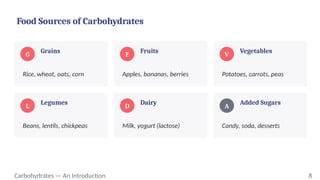
Food Sources ofCarbohydrates
G
Grains
Rice, wheat, oats, corn
F
Fruits
Apples, bananas, berries
V
Vegetables
Potatoes, carrots, peas
L
Legumes
Beans, lentils, chickpeas
D
Dairy
Milk, yogurt (lactose)
A
Added Sugars
Candy, soda, desserts
Carbohydrates — An Introduction 8
9.
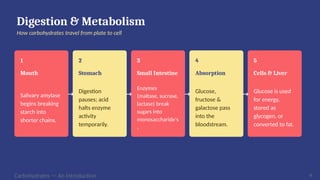
Digestion & Metabolism
Howcarbohydrates travel from plate to cell
1
Mouth
Salivary amylase
begins breaking
starch into
shorter chains.
2
Stomach
Digestion
pauses; acid
halts enzyme
activity
temporarily.
3
Small Intestine
Enzymes
(maltase, sucrase,
lactase) break
sugars into
monosaccharide's
.
4
Absorption
Glucose,
fructose &
galactose pass
into the
bloodstream.
5
Cells & Liver
Glucose is used
for energy,
stored as
glycogen, or
converted to fat.
→ → → →
Carbohydrates — An Introduction 9
10.
Simple vs. ComplexCarbohydrates
Simple Carbs
• Quick source of energy
• Digested and absorbed
rapidly
• Can cause fast blood sugar
spikes
• Found in candy, soda, table
sugar
Complex Carbs
• Longer, steadier energy
release
• Takes longer to digest
• Supports stable blood
sugar levels
• Found in whole grains,
legumes, vegetables
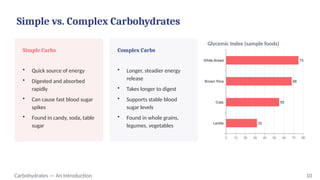
Glycemic Index (sample foods)
Lentils
Oats
Brown Rice
White Bread
0 10 20 30 40 50 60 70 80
32
55
68
75
Carbohydrates — An Introduction 10
11.
Dietary Recommendations
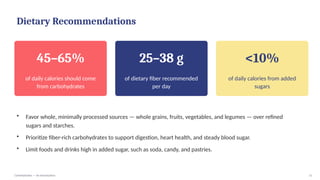
45–65%
of dailycalories should come
from carbohydrates
25–38 g
of dietary fiber recommended
per day
<10%
of daily calories from added
sugars
• Favor whole, minimally processed sources — whole grains, fruits, vegetables, and legumes — over refined
sugars and starches.
• Prioritize fiber-rich carbohydrates to support digestion, heart health, and steady blood sugar.
• Limit foods and drinks high in added sugar, such as soda, candy, and pastries.
Carbohydrates — An Introduction 11
12.
Key Takeaways
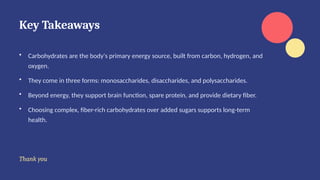
• Carbohydratesare the body's primary energy source, built from carbon, hydrogen, and
oxygen.
• They come in three forms: monosaccharides, disaccharides, and polysaccharides.
• Beyond energy, they support brain function, spare protein, and provide dietary fiber.
• Choosing complex, fiber-rich carbohydrates over added sugars supports long-term
health.
Thank you