Comprehensive Overview of Braking Systems in Automobile Engineering
1.
Sanjivani Rural EducationSociety’s
Sanjivani College of Engineering, Kopargaon-423603
(An Autonomous Institute Affiliated to Savitribai Phule Pune University, Pune)
NAAC ‘A’ Grade Accredited, ISO 9001:2015 Certified
Department of Mechanical Engineering
Subject : Electric Vehicle Design
Class : T.Y. Mechanical
Subject Code : ME 311D
Unit 1 : Introduction to Automobile Engineering
By
V. P. Bhaurkar
Department of Mechanical Engineering
2025 – 26 (sem - 5)
2.
V. P. BhaurkarEV (T. Y. Mechanical)
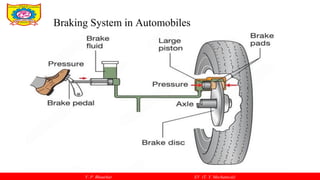
Braking System in Automobiles
3.
V. P. BhaurkarEV (T. Y. Mechanical)
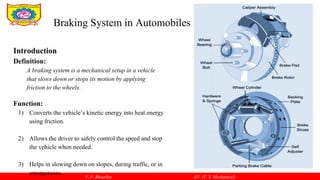
Introduction
Definition:
A braking system is a mechanical setup in a vehicle
that slows down or stops its motion by applying
friction to the wheels.
Function:
1) Converts the vehicle’s kinetic energy into heat energy
using friction.
2) Allows the driver to safely control the speed and stop
the vehicle when needed.
3) Helps in slowing down on slopes, during traffic, or in
emergencies.
Braking System in Automobiles
4.
V. P. BhaurkarEV (T. Y. Mechanical)
Introduction
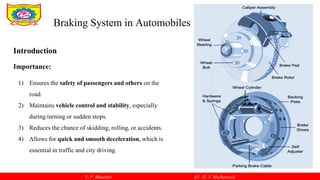
Importance:
1) Ensures the safety of passengers and others on the
road.
2) Maintains vehicle control and stability, especially
during turning or sudden stops.
3) Reduces the chance of skidding, rolling, or accidents.
4) Allows for quick and smooth deceleration, which is
essential in traffic and city driving.
Braking System in Automobiles
5.
V. P. BhaurkarEV (T. Y. Mechanical)
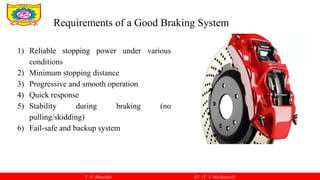
1) Reliable stopping power under various
conditions
2) Minimum stopping distance
3) Progressive and smooth operation
4) Quick response
5) Stability during braking (no
pulling/skidding)
6) Fail-safe and backup system
Requirements of a Good Braking System
6.
V. P. BhaurkarEV (T. Y. Mechanical)
Requirements of a Good Braking System
7.
V. P. BhaurkarEV (T. Y. Mechanical)
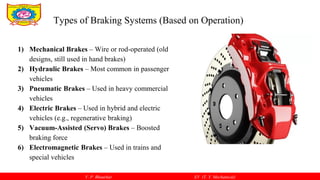
1) Mechanical Brakes – Wire or rod-operated (old
designs, still used in hand brakes)
2) Hydraulic Brakes – Most common in passenger
vehicles
3) Pneumatic Brakes – Used in heavy commercial
vehicles
4) Electric Brakes – Used in hybrid and electric
vehicles (e.g., regenerative braking)
5) Vacuum-Assisted (Servo) Brakes – Boosted
braking force
6) Electromagnetic Brakes – Used in trains and
special vehicles
Types of Braking Systems (Based on Operation)
8.
V. P. BhaurkarEV (T. Y. Mechanical)
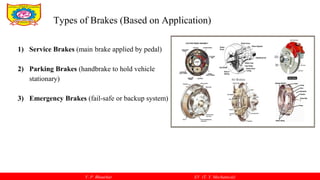
1) Service Brakes (main brake applied by pedal)
2) Parking Brakes (handbrake to hold vehicle
stationary)
3) Emergency Brakes (fail-safe or backup system)
Types of Brakes (Based on Application)
9.
V. P. BhaurkarEV (T. Y. Mechanical)
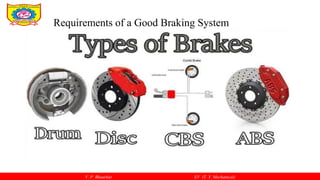
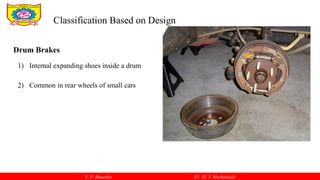
Drum Brakes
1) Internal expanding shoes inside a drum
2) Common in rear wheels of small cars
Classification Based on Design
10.
V. P. BhaurkarEV (T. Y. Mechanical)
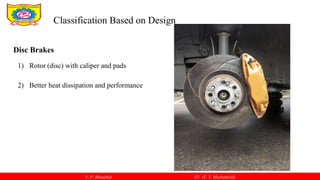
Disc Brakes
1) Rotor (disc) with caliper and pads
2) Better heat dissipation and performance
Classification Based on Design
11.
V. P. BhaurkarEV (T. Y. Mechanical)
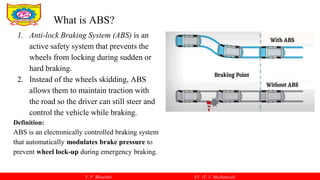
1. Anti-lock Braking System (ABS) is an
active safety system that prevents the
wheels from locking during sudden or
hard braking.
2. Instead of the wheels skidding, ABS
allows them to maintain traction with
the road so the driver can still steer and
control the vehicle while braking.
Definition:
ABS is an electronically controlled braking system
that automatically modulates brake pressure to
prevent wheel lock-up during emergency braking.
What is ABS?
12.
V. P. BhaurkarEV (T. Y. Mechanical)
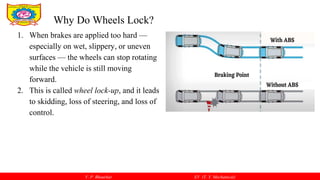
1. When brakes are applied too hard —
especially on wet, slippery, or uneven
surfaces — the wheels can stop rotating
while the vehicle is still moving
forward.
2. This is called wheel lock-up, and it leads
to skidding, loss of steering, and loss of
control.
Why Do Wheels Lock?
13.
V. P. BhaurkarEV (T. Y. Mechanical)
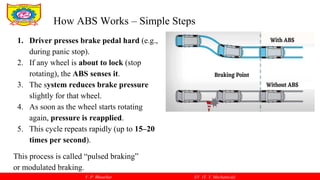
1. Driver presses brake pedal hard (e.g.,
during panic stop).
2. If any wheel is about to lock (stop
rotating), the ABS senses it.
3. The system reduces brake pressure
slightly for that wheel.
4. As soon as the wheel starts rotating
again, pressure is reapplied.
5. This cycle repeats rapidly (up to 15–20
times per second).
This process is called ―pulsed braking‖
or modulated braking.
How ABS Works – Simple Steps
14.
V. P. BhaurkarEV (T. Y. Mechanical)
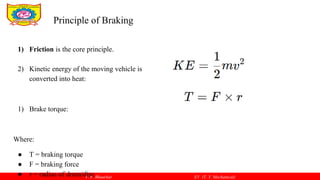
1) Friction is the core principle.
2) Kinetic energy of the moving vehicle is
converted into heat:
1) Brake torque:
Where:
● T = braking torque
● F = braking force
● r = radius of drum/disc
Principle of Braking
15.
V. P. BhaurkarEV (T. Y. Mechanical)
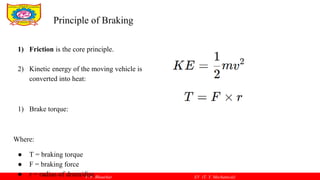
1) Friction is the core principle.
2) Kinetic energy of the moving vehicle is
converted into heat:
1) Brake torque:
Where:
● T = braking torque
● F = braking force
● r = radius of drum/disc
Principle of Braking
16.
V. P. BhaurkarEV (T. Y. Mechanical)
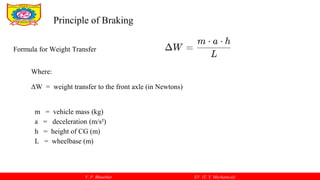
Formula for Weight Transfer
Principle of Braking
Where:
ΔW = weight transfer to the front axle (in Newtons)
m = vehicle mass (kg)
a = deceleration (m/s²)
h = height of CG (m)
L = wheelbase (m)
17.
V. P. BhaurkarEV (T. Y. Mechanical)
Q. 1] A disc brake applies a force of 500 N on
the disc at a radius of 0.25 m. What is the
braking torque produced?
Solution:
1. We have,
Problem on Braking Torque Calculation
18.
V. P. BhaurkarEV (T. Y. Mechanical)
Q. 2] A car of mass 1000 kg is decelerating at 5
m/s². What is the braking force applied?
Solution:
1. Now, the braking force is expressed as,
Problem on Braking Force from Deceleration
19.
V. P. BhaurkarEV (T. Y. Mechanical)
Q. 3] A vehicle moving at 20 m/s comes to rest
in 5 seconds. What is the stopping distance?
Solution:
Use formula:
Where:
● u=20 m/s (initial velocity)
● v=0 m/s (final velocity)
● t=5 s
Problem on Stopping Distance from Initial Speed and Time
20.
V. P. BhaurkarEV (T. Y. Mechanical)
Q. 4] Calculate the kinetic energy of a vehicle of
mass 1200 kg moving at 15 m/s.
Solution:
Use formula:
Problem on Kinetic Energy of Moving Vehicle
21.
V. P. BhaurkarEV (T. Y. Mechanical)
Q. 5] If a car of 1000 kg moving at 20 m/s is
brought to rest, how much heat energy is
generated in the brakes (assuming no loss)?
Solution:
Use formula:
Problem on Heat Energy Dissipated by Brakes
22.
V. P. BhaurkarEV (T. Y. Mechanical)
Q.6] From Q5, if the braking system distributes
the energy equally to 4 wheels, how much heat
energy does each wheel absorb?
Solution:
Use formula:
Problem on Heat Energy Converted Per Wheel (4 wheels)
23.
V. P. BhaurkarEV (T. Y. Mechanical)
Q. 7] A car has a mass of 1500 kg, wheelbase of 2.6 m, and center of gravity located 0.55 m above the
ground. The CG is located 1.1 m from the front axle. If the car decelerates at 6 m/s², calculate the
weight transfer to the front axle during braking.
Solution:
Data: m = 1500 kg, a = 6 m/s^2, g = 9.81 m/s^2, h = 0.55 m, L = 2.6 m,
Use formula:
Problem on Heat Energy Converted Per Wheel (4 wheels)
24.
V. P. BhaurkarEV (T. Y. Mechanical)
Q. 7] A car has a mass of 1500 kg, wheelbase of 2.6 m, and center of gravity located 0.55 m above the
ground. The CG is located 1.1 m from the front axle. If the car decelerates at 6 m/s², calculate the
weight transfer to the front axle during braking.
Solution:
Data: m = 1500 kg, a = 6 m/s^2, g = 9.81 m/s^2, h = 0.55 m, L = 2.6 m,
Use formula:
Approximately 1904 N of weight shifts from rear to front during braking.
This means the front tires now carry extra vertical load, and the rear tires carry less, which affects
braking force distribution.
Problem on Heat Energy Converted Per Wheel (4 wheels)
 Most read
 Most read
![V. P. Bhaurkar EV (T. Y. Mechanical)
Q. 1] A disc brake applies a force of 500 N on
the disc at a radius of 0.25 m. What is the
braking torque produced?
Solution:
1. We have,
Problem on Braking Torque Calculation](https://image.slidesharecdn.com/unit-1part6-260817124712-c7207475/85/Comprehensive-Overview-of-Braking-Systems-in-Automobile-Engineering-17-320.jpg) Most read
![V. P. Bhaurkar EV (T. Y. Mechanical)
Q. 2] A car of mass 1000 kg is decelerating at 5
m/s². What is the braking force applied?
Solution:
1. Now, the braking force is expressed as,
Problem on Braking Force from Deceleration](https://image.slidesharecdn.com/unit-1part6-260817124712-c7207475/85/Comprehensive-Overview-of-Braking-Systems-in-Automobile-Engineering-18-320.jpg)
![V. P. Bhaurkar EV (T. Y. Mechanical)
Q. 3] A vehicle moving at 20 m/s comes to rest
in 5 seconds. What is the stopping distance?
Solution:
Use formula:
Where:
● u=20 m/s (initial velocity)
● v=0 m/s (final velocity)
● t=5 s
Problem on Stopping Distance from Initial Speed and Time](https://image.slidesharecdn.com/unit-1part6-260817124712-c7207475/85/Comprehensive-Overview-of-Braking-Systems-in-Automobile-Engineering-19-320.jpg)
![V. P. Bhaurkar EV (T. Y. Mechanical)
Q. 4] Calculate the kinetic energy of a vehicle of
mass 1200 kg moving at 15 m/s.
Solution:
Use formula:
Problem on Kinetic Energy of Moving Vehicle](https://image.slidesharecdn.com/unit-1part6-260817124712-c7207475/85/Comprehensive-Overview-of-Braking-Systems-in-Automobile-Engineering-20-320.jpg)
![V. P. Bhaurkar EV (T. Y. Mechanical)
Q. 5] If a car of 1000 kg moving at 20 m/s is
brought to rest, how much heat energy is
generated in the brakes (assuming no loss)?
Solution:
Use formula:
Problem on Heat Energy Dissipated by Brakes](https://image.slidesharecdn.com/unit-1part6-260817124712-c7207475/85/Comprehensive-Overview-of-Braking-Systems-in-Automobile-Engineering-21-320.jpg)
![V. P. Bhaurkar EV (T. Y. Mechanical)
Q.6] From Q5, if the braking system distributes
the energy equally to 4 wheels, how much heat
energy does each wheel absorb?
Solution:
Use formula:
Problem on Heat Energy Converted Per Wheel (4 wheels)](https://image.slidesharecdn.com/unit-1part6-260817124712-c7207475/85/Comprehensive-Overview-of-Braking-Systems-in-Automobile-Engineering-22-320.jpg)
![V. P. Bhaurkar EV (T. Y. Mechanical)
Q. 7] A car has a mass of 1500 kg, wheelbase of 2.6 m, and center of gravity located 0.55 m above the
ground. The CG is located 1.1 m from the front axle. If the car decelerates at 6 m/s², calculate the
weight transfer to the front axle during braking.
Solution:
Data: m = 1500 kg, a = 6 m/s^2, g = 9.81 m/s^2, h = 0.55 m, L = 2.6 m,
Use formula:
Problem on Heat Energy Converted Per Wheel (4 wheels)](https://image.slidesharecdn.com/unit-1part6-260817124712-c7207475/85/Comprehensive-Overview-of-Braking-Systems-in-Automobile-Engineering-23-320.jpg)
![V. P. Bhaurkar EV (T. Y. Mechanical)
Q. 7] A car has a mass of 1500 kg, wheelbase of 2.6 m, and center of gravity located 0.55 m above the
ground. The CG is located 1.1 m from the front axle. If the car decelerates at 6 m/s², calculate the
weight transfer to the front axle during braking.
Solution:
Data: m = 1500 kg, a = 6 m/s^2, g = 9.81 m/s^2, h = 0.55 m, L = 2.6 m,
Use formula:
Approximately 1904 N of weight shifts from rear to front during braking.
This means the front tires now carry extra vertical load, and the rear tires carry less, which affects
braking force distribution.
Problem on Heat Energy Converted Per Wheel (4 wheels)](https://image.slidesharecdn.com/unit-1part6-260817124712-c7207475/85/Comprehensive-Overview-of-Braking-Systems-in-Automobile-Engineering-24-320.jpg)