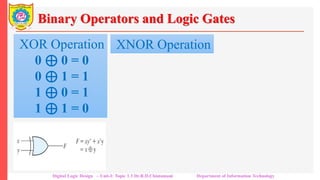
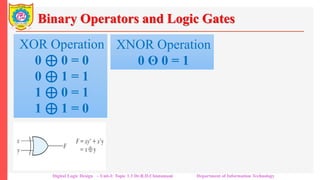
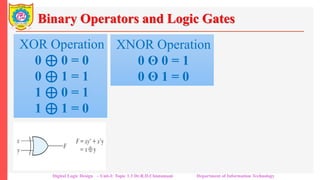
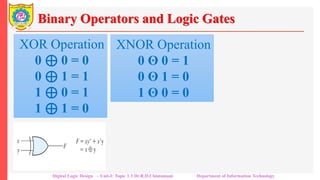
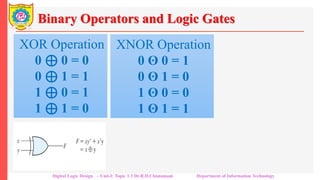
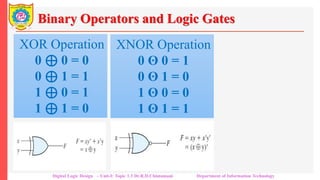
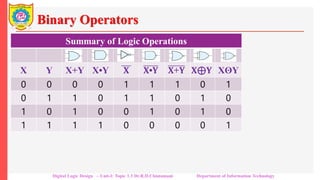
Comprehensive Overview of Boolean Algebra and Binary Operators in Digital Logic Design
Detailed exploration of Boolean algebra, binary operators, and logic gates including OR, AND, NOT, NAND, NOR, XOR, and XNOR operations for digital logic design fundamentals.
Comprehensive Overview of Boolean Algebra and Binary Operators in Digital Logic Design
1.
Digital Logic Design
SanjivaniRural Education Society’s
Sanjivani College of Engineering, Kopargaon-423603
(An Autonomous Institute Affiliated to Savitribai Phule Pune University, Pune)
NAAC ‘A’ Grade Accredited, ISO 9001:2015 Certified
Department of Information Technology
(NBAAccredited)
Dr.R.D.Chintamani
Assistant Professor
2.
Digital Logic Design
SanjivaniRural Education Society’s
Sanjivani College of Engineering, Kopargaon-423603
(An Autonomous Institute Affiliated to Savitribai Phule Pune University, Pune)
NAAC ‘A’ Grade Accredited, ISO 9001:2015 Certified
Department of Information Technology
(NBAAccredited)
Dr.R.D.Chintamani
Assistant Professor
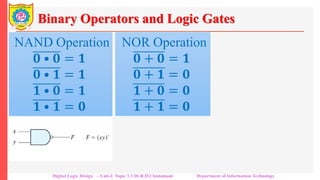
UNIT – I : NUMBER SYSTEM AND
BOOLEAN ALGEBRA
Topic
1.3
BOOLEAN ALGEBRA
3.
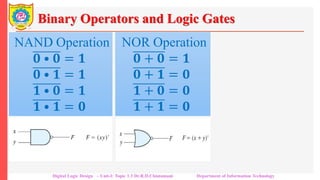
Boolean Algebra
Binary Operators
BasicRules of Binary Operations
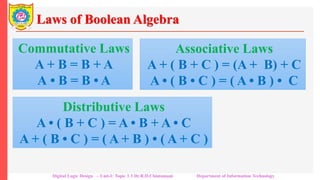
Laws of Boolean Algebra
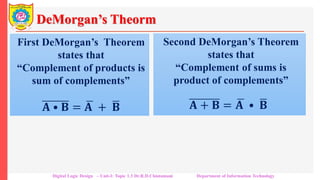
DeMorgan’s Theorem
Simplification of logic functions
Digital Logic Design – Unit-I: Topic 1.3 Dr.R.D.Chintamani Department of Information Technology
4.
Binary Operators
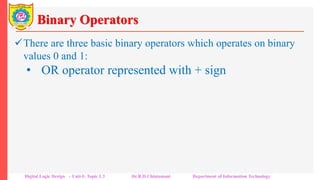
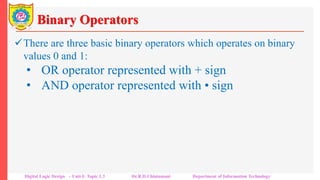
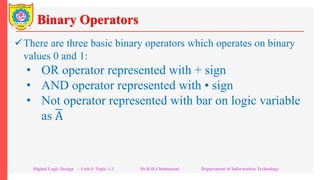
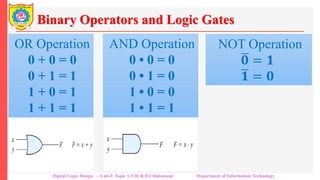
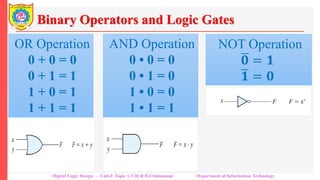
There arethree basic binary operators which operates on binary
values 0 and 1:
• OR operator represented with + sign
• AND operator represented with • sign
• Not operator represented with bar on logic variable
as ഥ
A
Digital Logic Design – Unit-I: Topic 1.3 Dr.R.D.Chintamani Department of Information Technology
5.
Binary Operators
There arethree basic binary operators which operates on binary
values 0 and 1:
• OR operator represented with + sign
• AND operator represented with • sign
• Not operator represented with bar on logic variable
as ഥ
A
Digital Logic Design – Unit-I: Topic 1.3 Dr.R.D.Chintamani Department of Information Technology
6.
Binary Operators
There arethree basic binary operators which operates on binary
values 0 and 1:
• OR operator represented with + sign
• AND operator represented with • sign
• Not operator represented with bar on logic variable
as ഥ
A
Digital Logic Design – Unit-I: Topic 1.3 Dr.R.D.Chintamani Department of Information Technology
7.
Binary Operators
There arethree basic binary operators which operates on binary
values 0 and 1:
• OR operator represented with + sign
• AND operator represented with • sign
• Not operator represented with bar on logic variable
as ഥ
A
Digital Logic Design – Unit-I: Topic 1.3 Dr.R.D.Chintamani Department of Information Technology
8.
Binary Operators
There arethree basic binary operators which operates on binary
values 0 and 1:
• OR operator represented with + sign
• AND operator represented with • sign
• Not operator represented with bar on logic variable
as ഥ
A
Digital Logic Design – Unit-I: Topic 1.3 Dr.R.D.Chintamani Department of Information Technology
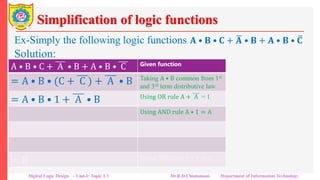
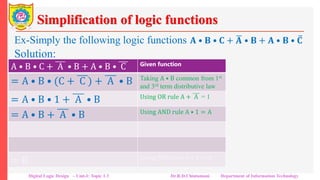
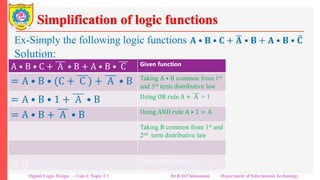
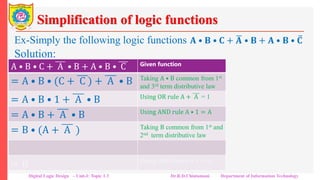
9.
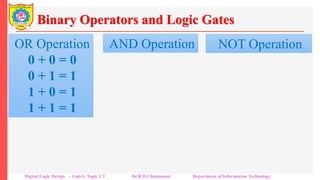
Binary Operators andLogic Gates
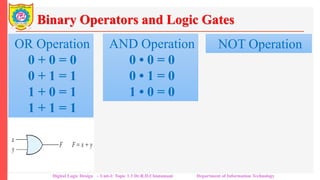
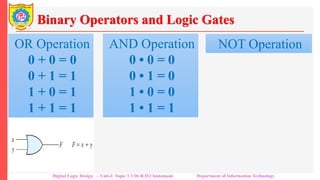
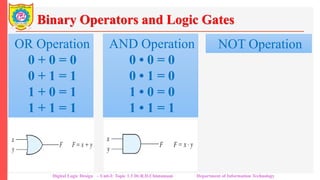
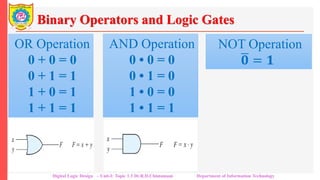
OR Operation AND Operation NOT Operation
Digital Logic Design – Unit-I: Topic 1.3 Dr.R.D.Chintamani Department of Information Technology
10.
Binary Operators andLogic Gates
OR Operation
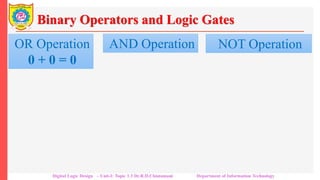
0 + 0 = 0
AND Operation NOT Operation
Digital Logic Design – Unit-I: Topic 1.3 Dr.R.D.Chintamani Department of Information Technology
11.
Binary Operators andLogic Gates
OR Operation
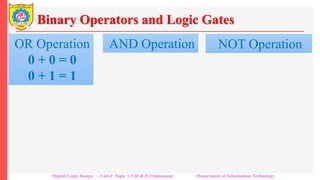
0 + 0 = 0
0 + 1 = 1
AND Operation NOT Operation
Digital Logic Design – Unit-I: Topic 1.3 Dr.R.D.Chintamani Department of Information Technology
12.
Binary Operators andLogic Gates
OR Operation
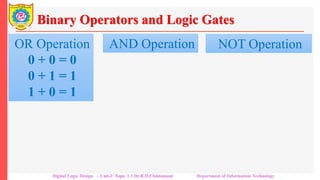
0 + 0 = 0
0 + 1 = 1
1 + 0 = 1
AND Operation NOT Operation
Digital Logic Design – Unit-I: Topic 1.3 Dr.R.D.Chintamani Department of Information Technology
13.
Binary Operators andLogic Gates
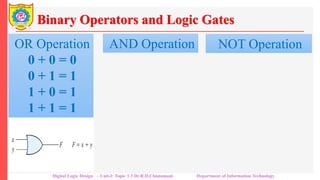
OR Operation
0 + 0 = 0
0 + 1 = 1
1 + 0 = 1
1 + 1 = 1
AND Operation NOT Operation
Digital Logic Design – Unit-I: Topic 1.3 Dr.R.D.Chintamani Department of Information Technology
14.
Binary Operators andLogic Gates
OR Operation
0 + 0 = 0
0 + 1 = 1
1 + 0 = 1
1 + 1 = 1
AND Operation NOT Operation
Digital Logic Design – Unit-I: Topic 1.3 Dr.R.D.Chintamani Department of Information Technology
15.
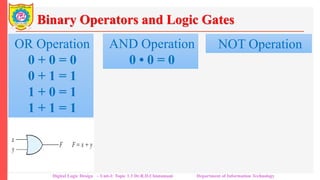
Binary Operators andLogic Gates
OR Operation
0 + 0 = 0
0 + 1 = 1
1 + 0 = 1
1 + 1 = 1
AND Operation
0 • 0 = 0
NOT Operation
Digital Logic Design – Unit-I: Topic 1.3 Dr.R.D.Chintamani Department of Information Technology
16.
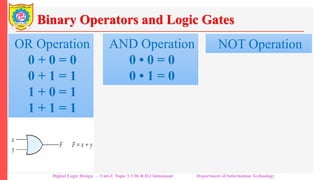
Binary Operators andLogic Gates
OR Operation
0 + 0 = 0
0 + 1 = 1
1 + 0 = 1
1 + 1 = 1
AND Operation
0 • 0 = 0
0 • 1 = 0
NOT Operation
Digital Logic Design – Unit-I: Topic 1.3 Dr.R.D.Chintamani Department of Information Technology
17.
Binary Operators andLogic Gates
OR Operation
0 + 0 = 0
0 + 1 = 1
1 + 0 = 1
1 + 1 = 1
AND Operation
0 • 0 = 0
0 • 1 = 0
1 • 0 = 0
NOT Operation
Digital Logic Design – Unit-I: Topic 1.3 Dr.R.D.Chintamani Department of Information Technology
18.
Binary Operators andLogic Gates
OR Operation
0 + 0 = 0
0 + 1 = 1
1 + 0 = 1
1 + 1 = 1
AND Operation
0 • 0 = 0
0 • 1 = 0
1 • 0 = 0
1 • 1 = 1
NOT Operation
Digital Logic Design – Unit-I: Topic 1.3 Dr.R.D.Chintamani Department of Information Technology
19.
Binary Operators andLogic Gates
OR Operation
0 + 0 = 0
0 + 1 = 1
1 + 0 = 1
1 + 1 = 1
AND Operation
0 • 0 = 0
0 • 1 = 0
1 • 0 = 0
1 • 1 = 1
NOT Operation
Digital Logic Design – Unit-I: Topic 1.3 Dr.R.D.Chintamani Department of Information Technology
20.
Binary Operators andLogic Gates
OR Operation
0 + 0 = 0
0 + 1 = 1
1 + 0 = 1
1 + 1 = 1
AND Operation
0 • 0 = 0
0 • 1 = 0
1 • 0 = 0
1 • 1 = 1
NOT Operation
ഥ
𝟎 = 𝟏
Digital Logic Design – Unit-I: Topic 1.3 Dr.R.D.Chintamani Department of Information Technology
21.
Binary Operators andLogic Gates
OR Operation
0 + 0 = 0
0 + 1 = 1
1 + 0 = 1
1 + 1 = 1
AND Operation
0 • 0 = 0
0 • 1 = 0
1 • 0 = 0
1 • 1 = 1
NOT Operation
ഥ
𝟎 = 𝟏
ഥ
𝟏 = 𝟎
Digital Logic Design – Unit-I: Topic 1.3 Dr.R.D.Chintamani Department of Information Technology
22.
Binary Operators andLogic Gates
OR Operation
0 + 0 = 0
0 + 1 = 1
1 + 0 = 1
1 + 1 = 1
AND Operation
0 • 0 = 0
0 • 1 = 0
1 • 0 = 0
1 • 1 = 1
NOT Operation
ഥ
𝟎 = 𝟏
ഥ
𝟏 = 𝟎
Digital Logic Design – Unit-I: Topic 1.3 Dr.R.D.Chintamani Department of Information Technology
23.
Binary Operators andLogic Gates
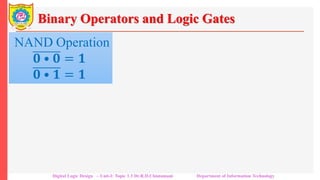
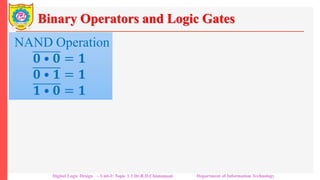
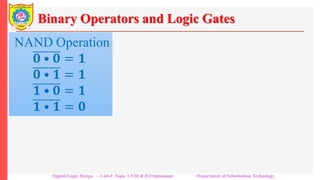
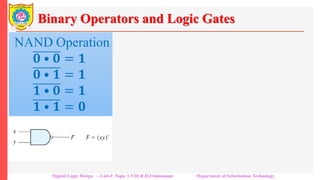
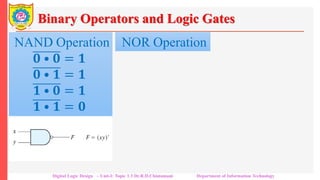
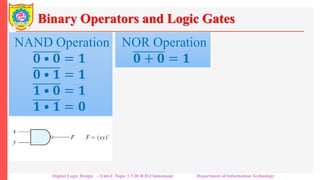
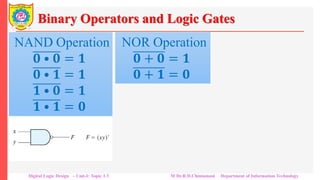
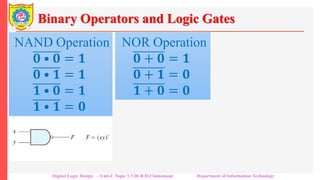
NAND Operation
Digital Logic Design – Unit-I: Topic 1.3 Dr.R.D.Chintamani Department of Information Technology
24.
Binary Operators andLogic Gates
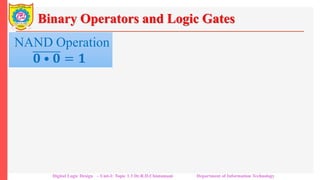
NAND Operation
𝟎 • 𝟎 = 𝟏
Digital Logic Design – Unit-I: Topic 1.3 Dr.R.D.Chintamani Department of Information Technology
25.
Binary Operators andLogic Gates
NAND Operation
𝟎 • 𝟎 = 𝟏
𝟎 • 𝟏 = 𝟏
Digital Logic Design – Unit-I: Topic 1.3 Dr.R.D.Chintamani Department of Information Technology
26.
Binary Operators andLogic Gates
NAND Operation
𝟎 • 𝟎 = 𝟏
𝟎 • 𝟏 = 𝟏
𝟏 • 𝟎 = 𝟏
Digital Logic Design – Unit-I: Topic 1.3 Dr.R.D.Chintamani Department of Information Technology
27.
Binary Operators andLogic Gates
NAND Operation
𝟎 • 𝟎 = 𝟏
𝟎 • 𝟏 = 𝟏
𝟏 • 𝟎 = 𝟏
𝟏 • 𝟏 = 𝟎
Digital Logic Design – Unit-I: Topic 1.3 Dr.R.D.Chintamani Department of Information Technology
28.
Binary Operators andLogic Gates
NAND Operation
𝟎 • 𝟎 = 𝟏
𝟎 • 𝟏 = 𝟏
𝟏 • 𝟎 = 𝟏
𝟏 • 𝟏 = 𝟎
Digital Logic Design – Unit-I: Topic 1.3 Dr.R.D.Chintamani Department of Information Technology
29.
Binary Operators andLogic Gates
NAND Operation
𝟎 • 𝟎 = 𝟏
𝟎 • 𝟏 = 𝟏
𝟏 • 𝟎 = 𝟏
𝟏 • 𝟏 = 𝟎
NOR Operation
Digital Logic Design – Unit-I: Topic 1.3 Dr.R.D.Chintamani Department of Information Technology
30.
Binary Operators andLogic Gates
NAND Operation
𝟎 • 𝟎 = 𝟏
𝟎 • 𝟏 = 𝟏
𝟏 • 𝟎 = 𝟏
𝟏 • 𝟏 = 𝟎
NOR Operation
𝟎 + 𝟎 = 𝟏
Digital Logic Design – Unit-I: Topic 1.3 Dr.R.D.Chintamani Department of Information Technology
31.
Binary Operators andLogic Gates
NAND Operation
𝟎 • 𝟎 = 𝟏
𝟎 • 𝟏 = 𝟏
𝟏 • 𝟎 = 𝟏
𝟏 • 𝟏 = 𝟎
NOR Operation
𝟎 + 𝟎 = 𝟏
𝟎 + 𝟏 = 𝟎
Digital Logic Design – Unit-I: Topic 1.3 M Dr.R.D.Chintamani Department of Information Technology
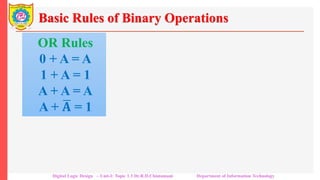
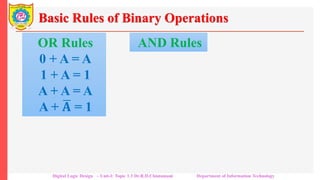
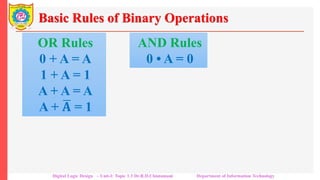
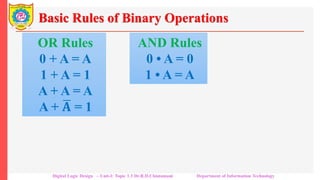
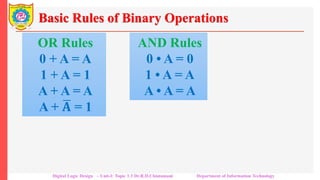
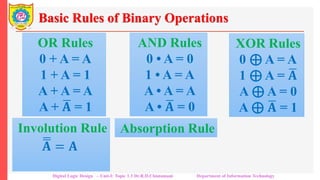
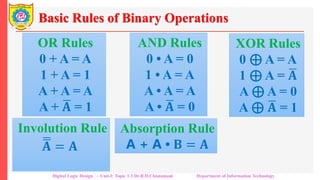
Basic Rules ofBinary Operations
Digital Logic Design – Unit-I: Topic 1.3 Dr.R.D.Chintamani Department of Information Technology
49.
Basic Rules ofBinary Operations
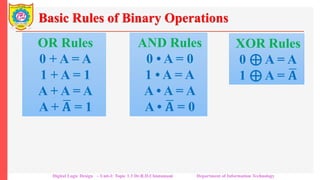
OR Rules
Digital Logic Design – Unit-I: Topic 1.3 Dr.R.D.Chintamani Department of Information Technology
50.
Basic Rules ofBinary Operations
OR Rules
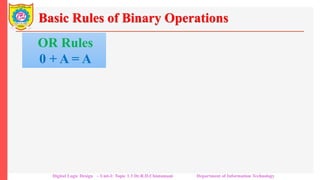
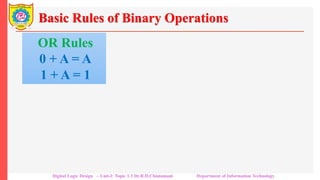
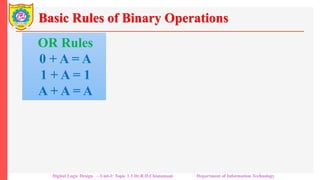
0 + A = A
Digital Logic Design – Unit-I: Topic 1.3 Dr.R.D.Chintamani Department of Information Technology
51.
Basic Rules ofBinary Operations
OR Rules
0 + A = A
1 + A = 1
Digital Logic Design – Unit-I: Topic 1.3 Dr.R.D.Chintamani Department of Information Technology
52.
Basic Rules ofBinary Operations
OR Rules
0 + A = A
1 + A = 1
A + A = A
Digital Logic Design – Unit-I: Topic 1.3 Dr.R.D.Chintamani Department of Information Technology
53.
Basic Rules ofBinary Operations
OR Rules
0 + A = A
1 + A = 1
A + A = A
A + ഥ
𝐀 = 1
Digital Logic Design – Unit-I: Topic 1.3 Dr.R.D.Chintamani Department of Information Technology
54.
Basic Rules ofBinary Operations
OR Rules
0 + A = A
1 + A = 1
A + A = A
A + ഥ
𝐀 = 1
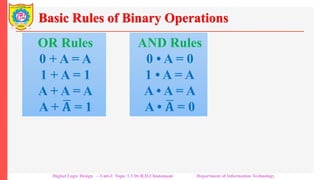
AND Rules
Digital Logic Design – Unit-I: Topic 1.3 Dr.R.D.Chintamani Department of Information Technology
55.
Basic Rules ofBinary Operations
OR Rules
0 + A = A
1 + A = 1
A + A = A
A + ഥ
𝐀 = 1
AND Rules
0 • A = 0
Digital Logic Design – Unit-I: Topic 1.3 Dr.R.D.Chintamani Department of Information Technology
56.
Basic Rules ofBinary Operations
OR Rules
0 + A = A
1 + A = 1
A + A = A
A + ഥ
𝐀 = 1
AND Rules
0 • A = 0
1 • A = A
Digital Logic Design – Unit-I: Topic 1.3 Dr.R.D.Chintamani Department of Information Technology
57.
Basic Rules ofBinary Operations
OR Rules
0 + A = A
1 + A = 1
A + A = A
A + ഥ
𝐀 = 1
AND Rules
0 • A = 0
1 • A = A
A • A = A
Digital Logic Design – Unit-I: Topic 1.3 Dr.R.D.Chintamani Department of Information Technology
58.
Basic Rules ofBinary Operations
OR Rules
0 + A = A
1 + A = 1
A + A = A
A + ഥ
𝐀 = 1
AND Rules
0 • A = 0
1 • A = A
A • A = A
A • ഥ
𝐀 = 0
Digital Logic Design – Unit-I: Topic 1.3 Dr.R.D.Chintamani Department of Information Technology
59.
Basic Rules ofBinary Operations
OR Rules
0 + A = A
1 + A = 1
A + A = A
A + ഥ
𝐀 = 1
AND Rules
0 • A = 0
1 • A = A
A • A = A
A • ഥ
𝐀 = 0
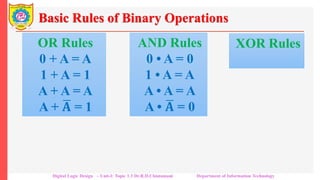
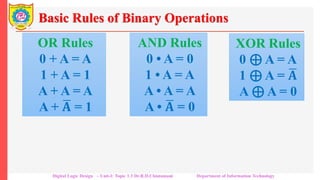
XOR Rules
Digital Logic Design – Unit-I: Topic 1.3 Dr.R.D.Chintamani Department of Information Technology
60.
Basic Rules ofBinary Operations
OR Rules
0 + A = A
1 + A = 1
A + A = A
A + ഥ
𝐀 = 1
AND Rules
0 • A = 0
1 • A = A
A • A = A
A • ഥ
𝐀 = 0
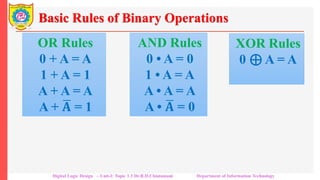
XOR Rules
0 ⊕ A = A
Digital Logic Design – Unit-I: Topic 1.3 Dr.R.D.Chintamani Department of Information Technology
61.
Basic Rules ofBinary Operations
OR Rules
0 + A = A
1 + A = 1
A + A = A
A + ഥ
𝐀 = 1
AND Rules
0 • A = 0
1 • A = A
A • A = A
A • ഥ
𝐀 = 0
XOR Rules
0 ⊕ A = A
1 ⊕ A = ഥ
𝐀
Digital Logic Design – Unit-I: Topic 1.3 Dr.R.D.Chintamani Department of Information Technology
62.
Basic Rules ofBinary Operations
OR Rules
0 + A = A
1 + A = 1
A + A = A
A + ഥ
𝐀 = 1
AND Rules
0 • A = 0
1 • A = A
A • A = A
A • ഥ
𝐀 = 0
XOR Rules
0 ⊕ A = A
1 ⊕ A = ഥ
𝐀
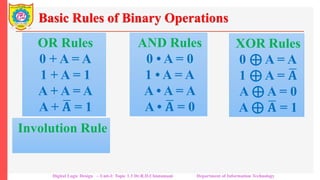
A ⊕ A = 0
Digital Logic Design – Unit-I: Topic 1.3 Dr.R.D.Chintamani Department of Information Technology
63.
Basic Rules ofBinary Operations
OR Rules
0 + A = A
1 + A = 1
A + A = A
A + ഥ
𝐀 = 1
AND Rules
0 • A = 0
1 • A = A
A • A = A
A • ഥ
𝐀 = 0
XOR Rules
0 ⊕ A = A
1 ⊕ A = ഥ
𝐀
A ⊕ A = 0
A ⊕ ഥ
𝐀 = 1
Involution Rule
Digital Logic Design – Unit-I: Topic 1.3 Dr.R.D.Chintamani Department of Information Technology
64.
Basic Rules ofBinary Operations
OR Rules
0 + A = A
1 + A = 1
A + A = A
A + ഥ
𝐀 = 1
AND Rules
0 • A = 0
1 • A = A
A • A = A
A • ഥ
𝐀 = 0
XOR Rules
0 ⊕ A = A
1 ⊕ A = ഥ
𝐀
A ⊕ A = 0
A ⊕ ഥ
𝐀 = 1
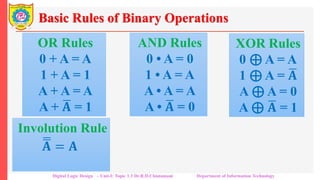
Involution Rule
ഥ
ഥ
𝐀 = 𝐀
Digital Logic Design – Unit-I: Topic 1.3 Dr.R.D.Chintamani Department of Information Technology
65.
Basic Rules ofBinary Operations
OR Rules
0 + A = A
1 + A = 1
A + A = A
A + ഥ
𝐀 = 1
AND Rules
0 • A = 0
1 • A = A
A • A = A
A • ഥ
𝐀 = 0
XOR Rules
0 ⊕ A = A
1 ⊕ A = ഥ
𝐀
A ⊕ A = 0
A ⊕ ഥ
𝐀 = 1
Involution Rule
ഥ
ഥ
𝐀 = 𝐀
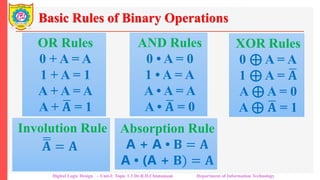
Absorption Rule
Digital Logic Design – Unit-I: Topic 1.3 Dr.R.D.Chintamani Department of Information Technology
66.
Basic Rules ofBinary Operations
OR Rules
0 + A = A
1 + A = 1
A + A = A
A + ഥ
𝐀 = 1
AND Rules
0 • A = 0
1 • A = A
A • A = A
A • ഥ
𝐀 = 0
XOR Rules
0 ⊕ A = A
1 ⊕ A = ഥ
𝐀
A ⊕ A = 0
A ⊕ ഥ
𝐀 = 1
Involution Rule
ഥ
ഥ
𝐀 = 𝐀
Absorption Rule
A + A • 𝐁 = 𝐀
Digital Logic Design – Unit-I: Topic 1.3 Dr.R.D.Chintamani Department of Information Technology
67.
Basic Rules ofBinary Operations
OR Rules
0 + A = A
1 + A = 1
A + A = A
A + ഥ
𝐀 = 1
AND Rules
0 • A = 0
1 • A = A
A • A = A
A • ഥ
𝐀 = 0
XOR Rules
0 ⊕ A = A
1 ⊕ A = ഥ
𝐀
A ⊕ A = 0
A ⊕ ഥ
𝐀 = 1
Involution Rule
ഥ
ഥ
𝐀 = 𝐀
Absorption Rule
A + A • 𝐁 = 𝐀
A • (A + 𝐁) = 𝐀
Digital Logic Design – Unit-I: Topic 1.3 Dr.R.D.Chintamani Department of Information Technology
68.
Laws of BooleanAlgebra
Digital Logic Design – Unit-I: Topic 1.3 Dr.R.D.Chintamani Department of Information Technology
69.
Laws of BooleanAlgebra
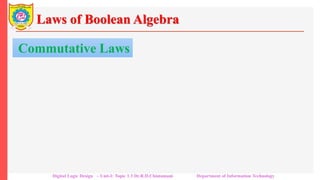
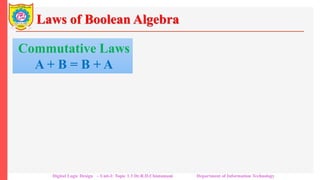
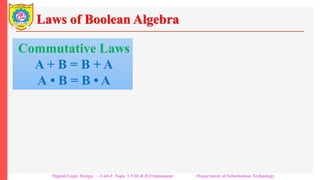
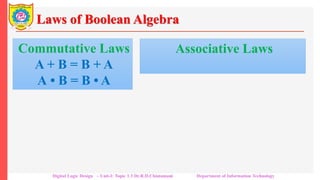
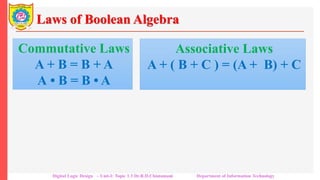
Commutative Laws
Digital Logic Design – Unit-I: Topic 1.3 Dr.R.D.Chintamani Department of Information Technology
70.
Laws of BooleanAlgebra
Commutative Laws
A + B = B + A
Digital Logic Design – Unit-I: Topic 1.3 Dr.R.D.Chintamani Department of Information Technology
71.
Laws of BooleanAlgebra
Commutative Laws
A + B = B + A
A • B = B • A
Digital Logic Design – Unit-I: Topic 1.3 Dr.R.D.Chintamani Department of Information Technology
72.
Laws of BooleanAlgebra
Commutative Laws
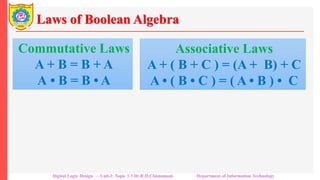
A + B = B + A
A • B = B • A
Associative Laws
Digital Logic Design – Unit-I: Topic 1.3 Dr.R.D.Chintamani Department of Information Technology
73.
Laws of BooleanAlgebra
Commutative Laws
A + B = B + A
A • B = B • A
Associative Laws
A + ( B + C ) = (A + B) + C
Digital Logic Design – Unit-I: Topic 1.3 Dr.R.D.Chintamani Department of Information Technology
74.
Laws of BooleanAlgebra
Commutative Laws
A + B = B + A
A • B = B • A
Associative Laws
A + ( B + C ) = (A + B) + C
A • ( B • C ) = ( A • B ) • C
Digital Logic Design – Unit-I: Topic 1.3 Dr.R.D.Chintamani Department of Information Technology
75.
Laws of BooleanAlgebra
Commutative Laws
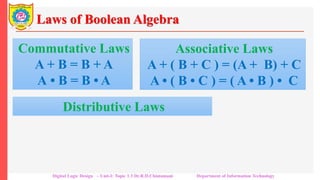
A + B = B + A
A • B = B • A
Distributive Laws
Associative Laws
A + ( B + C ) = (A + B) + C
A • ( B • C ) = ( A • B ) • C
Digital Logic Design – Unit-I: Topic 1.3 Dr.R.D.Chintamani Department of Information Technology
76.
Laws of BooleanAlgebra
Commutative Laws
A + B = B + A
A • B = B • A
Distributive Laws
A • ( B + C ) = A • B + A • C
Associative Laws
A + ( B + C ) = (A + B) + C
A • ( B • C ) = ( A • B ) • C
Digital Logic Design – Unit-I: Topic 1.3 Dr.R.D.Chintamani Department of Information Technology
77.
Laws of BooleanAlgebra
Commutative Laws
A + B = B + A
A • B = B • A
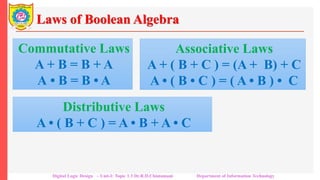
Distributive Laws
A • ( B + C ) = A • B + A • C
A + ( B • C ) = ( A + B ) • ( A + C )
Associative Laws
A + ( B + C ) = (A + B) + C
A • ( B • C ) = ( A • B ) • C
Digital Logic Design – Unit-I: Topic 1.3 Dr.R.D.Chintamani Department of Information Technology
DeMorgan’s Theorm
First DeMorgan’sTheorem
Digital Logic Design – Unit-I: Topic 1.3 Dr.R.D.Chintamani Department of Information Technology
80.
DeMorgan’s Theorm
First DeMorgan’sTheorem
states that
Digital Logic Design – Unit-I: Topic 1.3 Dr.R.D.Chintamani Department of Information Technology
81.
DeMorgan’s Theorm
First DeMorgan’sTheorem
states that
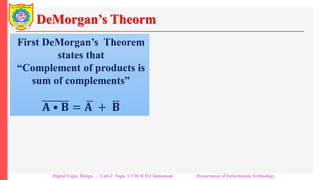
“Complement of products is
sum of complements”
Digital Logic Design – Unit-I: Topic 1.3 Dr.R.D.Chintamani Department of Information Technology
82.
DeMorgan’s Theorm
First DeMorgan’sTheorem
states that
“Complement of products is
sum of complements”
𝐀 • 𝐁 = ഥ
𝐀 + ഥ
𝐁
Digital Logic Design – Unit-I: Topic 1.3 Dr.R.D.Chintamani Department of Information Technology
83.
DeMorgan’s Theorm
First DeMorgan’sTheorem
states that
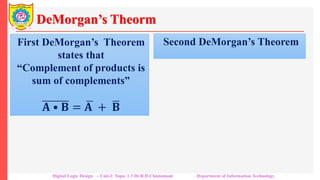
“Complement of products is
sum of complements”
𝐀 • 𝐁 = ഥ
𝐀 + ഥ
𝐁
Second DeMorgan’s Theorem
Digital Logic Design – Unit-I: Topic 1.3 Dr.R.D.Chintamani Department of Information Technology
84.
DeMorgan’s Theorm
First DeMorgan’sTheorem
states that
“Complement of products is
sum of complements”
𝐀 • 𝐁 = ഥ
𝐀 + ഥ
𝐁
Second DeMorgan’s Theorem
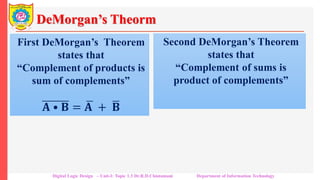
states that
“Complement of sums is
product of complements”
Digital Logic Design – Unit-I: Topic 1.3 Dr.R.D.Chintamani Department of Information Technology
85.
DeMorgan’s Theorm
First DeMorgan’sTheorem
states that
“Complement of products is
sum of complements”
𝐀 • 𝐁 = ഥ
𝐀 + ഥ
𝐁
Second DeMorgan’s Theorem
states that
“Complement of sums is
product of complements”
𝐀 + 𝐁 = ഥ
𝐀 • ഥ
𝐁
Digital Logic Design – Unit-I: Topic 1.3 Dr.R.D.Chintamani Department of Information Technology
86.
Simplification of logicfunctions
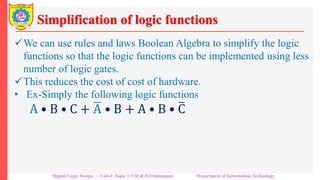
We can use rules and laws Boolean Algebra to simplify the logic
functions so that the logic functions can be implemented using less
number of logic gates.
This reduces the cost of cost of hardware.
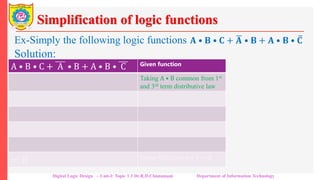
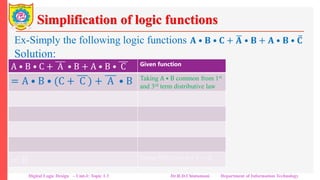
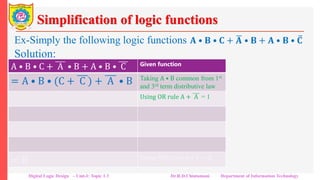
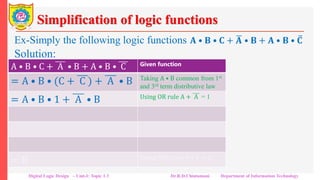
• Ex-Simply the following logic functions
A • B • C + ഥ
A • B + A • B • ത
C
Solution:
A • B • C + ഥ
A • B + A • B • ത
C
Taking A • B common from 1st and 3rd term
= A • B • (C + ത
C) + ഥ
A • B
Digital Logic Design – Unit-I: Topic 1.3 Dr.R.D.Chintamani Department of Information Technology
87.
Simplification of logicfunctions
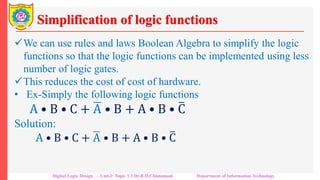
We can use rules and laws Boolean Algebra to simplify the logic
functions so that the logic functions can be implemented using less
number of logic gates.
This reduces the cost of cost of hardware.
• Ex-Simply the following logic functions
A • B • C + ഥ
A • B + A • B • ത
C
Solution:
A • B • C + ഥ
A • B + A • B • ത
C
Taking A • B common from 1st and 3rd term
= A • B • (C + ത
C) + ഥ
A • B
Digital Logic Design – Unit-I: Topic 1.3 Dr.R.D.Chintamani Department of Information Technology
88.
Simplification of logicfunctions
We can use rules and laws Boolean Algebra to simplify the logic
functions so that the logic functions can be implemented using less
number of logic gates.
This reduces the cost of cost of hardware.
• Ex-Simply the following logic functions
A • B • C + ഥ
A • B + A • B • ത
C
Solution:
A • B • C + ഥ
A • B + A • B • ത
C
Taking A • B common from 1st and 3rd term
= A • B • (C + ത
C) + ഥ
A • B
Digital Logic Design – Unit-I: Topic 1.3 Dr.R.D.Chintamani Department of Information Technology
89.
Simplification of logicfunctions
We can use rules and laws Boolean Algebra to simplify the logic
functions so that the logic functions can be implemented using less
number of logic gates.
This reduces the cost of cost of hardware.
• Ex-Simply the following logic functions
A • B • C + ഥ
A • B + A • B • ത
C
Solution:
A • B • C + ഥ
A • B + A • B • ത
C
Taking A • B common from 1st and 3rd term
= A • B • (C + ത
C) + ഥ
A • B
Digital Logic Design – Unit-I: Topic 1.3 Dr.R.D.Chintamani Department of Information Technology
90.
Simplification of logicfunctions
We can use rules and laws Boolean Algebra to simplify the logic
functions so that the logic functions can be implemented using less
number of logic gates.
This reduces the cost of cost of hardware.
• Ex-Simply the following logic functions
A • B • C + ഥ
A • B + A • B • ത
C
Solution:
A • B • C + ഥ
A • B + A • B • ത
C
Taking A • B common from 1st and 3rd term
= A • B • (C + ത
C) + ഥ
A • B
Digital Logic Design – Unit-I: Topic 1.3 Dr.R.D.Chintamani Department of Information Technology
91.
Simplification of logicfunctions
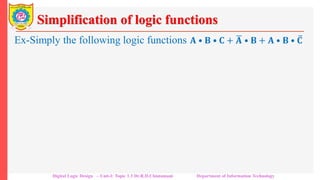
Ex-Simply the following logic functions 𝐀 • 𝐁 • 𝐂 + ഥ
𝐀 • 𝐁 + 𝐀 • 𝐁 • ത
𝐂
Digital Logic Design – Unit-I: Topic 1.3 Dr.R.D.Chintamani Department of Information Technology
92.
Simplification of logicfunctions
Ex-Simply the following logic functions 𝐀 • 𝐁 • 𝐂 + ഥ
𝐀 • 𝐁 + 𝐀 • 𝐁 • ത
𝐂
Solution:
A • B • C + A • B + A • B • C Given function
= B Using AND rule A • 1 = A
Digital Logic Design – Unit-I: Topic 1.3 Dr.R.D.Chintamani Department of Information Technology
93.
Simplification of logicfunctions
Ex-Simply the following logic functions 𝐀 • 𝐁 • 𝐂 + ഥ
𝐀 • 𝐁 + 𝐀 • 𝐁 • ത
𝐂
Solution:
A • B • C + A • B + A • B • C Given function
Taking A • B common from 1st
and 3rd term distributive law
= B Using AND rule A • 1 = A
Digital Logic Design – Unit-I: Topic 1.3 Dr.R.D.Chintamani Department of Information Technology
94.
Simplification of logicfunctions
Ex-Simply the following logic functions 𝐀 • 𝐁 • 𝐂 + ഥ
𝐀 • 𝐁 + 𝐀 • 𝐁 • ത
𝐂
Solution:
A • B • C + A • B + A • B • C Given function
= A • B • (C + C ) + A • B Taking A • B common from 1st
and 3rd term distributive law
= B Using AND rule A • 1 = A
Digital Logic Design – Unit-I: Topic 1.3 Dr.R.D.Chintamani Department of Information Technology
95.
Simplification of logicfunctions
Ex-Simply the following logic functions 𝐀 • 𝐁 • 𝐂 + ഥ
𝐀 • 𝐁 + 𝐀 • 𝐁 • ത
𝐂
Solution:
A • B • C + A • B + A • B • C Given function
= A • B • (C + C ) + A • B Taking A • B common from 1st
and 3rd term distributive law
Using OR rule A + A = 1
= B Using AND rule A • 1 = A
Digital Logic Design – Unit-I: Topic 1.3 Dr.R.D.Chintamani Department of Information Technology
96.
Simplification of logicfunctions
Ex-Simply the following logic functions 𝐀 • 𝐁 • 𝐂 + ഥ
𝐀 • 𝐁 + 𝐀 • 𝐁 • ത
𝐂
Solution:
A • B • C + A • B + A • B • C Given function
= A • B • (C + C ) + A • B Taking A • B common from 1st
and 3rd term distributive law
= A • B • 1 + A • B Using OR rule A + A = 1
= B Using AND rule A • 1 = A
Digital Logic Design – Unit-I: Topic 1.3 Dr.R.D.Chintamani Department of Information Technology
97.
Simplification of logicfunctions
Ex-Simply the following logic functions 𝐀 • 𝐁 • 𝐂 + ഥ
𝐀 • 𝐁 + 𝐀 • 𝐁 • ത
𝐂
Solution:
A • B • C + A • B + A • B • C Given function
= A • B • (C + C ) + A • B Taking A • B common from 1st
and 3rd term distributive law
= A • B • 1 + A • B Using OR rule A + A = 1
Using AND rule A • 1 = A
= B Using AND rule A • 1 = A
Digital Logic Design – Unit-I: Topic 1.3 Dr.R.D.Chintamani Department of Information Technology
98.
Simplification of logicfunctions
Ex-Simply the following logic functions 𝐀 • 𝐁 • 𝐂 + ഥ
𝐀 • 𝐁 + 𝐀 • 𝐁 • ത
𝐂
Solution:
A • B • C + A • B + A • B • C Given function
= A • B • (C + C ) + A • B Taking A • B common from 1st
and 3rd term distributive law
= A • B • 1 + A • B Using OR rule A + A = 1
= A • B + A • B Using AND rule A • 1 = A
= B Using AND rule A • 1 = A
Digital Logic Design – Unit-I: Topic 1.3 Dr.R.D.Chintamani Department of Information Technology
99.
Simplification of logicfunctions
Ex-Simply the following logic functions 𝐀 • 𝐁 • 𝐂 + ഥ
𝐀 • 𝐁 + 𝐀 • 𝐁 • ത
𝐂
Solution:
A • B • C + A • B + A • B • C Given function
= A • B • (C + C ) + A • B Taking A • B common from 1st
and 3rd term distributive law
= A • B • 1 + A • B Using OR rule A + A = 1
= A • B + A • B Using AND rule A • 1 = A
Taking B common from 1st and
2nd term distributive law
= B Using AND rule A • 1 = A
Digital Logic Design – Unit-I: Topic 1.3 Dr.R.D.Chintamani Department of Information Technology
100.
Simplification of logicfunctions
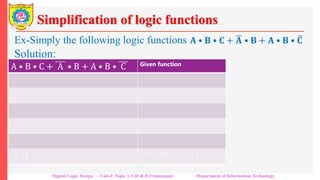
Ex-Simply the following logic functions 𝐀 • 𝐁 • 𝐂 + ഥ
𝐀 • 𝐁 + 𝐀 • 𝐁 • ത
𝐂
Solution:
A • B • C + A • B + A • B • C Given function
= A • B • (C + C ) + A • B Taking A • B common from 1st
and 3rd term distributive law
= A • B • 1 + A • B Using OR rule A + A = 1
= A • B + A • B Using AND rule A • 1 = A
= B • (A + A ) Taking B common from 1st and
2nd term distributive law
= B Using AND rule A • 1 = A
Digital Logic Design – Unit-I: Topic 1.3 Dr.R.D.Chintamani Department of Information Technology