Comprehensive Overview of Bioinformatics: Tools, Aims, and Applications
Explore the fundamentals of bioinformatics, including its aims, scope, and key computational tools like FASTA and BLAST, with applications spanning medicine, genetics, and biotechnology.The PowerPoint presentation offers a beginners guide to have a bird's eye view of this synthetic science and its potential in wide perspective.
Comprehensive Overview of Bioinformatics: Tools, Aims, and Applications
1.
INTRODUCTION, AIM, SCOPEOF BIOINFORMATICS,
RELATED TOOLS (FASTA, BLAST)
Dr. Nandadulal
Sannigrahi,
Associate Professor,
Department of Botany,
Nistarini College, Purulia
D.B. Road, Purulia,
INDIA (W.B)
2.
INTRODUCTION
Biology hastraditionally been an observational rather than a
deductive science. Although recent developments have not altered this
basic orientation, the nature of the data has radically changed.
It is arguable that until recently all biological observations were
fundamentally anecdotal - admittedly with varying degrees of
precision, some very high indeed.
However, in the last generation the data have become not only much
more quantitative and precise, but, in the case of nucleotide and
amino acid sequences, they have become discrete.
It is possible to determine the genome sequence of an individual
organism or clone not only completely, but in principle exactly.
Growth in laboratory technology facilitated collection of data at a rate
that was faster than the rate of data interpretation,
Collecting and cataloguing information about individuals species as
well as genes and their wide uses make the foundation of biological
sciences garnished with Information science builds the novel branch-
Bioinformatics.
3.
BIOINFORMATICS- DEFINITION
Thedefinition of Bioinformatics have been defined by the scientists
different time.
“The mathematical, statistical and computing methods that aim to
solve biological problems using DNA and amino acid sequences and
related information” ( Fredij Tekaia, The Institute Pasteur).
“The term Bioinformatics is used to encompass almost all computer
applications in biological processes” ( T.K. Attwood and D.J.
Parry-Smith)
As per Cynthia Gibas, Bioinformatics is the intersection of
information technology and Biology.
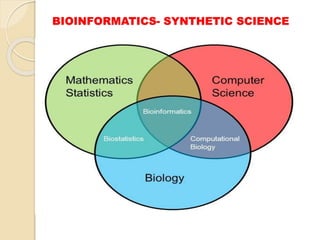
Bioinformatics is a highly multidisciplinary field of biology , relying
on basic principles of Computer science, biology, physics, chemistry
and mathematics (statistics).
Harold Morowitz believes that “ Computers are to biology, what
mathematics is to physics”.
4.
AIM OF BIOINFORMATICS
FIRST AIM
First, at its simplest bioinformatics organizes data in a way that allows
researchers to access existing information and to submit new entries as
they are produced, e.g. the Protein Data Bank for 3D macromolecular
structures. While data-curation is an essential task, the information stored
in these databases is essentially useless until analyzed.
Thus the purpose of bioinformatics extends much further to explore wide
areas.
SECOND AIM
The second aim is to develop tools and resources that aid in the analysis
of data. For example, having sequenced a particular protein, it is of
interest to compare it with previously characterized sequences.
This needs more than just a simple text-based search and programs such
as FASTA and PSI-BLAST must consider what comprises a biologically
significant match.
Development of such resources dictates expertise in computational theory
as well as a thorough understanding of biology.
AIM OF BIOINFORMATICS
THIRD AIM
The third aim is to use these tools to analyze the data and interpret the
results in a biologically meaningful manner.
Traditionally, biological studies examined individual systems in
detail, and frequently compared them with a few that are related.
In bioinformatics, we can now conduct global analyses of all the
available data with the aim of uncovering common principles that
apply across many systems and highlight novel features.
The field of bioinformatics has three main objectives:
To organize vast reams of molecular biology data in an efficient
manner
To develop tools that aid in the analysis of such data
To interpret the results accurately and meaningfully.
Thus, Bioinformatics is an holistic science to bring the data under
single canopy and to curate to multipurpose uses.
7.
SCOPE OF BIOINFORMATICS
Bioinformatics nourishes mainly two scopes-
COMPUTATIONAL BIOINFORMATICS
It involves computational works to develop an application for dealing
biological problems. Computational bioinformatics deals with
development of algorithm and software. Algorithm is a logical
sequence of steps by which a task can be performed.
Molecular biologists, bioinformaticist, computer scientist, system
engineer, mathematicians or statistician work together to solve
biological problem by designing an algorithm.
Another important aspect of computational bioinformatics is database
construction and curation. Vast range of information that have
generated by biotechnological works on genome, protein and other
bio-molecules of various organisms are stored in respective
databases.
The data that are stored in databases are annotated and can be easily
retrieved by researchers. There are countless public databases that
store different level of biological information.
8.
SCOPE OF BIOINFORMATICS
APPLICATION BIOINFORMATICS
Application Bioinformatics of Another exciting study area of
bioinformatics is application bioinformatics. Application
bioinformatics deals with sequence analysis, structure analysis and
function analysis bio-molecules.
With the help of computer program bioinformaticist analyses the
sequence of bio-molecules like DNA, RNA and protein.
Analysis of the sequence of bio-molecules is done for evolutionary
analysis, identification of mutations, identification of exon and
introns, identification and characterization of novel microbes,
selection of drug and its appropriate dose for a patient,
identification of drug target and gene therapy etc.
Structure analysis deals with analysis of structure of unknown protein
or nucleic acid by comparing the structure of these unknown bio-
molecules with the known structures stored in structure databases.
It facilitates determination of 2D or 3D structure of proteins and
nucleic acids and thus helps in prediction of their function. Function
analysis deals with determination of function of gene or protein with
the help of function databases. It promotes use of annotated gene or
protein for human welfare by biotechnological means.
SCOPE OF BIOINFORMATICS
Bioinformatics can be used in the following fields as mentioned below:
Microbial genome applications- the study of genome of unicellular/ virus
Molecular medicine- genes, proteins interactions for diseases diagnosis
Personalized medicine- disease prevention, diagnosis and treatment based on
individual’s genetic make-up, life style and environment,
Preventative medicine –focus on promoting health and preventing diseases
before they develop
Gene therapy- modifies, replaces or inactivates a person’s genes to treat or
cure disease.
Drug development- complex, highly regulated process of bringing new
pharmaceutical from laboratory to the users.
Antibiotic resistance – To find out the microbes nature to resist antibiotics
Evolutionary studies – to study the phylogeny and to construct the
phylogeny tree on the basis of databases
Waste cleanup – Microbial technology to clean the waste of diverse nature,
Biotechnology – to design, develop the new products using living organisms.
11.
SCOPE OF BIOINFORMATICS
Various Fields of Bioinformatics to Climate change Studies- cause,
consequences of on going climate changes and its impact analysis,
Alternative energy sources – To find out the substitute of non-
renewable energy sources through green chemistry and others,
Crop improvement – to design and develop the crop varieties through
breeding and genetic engineering techniques,
Forensic analysis- examination of evidence to uncover facts ,
reconstruct events and identify perpetrators,
Bio-weapon creation- the design ad develop disease causing agents
like virus, bacteria, fungi or toxins to intentional killing of the population.
Insect resistance- to design the plants or organisms to resist the insect
lethality,
Improve nutritional quality- to improve the quality of nutrients and
fortification,
Development of Drought resistant varieties- To address drought by
designing drought resistance varieties
Vetinary Science Applications in Medicines- treatments for different
animals.
BIOINFORMATICS TOOLS
Bioinformatics, the discipline that generates computational tools,
databases and methods to support genomic research and it acts as
interface among biology, medicine, mathematics and computer science.
It faces a major challenge which is elucidate the relationship between a
sequence.
The data produced by functional genomics in the form of gene
expression, disease profiling, secondary structure prediction, and cell
modeling would obviously require unique and sometimes new methods
of analysis,
To address the growing need, several tools have been developed in order
to extract hidden information from the available data, such as patterns etc.
,
Data-mining and knowledge-discovery tools are not only used for
fundamental biological research but also for development,
These tools required for DNA or protein sequences, protein structure,
genomes, proteomes, pathways etc. and they all contribute a huge value
in the exploration of hidden knowledge of this domain.
14.
BIOINFORMATICS TOOLS
Thebioinformatics tools are diverse depending upon the needs in the
emerging context. These are as follows:
Sequence Analysis Tools- Basic Local Alignment Search Tools
(BLAST) that is used to search similarities between the known
sequences and newly discovered sequences; Electronic PCR( ePCR)that
searches query DNA sequences for sequence tagged sites (STSs), ORF
tool to identify all possible ORFs in DNA sequences and more.
Protein sequence analysis and Proteomics Tools-PSI-
BLAST, PHI-BLAST, CD search, CDART are some of the tools used in
this regard.
Structure Analysis Tools- Cn3D is a web browser application
that allows one to view 3D structures from NCBI’s Entrez retrieval
service,
Genome Analysis and gene Expression tools- Clusters of
orthologous groups (COGs)is a tool uses a natural system of gene
families from complete genomes; used to derive the phylogenetic system
of classification of proteins encoded in genomes.
15.
BIOINFORMATICS TOOLS
DataSubmission Tools- Bankit ( submission of data into
Genbank), Sequin( stand-alone tool developed by NCBI to three
databases namely GenBank, EMBL and DDBJ), Webin (submission
of nucleotide sequences to the EMBL database), Sakura( Nucleotide
sequence submission through interne to feed into DDBJ. Database)
etc.
Prediction tools- Phylip (package of programs for deducing
phylogeny), Alibee ( utilizes the old Gene Bee algorithm of multiple
alignment), GenScan ( best gene finding algorithm), Prosite (
Databases of protein families) and many more in this regard,
Modeling tools- Rasmol ( molecular graphics program intended
for the visualization of proteins, nucleic acids, small molecules
available for Windows, Macintosh and UNIX platforms), SPDV i.e.
Swiss PDF viewer to view, manipulate and modeling of multiple
molecules layers), Hyperchem,( molecular modeling software used
for 3D visualization and animation with quantum chemical
calculations, molecular mechanics and dynamics.
16.
BLAST- SEQUENCE ANALYSISTOOL
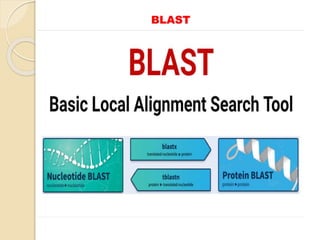
BLAST stands for Basic Local Alignment Search Tool
It is a widely used bioinformatics program that was first introduced by
Stephen Altschul et al. in 1990 and has since become one of the most
popular tools for sequence similarity search,
It has played a vital role in numerous research studies and has paved
the way for the development of other sequence comparison tools.
BLAST works by comparing a query sequence to a database of
sequences to find regions of similarity.
It uses a heuristic approach to search for similarities in the database,
making it faster and more efficient.
17.
BLAST- SEQUENCE ANALYSISTOOL
There are five types (variants) of BLAST that are differentiated
based on the type of sequence (DNA or protein) of the query and
database sequences.
BLASTN-It basically compares a nucleotide query sequence to a
nucleotide sequence database.
BLASTP-To compare a protein query sequence to a protein
sequence database.
BLASTX-compares a nucleotide query sequence to a protein
sequence database by translating the query sequence into its six
possible reading frames and aligning them with the protein
sequences.
TBLASTN-compares a protein query sequence to a nucleotide
sequence database by translating the nucleotide sequences in all six
reading frames and aligning them with the protein sequence.
TBLASTX-compares a nucleotide query sequence to a nucleotide
sequence database by translating the query sequence in all six
reading frames and aligning them with the nucleotide sequences.
BIOINFORMATICS TOOLS
Severalkey features of BLAST make it a widely used tool in
bioinformatics. Some of these are:
BLAST is fast and efficient, making it possible to handle large
databases of sequences.
It is a flexible and versatile tool as it can be used to search for
similarities in both nucleotide and protein sequences.
It is highly sensitive which allows the identification of even small
similarities between sequences.
It aims to identify regions of local similarity between the query
sequence and the database sequence, rather than attempting to align
the entire sequences.
It has a user-friendly interface that makes it easy to input query
sequences and interpret the results.
20.
BIOINFORMATICS TOOLS
BLASThas a wide range of applications. Some of the most common
applications are:
BLAST can be used to identify unknown sequences by comparing
them with known sequences in a database which helps in predicting
the functions of proteins or genes.
BLAST can also be used in phylogenetic analysis which is important
for understanding the evolutionary relationships between different
species.
BLAST can also be used to identify functionally conserved domains
within proteins which is important for predicting the functions of
proteins.
21.
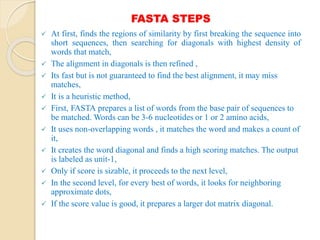
FASTA STEPS
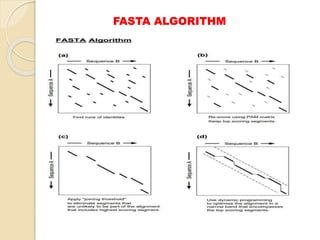
Atfirst, finds the regions of similarity by first breaking the sequence into
short sequences, then searching for diagonals with highest density of
words that match,
The alignment in diagonals is then refined ,
Its fast but is not guaranteed to find the best alignment, it may miss
matches,
It is a heuristic method,
First, FASTA prepares a list of words from the base pair of sequences to
be matched. Words can be 3-6 nucleotides or 1 or 2 amino acids,
It uses non-overlapping words , it matches the word and makes a count of
it,
It creates the word diagonal and finds a high scoring matches. The output
is labeled as unit-1,
Only if score is sizable, it proceeds to the next level,
In the second level, for every best of words, it looks for neighboring
approximate dots,
If the score value is good, it prepares a larger dot matrix diagonal.
BLAST & FASTA
BLASTFASTA
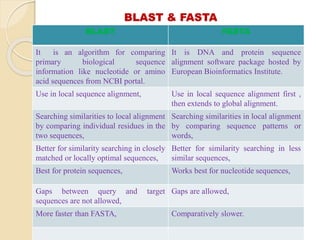
It is an algorithm for comparing
primary biological sequence
information like nucleotide or amino
acid sequences from NCBI portal.
It is DNA and protein sequence
alignment software package hosted by
European Bioinformatics Institute.
Use in local sequence alignment, Use in local sequence alignment first ,
then extends to global alignment.
Searching similarities to local alignment
by comparing individual residues in the
two sequences,
Searching similarities in local alignment
by comparing sequence patterns or
words,
Better for similarity searching in closely
matched or locally optimal sequences,
Better for similarity searching in less
similar sequences,
Best for protein sequences, Works best for nucleotide sequences,
Gaps between query and target
sequences are not allowed,
Gaps are allowed,
More faster than FASTA, Comparatively slower.
24.
THANKS FOR YOURVISIT
ACKNOWLEDGEMENTS:
a. Google for images,
b. Different websites for enriching the course content,
c. Science Direct pages,
d. NCBI website,
e. Bioinformatics- Orpita Basu & Simminder Kaur Thukral,
f. misu.ac.in
g. www.researchgate.in
h. microbesnotes.com
DISCLAIMER:
This presentation has been designed to address the academic
fraternity without any financial interest. This is absolutely free to
use . The author does not claim any kind of financial benefits from
this content.