Comprehensive Overview of Bharatiya Nagarik Suraksha Sanhita 2023: Legal Reforms and Implementation
Detailed insights into BNSS 2023 including objectives, court hierarchy changes, arrest procedures, property attachment, and timelines for investigation to enhance justice delivery in India.
Introduction
• Delay indelivery of justices due to complex legal
procedures, large pendency of cases in the Court, low
conviction rate, insufficient use of technology in legal
system , delays in investigation system, inadequate use
of forensics are the biggest hurdles in speedy delivery
of justice.
• In view of the object and reasons, the government of
India on 11/08/2023 introduced BNSS in the Lok Sabha
with the objective to repeal the Cr.PC, 1973 as a mark
of the 74th years of independent.
• The BNSS retains most of the provision of the Cr.PC.
3.
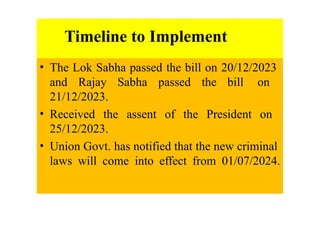
Timeline to Implement
•The Lok Sabha passed the bill on 20/12/2023
and Rajay Sabha passed the bill on
21/12/2023.
• Received the assent of the President on
25/12/2023.
• Union Govt. has notified that the new criminal
laws will come into effect from 01/07/2024.
4.
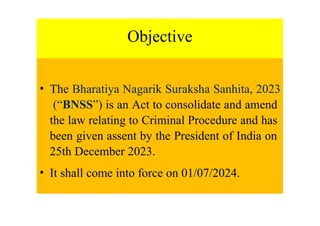
Objective
• The BharatiyaNagarik Suraksha Sanhita, 2023
(“BNSS”) is an Act to consolidate and amend
the law relating to Criminal Procedure and has
been given assent by the President of India on
25th December 2023.
• It shall come into force on 01/07/2024.
5.
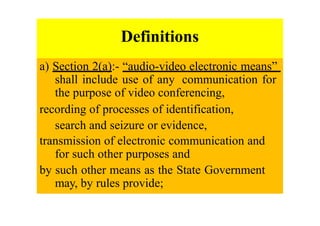
Definitions
a) Section 2(a):-“audio-video electronic means”
shall include use of any communication for
the purpose of video conferencing,
recording of processes of identification,
search and seizure or evidence,
transmission of electronic communication and
for such other purposes and
by such other means as the State Government
may, by rules provide;
6.
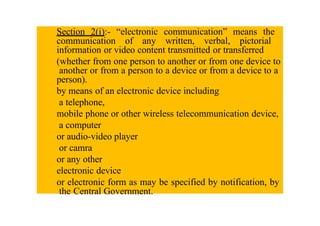
Section 2(i):- “electroniccommunication” means the
communication of any written, verbal, pictorial
information or video content transmitted or transferred
(whether from one person to another or from one device to
another or from a person to a device or from a device to a
person).
by means of an electronic device including
a telephone,
mobile phone or other wireless telecommunication device,
a computer
or audio-video player
or camra
or any other
electronic device
or electronic form as may be specified by notification, by
the Central Government.
7.
Hierarchy of Courts
•The CrPC empowers the state governments to
notify any city or town with a population of more
than one million as a metropolitan area(Section 8
of Cr.PC). Such areas have Metropolitan
Magistrates (Section 16 Cr.PC).
• The BNSS removes the classification of
metropolitan areas and Metropolitan Magistrates.
8.
Establishing a Directorateof
Prosecution
• In Section 20 of the BNSS, the concept of Directorate
of Prosecution has been introduced for each of the
states to establish (with a prescribed hierarchy) with the
stated purpose of monitoring cases by scrutinizing
police reports, expediting proceedings, and providing
opinions on filing of appeals, wherever applicable.
• Director of Prosecution shall monitor cases in which
offences are punishable for 10 years or more, or with
life imprisonment, or with death: to expedite the
proceedings and to give opinion on filing of appeals.
9.
In Relation toArrest
• Section 35 of the BNSS now consolidates
Sections 41 and 41A of the CrPC2 into one
section. In case of an offence punishable for
less than 3 years, and where a person is infirm
or above 60 years of age, an arrest can be
made only if an officer not below the rank of
Deputy Superintendent of Police grants prior
permission for such arrest.
10.
• As regardsarrest by a private person(Section
40 of BNSS), a time limit of six hours has now
been introduced within which the private
person will have to make over such person so
arrested to the Police.
11.
Arrest how made/handcuffing
•Under Section 43 of the BNSS, provides that a police officer may,
keeping in view the nature and gravity of offence use handcuff while
making the arrest of a person or while producing such person before
the court, who is a habitual or a repeat offender, or who escaped
from custody, or who has committed offence of organized crime,
terrorist, drug related crime or illegal possession of arms and
ammunition, murder, rape, acid attack, counterfeiting of coins and
currency notes, human trafficking, sexual offence against children or
offence against state.
• The BNSS, contradicting the Hon’ble Supreme Court direction in
Sunil Batra Vs Delhi administration and Prem Sankr Shukla Vs.
Delhi Administration, formally brings back the usage of handcuff.
• Section 43 of the BNSS dealing with manner in which an arrest is to
be made, provides the police with discretionary powers to handcuff
accused persons for serious offences.
12.
• As regardsarrest of a woman, in Section
43(1) of the BNSS, an obligation has been cast
on the police to effectuate the arrest of a
woman only by a female police officer or
unless the circumstances so require.
13.
Medical Examination
• Whilethe Cr.PC mandates the medical
examination of the accused in specific cases,
including rape, carried out by a registered
medical practitioner upon the request of a Sub-
inspector level police officer.
• Section 51 of the BNSS expands this authority
to any police officer. Now any police officer
can request for the medical examination of the
accused.
14.
Identification and Attachmentof Property of
Proclaimed Person
• Section 86 of BNSS provides that the Court may, on the
written request from a police officer not below the rank
of Superintendent of Police or Commissioner of Police,
initiate the process of requesting assistance from a
Court or an authority in the contracting State for
identification, attachment and forfeiture of property
belonging to a proclaimed person.
• The intention behind this provision seems to be either
to secure the presence of fugitives or confiscate
properties of fugitives who are evading
summons/investigation/trial and have properties outside
the country.
15.
• As perSection 82(4) of Criminal Procedure
Code as per 2005 Amendment, someone can
be declared as a ‘Proclaimed offender’ for only
nineteen specified offences under IPC namely,
“302, 304, 364, 367, 382, 392, 393, 394, 395,
396, 397, 398, 399, 400, 402, 436, 449, 459 or
460”.
16.
• This ledto situations when someone
repeatedly evading legal processes of
summons/warrant for any other offence under
general penal code of IPC or any other special
law could not be declared as a Proclaimed
offender.
• By removing the arbitrary list of sections, any
accused of an offence with more than 10 years
of imprisonment or other special offences
could be declared a proclaimed offender.
17.
• Significant defaultsare being committed by
many loan defaulters who escape justice by
fleeing abroad.
• Section 356 has been added to the BNSS
which provides for a detailed procedure for
conducting a trial/inquiry in the absence of a
person declared as ‘Proclaimed offender’.
18.
Additional power forattachment
and for forfeiture of property
• Section 107 of BNSS gives magistrate power to attached property
identified as “processed of crime”
• The magistrate may upon an application of an I.O. giving reasons to
believe that property is derived from a criminal activity, pass the
following orders:-
a) Direct attachment of property found to be “proceeds of crime”
after hearing all parties concerned:
b) Pass an ex-party interim order attaching property:- if the
magistrate is of the opinion that issuing notice to the owner of the
property for attachment will defeat the object of the attachment or
seizure: and
c) Upon determination that the property in question falls under
proceed of crime, the magistrate will direct the District Magistrate
to rateably distribute the property amongst those who are affected
by such crime.
19.
• Notably, asper the explanation to this section,
the word ‘proceeds of crime’ is defined in
Section 111 of the BNSS and is akin to the
definition of the term under the Prevention of
Money Laundering Act, 2002.
• The exercise of powers granted under BNSS is
not restricted to schedule of offences but may
cover all offences under the IPC
20.
• The powerincludes not just tracing the property
but also attaching any equivalent of the property.
• The intention behind this provision seems to be
either to secure the presence of fugitives or
confiscate properties of fugitives who are evading
summons/investigation/trial and who have
properties outside the country.
• However, there is a possibility of overlap between
this provision and the Fugitive Economic
Offender Act, 2018, which also provides for
requesting contracting states for execution of
order of confiscation of property of fugitive
offenders.
21.
Seizure of ImmovableProperty
• The BNSS broadens the scope of the CrPC’s
police power in property seizure. While the
CrPC initially allowed the seizure of movable
properties suspected to be stolen or found
under suspicious circumstances.
• The BNSS extends this authority to include
immovable properties as well.
22.
Power to removeobstructions by a
police officer
• Section 172 of the BNSS is a newly inserted provision
which casts an obligation on persons to conform to the
lawful directions of a police officer in the fulfillment of
any of his duty under the relevant chapter pertaining to
the preventive action of the Police.
• Further, the Police officer has the power to detain or
remove any person resisting, refusing, ignoring, or
disregarding to conform to any direction given by such
police officer.
• The police officer may either present such person
before a Magistrate or in petty cases, release him within
a period of 24 hours.
23.
ZERO FIR
• Itis mandatory for police to register a FIR where
information regarding commission of a
cognizable offence is received either orally or
through electronic communication irrespective of
whether it has jurisdiction or not(Section 173 of
BNSS).
• Once the zero FIR register, the concerned Police
Station can transfer such FIR to the Police Station
which has jurisdiction to investigate the case.
24.
Introduction of timelinesPreliminary
enquiry and investigation
• One of the more significant changes sought to be
brought about through the BNSS is the attempt to
address the delays in investigation and trial.
Specified timelines have been prescribed for
various stages of the criminal process including to
complete the investigation and file a final report
and for trial of the offence.
• For instance, it is mandatory for a Magistrate to
decide whether to take cognizance of the charge
sheet within a period of 14 days.
25.
• In Section173(3) of the BNSS (which
corresponds to Section 154 of the CrPC), for
offences punishable for 3 years or more but
less than 7 years, the officer in charge may
with the prior permission of the Deputy
Superintendent of Police proceed to conduct a
preliminary enquiry within 14 days to ascertain
if there exists a prima facie case and proceed
with the investigation where there exists one.
26.
• This seemsto contradict the direction of the Hon’ble
Supreme Court in Lalita Kumari Vs Govt. of Uttra
Pardesh which mandated the police to record
information of a cognizable offence as FIR and
investigate the offence regardless of what the police felt
about the credibility of the information.
• Another change is found in Section 173(4)
(corresponding to Section 154(4) of the CrPC) which
provides that the complainant may file an application to
the Magistrate to register an FIR only if the
Superintendent of Police does not investigate the case
or direct a subordinate police officer to investigate, in
accordance with the BNSS.
27.
• Section 155of the CrPC (under Section 174(1) of
the BNSS) has been augmented by introducing a
time period of a fortnight for a police officer to
forward the daily diary report to the Magistrate.
• As regards the police officer’s power to
investigate cognizable offences, the BNSS now
provides that the Superintendent of Police may
require the Deputy Superintendent of Police
to
investigate the offence. The BNSS further
provides that a Judicial Magistrate may take
cognizance of a complaint against a
public servant.
28.
Report of policeofficer on completion
of investigation
• Crucially, Section 193 of the BNSS
(corresponding to Section 1736 of the CrPC) now
casts an obligation on the Police to inform the
victim or informant of the progress of the
investigation including by electronic
communication within a period of 90 days.
Further, the BNSS also permits further
investigation after the chargesheet has been
submitted to the Magistrate but now requires that
such further investigation shall be completed
within 90 days, but which may be extended with
the permission of the Court.
29.
Sanction for Prosecution
•Section 218 of the BNSS (corresponding to
Section 197 of the CrPC) now provides that
the Government shall take the decision of
whether to grant sanction for prosecution of
judges or public servants within 120 days from
the date of receipt of the request for sanction
and if it fails to do so, the sanction shall be
deemed to have been accorded.
30.
Committal to theSessions Court
• In cases involving offences which are triable
exclusively by a sessions court, which are
required to be committed by the Magistrate
under Section 209 of the CrPC, the
corresponding Section 232 of BNSS stipulates
a time period of 90 days to commit the
offences to the sessions court, which may be
extended for a period not exceeding 180 days
for reasons to be recorded in writing.
31.
Framing of charge,trial, and
Judgment
• In relation to framing of charges, a timeline of 60 days has
been specified (in Section 251(1)(b) of the BNSS) for the
Sessions judge from the date of the first hearing to frame in
writing a charge against the accused.
• Section 258(1) of the BNSS (corresponding to Section
235(1)9 of the CrPC) provides that after hearing arguments
and points of law, the judge shall give a judgment within 30
days from the completion of arguments, which may for
specific reasons extend to a period of 45 days, for reasons to
be recorded in writing.
• Finally, the BNSS under Section 392, provides that the
Court shall upload a copy of the judgment on its portal
within 7 days from the date of judgment “No Such
Provision in Cr.PC”.
32.
Discharge
• Section 262of the BNSS (corresponding to Section 239
of the Cr.PC) provides a time limit to the accused to
prefer an application for discharge within a period of 60
days from the date of supply of copies of documents
under Section 230 of the CrPC.
• Section 274 of the BNSS has a newly inserted proviso
providing that if the Magistrate considers the
accusation as groundless, he shall, after recording
reasons in writing, release the accused and such release
shall have the effect of discharge.
33.
Summary trial
• TheBNSS now provides that the Magistrate
may, after giving the accused a reasonable
opportunity of being heard, for reasons to be
recorded in writing, try in a summary way, all
or any of the offences not punishable with
death or imprisonment for life or imprisonment
for a term exceeding 3 years, provided that no
appeal shall lie against any such decision of a
Magistrate (Section 283).
34.
Signature and fingerimpression
• The Cr.P.C. authorizes Magistrate to demand
specimen signature or handwriting from
individuals.
• Section 349 of the BNSS broadens this scope
and further embowers the magistrate to
demand collection of finger impressions and
voice samples too.
• This provision extends to individuals who have
not been arrested under any investigation.
35.
Use of electroniccommunication and video
conferencing in investigation, inquiry and trial
• The BNSS has sought to adopt electronic
communication and video conferencing
facilities at various stages including at the time
of inquiry, investigation, and trial. For
instance, the BNSS permits giving information
as regards commission of a cognizable in
electronic form.
36.
Issuance of process
•A summons issued by a Court under Section 63
(corresponding to Section 61 of the CrPC), or a witness
under Section 71, or a warrant may also be in the form of
electronic communication.
• Section 94 of the BNSS (corresponding to Section 91 of the
CrPC) now permits a Court or an officer in charge of a
police station to summon electronic communication which
is likely to contain digital evidence.
• Section 231 of the BNSS provides that supply of copies of
statements and documents to accused in other cases triable
by Court of Session are permitted to be issued by the
Magistrate in an electronic form.
37.
Use of audio-visualelectronic means
in investigations
• Under Section 176 of the BNSS providing for
procedure for investigation of cognizable offence
(corresponding to Section 157 of the CrPC), the
statement of the victim may also be recorded through
audio-video electronic means including a cell phone, as
also that of a witness under Section 265(3) of the
BNSS.
• Similarly, Section 185 of the BNSS (dealing with
search by a police officer corresponding to Section 165
of he CrPC) requires the search to be recorded through
audio-visual electronic means preferably by cell phone.
38.
Production of DevicesContaining
Digital Evidence
• A Court or an officer in charge of a police station can
compel production of communication devices which
are likely to contain digital evidence from the person
who is in possession of such digital evidence.
• This provision may give the investigating authority
unrestricted use of electronic device in complete breach
of right to privacy as well as privilege.
• The positive aspect of having such a provision is that
the production of original devices will ensure the
genuineness of the digital evidence.
• If such digital evidences have been deleted, with the aid
of technology, such evidences can be retrieved.
39.
Conduct of proceedingsthrough
electronic means
• Section 355 of the BNSS (corresponding to Section 317
of the CrPC) now inserts a new explanation to sub-
section (2) providing that personal attendance of the
accused includes attendance through audio video
electronic means.
• On the same vein, Section 530 of the BNSS now allows
that all trials, inquiries and proceedings including
issuance, service and execution of summons and
warrant; examination of complainant and witnesses;
recording of evidence in inquiries and trials; and all
appellate proceedings or any other proceeding may be
held in electronic mode, by use of electronic
communication or use of audio-video electronic means.
40.
Forensic Experts
• Asper section 176 of BNSS offences carrying a
minimum of punishment of 7 year imprisonment
necessitate forensic investigation.
• In these instances, forensic expert are required to
visit crime scenes for evidence collection,
documenting the process using electronic devices
a like mobile phone.
• These expert are responsible for both evidence
collection and documenting there processer.
41.
Cheating through electronicmeans
• From the perspective of economic offences,
particularly in relation to the offence of
cheating, Section 202(1) of the BNSS
corresponding to Section 182 of the CrPC now
includes cheating by electronic
communications and a Court within whose
local jurisdiction such electronic
communications or letters or messages were
sent or were received has been empowered to
try such offence.
42.
Custody of anaccused
• Under Section 187(2) of the BNSS (corresponding to
Section 167(2) of the CrPC), a Magistrate to whom an
accused is forwarded, may authorize detention of custody of
the accused for a term not exceeding 15 days in the whole,
or in parts at any time during the initial 40 days out of 60
days or 60 days out of 90 days.
• The Magistrate may now authorize detention in police
custody beyond the period of 15 days if there exist adequate
grounds for doing so. However, such detention shall not
exceed 90 days, where the investigation relates to an
offence punishable with death, imprisonment for life or
imprisonment for a term of 10 years or more, or 60 days in
case of any other offence.
43.
• The BNSSprovides that if the accused is not
in custody (corresponding to Section 170 of
the CrPC), the police officer shall take the
security from such person for his appearance
before the Magistrate and the Magistrate to
whom such report is forwarded shall not refuse
to accept the same on the ground that the
accused is not taken in custody.
44.
Bail and AnticipatoryBail
• The definitions of bail, bond, and bail bond have
also been added to Section 2 of the BNSS. The
BNSS now provides that where an investigation,
inquiry, or trial in more than one offence or in
multiple cases are pending against a person, he
shall not be released on bail by the Court.
• More importantly, with regard to anticipatory bail
under Section 438 of the CrPC, the new Section
482 of the BNSS omits the factors contained in
Section 438(1) for grant of anticipatory bail.
Further, Section 438(1A) and (1B) stand omitted.
45.
Cognizance of speciallaw and cases
against public servants
• The BNSS, under Section 210(1) now permits a
magistrate to take cognizance of any offence also in
relation to a complaint filed by a person authorized
under any special law which constitutes an offence.
• the Magistrate may also take cognizance against a
public servant arising in the course of discharge of his
official duties subject to (i) receiving a report
containing facts and circumstances of the incident from
the officer superior to such public servant; and (ii) after
consideration of the assertions made by the public
servant as to the situation that led to the incident so
alleged.
46.
Trial against anabsconding person
• Another significant addition through the BNSS is the introduction of
Section 356, which provides for an inquiry, trial to be conducted or
a judgment to be passed against a proclaimed offender, in absentia.
• In trying a proclaimed offender who has absconded to evade trial
and where there is no immediate prospect of arresting him, it shall
be deemed to operate as waiver of the right of such person to be
present and tried in person, and the Court shall, after recording
reasons in writing, in the interest of justice, proceed with the trial in
the like manner and with like effect as if he was present, under this
Sanhita and pronounce the judgment.
• Further, the proclaimed offender shall not prefer an appeal unless he
presents himself before the Court of Appeal.
• Further, no appeal against conviction shall lie after the expiry of
three years from the date of judgment.
47.
Other relevant provisionsIn relation
to trial
• Section 269(7) of the BNSS (corresponding to
Section 246 of the CrPC) which is newly inserted
provides that where despite giving opportunity to
the prosecution and after taking all reasonable
measures,, if the attendance of prosecution
witnesses cannot be secured for cross
examination, it shall be deemed that such witness
has not been examined for not being available,
and the Magistrate may close the prosecution
evidence for reasons to be recorded in writing and
proceed with the case on the basis of the
materials on record.
48.
• Section 336of the BNSS provides that where any document or
report prepared by a public servant, scientific expert, medical officer
of investigating officer is purported to be used as evidence in any
enquiry, trial or other proceeding under this Code and
• (i) such public servant, expert of officer is either transferred, retired
or died; or
• (ii) such public servant, expert or officer cannot be found or is
incapable of giving deposition or securing the presence of such
public servant, expert or officer is likely to cause delay in holding
the inquiry, trial or proceeding, the Court shall secure presence of
successor officer of such public servant, expert or officer who is
holding that post at the time of such deposition to give deposition on
such document or report.
• However, the section also provides that no public servant, scientific
expert, or medical officer shall be called to appear before Court
unless their report is disputed by any of the parties to the trial or
other proceedings.
49.
Witness Protection Scheme
•By virtue of Section 398 of the BNSS, every
State Govt. shall prepare and notify a Witness
Protection Scheme for the State with a view to
ensure protection of witnesses.
50.
Withdrawal from Prosecution
•As per Cr.PC the Public Prosecutor or APP
may with the concerned of the Court withdraw
from the prosecution of any persons.
• As per BNSS no Court shall allow such
withdrawal without giving an opportunity of
being heard to the victim in case.
51.
Compoundable Offences
• Section359 of the BNSS (corresponding to Section 320 of
the CrPC) now removes adultery for the table of
compoundable offences.
• It provides for compounding with the permission of the
Court for the offence of defamation, specified under Section
356(2) of the BNSS, as against
The President or
The Vice- President or
The Governor of a State or
The Administrator of a
Union Territory or
A minister in respect of his public functions when instituted
upon a complaint made by the public prosecutor.
52.
Clarifications with respectto
Limitation period and
Superintendence of the High Court
• The BNSS now clarifies that (i) for computing
the period of limitation, the relevant date shall
be the date of filing complaint under Section
223 or the date of recording information under
Section 173; and (ii) that every High Court
shall so exercise its superintendence over
Sessions Courts in the state.
53.
Conclusion
• In anutshell, in so far as the prescription of timelines for
inquiry, investigation and trial and formal adoption of
audio-visual and electronic means for to undertake various
processes, the proposed changes are intended to introduce a
more efficient and technologically aligned regime for
administration of criminal justice and move away from the
language of British-era criminal laws.
• However, its efficacy in the real world depends not only on
the manner in which such provisions are implemented and
adhered to in letter and spirit, but also on ensuring that all
magistrates, law enforcement personnel, and allied agencies
undergo the necessary training to implement the changes
that the BNSS brings in its word and spirit.

 Most read
 Most read
 Most read