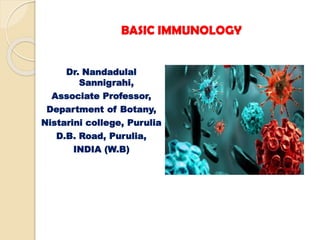
Comprehensive Overview of Basic Immunology and Body Defence Mechanisms
Explores health definitions, disease, and detailed innate and acquired immunity mechanisms including physical barriers, cellular responses, and immune system functions.
HEALTH AND DEFENCEMECHANISMS
Although health is an essential and important issue for the progress of
developing countries, the definition and goals of health tend to be
seen as very important in this consequences.
According to the World Health Organization’s (WHO) definition,
health is “a state of complete physical, mental, and social well-being
and not merely the absence of disease or infirmity.”
Health development encompasses all the elements that are necessary
for the achievement of such a state of being. In this context, a wide
variety of disciplines have some relation to health; specifically, these
disciplines include epidemiology, biology, public health and medical
science as well as demography, economics, and international health.
The Declaration of Alma-Ata of 1978 which introduced the concept
of Primary Health Care (PHC) marked a turning point in the approach
and goals of international aid in the field of health in developing
countries. PHC made explicit the importance of primary health care in
developing countries. In addition, it calls for prioritizing local health
care needs and
3.
HEALTH AND DEFENCEMECHANISMS
fully utilizing locally-available resources to provide health care
services to meet those needs. This approach represents a dramatic
departure from the previous goal of international aid which was to
introduce health systems or models of developed countries into
developing countries.
Health may be either Physical or mental,
Very often, Spiritual, Emotional and Financial health ay contribute
and enrich the definition of health.
Physical, Genetic, Environmental and Socio-economic factors play
decisive role on someone’s health,
Life style factors are also very pertinent one in the context of global
health issue,
Preservation of good and sound health needs nutrition, physical
activity, stress management , preventive care and social connection
are very important issues,
Holistic and sustainable health are the call of the century.
DEFENCE MECHANISMS OFBODY
The environment surrounding us is crowded with organisms; not all
of them are visible but some enter our body and cause harm, resulting
in infection and disease.
There are numerous others that do not always cause disease even
when they use the human body as a host, and instead establish
beneficial relationships with the human host.
The organisms that get into the human body and do harm of some
kind vary in magnitude from those visible to the naked eye like
worms or helminthes, to ones largely visible only under microscopy
including fungi, protozoa, bacteria and viruses, to others not seen like
prions. Such organisms that are agents of disease are referred to as
pathogens.
The human body has a range of defence mechanisms to tackle these
pathogens. The first line of defence is the ability of the human host to
prevent entry of the pathogen and the next response is that mediated
by the host’s natural or innate immunity.
If the pathogen overcomes these obstacles, the host has the ability to
resist infection and disease by resorting to adaptive immunity.
6.
DEFENCE MECHANISMS OFBODY
Failure at any of these stages of the battle between the pathogen and
the human host can result in disease and even death of the host.
The human immune system is complex and highly organized, and
functions to protect the individual from a range of environmental
agents or pathogens that can infect the body and cause disease.
From the perspective of this book it is important to note from the start
that poor nutrition can compromise the body’s ability to mount
effective defence and immune responses, while infections, in turn, can
undermine the normal nutritional status of an individual.
From the above perspectives, human body exercises three basic
defence mechanisms to get rid of from the diseases as follows-
i. Physical barriers,
ii. Defence cells and proteins, inflammation and fever,
iii. The Immune system.
7.
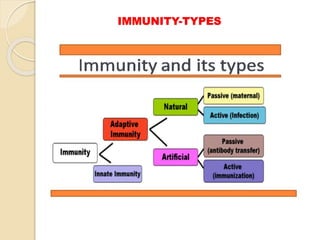
IMMUNITY-TYPES
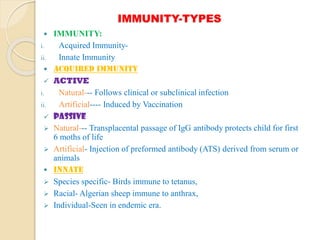
IMMUNITY:
i. AcquiredImmunity-
ii. Innate Immunity
ACQUIRED IMMUNITY
ACTIVE
i. Natural--- Follows clinical or subclinical infection
ii. Artificial---- Induced by Vaccination
PASSIVE
Natural--- Transplacental passage of IgG antibody protects child for first
6 moths of life
Artificial- Injection of preformed antibody (ATS) derived from serum or
animals
INNATE
Species specific- Birds immune to tetanus,
Racial- Algerian sheep immune to anthrax,
Individual-Seen in endemic era.
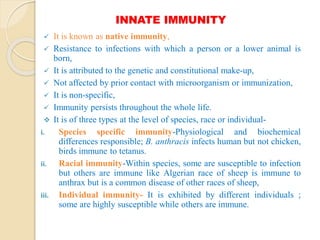
INNATE IMMUNITY
Itis known as native immunity,
Resistance to infections with which a person or a lower animal is
born,
It is attributed to the genetic and constitutional make-up,
Not affected by prior contact with microorganism or immunization,
It is non-specific,
Immunity persists throughout the whole life.
It is of three types at the level of species, race or individual-
i. Species specific immunity-Physiological and biochemical
differences responsible; B. anthracis infects human but not chicken,
birds immune to tetanus.
ii. Racial immunity-Within species, some are susceptible to infection
but others are immune like Algerian race of sheep is immune to
anthrax but is a common disease of other races of sheep,
iii. Individual immunity- It is exhibited by different individuals ;
some are highly susceptible while others are immune.
10.
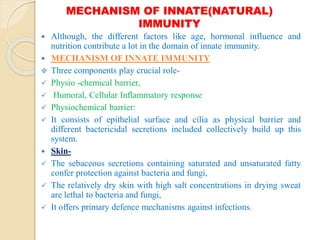
MECHANISM OF INNATE(NATURAL)
IMMUNITY
Although, the different factors like age, hormonal influence and
nutrition contribute a lot in the domain of innate immunity.
MECHANISM OF INNATE IMMUNITY
Three components play crucial role-
Physio -chemical barrier,
Humoral, Cellular Inflammatory response
Physiochemical barrier:
It consists of epithelial surface and cilia as physical barrier and
different bactericidal secretions included collectively build up this
system.
Skin-
The sebaceous secretions containing saturated and unsaturated fatty
confer protection against bacteria and fungi,
The relatively dry skin with high salt concentrations in drying sweat
are lethal to bacteria and fungi,
It offers primary defence mechanisms against infections.
11.
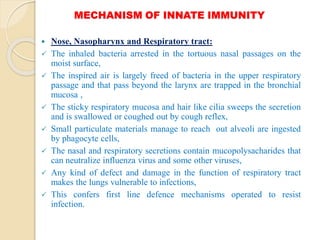
MECHANISM OF INNATEIMMUNITY
Nose, Nasopharynx and Respiratory tract:
The inhaled bacteria arrested in the tortuous nasal passages on the
moist surface,
The inspired air is largely freed of bacteria in the upper respiratory
passage and that pass beyond the larynx are trapped in the bronchial
mucosa ,
The sticky respiratory mucosa and hair like cilia sweeps the secretion
and is swallowed or coughed out by cough reflex,
Small particulate materials manage to reach out alveoli are ingested
by phagocyte cells,
The nasal and respiratory secretions contain mucopolysacharides that
can neutralize influenza virus and some other viruses,
Any kind of defect and damage in the function of respiratory tract
makes the lungs vulnerable to infections,
This confers first line defence mechanisms operated to resist
infection.
12.
MECHANISM OF INNATEIMMUNITY
Mouth, stomach and intestinal tract:
Saliva possesses mild bactericidal action,
The anaerobic colon bacteria produce fatty acids in contact to the
bactericidal action- colonization resistance refers to resistance offered
by the predominant normal flora to infection,
The high acidity of the stomach always destroyed most ingested
bacteria from the diverse sources,
In addition to that, the large intestinal tract offers a resistance
mechanism against the microbial infection.
Conjunctive
The lachrymal glands excitation triggers the production of mild
saline water,
It also contains lysosomes having bactericidal action,
All these offers a strong conjunctive secretions to offer protection
against microbes supposed to enter through eyes.
13.
MECHANISM OF INNATEIMMUNITY
The genitourinary tract:
The urine generally slightly acidic; the flushing action of urine
maintains sterility of both male and female urethra,
Semen contains spermine and zinc having antibacterial activity,
The acid reaction of the vaginal secretion in female due to
fermentation of glycogen in the epithelial cells by the resident acidic
flora possess markedly bactericidal action towards the microbes
supposed to cause genitourinary damages in the human,
This line of system enables the body not to enter pathogens through
genital and urinary apertures.
B. CELLULAR AND HUMORAL BARRIERS
Phagocytes accumulates at the site of infection along with outpouring
of natural and antibacterial substances and deposition of fibrin,
Fibrin acts as net not to allow the microbes to spread further
infection,
It may be of the following types-
14.
CELLULAR AND HUMORALBARRIERS
NEUTROPHIL POLYMORPH NUCLEAR LEUCOCYTES:
Short lived cells formed by bone-marrow and circulate in the blood
stream for about 6-7 hours,
Polymorphs reaches o the site of infection attracted by the chemotactic
substances,
Phagocytosis is promoted in the presence of specific antibody and
complement,
MACROPHAGES
These are mononuclear phagocyte cells – of the reticulo endothelial
system distributed throughout the body- both as wandering amoeboid
cells (monocytes), fixed cells in tissue ( histocyctes) and reticulo
endothelial cells in bone-marrow, spleen, liver, lymph node, thymus etc.
Phagocyte actions done by the following stages-
i. Chemotaxis - Phagocytes reach to the site of infection,
ii. Attachment- Infective agent adhere to phagocyte,
iii. Ingestion- By means of phagosome, phagocyte cells engulf the material
and by hydrolytic enzymes, phagolysosome destroy them.
CELLULAR AND HUMORALBARRIERS
NATURAL KILLER CELLS (NK CELLS)
A class of lymphocytes called natural killer cells (NK) play the role in
non-specific defence against viral infections and tumors,
NK cells selectively kill the selectively virus-infected cells and tumor
cells by means of interferon.
HUMORAL FACTORS
These are associated with nonspecific antibacterial substances in blood
and tissues,
It may be of the following types-
Properdin – Present in blood serum, causes lyses of Gram-negative
bacteria with the help of Mg+ and complement, inactivate some viruses,
Complement- Non-specific, acts on microorganism sensitized by specific
antibody with bactericidal activity,
Lysozyme- Bactericidal enzyme of low molecular weight basic protein
present in polymorph nuclear leucocytes, tears and other bodies, lyses the
mucopeptide of many Gram (-) bacteria,
Acute phase proteins- Increase in concentration during acute
inflammatory responses , like C-reactive protein (CRP), play defensive
role of body by enhancing host resistance.
17.
CELLULAR AND HUMORALBARRIERS
INFLAMMATION
During the infection , the host protection mechanism operated,
The blood vessels particularly arterioles constrict initially and dilate
leading to the increased blood flow,
The blood flow slows down and margination of leucocytes,
The leucocytes escape from the blood vessels by diapedesis and
attracted by the chemotaxis process as released by the microorganism,
Due to the large number of leucocytes, there is an outpouring of
plasma at the site of injury,
These dilute the toxic substances, hence the infection site trigger the
defence mechanisms.
FEVER
A slight raise of temperature accompanies with infection,
It is caused by Interleukin I (IL1) or IL6 and tumor necrosis factor
(TNF) that can act on hypothalamus,
Host immune mechanisms trigger due to increase of body temperature.
18.
ACQUIRED IMMUNITY
Resistanceagainst diseases acquired by an individual during the disease
is called acquired immunity or specific immunity.
Acquired immunity of two types- Active and passive,
ACTIVE IMMUNITY
Resistance developed by an individual after effective contact with antigen
either by the consequences of natural infection by the microbes or by
means of vaccination as a part of preventive measures,
Immune system actively participates producing antibody and often cell
mediated immunity also, It develops slowly over a period but persists for
a long time usually from days to years.
MECHANISM
The body’s immune apparatus offers protection by synthesizing antibody
either by Antibody immune system (AMIS) or cell mediated immune
system (CMIS),
During the encounter between host and microbes, antibody formation
starts only after a latent period , attributing to antigen to combine with
pre-existing antibody in blood,
Lowering of blood concentration level of antigen ,
This is called primary immune response.
19.
ACQUIRED IMMUNITY
Afterthe first encounter, the same antigen when enters into body, the
immune response becomes more rapid and stronger to resist the
antigen , called secondary immune response.
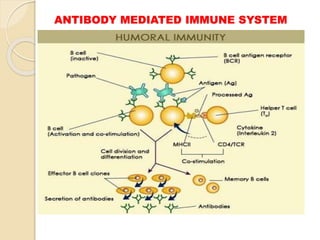
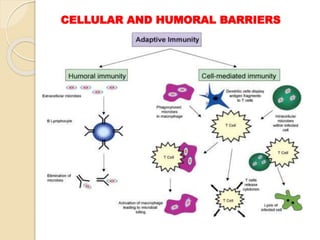
HUMORAL OR ANTIBODY MEDIATED IMMUNE SYSTEM
(AMIS)
It is a critical component of the adaptive immune system.
This specialized response relies on antibodies, which are proteins
produced by B cells, to identify and neutralize pathogens such as
bacteria, viruses, and toxins. Antibodies provide highly specific
targeting, ensuring precision in neutralizing threats while minimizing
harm to the body’s own cells.
Antibodies, or immunoglobulin, are Y-shaped proteins composed of
variable and constant regions. The variable region, located at the tips
of the "Y," is uniquely structured to bind to specific antigens, much
like a lock and key.
The constant region determines the antibody's functional properties,
such as its ability to recruit other immune components.
20.
ACQUIRED IMMUNITY
Antibodiesexert their effects through three primary mechanisms:
Agglutination: agglutinate the antigens by special mechanisms,
Neutralization: Binding to pathogens or their toxins to prevent them from
interacting with host cells.
Opsonization: Coating pathogens to enhance their recognition and
engulfment by phagocytes.
Complement Activation: Triggering a cascade of proteins that help
destroy pathogens and recruit immune cells.
STEPS:
When a B cell encounters an antigen, it processes and presents fragments
of the antigen on its surface using major histo-compatibility complex
(MHC) molecules.
T helper cells recognize this presentation and release signaling molecules
(cytokines) that activate the B cell.
Once activated, B cells proliferate and differentiate into plasma cells,
which secrete large quantities of antibodies specific to the encountered
antigen. Some B cells become memory cells, providing long-lasting
immunity by enabling a faster and stronger response upon re-exposure to
the same pathogen.
ACQUIRED IMMUNITY
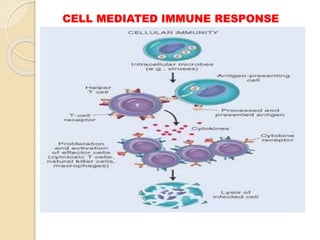
CELLMEDIATED IMMUNE SYSTEM ( CMIS)
It mainly depends on specifically developed T-cells by certain antigens,
The sensitized T-lymphocytes become active in operation to counter
chronic infections,
Helper T cells are like the “managers” of the immune response. They
secrete cytokines, which activate or control the activities of other
lymphocytes. Most helper T cells die out once a pathogen has been
cleared from the body, but a few remain as memory cells.
These memory cells are ready to produce large numbers of antigen-
specific helper T cells like themselves if they are exposed to the same
antigen in the future,
Cytotoxic T cells destroy virus-infected cells and some cancer cells.
Once activated, a cytotoxic T cell divides rapidly and produces an “army”
of cells identical to itself.
These cells travel throughout the body “searching” for more cells to
destroy. cytotoxic T cell destroys a body cell infected with viruses.
This T cell releases toxins that form pores in the membrane of the
infected cell. This causes the cell to burst, destroying both the cell and the
viruses inside.
ACQUIRED IMMUNITY
IMMUNOLOGICALMEMORY:
Besides development of antibody mediated immunity, active immunity is
associated with immunological memory,
The immune system retains the memory of a prior antigenic exposure for
long periods and are able to produce a secondary type of immune response
when it encounters the same antigen once again,
The generation of memory T cells, long-lived cells that give an
accelerated response to antigen, is much less well understood than the
generation of effectors T cells .
TYPES OF ACTIVE IMMUNITY
Active Immunity of two types- Natural and artificial
NATURAL-
The subclinical infection after repeated exposure of small antigen
generally develops this natural immunity by the means of natural
discourse,
Such immunity is long lasting and plays role in epidemics like the
poliomyelitis, TB etc.
25.
ACQUIRED IMMUNITY
ARTIFICIALACTIVEIMMUNITY
It is generally done by vaccination by the introduction of live, attenuated
or killed microorganism,
The materials derived from toxoids,
The most commonly toxoids are as follows-
i. Live bacterial vaccines like BCG, anthrax, plague, brucella vaccines,
ii. Killed bacterial vaccines like TAB for enteric fever, auto vaccine
Viral live vaccines like small pox, measles, influenza, mumps etc,
Killed viral vaccines like Salk vaccine for Polymelities,
Toxoids for tetanus and diphtheria.
Attenuation is a process to design vaccine by aging of culture , cultivation
at high temperature through the passage of different animal species. The
immunity derived by the use of live vaccine parallels to the natural
infection through the immune response may be lower order.
Killed vaccines are the vaccines designed by the killing of organisms by
heat, formalin, phenol, alcohol , U-V light and photodynamic
inactivation.
26.
ACQUIRED IMMUNITY
Toxoidsare preparation of bacterial endotoxins inactivated by
formalin (formal toxoid) or by alum (APT). They retain
immunogenicity but lose toxigenicity.
PASSIVE IMMUNITY
The resistance is transmitted passively to a recipient by transfer of
preformed antibodies against infective agent or toxin from another
host,
The immune response plays no active role and the protective
mechanisms comes from readymade antibodies prepared earlier,
It is short lasting, only for a days to week,
Useful when instant immunity is required,
It generates no immune memory,
Passive immunity of two types- Natural and Artificial.
27.
ACQUIRED IMMUNITY
NATURALPASSIVE IMMUNITY
Resistance passively transferred to fetus by mother,
Human colostrums contains high concentration of IgA antibodies ,
resistant to human intestinal digestion and offers protection to the
neonate,
Infant acquires some degree of immunological independence by about
three moths of age,
Maternal antibodies give passive protection against infectious diseases to
the infant till three months of age,
Active immunization of pregnant mother , the quality of passive
immunity in infants can improved , hence administration of tetanus
toxoid in recommended during pregnancy.
ARTIFICAL PASSIVE IMMUNITY
Resistance passively transferred to a recipient to the parental
administration of antibodies,
Passive immunization is done usually done in the treatment of some
diseases associated to provide temporary immunity to individuals who
have been exposed to infectious organism and who have not been actively
immunized,
28.
ACQUIRED IMMUNITY
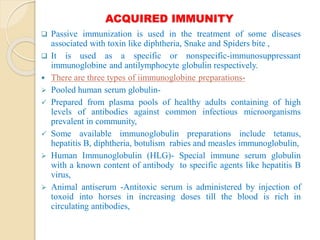
Passiveimmunization is used in the treatment of some diseases
associated with toxin like diphtheria, Snake and Spiders bite ,
It is used as a specific or nonspecific-immunosuppressant
immunoglobine and antilymphocyte globulin respectively.
There are three types of iimmunoglobine preparations-
Pooled human serum globulin-
Prepared from plasma pools of healthy adults containing of high
levels of antibodies against common infectious microorganisms
prevalent in community,
Some available immunoglobulin preparations include tetanus,
hepatitis B, diphtheria, botulism rabies and measles immunoglobulin,
Human Immunoglobulin (HLG)- Special immune serum globulin
with a known content of antibody to specific agents like hepatitis B
virus,
Animal antiserum -Antitoxic serum is administered by injection of
toxoid into horses in increasing doses till the blood is rich in
circulating antibodies,
29.
ACQUIRED IMMUNITY
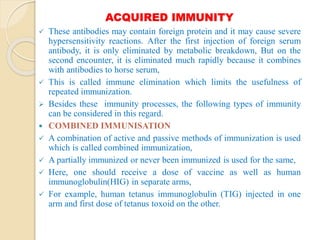
Theseantibodies may contain foreign protein and it may cause severe
hypersensitivity reactions. After the first injection of foreign serum
antibody, it is only eliminated by metabolic breakdown, But on the
second encounter, it is eliminated much rapidly because it combines
with antibodies to horse serum,
This is called immune elimination which limits the usefulness of
repeated immunization.
Besides these immunity processes, the following types of immunity
can be considered in this regard.
COMBINED IMMUNISATION
A combination of active and passive methods of immunization is used
which is called combined immunization,
A partially immunized or never been immunized is used for the same,
Here, one should receive a dose of vaccine as well as human
immunoglobulin(HIG) in separate arms,
For example, human tetanus immunoglobulin (TIG) injected in one
arm and first dose of tetanus toxoid on the other.
30.
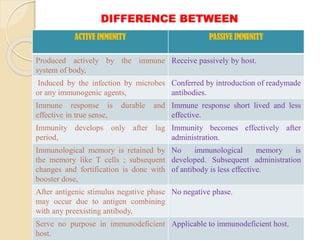
DIFFERENCE BETWEEN
ACTIVE IMMUNITYPASSIVE IMMUNITY
Produced actively by the immune
system of body,
Receive passively by host.
Induced by the infection by microbes
or any immunogenic agents,
Conferred by introduction of readymade
antibodies.
Immune response is durable and
effective in true sense,
Immune response short lived and less
effective.
Immunity develops only after lag
period,
Immunity becomes effectively after
administration.
Immunological memory is retained by
the memory like T cells ; subsequent
changes and fortification is done with
booster dose,
No immunological memory is
developed. Subsequent administration
of antibody is less effective.
After antigenic stimulus negative phase
may occur due to antigen combining
with any preexisting antibody,
No negative phase.
Serve no purpose in immunodeficient
host.
Applicable to immunodeficient host.
31.
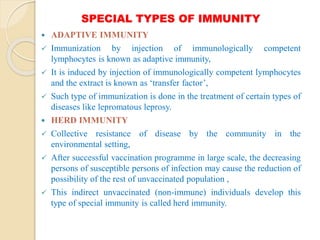
SPECIAL TYPES OFIMMUNITY
ADAPTIVE IMMUNITY
Immunization by injection of immunologically competent
lymphocytes is known as adaptive immunity,
It is induced by injection of immunologically competent lymphocytes
and the extract is known as ‘transfer factor’,
Such type of immunization is done in the treatment of certain types of
diseases like lepromatous leprosy.
HERD IMMUNITY
Collective resistance of disease by the community in the
environmental setting,
After successful vaccination programme in large scale, the decreasing
persons of susceptible persons of infection may cause the reduction of
possibility of the rest of unvaccinated population ,
This indirect unvaccinated (non-immune) individuals develop this
type of special immunity is called herd immunity.
32.
THANKS FOR YOURVISIT
ACKNOWLEDGEMENTS:
a. Google for images,
b. Different websites for enriching the course content,
c. Science Direct pages,
d. A Textbook of Microbiology- P. Chakraborty,
e. Immunology, 5th edition- Benjamini, Coico & Sunshine
f. Immunobiology – Janeway,
g. Concept of Genetics- Klug. Cummings, Spencer, Palladino,
DISCLAIMER:
This presentation has been designed to address the academic
fraternity without any financial interest. This is absolutely free to
use . The author does not claim any kind of financial benefits from
this content.
 Most read
 Most read
 Most read