Comprehensive Overview of B and T Cell Epitopes, Haptens, Superantigens, and Adjuvants in Immunology
Explore the roles and characteristics of B and T cell epitopes, haptens, superantigens, and adjuvants in immune response mechanisms and immunogenicity enhancement.
Comprehensive Overview of B and T Cell Epitopes, Haptens, Superantigens, and Adjuvants in Immunology
1.
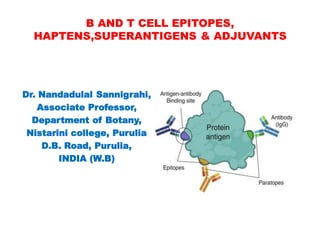
B AND TCELL EPITOPES,
HAPTENS,SUPERANTIGENS & ADJUVANTS
Dr. Nandadulal Sannigrahi,
Associate Professor,
Department of Botany,
Nistarini college, Purulia
D.B. Road, Purulia,
INDIA (W.B)
2.
ANTIGEN
A mancannot be husband without wife; similarly a molecule cannot be
antigen without a corresponding antiserum or antibody or T-cell receptor,
The term ‘antigen’ have dual meanings- first, it describe a molecule which
generates an immune response called immunogen and secondly, a molecule
reacts with antibody or primed T-cells irrespective of its ability to generate
then,
The entire part of the antigen does not in function to act as immunogen;
instead of , small well defined chemical groupings such as dinitrophenyl
(DNP) or m- amino benzene sulfonate will not act as immunogenic but
will react with preformed antibodies induced by the injection of the
‘hapten’ linked to a ‘carrier’ molecule which is itself an immunogen,
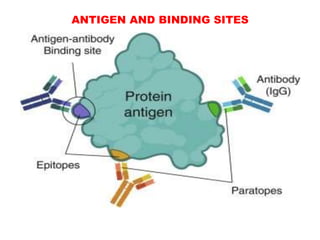
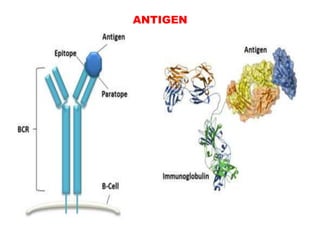
The parts of the hypervarible regions on the antibody which contact the
antigen termed as ‘paratope’ and the part of the antigen is designated the
epitope.
Hapten mostly a linear peptide or carbohydrate , the combining site can
usually accommodate up to five or six amino acids residues or Hexose
units.
3.
INTRODUCTION
Immunity isthe most important attribute of the animals in general and
human beings in particular to counter the infectious agents.
When an infectious agent or foreign protein try to invade into the body, the
first line defence mechanisms are operated by the skin and mucous barriers,
Then it is tackled by the other non-specific mechanisms of the body-natural
killer cells, neutrophils, macrophages; humoral factors like properdin,
complement etc,
Finally, if these are not enough, the invader proliferates and taken up by the
tissue macrophages in the regional lymphoid tissue,
It activates the specific immune responses in the form of the production of
antibodies,
The different type of immune cells-T-cells, memory cells and others are
formed in this defence mechanisms,
The lymph reticular cells are primarily responsible for the development of
specific immune response.
GENERAL PROPERTIES OFANTIGENS
Molecular size- Irrespective of its nature, proteins, polysaccharides and
nucleoproteins are capable of eliciting immune response but it met certain
criteria to size and structure. Below 1000 Daltons molecular mass, the
molecules are non- immunogenic , 5000-10,000 Daltons are weekly
immunogenic but molecules having more than 10000 Daltons show strong
immune response acting as immunogens.
Self or foreign- In order to elicit immune response, antigen must be foreign
in nature , however, homologous antigens from another species will be
recognized as immunogenic. Generally, the greater the phylogenic distance
between two species. the greater the structural disparity between them,
stronger the immune response.
Chemical complexity- the heteropolymers like heteropolymers, a complex
lipids with polysaccharide is strongly immunogenic.
Route if entry-Protein antigens enters subcutaneously are usually
immunogenic as these antigens taken up and transported to lymph nodes
where immune response occurs. Large doses of protein antigens
administered intravenously often induce specific irresponsiveness.
6.
T CELLS ANDB CELLS
The T and B lymphocytes (T and B Cells) are involved in the acquired or
antigen-specific immune response given that they are the only cells in the
organism able to recognize and respond specifically to each antigenic
epitope.
The B Cells have the ability to transform into plasmocytes and are
responsible for producing antibodies (Abs).
Thus, humoral immunity depends on the B Cells while cell immunity
depends on the T Cells.
EPITOPES
An epitoperefers to the specific target against which an individual antibody
binds.
When an antibody binds to a protein, it isn’t binding to the entire full-
length protein. Instead, it is binding to a to a segment of that protein known
as an epitope. In general, an epitope is approximately five or six amino
acids in length. So, a typical full-length protein sequence actually contains
many different epitopes against which antibodies can bind.
And, for any given protein sequence, one will typically find that multiple
unique antibodies will recognize the protein. Each of these antibodies binds
to a specific epitope located on that protein.
Binding between the antibody and the epitope occurs at the Antigen
Binding Site, which is called a paratope and is located at the tip of the
variable region on the antibody. This paratope is only capable of binding
with one unique epitope.
Within a protein sequence, one can find:
Continuous epitopes, which are linear sequences of amino acids
Discontinuous epitopes, which exist only when the protein is folded into a
particular conformation.
9.
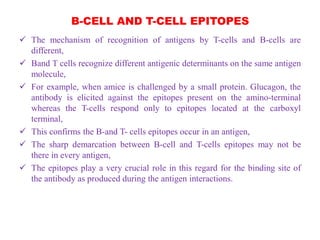
B-CELL AND T-CELLEPITOPES
The mechanism of recognition of antigens by T-cells and B-cells are
different,
Band T cells recognize different antigenic determinants on the same antigen
molecule,
For example, when amice is challenged by a small protein. Glucagon, the
antibody is elicited against the epitopes present on the amino-terminal
whereas the T-cells respond only to epitopes located at the carboxyl
terminal,
This confirms the B-and T- cells epitopes occur in an antigen,
The sharp demarcation between B-cell and T-cells epitopes may not be
there in every antigen,
The epitopes play a very crucial role in this regard for the binding site of
the antibody as produced during the antigen interactions.
10.
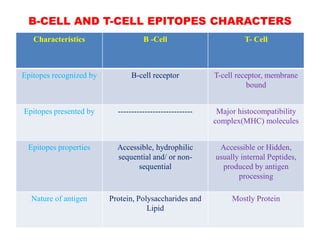
B-CELL AND T-CELLEPITOPES CHARACTERS
Characteristics B -Cell T- Cell
Epitopes recognized by B-cell receptor T-cell receptor, membrane
bound
Epitopes presented by ---------------------------- Major histocompatibility
complex(MHC) molecules
Epitopes properties Accessible, hydrophilic
sequential and/ or non-
sequential
Accessible or Hidden,
usually internal Peptides,
produced by antigen
processing
Nature of antigen Protein, Polysaccharides and
Lipid
Mostly Protein
11.
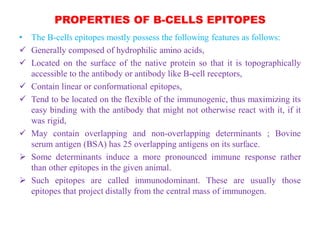
PROPERTIES OF B-CELLSEPITOPES
• The B-cells epitopes mostly possess the following features as follows:
Generally composed of hydrophilic amino acids,
Located on the surface of the native protein so that it is topographically
accessible to the antibody or antibody like B-cell receptors,
Contain linear or conformational epitopes,
Tend to be located on the flexible of the immunogenic, thus maximizing its
easy binding with the antibody that might not otherwise react with it, if it
was rigid,
May contain overlapping and non-overlapping determinants ; Bovine
serum antigen (BSA) has 25 overlapping antigens on its surface.
Some determinants induce a more pronounced immune response rather
than other epitopes in the given animal.
Such epitopes are called immunodominant. These are usually those
epitopes that project distally from the central mass of immunogen.
12.
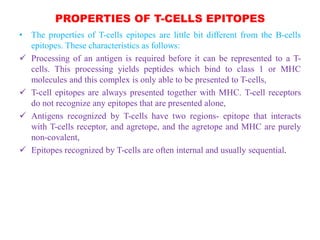
PROPERTIES OF T-CELLSEPITOPES
• The properties of T-cells epitopes are little bit different from the B-cells
epitopes. These characteristics as follows:
Processing of an antigen is required before it can be represented to a T-
cells. This processing yields peptides which bind to class 1 or MHC
molecules and this complex is only able to be presented to T-cells,
T-cell epitopes are always presented together with MHC. T-cell receptors
do not recognize any epitopes that are presented alone,
Antigens recognized by T-cells have two regions- epitope that interacts
with T-cells receptor, and agretope, and the agretope and MHC are purely
non-covalent,
Epitopes recognized by T-cells are often internal and usually sequential.
13.
HAPTENS
The term,hapten come from ‘aptein’- to grasp or fasten,, used by Ehrlich,
Can be defined any substance having molecular weight less than 1000 Da,
Incapable of stimulating antibody molecule by itself but able to react with
pre-formed antibody,
It becomes immunogenic when it is attached to the immunogenic carrier
molecule such as a protein, yielding an immunogenic hapten carrier
conjugate,
2,4 dinitrophenol p- aminobenzenearosonate monosaccharide, amino acids
etc .It is unable to induce antibody formation when injected to test animal
alone .However, when DNP is linked to immunogenic carrier molecule
such as bovine serum albumin (BSA), it results the formation of anti-DNP
antibodies,
A hapten becomes immunogenic when it is attached to the immunogenic
carrier molecule such as a protein, yielding an immunogenic hapten-carrier
molecule.
14.
SUPERANTIGENS
A classof protein antigens with ‘super’ antigenic properties ,
They bind simultaneously to T-cell receptors and class II MHC complex
molecules,
This non-specific binding activates into the lymphoproliferative phase in T-
cells and induces pronounced Cytokinines production by T-cells in vivo,
thereby causing a variety of pathological consequences such as fever,
malaise, diarrhea etc,
Unlike conventional antigens, super antigens are not internalized and
degraded by antigen-presenting cells . Instead, they bind directly to class II
MHC molecules outside the antigen-binding cleft,
Most super antigens activate an impressive 5-25% of T-cells although most
benign antigens can activate less than 0.01% of T cells,
The most extensively studied super antigen is Staphylococcal enterotoxin B
(SEB) ,
Other important bacterial super antigens are pyrogenic exotoxin from
Streptococcus pyrogens , Mycoplasma arthritidis (MAS) and
Staphylococcal exofoliative toxin.
15.
ADJUVANTS
Adjuvants (Latin: adjuvare) are substances which when mixed with
antigen and injected with it, accelerate, enhance and prolong
immunogenicity of the antigen without altering the chemical properties of
antigen,
Adjuvants are mostly used when the concentration of the antigen or
immunogenicity is low, Both the cases, the addition of adjuvant augments
the immune response manifold,
The most common adjuvants are alum ( aluminum potassium sulphate),
Freund’s complete,
Adjuvants use beneficial in improving the delivery to antigen presenting
cells as well as processing and presentation cells by binding with antigens
and increase size, thereby increases the chances of phagocytosis,
It may increase non-specific proliferation of committed lymphocytes
thereby increasing the chances of antigen-specific clonal proliferation,
It increases the efficiency of macrophage-processing antigen by inducing a
local inflammatory response, that attracts macrophages.
16.
THANKS FOR YOURVISIT
• REFERENCES:
https://pmc.ncbi.nlm.nih.gov/articles/PMC7321027/
https://www.sciencedirect.com/topics/agricultural-and-biological-
sciences/epitope
https://www.pacificimmunology.com/resources/antibody-
introduction/what-is-an-epitope/
Google for images,
The elements of Immunology- F.H. Khan,
Essential Immunology- Roitt and deves
a. A Textbook of Microbiology- P. Chakraborty,
b. Immunology, 5th edition- Benjamini, Coico & Sunshine
c. Immunobiology – Janeway,
DISCLAIMER:
This presentation has been designed to address the academic fraternity
without any financial interest. This is absolutely free to use . The author
does not claim any kind of financial benefits from this content.