Comprehensive Overview of Artificial Intelligence Fundamentals and Applications
Explore AI basics, subfields, goals, pros and cons, and real-world applications including intelligent agents, machine learning, and digital assistants.
Comprehensive Overview of Artificial Intelligence Fundamentals and Applications
1.
PCIT402 : ArtificialIntelligence
Sanjivani Rural Education Society’s
Sanjivani College of Engineering, Kopargaon-423603
(An Autonomous Institute Affiliated to Savitribai Phule Pune University, Pune)
NAAC ‘A’ Grade Accredited, ISO 9001:2015 Certified
Department of Information Technology
(UG Course: NBA Accredited)
Mr. R. N. Kankrale
Assistant Professor
2.
Unit-I FUNDAMENTALS OFARTIFICIAL INTELLIGENCE
Artificial Intelligence – Overview Mr. R. N. Kankrale Department of Information Technology
Definition, Scope, and History of Artificial Intelligence, Applications of Artificial
Intelligence, Characteristics of Intelligent Systems, Intelligent Agents and Rational
Agents, PEAS Representation, Types of Environments, Agent Architectures, Simple
Reflex Agents, Model-Based Agents, Goal-Based Agents
Utility-Based Agents, Learning Agents, Problem Formulation and State-Space
Representation
Illustrative examples: Vacuum Cleaner World and Wumpus World.
3.
Unit-I FUNDAMENTALS OFARTIFICIAL INTELLIGENCE
Artificial Intelligence – Overview Mr. R. N. Kankrale Department of Information Technology
What is AI-Artificial Intelligence?
The term "Artificial Intelligence" refers to the
simulation of human intelligence processes by
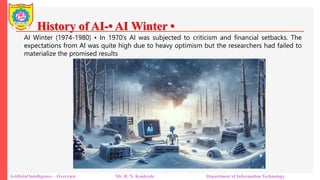
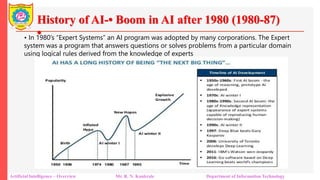
machines, especially computer systems. It also
includes Expert systems, voice recognition, machine
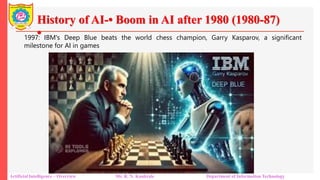
vision, and natural language processing (NLP).
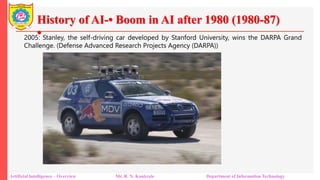
4.
Unit-I FUNDAMENTALS OFARTIFICIAL INTELLIGENCE
Artificial Intelligence – Overview Mr. R. N. Kankrale Department of Information Technology
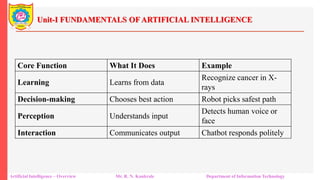
Core Function What It Does Example
Learning Learns from data
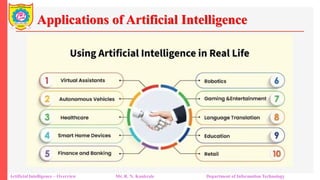
Recognize cancer in X-
rays
Decision-making Chooses best action Robot picks safest path
Perception Understands input
Detects human voice or
face
Interaction Communicates output Chatbot responds politely
5.
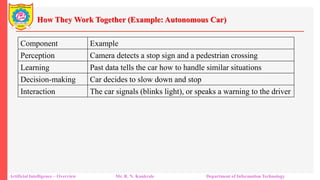
How They WorkTogether (Example: Autonomous Car)
Artificial Intelligence – Overview Mr. R. N. Kankrale Department of Information Technology
Component Example
Perception Camera detects a stop sign and a pedestrian crossing
Learning Past data tells the car how to handle similar situations
Decision-making Car decides to slow down and stop
Interaction The car signals (blinks light), or speaks a warning to the driver
6.
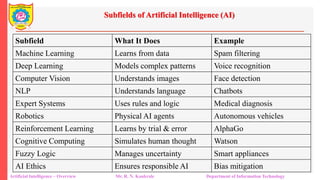
Subfields of ArtificialIntelligence (AI)
Artificial Intelligence – Overview Mr. R. N. Kankrale Department of Information Technology
Subfield What It Does Example
Machine Learning Learns from data Spam filtering
Deep Learning Models complex patterns Voice recognition
Computer Vision Understands images Face detection
NLP Understands language Chatbots
Expert Systems Uses rules and logic Medical diagnosis
Robotics Physical AI agents Autonomous vehicles
Reinforcement Learning Learns by trial & error AlphaGo
Cognitive Computing Simulates human thought Watson
Fuzzy Logic Manages uncertainty Smart appliances
AI Ethics Ensures responsible AI Bias mitigation
7.
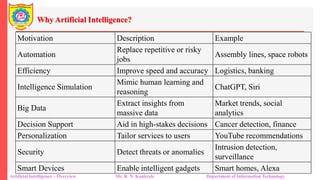
Why Artificial Intelligence?
ArtificialIntelligence – Overview Mr. R. N. Kankrale Department of Information Technology
Motivation Description Example
Automation
Replace repetitive or risky
jobs
Assembly lines, space robots
Efficiency Improve speed and accuracy Logistics, banking
Intelligence Simulation
Mimic human learning and
reasoning
ChatGPT, Siri
Big Data
Extract insights from
massive data
Market trends, social
analytics
Decision Support Aid in high-stakes decisions Cancer detection, finance
Personalization Tailor services to users YouTube recommendations
Security Detect threats or anomalies
Intrusion detection,
surveillance
Smart Devices Enable intelligent gadgets Smart homes, Alexa
8.
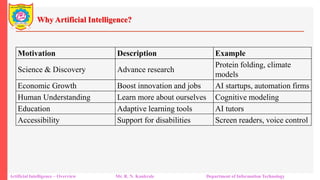
Why Artificial Intelligence?
ArtificialIntelligence – Overview Mr. R. N. Kankrale Department of Information Technology
Motivation Description Example
Science & Discovery Advance research
Protein folding, climate
models
Economic Growth Boost innovation and jobs AI startups, automation firms
Human Understanding Learn more about ourselves Cognitive modeling
Education Adaptive learning tools AI tutors
Accessibility Support for disabilities Screen readers, voice control
9.
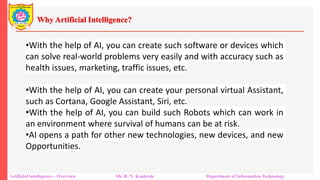
Why Artificial Intelligence?
ArtificialIntelligence – Overview Mr. R. N. Kankrale Department of Information Technology
•With the help of AI, you can create such software or devices which
can solve real-world problems very easily and with accuracy such as
health issues, marketing, traffic issues, etc.
•With the help of AI, you can create your personal virtual Assistant,
such as Cortana, Google Assistant, Siri, etc.
•With the help of AI, you can build such Robots which can work in
an environment where survival of humans can be at risk.
•AI opens a path for other new technologies, new devices, and new
Opportunities.
10.
Goals of ArtificialIntelligence
Artificial Intelligence – Overview Mr. R. N. Kankrale Department of Information Technology
Following are the main goals of Artificial Intelligence:
1.Replicate human intelligence
2.Solve Knowledge-intensive tasks
3.An intelligent connection of perception and action
4.Building a machine which can perform tasks that requires human intelligence such as:
1. Proving a theorem
2. Playing chess
3. Plan some surgical operation
4. Driving a car in traffic
5.Creating some system which can exhibit intelligent behavior, learn new things by itself,
demonstrate, explain, and can advise to its user.
11.
AI vs NonAI Techniques
Artificial Intelligence – Overview Mr. R. N. Kankrale Department of Information Technology
To understand the difference between AI and Non-AI techniques let's take an example of
Trigonometry. You come across an equation 1-(cos 2x)1+(cos 2x), now to solve any
trigonometric equation there are some defined sets of rules one has to follow to reach
the solution. Consider these defined rules as algorithms in computers. After following
the rules of trigonometry one reaches a conclusion in the same way a computer does its
job based on the designed algorithms. So after solving the equation 1-(cos 2x)1+(cos 2x)
you get the answer as tan2(x). The next time you come across the same equation
instead of following all the steps and solving, you directly write the answer that you
already know and save time. This process of skipping a few steps, outcome to which you
already know based on past experiences, is called Artificial Intelligence. The bottom
line, Non-AI technique is when the system keeps on following the defined set of rules to
reach the solution and AI is when the system learns from its past, overcomes its
mistakes and gives more optimal solutions to the problems.
12.
Pros and Consof Artificial Intelligence
Artificial Intelligence – Overview Mr. R. N. Kankrale Department of Information Technology
13.
Pros and Consof Artificial Intelligence
Artificial Intelligence – Overview Mr. R. N. Kankrale Department of Information Technology
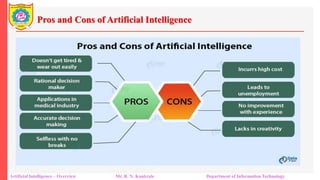
1.Reduction in Human Error:
•With Artificial intelligence, the decisions are taken based on the previously gained
knowledge from multiple testing.
•In return, errors are reduced and the chance of reaching accuracy with a greater degree
of precision is a possibility.
•Example: In Weather Forecasting using AI, human error has been reduced drastically.
2. Takes risks instead of Humans:
•This is one of the biggest advantages of Artificial intelligence.
•Many operations involve risk which may, in turn, be expensive. AI robots can take the
risk and compute the outputs for the optimal solution to a problem.
•AI Robots can be used in such situations where intervention can be hazardous.
14.
Pros and Consof Artificial Intelligence
Artificial Intelligence – Overview Mr. R. N. Kankrale Department of Information Technology
3. Available 24x7:
•An average human has to work with limitations like breaks, limited hours of work, food,
etc.
•But using AI we can make machines work 24x7 without any breaks and they don’t even
get bored, unlike humans.
4. Helping in Repetitive Jobs:
•There is a possibility that humans may get bored while doing some repetitive tasks
which may result in errors. But, AI machines can do any task given to them, no matter
how boring or repetitive it is.
•Example: In banks, we often see many verifications of documents to get a loan which is
a repetitive task for the owner of the bank. Using AI Cognitive Automation the owner can
speed up the process of verifying the documents by which both the customers and the
owner will be benefited.
15.
Pros and Consof Artificial Intelligence
Artificial Intelligence – Overview Mr. R. N. Kankrale Department of Information Technology
3. Available 24x7:
•An average human has to work with limitations like breaks, limited hours of work, food,
etc.
•But using AI we can make machines work 24x7 without any breaks and they don’t even
get bored, unlike humans.
4. Helping in Repetitive Jobs:
•There is a possibility that humans may get bored while doing some repetitive tasks
which may result in errors. But, AI machines can do any task given to them, no matter
how boring or repetitive it is.
•Example: In banks, we often see many verifications of documents to get a loan which is
a repetitive task for the owner of the bank. Using AI Cognitive Automation the owner can
speed up the process of verifying the documents by which both the customers and the
owner will be benefited.
16.
Pros and Consof Artificial Intelligence
Artificial Intelligence – Overview Mr. R. N. Kankrale Department of Information Technology
5. Digital Assistance:
•Human aid in some sensitive situations may cause errors and may result in disasters.
•Some of the highly advanced organizations use digital assistants to interact with users
which saves the need for human resources.
•The digital assistants are also used in many websites to provide things that users want.
•Example: We all know that organizations have a customer support team that needs to
clarify the doubts and queries of the customers. Using AI the organizations can set up a
Voice bot or Chatbot which can help customers with all their queries. We can see many
organizations already started using them on their websites and mobile applications.
17.
Pros and Consof Artificial Intelligence
Artificial Intelligence – Overview Mr. R. N. Kankrale Department of Information Technology
6.Faster Decisions:
•Using human or non-AI techniques can be time-consuming.
•Using AI alongside other technologies, we can make machines take decisions faster.
•While taking a decision humans will analyze many factors both emotionally and
practically but an AI-powered machine works on what it is programmed and delivers the
results in a faster way.
7. Daily Applications:
•Daily applications such as Apple’s Siri, Windows’ Cortana, Google’s Assistant are
frequently used in our daily routine whether it is for searching a location, taking a selfie,
making a phone call, replying to a mail and many more.
18.
Pros and Consof Artificial Intelligence
Artificial Intelligence – Overview Mr. R. N. Kankrale Department of Information Technology
8. New Inventions:
•AI is powering many inventions in almost every domain which will help humans solve
the majority of complex problems.
•Example: Recently doctors can predict breast cancer in the woman at earlier stages
using advanced AI-based technologies.
19.
Pros and Consof Artificial Intelligence
Artificial Intelligence – Overview Mr. R. N. Kankrale Department of Information Technology
As every coin has 2 sides, AI also has a darker side. Artificial Intelligence also has some
disadvantages.
1. High Costs of Creation:
•As AI is updating every day the hardware and software need to get updated with time to
meet the latest requirements.
•Machines need maintenance and updating with the latest hardware and software which is
expensive.
•It’ s creation requires huge costs as they are very complex machines.
1.Making Humans Lazy:
•As humans have found an easy way out of working longer on solving problems, they are
being lazier by the day.
•AI is making humans lazy with its applications automating the majority of the work.
•Humans tend to get addicted to these inventions which can cause a problem to future
generations.
20.
Pros and Consof Artificial Intelligence
Artificial Intelligence – Overview Mr. R. N. Kankrale Department of Information Technology
3. Unemployment:
•As AI is replacing the majority of the repetitive tasks and other work with robots, human
interference is becoming less which comes as less of a burden on companies in case of hiring
humans.
•Most organizations run for-profit and a better-done job by AI helps them lead in that
direction.
4. No Emotions:
•Teamwork is extremely important when it comes to any project work, the inputs from the
team members help a project evolve with time. This brings out the best possible outcome.
AI lacks this kind of thinking as it makes decisions based on only previously learned things.
•Machines cannot develop a bond with humans which is an essential attribute when it
comes to Team Management.
21.
Pros and Consof Artificial Intelligence
Artificial Intelligence – Overview Mr. R. N. Kankrale Department of Information Technology
5. Lacking Out of Box Thinking:
•Machines can perform only those tasks which they are designed or programmed to do,
anything out of that they tend to crash or give irrelevant outputs which could be a major
backdrop.
22.
History of AI
ArtificialIntelligence – Overview Mr. R. N. Kankrale Department of Information Technology
23.
History of AI
ArtificialIntelligence – Overview Mr. R. N. Kankrale Department of Information Technology
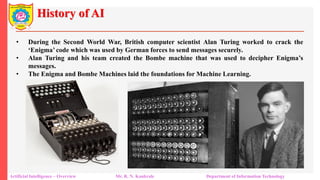
• During the Second World War, British computer scientist Alan Turing worked to crack the
‘Enigma’ code which was used by German forces to send messages securely.
• Alan Turing and his team created the Bombe machine that was used to decipher Enigma’s
messages.
• The Enigma and Bombe Machines laid the foundations for Machine Learning.
24.
History of AI-Firstwork in AI
Artificial Intelligence – Overview Mr. R. N. Kankrale Department of Information Technology
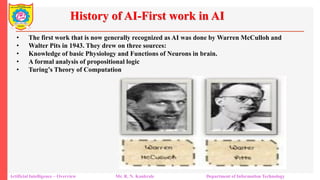
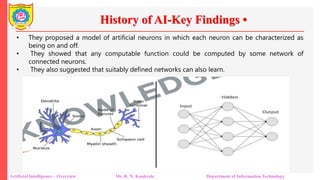
• The first work that is now generally recognized as AI was done by Warren McCulloh and
• Walter Pits in 1943. They drew on three sources:
• Knowledge of basic Physiology and Functions of Neurons in brain.
• A formal analysis of propositional logic
• Turing’s Theory of Computation
25.
History of AI-KeyFindings •
Artificial Intelligence – Overview Mr. R. N. Kankrale Department of Information Technology
• They proposed a model of artificial neurons in which each neuron can be characterized as
being on and off.
• They showed that any computable function could be computed by some network of
connected neurons.
• They also suggested that suitably defined networks can also learn.
26.
History of AI-Actinghumanly: The Turing Test
approach •
Artificial Intelligence – Overview Mr. R. N. Kankrale Department of Information Technology
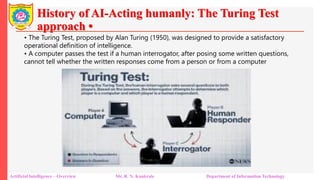
• The Turing Test, proposed by Alan Turing (1950), was designed to provide a satisfactory
operational definition of intelligence.
• A computer passes the test if a human interrogator, after posing some written questions,
cannot tell whether the written responses come from a person or from a computer
27.
History of AI-
ArtificialIntelligence – Overview Mr. R. N. Kankrale Department of Information Technology
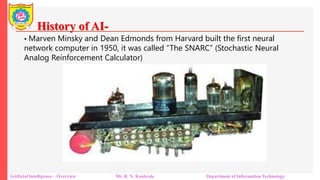
• Marven Minsky and Dean Edmonds from Harvard built the first neural
network computer in 1950, it was called “The SNARC” (Stochastic Neural
Analog Reinforcement Calculator)
28.
History of AI-•The Birth of AI •
Artificial Intelligence – Overview Mr. R. N. Kankrale Department of Information Technology
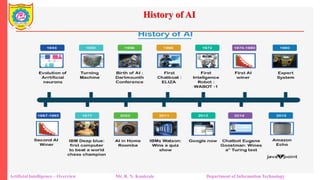
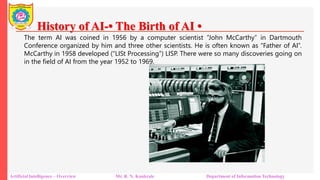
The term AI was coined in 1956 by a computer scientist “John McCarthy” in Dartmouth
Conference organized by him and three other scientists. He is often known as “Father of AI”.
McCarthy in 1958 developed (“LISt Processing”) LISP. There were so many discoveries going on
in the field of AI from the year 1952 to 1969.
29.
History of AI-•AI Winter •
Artificial Intelligence – Overview Mr. R. N. Kankrale Department of Information Technology
AI Winter (1974-1980) • In 1970’s AI was subjected to criticism and financial setbacks. The
expectations from AI was quite high due to heavy optimism but the researchers had failed to
materialize the promised results
30.
History of AI-•Boom in AI after 1980 (1980-87)
•
Artificial Intelligence – Overview Mr. R. N. Kankrale Department of Information Technology
• In 1980’s “Expert Systems” an AI program was adopted by many corporations. The Expert
system was a program that answers questions or solves problems from a particular domain
using logical rules derived from the knowledge of experts
31.
History of AI-•Boom in AI after 1980 (1980-87)
•
Artificial Intelligence – Overview Mr. R. N. Kankrale Department of Information Technology
1997: IBM's Deep Blue beats the world chess champion, Garry Kasparov, a significant
milestone for AI in games
32.
History of AI-•Boom in AI after 1980 (1980-87)
•
Artificial Intelligence – Overview Mr. R. N. Kankrale Department of Information Technology
2005: Stanley, the self-driving car developed by Stanford University, wins the DARPA Grand
Challenge. (Defense Advanced Research Projects Agency (DARPA))
33.
History of AI-•Boom in AI after 1980 (1980-87)
•
Artificial Intelligence – Overview Mr. R. N. Kankrale Department of Information Technology
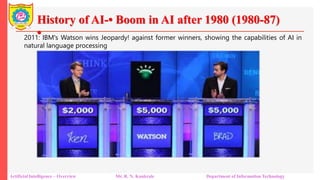
2011: IBM's Watson wins Jeopardy! against former winners, showing the capabilities of AI in
natural language processing
34.
History of AI-•Boom in AI after 1980 (1980-87)
•
Artificial Intelligence – Overview Mr. R. N. Kankrale Department of Information Technology
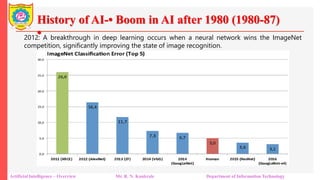
2012: A breakthrough in deep learning occurs when a neural network wins the ImageNet
competition, significantly improving the state of image recognition.
35.
History of AI-•Boom in AI after 1980 (1980-87)
•
Artificial Intelligence – Overview Mr. R. N. Kankrale Department of Information Technology
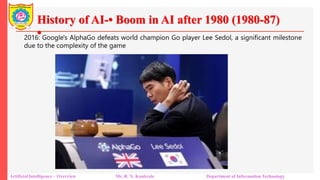
2016: Google's AlphaGo defeats world champion Go player Lee Sedol, a significant milestone
due to the complexity of the game
36.
History of AI-•Boom in AI after 1980 (1980-87)
•
Artificial Intelligence – Overview Mr. R. N. Kankrale Department of Information Technology
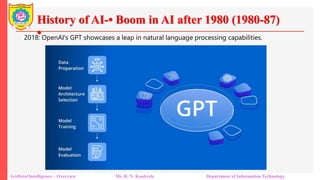
2018: OpenAI's GPT showcases a leap in natural language processing capabilities.
37.
Applications of ArtificialIntelligence
Artificial Intelligence – Overview Mr. R. N. Kankrale Department of Information Technology
38.
Applications of ArtificialIntelligence
Artificial Intelligence – Overview Mr. R. N. Kankrale Department of Information Technology
Virtual Assistants
They are AI-powered tools that help in managing everyday tasks and providing users with
hands-free assistance. They are used in this:
•Tools: Amazon Alexa, Apple Siri, Google Assistant, Microsoft Cortana
•Task Management: They help users to schedule appointments, send messages and set
reminders for making our life more easier.
•Smart Home Integration: These assistants connect with smart home devices, lights and
helps in sending messages.
•Personalization: They learn user preferences with time and offers personalized suggestions.
•Voice Interaction: Users can control their devices and access information just by speaking
which is making the tools efficient and accessible.
39.
Applications of ArtificialIntelligence
Artificial Intelligence – Overview Mr. R. N. Kankrale Department of Information Technology
Language Translation
AI translation tools helps people in the world to communicate easily as it is breaking down
language issues. Here’s how language translation tools works:
Tools: Google Translate, DeepL, Microsoft Translator
Real-Time Translation: It translate text, speech and images helping in better communication
across different languages.
Contextual Accuracy: These tools adapt themselves by learning from new data and ensuring
translations are more accurate.
Global Communication: Enables seamless communication for business, travel and personal
purposes in the world.
Accessibility: Language translation tools have become necessary for travelers as it helps them to
navigate foreign places easily.
40.
Applications of ArtificialIntelligence
Artificial Intelligence – Overview Mr. R. N. Kankrale Department of Information Technology
Education
AI is changing education sector by offering personalized learning experiences and
automating administrative tasks. Lets see how it helps students and teachers.
Tools: Coursera, Khan Academy, Duolingo, Quizlet
Adaptive Learning: Platforms adjust content and lessons based on individual student
performance and ensures personalized learning experiences.
Automated Grading and Feedback: Saves time by checking assignments and offering
instant feedback to students.
Tutoring Assistance: It help students with one-on-one tutoring in the areas where they
struggle.
Classroom Insights: Teachers can analyze performance data to identify areas where
students need extra help.
41.
Applications of ArtificialIntelligence
Artificial Intelligence – Overview Mr. R. N. Kankrale Department of Information Technology
Autonomous Vehicles
Self-driving vehicles are changing the transportation system and also it plays a important role in the
navigation and decision-making processes of these vehicles.
•Tools: Tesla Autopilot, Waymo, Uber ATG, Cruise
•Navigation and Decision-Making: Vehicles use sensors and algorithms to understand and find
roads, detecting objects and obstacles.
•Safety Improvements: This technology helps in reducing accidents caused by human error which
makes our travel more safer.
•Traffic Optimization: Autonomous cars communicate with each other to reduce traffic and improve
fuel efficiency.
•Future of Transport: These vehicles are more efficient and accessible in the terms of transportation
as they are including in delivery and public transport.
42.
Applications of ArtificialIntelligence
Artificial Intelligence – Overview Mr. R. N. Kankrale Department of Information Technology
Healthcare Diagnostics
It is helping doctors to diagnose diseases more quickly and accurately. Lets see how AI tools are
used in medical diagnostics.
•Tools: Zebra Medical Vision, Aidoc, PathAI, Arterys
•Medical Imaging Analysis: They process medical images like X-rays and MRIs to detect
diseases early.
•Personalized Treatment: Stores patient data and offers personalized treatment plans for our
needs.
•Predicting Health Risks: Can predict future health risks by analyzing patterns in patient data.
•Efficiency: These tools increases the speed of diagnostics and reduces wait times and improving
patient outcomes.
43.
Applications of ArtificialIntelligence
Artificial Intelligence – Overview Mr. R. N. Kankrale Department of Information Technology
Retail
In retail AI enhance customer experiences, manage inventory and personalize marketing efforts. Here’s
how AI is transforming retail industry.
•Tools: Shopify, Magento, BigCommerce, Square
•Product Recommendations: AI analyzes customer behavior and suggests products based on past
purchases.
•Dynamic Pricing: It adjusts prices in real-time, based on market trends and competitor analysis.
•Inventory Management: AIso helps in tracking stock levels and manage restocking, improving
operational efficiency.
•Customer Support: It handle common customer queries after providing 24/7 support.
44.
Applications of ArtificialIntelligence
Artificial Intelligence – Overview Mr. R. N. Kankrale Department of Information Technology
Finance and Banking
AI plays an important role in making finance and banking services more efficient and secure. Lets
see how AI tools are used in this sector.
•Tools: Robinhood, Mint, PayPal, Stripe
•Algorithmic Trading: These algorithms helps in analyzing market data and make real-time
trading decisions.
•Fraud Detection: AI monitors financial transactions to detect suspicious activity and prevent
fraud.
•Customer Service: Also chatbots answer customer questions and helps in assisting with
transactions.
•Personalized Financial Advice: AI-driven platforms provide investment advices and helps
individuals to manage their finances.
45.
Applications of ArtificialIntelligence
Artificial Intelligence – Overview Mr. R. N. Kankrale Department of Information Technology
Smart Home Devices
Smart home devices using AI are becoming a common feature in our homes. These devices automate
tasks and optimize energy use for enhanced convenience and security.
•Tools: Nest Thermostat, Philips Hue, Ring Security, Google Nest
•Automation: Devices like thermostats and lights can adjust automatically based on user behavior.
•Energy Efficiency: Using AI we can save electricity costs while maintaining comfort.
•Home Security: AI-powered cameras and sensors detect unusual activity and send real-time alerts to
homeowners.
•Personalized Control: Devices learn user preferences and adapt to improve over time.
46.
Applications of ArtificialIntelligence
Artificial Intelligence – Overview Mr. R. N. Kankrale Department of Information Technology
Robotics
AI-powered robots are used in the industries like manufacturing, healthcare and agriculture. They
helps in performing tasks easily and efficiently.
•Tools: Boston Dynamics Spot, iRobot Roomba, DJI Tello, Kuka Robotics
•Manufacturing: It can automate tasks which improves productivity and accuracy.
•Healthcare: It helps with complex procedures, improves accuracy and reduces human error.
•Agriculture: Robots in farming help with tasks like harvesting, planting and watering crops.
•Exploration: They are used in environments that are hazardous for humans.
47.
Applications of ArtificialIntelligence
Artificial Intelligence – Overview Mr. R. N. Kankrale Department of Information Technology
Gaming and Entertainment
AI is upgrading gaming and entertainment industry by creating more engaging, personalized experiences
for users.
•Tools: Unity, Unreal Engine, Oculus VR, Steam
•Dynamic Gameplay: It can adjusts difficulty of games based on player performance also ensures an
engaging experience.
•Content Generation: It helps in creating game levels, characters and storylines which helps in
speeding up game development and offers variations.
•Smarter NPCs: It helps in making non-playable characters (NPCs) which behaves like a human and
reacts to player actions in a natural way.
•Immersive Experiences: In virtual reality (VR) and augmented reality (AR), it adapts environments in
real time to provide a better experience.
48.
Artificial Intelligence
Artificial Intelligence– Overview Mr. R. N. Kankrale Department of Information Technology
Text Books:
1. Elaine Rich and Kevin Knight, "Artificial Intelligence" Tata McGraw
Hill.
2. Stuart Russell & Peter Norvig, "Artificial Intelligence: A Modern
Approach", Pearson Education, 2nd Edition.
49.
Artificial Intelligence
Artificial Intelligence– Overview Mr. R. N. Kankrale Department of Information Technology
Reference Books:
1. Ivan Bratko, "Prolog Programming For Artificial Intelligence", 2nd
Edition, Addison Wesley, 1440.
2. Eugene, Charniak, Drew Mcdermott, "Introduction to Artificial
Intelligence", Addison Wesley.
3. Patterson, “Introduction to AI and Expert Systems”, PHI.
4. Nilsson, “Principles of Artificial Intelligence”, Morgan Kaufmann.
5. Carl Townsend, “Introduction to turbo Prolog”, Paperback, 1483.
6. Jacek M. Zurada, “Introduction to Artificial Neural Systems”, Jaico
Publication.
50.
Artificial Intelligence
Artificial Intelligence– Overview Mr. R. N. Kankrale Department of Information Technology
eLearning Resources:
➢Online Courses:
1. An Introduction to Artificial Intelligence by Prof. Mausam, IIT Delhi, NPTEL
Course.
2. AI for Everyone by Andrew Ng, Coursera Course.
➢eResources:
1. http://www.eecs.qmul.ac.uk/~mmh/AINotes/AINotes4.pdf
2. https://www.slideshare.net/JismyKJose/conceptual-dependency-70129647
3.https://web.archive.org/web/20150813153834/http://www.cs.berkeley.edu/~zadeh/p
apers/Fuzzy%20Sets-Information%20and%20Control-1965.pdf
4. https://www.youtube.com/watch?v=aircAruvnKk
5. https://www.youtube.com/watch?v=IHZwWFHWa-w
 Most read