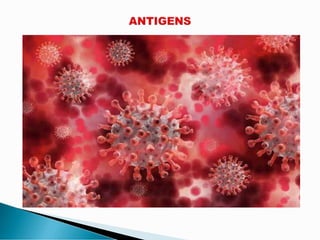
Antigen isany substance that evokes immune response with the production of
antibody with which it reacts specifically into the living body.
Antigens that do not produce antibodies may sensitize specific lymphocytes
leading to cell mediated immune response,
The human body is exposed to different type of exogenous along with little bit
of endogenous cells that possess the potential to trigger the immune system to
defend. These substances are normally treated as antigens.
An antigen is any kind of marker — like a protein or string of amino acids —
that your immune system can recognize. If this definition seems a little vague
to you, you’re not alone.
Antigens are usually proteins or sugars (polysaccharides) found on the outside
of things like cells or viruses. Each has a unique shape that your immune
system reads like a nametag to know whether it belongs in your body.
Antigens exist on viruses, bacteria, allergens, parasites, proteins, tumor cells
and normal cells in your own body. You might hear your own body’s antigens
referred to as “self” and viruses, bacteria and other harmful antigens referred to
as “non-self.” This means that your body recognizes your own cells as you, but
other antigens as intruders.
4.
Immunogens i.e.can induce antibody depends on two factors-
Immunogenicity - induction of immune response,
Immunological reactivity- specific reaction with antibodies or sensitized T
cells .
On the basis of these two factors , the antigens are classified into following
categories.
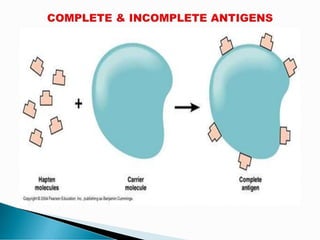
COMPLETE ANTIGEN /IMMUNOGEN
These are the antigens that possess de novo , i.e., they are able to generate
immune response by themselves ,
Such antigen induces antibody production,
These are high molecular weight containing protein substances (more than
1000 Daltons) or sometimes polysaccharides,
HAPTEN/INCOMPLETE ANTIGEN
These are low molecular weight of non-protein substances (less than 10000
Daltons) unable to induce antibody formation but can be immunogenic
when these are introduced into the busy with covalently linked protein..
6.
It reactsspecifically antibody and the antibodies are not only produced
against hapten but also to carrier proteins,
CARRIER MOLECULE OF HAPTEN
It may be serum protein like albumin or globulin or synthetic polypeptide,
Usually low molecular weight lipids or carbohydrates,
Some chemicals and drugs can act as hapten,
Haptens either simple or complex;
Complex haptens relatively large molecules like capsular polysaccharide of
pneumococci,
Simple haptens are low molecular weight chemical substances like
bacterial polysaccharides , drugs and chemical agents causing allergic
contact dermatitis , glycoprotein of ABC blood group, different types of
lipids etc.
8.
PROANTIGEN
Substanceswith low molecular weight that do not induce formation of
antibody but can delayed hypersensitivity like dinitrochlorobenzene,
DNCB.
HETEROPHLIC ANTIGEN
Certain antigens of similar nature, if not identical, present in different
tissues of more than one species are called heterophil antigen,
Antibody to those closely related antigens produced by one species cross-
react with antigens of other species,
Chemically, these are lipoprotein polysaccharides complex , possibly there
are identical chemical groupings in the structure of mono-polysaccharides
and lipids,
Examples : Forssmann antigen that present in Streptococcus pneumoniae,
some Salmonella serotypes and Shigella dysentriae; Cross reacting antigen
like Blood group B substances and Escherichia coli.
9.
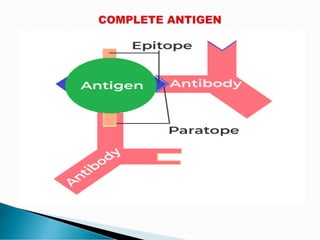
The wholeantigen does not act as immune response; only a small part of it
induces B and T cell response,
The small part of the chemical grouping on the antigen molecule that
determines specific immune response and reacts specifically with a single
antibody molecule is called antigen determinant or epitope,
The combining area of the epitope and antibody molecule , corresponding
to epitope is called paratope,
Each determinant is about 25-34 Ȧ in size and 400-1000Da M.W ,
Within a protein, an epitope may be formed by a specific sequence (liner
epitope) or three dimensional structure (conformational epitope) ,
The antigenic property is lost by denaturation of proteins,
The number of antigenic determinants of an antigen is referred as Valency;
the valency can be two types- total and functional, there are two or more
than two functional valency for complete antigen which are areas on the
surface of antigen molecule.
10.
There areseveral factors that can play an important role for the
antigenicity. These are as follows:
Foreignness- Antigens which are non-self and foreign induce immune
system. The immune system possess the potential to make difference
between self and foreign entity. The more foreign a substance to a
particular species, it is likely to be more powerful in its antigenicity. The
egg albumin is an excellent antigen to rabbit but for fowl, it is
nonimmunogenic. Normally, the individual does not mount an immune
response against its own normal constituent antigen except in autoimmune
cases and autoimmune diseases.
Size- The molecular weight is directly proportional to the antigenicity.
Macromolecules higher than 10000 Daltons are treated in this category
with massive immune response. Substances with less than 5000 Daltons
are mostly nonantigenic.Tetanus toxoid, egg albumin , thymoglobin have
high immune response.
11.
Chemical nature-Mostly proteins and polysaccharides are best
immunogens than other kind of bio-molecules like fats, nucleic acids and
little bit carbohydrates. Mostly, the presence of aromatic radical is essential
for rigidity and antigenicity of substance. A certain degree of structural
diversity is necessary for better antigens.
Susceptibility to tissue enzymes- Substances that can be metabolized and
can be converted to soluble forms by the action of tissue enzymes can be
act as good antigens. Antigens introduced into the body are degraded by
the digestive enzymes of the phagocyte cells and broken down into smaller
substances fir being appropriate size containing antigenic determinants.
Macromolecules that cannot be degraded and presented with MHC
molecules are poor immunogens. Such substances are insoluble into the
body.
Antigenic specificity-Antigenic specificity depends on the specific active
sites on the antigenic molecule- antigenic determinants. The remaining
portion is antigenic inert. It depends on acids and basic group of antigenic
determinant, special configuration of haptens and the terminal group of
antigen.
12.
Species specificity-Tissues of all individuals in a particular species
possess species specific antigen. The immunological basis sharing antigen
by related species parallels phylogenetic relationship between species. A
man sensitized with horse serum will react with serum from other horses
but may not with sheep serum. Species specificity is used in the forensic
application in the identification of the species blood and seminal stains. It
is also used to construct the evolutionary relationship between species .
Isospecificity- Alloantigen or isoantigens are found to be present in some
but not all members of a species which are able to produce alloantibody in
individuals who are free from antigens. Based on erythrocytes and Rh
antigens, individuals are classified into A, AB, O groups along with A+,
B+, AB+, O+, A-, B-, AB-, O- like this.
Organ specificity-Some organs like brain, kidney and lens protein of one
species share same antigen that of another species. Such antigens-
characteristic of an organ or tissue and present in different animal species
including man-are known as organ specific antigens.
13.
There areseveral types of antigens, categorized by where they come from.
These include exogenous antigens, endogenous antigens, autoantigens and
tumor antigens.
Exogenous antigens
Exogenous antigens come from foreign substances that can enter your body
through your nose, your mouth or cuts in your skin. These include viruses,
bacteria, pollen, parasites and fungi.
Endogenous antigens
Endogenous antigens exist on cells inside your body. They tell your
immune system that they are either friendly (“self”) or harmful. These
include cells that are infected with bacteria or a virus that mark themselves
to be destroyed by the immune system. Red blood cell antigens and special
markers that your body recognizes as “self” (HLAs) are also endogenous
antigens.
Autoantigens
Auto-antigens are markers on cells inside your body that your immune
system attacks even though they shouldn’t. Auto-antigens cause
autoimmune diseases.
14.
Tumor antigens
Tumor antigens are markers on the surface of tumors. You might hear these
called tumor-associated antigens (TAA), tumor-specific antigens (TSA),
neoantigens or oncogenic antigens.
These antigens are sometimes normal parts of a cell that act differently in
tumor cells (for example, a tumor cell might make much more of a
particular protein than a normal cell). Other times, they come from
mutations in the tumor’s genes or from a virus inside the tumor cells.
What are antigen-presenting cells?
Antigen-presenting cells help the immune system mount its attack. There
are three types of antigen-presenting cells in your body: macrophages,
dendrite cells and B cells.
One of their jobs is to act like a detective, showing the other cells of the
immune system suspects they think are invading your body. (In fact, you’ll
sometimes hear them called “professional” antigen-presenting cells.)
15.
What happenswhen an antigen enters your body?
Your body defends itself against harmful antigens with chemicals called
antibodies. When an antigen enters your body, the B-cells of your immune
system inspect it.
B-cells have special parts (receptors) that test the antigen to see if they fit
together, like a lock and key. If it’s a fit, the B-cell makes chemicals called
antibodies that all have the same shape to recognize the antigen.
An antibody’s job is to find antigens that fit the specific shape on their
surface. Antibodies lock on (bind) to antigens so that your immune system
can destroy them.
Once your immune system has seen an antigen, it has special cells that
remember it, allowing your body to create a faster and more effective
response if it invades again — this is called immunological memory.
Unfortunately, antigens change shape when a harmful substance mutates,
and your immune system may not be able to lock onto it to defend itself
effectively anymore. Imagine what would happen if the locks on your
house changed every time you left home!
16.
Carcinoembryonic antigen(CEA) test:
CEA is typically found in low levels in adults. Certain conditions,
including cancer, can cause high levels of CEA in your blood. Your
healthcare provider might monitor your levels of CEA in many cancers to
understand if treatment has been effective.
Hepatitis B surface antigen test (HBsAg):
An HBsAg is a blood test that providers use in combination with other tests
to diagnose hepatitis B.
Human leukocyte antigen (HLA) test:
All of our cells except red blood cells have a combination of HLAs that’s
unique to us. Providers test recipients of organs or stem cells and their
donors to see if they have similar HLAs.
Recipients also undergo tests to make sure they don’t have antibodies to a
donor’s HLAs, which would cause their body to attack the organ or cells
from the donor (graft versus host disease). Many transplants are much
more likely to be successful if the recipient and the donor have similar
HLAs. They don’t have to be a perfect match.
17.
Prostrate SpecificAntigen Test(PSA):
PSA levels can be higher in people with prostate cancer or less serious prostate
conditions. A PSA test may can happen as a part of a routine screening with
your healthcare provider.
SARS-Cov-2 or COVID-19 antigen test:
Sometimes called a rapid test, this looks for antigens to SARS-CoV-2, the virus
that causes COVID-19, in a sample taken from your nose or throat. You can do
this test at home with a test kit or with a healthcare provider.
Human leukocyte antigens (HLAs) are special markers that identify your cells
as “self,” or belonging to your body. All of your cells have HLAs except your
red blood cells.
HLAs can be thought of as similar to your blood type, but they’re a lot more
complex. For instance, we all have many HLAs, so it’s very unlikely to find
someone else with the exact same combination.
You can have antibodies to HLAs, causing an autoimmune disease if they
happen to be your own. If you need a stem cell transplant, you'll need to
undergo HLA tests to find someone who is a close match. This is usually a
close relative, like a parent, sibling or child
18.
The abilityof a substance that contains antigens to cause the body to make
an immune response against that substance.
The immune system recognizes antigens on the surface of substances it
sees as foreign, such as vaccines, bacteria, viruses, or cancer cells, and
makes an immune response against them. The strength of an immune
response depends on how immunogenic a substance is.
Immunogenicity may be wanted or unwanted,
Wanted immunogenicity indicates the requirement of vaccines where the
inoculation of mild or attenuated antigen in the form of vaccine is
administered into the body protecting the organism from future infection or
the infection in a very mild form; it is case of passive immunity
programme.
Unwanted immunogenicity is the immune response by an organism against
the administered therapeutic agent like drugs; this reaction enables the
production of anti-drug antibodies and inactivate the effects of drug for the
treatment of the disease for which it was administered.
20.
ACKNOWLEDGEMENTS:
a. Googlefor images,
b. Different websites for enriching the course content,
c. Science Direct pages,
d. A Textbook of Microbiology- P. Chakraborty,
e. Immunology, 5th edition- Benjamini, Coico & Sunshine
f. Immunobiology – Janeway,
g. Concept of Genetics- Klug. Cummings, Spencer, Palladino,
h. Pearson Education
DISCLAIMER:
This presentation has been designed to address the academic fraternity
without any financial interest. This is absolutely free to use . The author
does not claim any kind of financial benefits from this content.
 Most read