Comprehensive Overview of Anticoagulants: Mechanisms, Uses, and Safety
Detailed insights into anticoagulants including heparins, warfarin, and DOACs, covering mechanisms, therapeutic uses, adverse effects, and monitoring for effective thromboembolic disorder management.
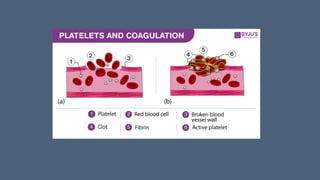
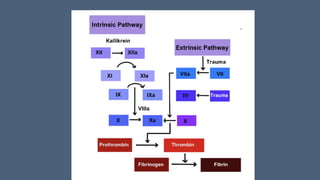
Coagulation is theprocess by which blood changes from a liquid to a
gel-like clot in order to stop bleeding after injury. It is an important
part of hemostasis, the body’s mechanism for preventing blood loss.
Steps in Coagulation
1.Vasoconstriction – Blood vessels constrict to reduce blood flow.
2.Platelet Plug Formation – Platelets stick to the injured area and
form a temporary plug.
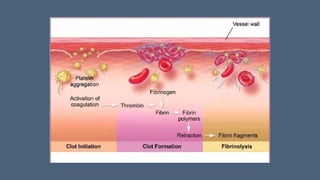
3.Coagulation Cascade – Clotting factors in the blood activate one
another in a sequence, ultimately producing fibrin.
4.Clot Formation – Fibrin forms a mesh that stabilizes the platelet
plug and creates a firm clot.
6.
Introduction
•Anticoagulants are drugsthat prevent or reduce blood
coagulation.
•They are used in prevention and treatment of
thromboembolic disorders.
•Common indications include deep vein thrombosis (DVT),
pulmonary embolism, myocardial infarction, and atrial
fibrillation.
8.
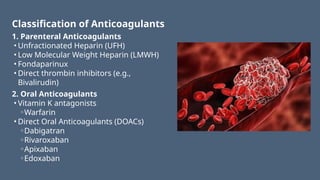
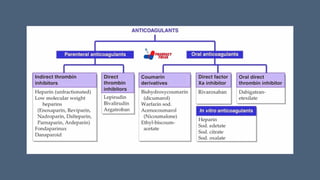
Classification of Anticoagulants
1.Parenteral Anticoagulants
• Unfractionated Heparin (UFH)
• Low Molecular Weight Heparin (LMWH)
• Fondaparinux
• Direct thrombin inhibitors (e.g.,
Bivalirudin)
2. Oral Anticoagulants
• Vitamin K antagonists
◦Warfarin
• Direct Oral Anticoagulants (DOACs)
◦Dabigatran
◦Rivaroxaban
◦Apixaban
◦Edoxaban
10.
eparin – Introduction
Heparinis a naturally occurring anticoagulant.
Obtained from animal tissues such as porcine intestinal mucosa.
dministered mainly through intravenous (IV) or subcutaneous (SC) route
roduces rapid anticoagulant action.
11.
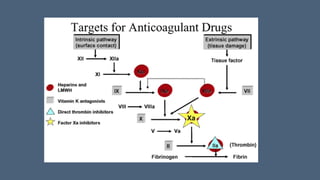
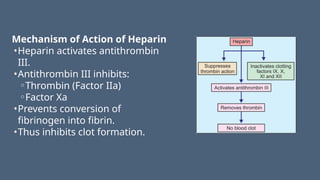
Mechanism of Actionof Heparin
•Heparin activates antithrombin
III.
•Antithrombin III inhibits:
◦Thrombin (Factor IIa)
◦Factor Xa
•Prevents conversion of
fibrinogen into fibrin.
•Thus inhibits clot formation.
12.
Pharmacokinetics of Heparin
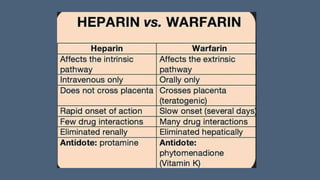
•Noteffective orally due to large molecular size.
•Administered IV or SC.
•Rapid onset of action.
•Short half-life (1–2 hours).
•Metabolized mainly in the liver.
•Does not cross placenta, therefore safer in pregnancy.
Adverse Effects ofHeparin
•Bleeding (most common)
•Heparin-induced thrombocytopenia (HIT)
•Osteoporosis with prolonged use
•Hypersensitivity reactions
•Alopecia
Contraindications of Heparin
•Active bleeding disorders
•Severe hypertension
•Peptic ulcer disease
•Hemophilia
•Recent surgery involving brain or eye
Monitoring and Antidote
Monitoring
•Activated Partial Thromboplastin Time
(aPTT)
Antidote
•Protamine sulfate neutralizes heparin.
15.
Low Molecular WeightHeparin (LMWH)
Examples
•Enoxaparin
•Dalteparin
Advantages
•Longer duration of action
•More predictable anticoagulant response
•Lower risk of HIT
•Less monitoring required
16.
Classification of OralAnticoagulants
1. Vitamin K Antagonists
•Warfarin
•Acenocoumarol
2. Direct Oral Anticoagulants (DOACs)
Direct Thrombin Inhibitor
•Dabigatran
Factor Xa Inhibitors
•Rivaroxaban
•Apixaban
•Edoxaban
17.
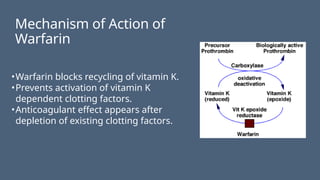
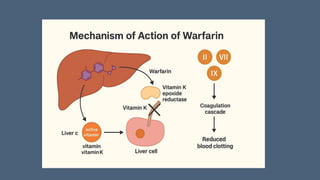
Mechanism of Actionof
Warfarin
•Warfarin blocks recycling of vitamin K.
•Prevents activation of vitamin K
dependent clotting factors.
•Anticoagulant effect appears after
depletion of existing clotting factors.
19.
Pharmacokinetics
•Well absorbed orally.
•Highlyprotein bound.
•Metabolized in liver by CYP450 enzymes.
•Long half-life.
•Delayed onset of action.
Therapeutic Uses
•Deep vein thrombosis (DVT)
•Pulmonary embolism
•Atrial fibrillation
•Prosthetic heart valves
•Prevention of stroke
20.
Adverse Effects
•Bleeding
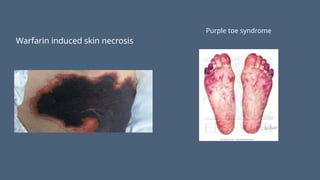
•Skin necrosis
•Purpletoe syndrome
•Teratogenicity
•Numerous drug interactions
Antidote of Warfarin
•Vitamin K (Phytonadione)
•Fresh frozen plasma in severe bleeding
•Prothrombin complex concentrate
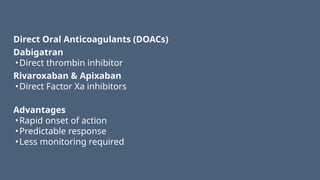
Direct Oral Anticoagulants(DOACs)
Dabigatran
•Direct thrombin inhibitor
Rivaroxaban & Apixaban
•Direct Factor Xa inhibitors
Advantages
•Rapid onset of action
•Predictable response
•Less monitoring required
23.
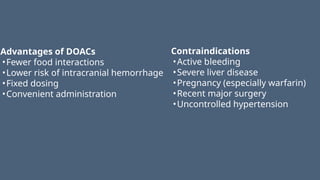
Advantages of DOACs
•Fewerfood interactions
•Lower risk of intracranial hemorrhage
•Fixed dosing
•Convenient administration
Contraindications
•Active bleeding
•Severe liver disease
•Pregnancy (especially warfarin)
•Recent major surgery
•Uncontrolled hypertension
24.
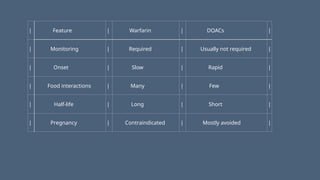
| Feature |Warfarin | DOACs |
| Monitoring | Required | Usually not required |
| Onset | Slow | Rapid |
| Food interactions | Many | Few |
| Half-life | Long | Short |
| Pregnancy | Contraindicated | Mostly avoided |
26.
Anticoagulants prevent andtreat thromboembolic disorders by inhibiting blood clot formation.
hey are used in conditions such as DVT, pulmonary embolism, atrial fibrillation, and myocardial infarctio
Major classes include heparins, warfarin, and direct oral anticoagulants (DOACs).
hey reduce morbidity and mortality associated with thrombosis.
Bleeding is the major adverse effect; therefore, careful monitoring is important.
Newer anticoagulants offer better safety, predictable action, and improved patient compliance.
Rational drug selection and appropriate dosing are essential for safe and effective therapy.
Summary