Comprehensive Overview of Anti-Arrhythmic Drugs and Cardiac Action Potentials
Detailed insights into anti-arrhythmic drug classes, mechanisms, uses, and side effects in managing cardiac arrhythmias and action potential modulation.
Overview:
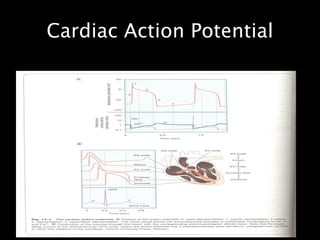
Cardiac cells undergodepolarization and
repolarization to form cardiac action potentials
about 60s times/min.
activity of ion channel protein complexes
determines the shape and duration of each
action potential .
Ion channel function can be perturbed by acute
ischemia, sympathetic stimulation, or
myocardial scarring to create abnormalities of
cardiac rhythm, or arrhythmias.
3.
• antiarrhythmic drugssuppress
arrhythmias by blocking flow through
specific ion channels or by altering
autonomic function.
• Arrhythmias can range from incidental,
asymptomatic clinical findings to life-
threatening abnormalities.
4.
• Antiarrhythmic drugtherapy can have
two goals:
• termination of an ongoing arrhythmia
• or prevention of an arrhythmia.
• Unfortunately, antiarrhythmic drugs not
only help to control arrhythmias but also
can cause them, especially during long-
term therapy.
5.
• Most antiarrhythmic drugs affect more
than one current; such as modification of
cardiac contractility or autonomic nervous
system function.
• Thus antiarrhythmic drugs usually exert
multiple actions and can be of beneficial
or harmful in individual patients.
6.
Antiarrhythmic Drugs
• Theaim of therapy is to reduce ectopic pacemaker
activity and modify conduction or refractoriness in
reentry circuits to disable circus movement.
• Most of anti-arrhythmic drugs suppress
automaticity by raising the threshold of discharge
to a less negative voltage
• They also prevent reentry by slowing conduction
or increasing the refractory period required to
convert a unidirectional block to a bidirectional
block
7.
• In emergencytreatment, drugs are not
used, but rather done by physical means,
like pacing, direct current shock…
• Four classes of drugs are identified, I, II,
III and IV.
• The majormechanisms to accomplish
these aims are:
1. Na +
channel blockade
2. Blockade of sympathetic effects in the heart
3. Prolongation of effective refractory period
4. Ca ++
channel blockade
10.
Classification of Anti-ArrhythmicDrugs
(Vaughn-Williams Classification)
• Classified according to effect on action potential:
1. Class I – Na+
channel blockers
2. Class II – b-adrenoreceptor blockers
3. Class III – drugs that prolong repolarisation
4. Class IV – Ca2+
channel blockers
• Other antiarrythmic drugs e.g. digoxin and
adenosine, Mg, K.
11.
Class I: Na+
ChannelBlockers
• Binds to the α-subunit of the Na+
channels and prevent conduction of ions.
• They act by reducing the maximum rate of
depolarisation during phase 0.
• They show “use dependence” i.e. the
more frequently the channels are
activated, the greater the degree of block
produced.
12.
• The morethe channel is used, the more
drug is bound.
• Useful in conditions where channels
open frequently.
• Sub-classified according to effect on
duration of action potential into 3
groups: IA, IB and IC.
13.
Class IA: Quinidine,Procainamide,
Disopyramide
• Slow phase 0 of the cardiac AP, slow
conduction, prolong phase 3
repolarisation but less than class III.
• Increase fibrillation threshold in atria
and ventricles.
• These drugs associate and dissociate at
intermediate rate.
14.
Quinidine:
– The prototype
–Treat a wide variety of arrythmias, including atrial,
AV junctional and ventricular
– Has potential adverse effects.*
– Cinchonism.
15.
Procainamide:
– Shows actionssimilar to quinidine
– Chronic use leads to lupus erythematosus-like
syndrome in 25% of patients.
16.
Disopyramide:
– Shows actionssimilar to quinidine
– Produces a negative inotropic effect
– Used for ventricular arrythmias.
– Shows anticholinergic side effects; i.e. has atropine-
like actions, blurred vision, dry mouth,
constipation, glaucoma and urinary retention. It
can precipitate heart failure and can cause torsades
de pointes.
– Dose has to be reduced in patients with renal
dysfunction. Higher doses are needed in patients
taking phenytoin.
17.
Class IB –Lidocaine, Mexiletine,
Tocainide
• Minimal phase 0 depression and slows
conduction (less than Ia).
• Shortens repolarisation.
• associate and dissociate rapidly. It binds
to the open channels during phase 0
(rapid depolarisation). They can also bind
selectively to refractory channels, thus
block cells when they are depolarised.
18.
Lidocaine: (Xylocaine )
•Is the drug of choice for emergency treatment of
cardiac arrhythmias.
• is used (i.v.) to treat ventricular tachycardia and to
prevent ventricular fibrillation after myocardial
infarction.
• Can cause heart failure or heart block.
• It blocks both open and inactivated cardiac sodium
channels. Recovery is very rapid.
• Not useful in Atrial arrhythmias because Atrial action
potentials are so short that the sodium channel is in the
inactivated state only briefly.
19.
• Adverse effects:I.V. can cause seizures,
tremor and nystagmas
• Undergoes extensive first pass effect and
plasma levels are affected by rapid
distribution into tissues and reduced
hepatic blood flow by reduced cardiac
output.
20.
Class IC: flecainide,encainide, and
Propafenone.
• associate and dissociate much more
slowly.
• Markedly slow phase 0 depolarization.
• No effect on repolarisation.
• Refractory period of AV node increased.
• There are doubts on the safety of the
class 1C drugs
21.
Flecainide:
• Approved onlyfor refractory ventricular arrythmias
• used mainly in patients with supraventricular arrhythmias
to maintain sinus rhythm and also for atrial fibrillation.
• Can aggrevate preexisting arrythmias.
• Adverse effects: blurred vision. Can exacerbate congestive
heart failure in patients with depressed left ventricular
performance.
• Serious AD include exacerbation of potentially
lethal arrhythmias in patients with atrial flutter.
• Can also cause heart block in patients with
conduction system disease.
Class II –b-adrenoreceptor
blockade
• There are b1 receptors in the heart which increase heart
rate when stimulated by sympathetic nerves.
• Adrenaline may cause arrhythmias by increasing
spontaneous firing of the SA node. AV node conduction
also requires sympathetic activity. e.g. ventricular
dysrhythmias after myocardial infarction is due to
increased sympathetic activity. SVT and paroxysmal
attacks of atrial fibrillation .
• b-blockers prevent these events.
• Propanolol, metoprolol and esmolol decrease heart rate.
24.
• Propranolol:
– Themost widely used for cardiac arrythmias
– Reduces the incidence of sudden arrythmic death after
myocardial infarction
• Metoprolol:
– Β1 adrenergic blocker
– Reduces the risk of bronchospasm
• Esmolol:
– Short acting
– For acute arrythmias (emergency, i.v.)
25.
Class III -Drugs that prolong
repolarisation
• Examples are sotalol, bretyllium and
amiodarone.
• Full mechanism is not understood, but
they block some of the potassium channels
involved in cardiac repolarisation.
• Prolong phase 3 repolarization and
refractory period
26.
• Action potentialprolongation increases
the refractory period, causing powerful &
varied antidysrhythmic activity.
• Be careful in patients taking other drugs
that may cause prolonged Q-T interval on
ECG (torsades de pointes).
• Antipsychotic drugs, hypokalaemia,
hypercalcaemia or in individuals with
hereditary prolonged Q-T mainly “Ward-
Romano syndrome”.
27.
Amiodarone (Cordarone)
• Pharmacologicaleffects:
• Blocks inactivated potassium channels with
rapid rate of recovery
• Decreases calcium current
• Decreases transient outward delayed rectifier
and inward rectifier potassium currents
• Exerts a non-competitive adrenergic blocking
effect.
• Blocks abnormal automaticity and prolongs
action potential duration.
28.
• Decreases conductionvelocity
• Prolongs PR, QRA and QT intervals
• Ad. Effects: Hypotension with intravenous injections
• Depressed contractility during long term treatment
via the oral route.
• During chronic amiodarone therapy is pulmonary
fibrosis which can be rapidly progressive and fatal
• Risk factors for pulmonary fibrosis include
underlying lung disease, doses of 400mg/day or
more, and pneumonia.
• Corneal deposits, hepatic dysfunction, perpheral
neuropathy, muscular weakness, photosensitivity and
hypo- or hyperthyroidism.
29.
• Treatment consistsof withdrawal of the
drug and administration of corticosteroids
and other supportive measures.
• Poor absorption, 30% bioavailability.
Distributes into fat (300:1)
• Undergoes hepatic metabolism (CYP3A4)
to active metabolite, desethylamiodarone.
• Dosages of digoxin, warfarin, flecainide
usually require reduction during
amiodarone therapy.
30.
• Sotalol: forlong therapy after acute MI
• Bretyllium only used for life-threatening
ventricular arrhythmias, amiodarone for
recurrent ventricular fibrillation.
31.
Class IV:Ca2+
-channel blockers
•Verapamil, diltiazem, nifedipine
• Block Ca2+
channels (especially L-type
channels).
• Slow conduction in the SA and AV nodes
where action propagation depends on
slow inward Ca2+ CURRENT.
32.
• They shortenthe plateau of the action
potential and reduce the force of
contraction.
• Reduced calcium entry reduces after-
depolarisation and thus suppresses
premature ectopic beats.
33.
• Verapamil anddiltiazem:
– are more effective against atrial than ventricular
dysrythmias
– Have negative inotropic effects and may be
contraindicated in patients with depressed cardiac
function