Comprehensive Orientation on the New Three-Term School Calendar and Classroom Expectations
2.
Welcome!
Good day, learners!
Welcometo a new and exciting school year.
This orientation will help everyone
understand the classroom expectations,
routines, school policies, and the new Three-
Term School Calendar implemented by the
Department of Education.
Let us work together to make this school
year productive, safe, and meaningful for all
learners.
3.
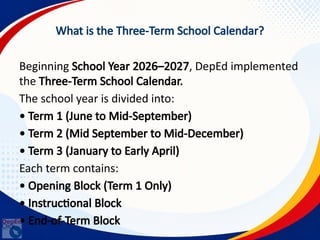
What is theThree-Term School Calendar?
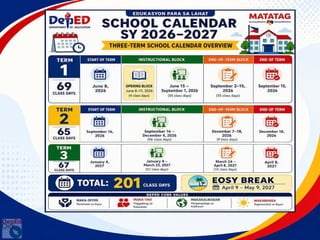
Beginning School Year 2026–2027, DepEd implemented
the Three-Term School Calendar.
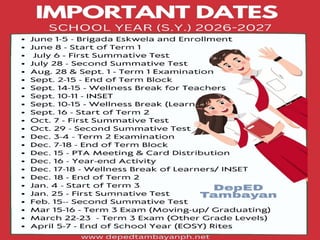
The school year is divided into:
• Term 1 (June to Mid-September)
• Term 2 (Mid September to Mid-December)
• Term 3 (January to Early April)
Each term contains:
• Opening Block (Term 1 Only)
• Instructional Block
• End-of-Term Block
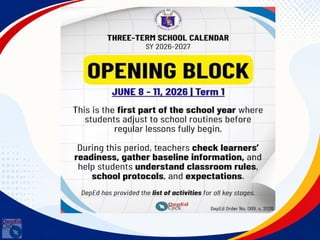
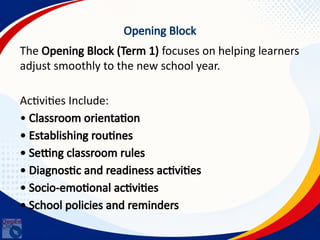
Opening Block
The OpeningBlock (Term 1) focuses on helping learners
adjust smoothly to the new school year.
Activities Include:
• Classroom orientation
• Establishing routines
• Setting classroom rules
• Diagnostic and readiness activities
• Socio-emotional activities
• School policies and reminders
10.
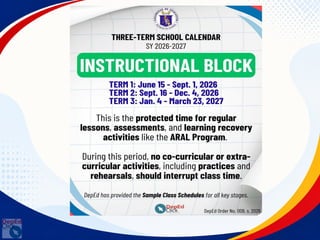
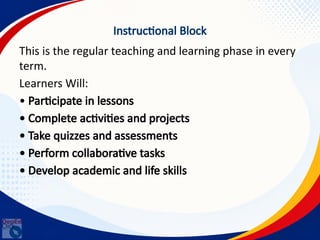
Instructional Block
This isthe regular teaching and learning phase in every
term.
Learners Will:
• Participate in lessons
• Complete activities and projects
• Take quizzes and assessments
• Perform collaborative tasks
• Develop academic and life skills
11.
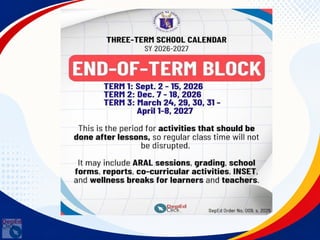
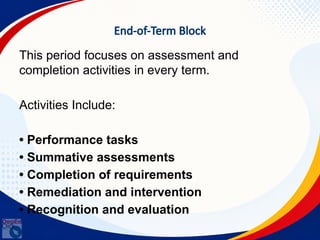
End-of-Term Block
This periodfocuses on assessment and
completion activities in every term.
Activities Include:
• Performance tasks
• Summative assessments
• Completion of requirements
• Remediation and intervention
• Recognition and evaluation
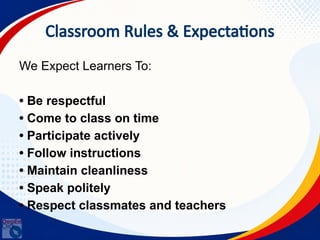
Classroom Rules &Expectations
We Expect Learners To:
• Be respectful
• Come to class on time
• Participate actively
• Follow instructions
• Maintain cleanliness
• Speak politely
• Respect classmates and teachers
14.
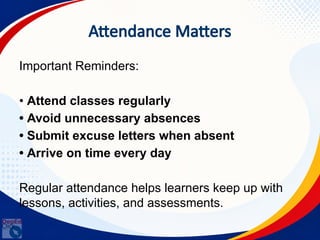
Attendance Matters
Important Reminders:
•Attend classes regularly
• Avoid unnecessary absences
• Submit excuse letters when absent
• Arrive on time every day
Regular attendance helps learners keep up with
lessons, activities, and assessments.
15.
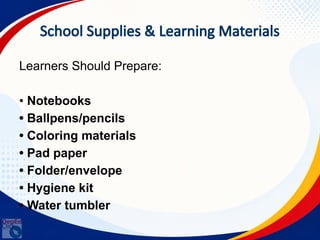
School Supplies &Learning Materials
Learners Should Prepare:
• Notebooks
• Ballpens/pencils
• Coloring materials
• Pad paper
• Folder/envelope
• Hygiene kit
• Water tumbler
16.
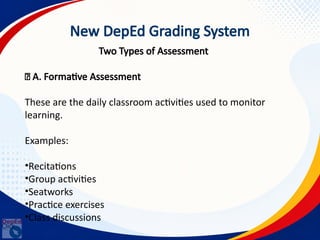
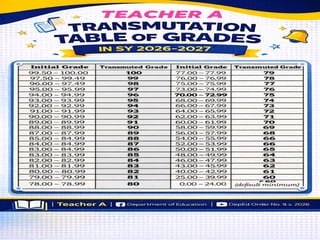
New DepEd GradingSystem
Two Types of Assessment
✅ A. Formative Assessment
These are the daily classroom activities used to monitor
learning.
Examples:
•Recitations
•Group activities
•Seatworks
•Practice exercises
•Class discussions
17.
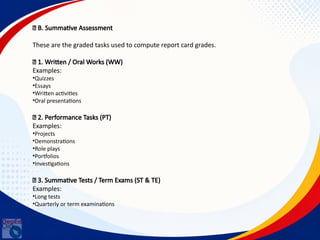
✅ B. SummativeAssessment
These are the graded tasks used to compute report card grades.
📖 1. Written / Oral Works (WW)
Examples:
•Quizzes
•Essays
•Written activities
•Oral presentations
🎨 2. Performance Tasks (PT)
Examples:
•Projects
•Demonstrations
•Role plays
•Portfolios
•Investigations
📝 3. Summative Tests / Term Exams (ST & TE)
Examples:
•Long tests
•Quarterly or term examinations
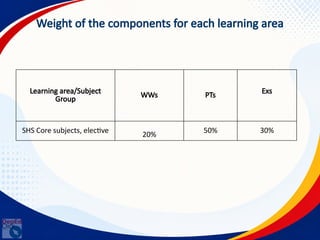
Weight of thecomponents for each learning area
Learning area/Subject
Group
WWs PTs
Exs
SHS Core subjects, elective
20%
50% 30%
20.
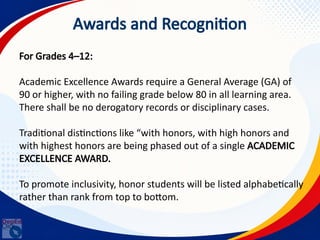
Awards and Recognition
ForGrades 4–12:
Academic Excellence Awards require a General Average (GA) of
90 or higher, with no failing grade below 80 in all learning area.
There shall be no derogatory records or disciplinary cases.
Traditional distinctions like “with honors, with high honors and
with highest honors are being phased out of a single ACADEMIC
EXCELLENCE AWARD.
To promote inclusivity, honor students will be listed alphabetically
rather than rank from top to bottom.
Health, Safety, andDRRM Reminders
Safety Practices:
• Follow school safety rules
• Participate in drills seriously
• Observe proper hallway behavior
• Stay alert during emergencies
Learners should prioritize safety at all times.
23.
Dear Learners…
This classroomis a safe place for learning,
growth, kindness, and respect.
Do your best, believe in yourself, and never be
afraid to ask questions.
Let us make this school year meaningful and
successful together.