Comprehensive Nursing Care for the Elderly: Biological, Psychological, and Sociocultural Perspectives
An in-depth overview of geriatric nursing covering aging processes, assessment tools, psychosocial and biological changes, elder abuse, and the nurse's role in elderly care.
Contents
■ Introduction tocare of elderly
■ Terminology
■ Geriatric Nursing
■ Assessment of the older adult
■ Biological aspects of aging
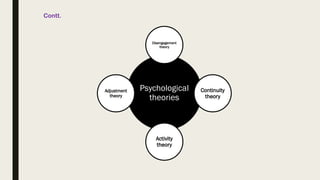
■ Psychosocial aspects of aging
■ Sociocultural aspects of aging
■ Sexual aspects of aging
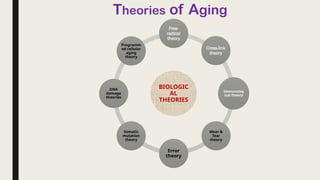
■ Theories of Aging
■ Elder Abuse
■ Uses of Aids and prosthesis
Role of Nurse in Geriatric care
New research done
Summary
Evaluation
Bibliography
Introduction to careof elderly
o ELDERLY is an individual over 65 years old who have a functional impairments.
o Elderly care is the fulfilment of the special needs and requirements that are unique
to senior citizens. This broad term encompasses such services as assisted living,
adult day care, long term care, nursing homes, hospital care, and In-Home care.
o Providing nursing care for older people is a major area of responsibility in the
caseloads of nurses in almost all health care settings.
o Nurses are accustomed to a multidisciplinary approach in giving care. In the field of
geriatrics and gerontology, nurses will undoubtedly continue to assume
multidisciplinary roles, particularly in home care and long term care settings.
o When caring for older patients, we need to take into account the physiologic and
biologic changes that normally occur during aging and to understand older adults’
special health requirements. Also, the effects of drugs on older patients should be
understood.
5.
TERMINOLOGY
Geriatrics- Geriatrics comefrom the Greek word GERAS- Old age and IATRIKQS- Branch
of Medical.
Hence, it is defined as “the branch of medicine concerned with medical problems and
care of old people.”
Gerontology: Gerontology is the study of all aspects of the aging process and its
consequences in humans. Gerontology achieves a level of wellness consistent with the
changes of aging.
Aging: It is defined as a maturational process that creates the need for individual
adaptation because of physical and psychological declines that occur during a lifetime.
6.
Geriatric
Nursing
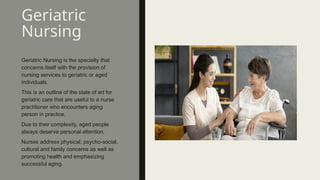
Geriatric Nursing isthe specialty that
concerns itself with the provision of
nursing services to geriatric or aged
individuals.
This is an outline of the state of art for
geriatric care that are useful to a nurse
practitioner who encounters aging
person in practice.
Due to their complexity, aged people
always deserve personal attention.
Nurses address physical, psycho-social,
cultural and family concerns as well as
promoting health and emphasizing
successful aging.
7.
Assessment of theolder adult
Careful assessment is the foundation of care for all patients, regardless of age. To
identify the problems and needs of older adults, nurse must integrate a sound
theoretical knowledge of the geriatric population with best assessment skills.
■ Components of geriatric assessment
1) Functional Assessment – it is the measurement of patient’s ability to complete
functional tasks and are used to evaluate the older adult’s overall well-being & self
care abilities.
8.
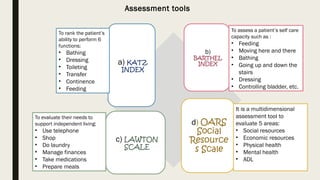
Assessment tools
a) KATZ
INDEX
b)
BARTHEL
INDEX
c)LAWTON
SCALE
d) OARS
Social
Resource
s Scale
To rank the patient’s
ability to perform 6
functions:
• Bathing
• Dressing
• Toileting
• Transfer
• Continence
• Feeding
To evaluate their needs to
support independent living:
• Use telephone
• Shop
• Do laundry
• Manage finances
• Take medications
• Prepare meals
To assess a patient’s self care
capacity such as :
• Feeding
• Moving here and there
• Bathing
• Going up and down the
stairs
• Dressing
• Controlling bladder, etc.
It is a multidimensional
assessment tool to
evaluate 5 areas:
• Social resources
• Economic resources
• Physical health
• Mental health
• ADL
9.
2) Physical Examination-It is the second component of the health assessment.
It focuses on several aspects:
Obtaining health history
Current health status
Medical history
Review of body systems
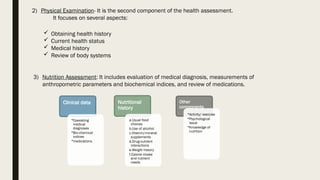
3) Nutrition Assessment: It includes evaluation of medical diagnosis, measurements of
anthropometric parameters and biochemical indices, and review of medications.
Clinical data
•Coexisting
medical
diagnoses
•Bio-chemical
indices
•medications
Nutritional
history
a.Usual food
choices
b.Use of alcohol
c.Vitamin/mineral
supplements
d.Drug-nutrient
interactions
e.Weight history
f.Calorie intake
and nutrient
needs
Other
components
•Activity/ exercise
•Psychological
issue
•Knowledge of
nutrition
10.
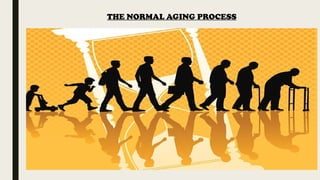
Normal aging hasfour aspects:
1. Biological aspects of aging
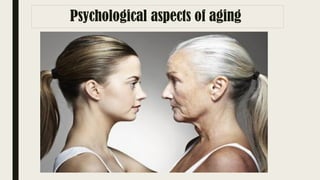
2. Psychological aspects of aging
3. Sociocultural aspects of aging
4. Sexual aspects of aging
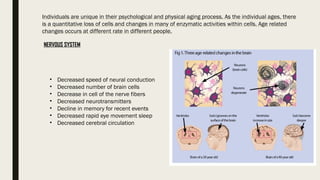
Individuals are uniquein their psychological and physical aging process. As the individual ages, there
is a quantitative loss of cells and changes in many of enzymatic activities within cells. Age related
changes occurs at different rate in different people.
NERVOUS SYSTEM
• Decreased speed of neural conduction
• Decreased number of brain cells
• Decrease in cell of the nerve fibers
• Decreased neurotransmitters
• Decline in memory for recent events
• Decreased rapid eye movement sleep
• Decreased cerebral circulation
13.
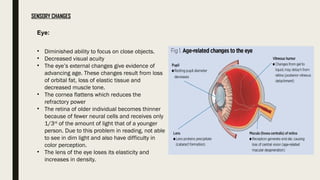
SENSORY CHANGES
Eye:
• Diminishedability to focus on close objects.
• Decreased visual acuity
• The eye’s external changes give evidence of
advancing age. These changes result from loss
of orbital fat, loss of elastic tissue and
decreased muscle tone.
• The cornea flattens which reduces the
refractory power
• The retina of older individual becomes thinner
because of fewer neural cells and receives only
1/3rd
of the amount of light that of a younger
person. Due to this problem in reading, not able
to see in dim light and also have difficulty in
color perception.
• The lens of the eye loses its elasticity and
increases in density.
14.
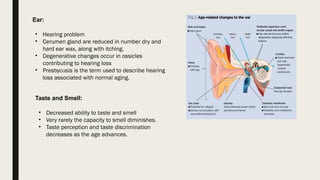
Ear:
• Hearing problem
•Cerumen gland are reduced in number dry and
hard ear wax, along with itching.
• Degenerative changes occur in ossicles
contributing to hearing loss
• Presbycusis is the term used to describe hearing
loss associated with normal aging.
Taste and Smell:
• Decreased ability to taste and smell
• Very rarely the capacity to smell diminishes.
• Taste perception and taste discrimination
decreases as the age advances.
15.
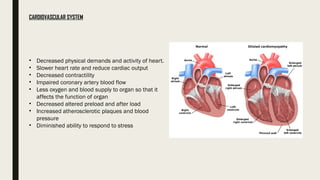
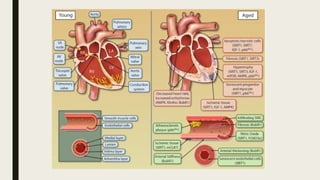
CARDIOVASCULAR SYSTEM
• Decreasedphysical demands and activity of heart.
• Slower heart rate and reduce cardiac output
• Decreased contractility
• Impaired coronary artery blood flow
• Less oxygen and blood supply to organ so that it
affects the function of organ
• Decreased altered preload and after load
• Increased atherosclerotic plaques and blood
pressure
• Diminished ability to respond to stress
17.
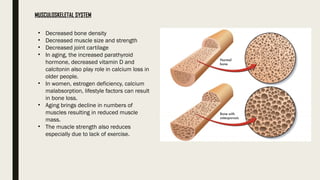
MUSCULOSKELETAL SYSTEM
• Decreasedbone density
• Decreased muscle size and strength
• Decreased joint cartilage
• In aging, the increased parathyroid
hormone, decreased vitamin D and
calcitonin also play role in calcium loss in
older people.
• In women, estrogen deficiency, calcium
malabsorption, lifestyle factors can result
in bone loss.
• Aging brings decline in numbers of
muscles resulting in reduced muscle
mass.
• The muscle strength also reduces
especially due to lack of exercise.
Memory Functioning
Shortterm memory deteriorate with age, long term memory does not show similar
changes.
A well educated and mentally active person does not exhibit such changes in faster
rate.
The time required for memory scanning is longer for both recent and remote recall
among older people.
This can be attributed to social or health factors (stress, fatigue, illness), but it can
also occur with certain physiological changes due to aging.
21.
Intellectual functioning
■ Fluidabilities or abilities involved in solving novel
problems, tend to decline from adult period to old
age.
■ High degree of regularity in intellectual function
present on most of the old age people.
■ Intellectual abilities of older people do not decline,
but do become obsolete.
■ Their formal educational experience is reflected in
their intelligence performance.
23.
Learning ability
Theability to learn is not decline by age.
The slowing of reaction time with age and over arousal of
CNS are noted in old age. It may lead to lower levels of
performance in tasks which requires high efficiency.
Ability to learn continue throughout the life, although
strongly influenced by personal interests and preferences.
Accuracy of performances diminishes,
25.
Loss and grief
oBy the individuals reach 60-70 yrs of age, they have experienced numerous losses
and mourning has become a life long process.
o It is impossible for some of the older age people to complete the grief process in
response to one loss before the other loss occurs.
o This can further predispose to depression.
Dealingwith death
• Death anxiety among the elderly is more of a myth than reality.
• The feeling of abandonment, pain and loss may lead to fear or anxiety
in elderly.
• Old agebrings many important socially induced changes.
• Some of them have potential for negative effect on both the physical
and mental well-being of older persons.
• They want protection from hazards and weariness of every day tasks
• They want to be treated with respect and dignity and also want to die
with respect and dignity.
• In developing countries and Asian countries the aged are awarded a
position of honour, that place emphasize on family cohesiveness.
• In industrialized countries many negative stereotyped perspectives on
aging still persisting, aged are always tires or sick, slow and forgetful,
isolated and lonely, unproductive, etc.
• The status of elderly may improve with time as the number of elder
person increases world wide.
Changes in females
♀Menopause may begin anytime during the 40s or early 50s.
♀ Gradual decline in the functioning of the ovaries and subsequent reduction in the
production of estrogen.
♀ The walls of the vagina become thin and inelastic and vaginal lubrication decreases.
♀ Orgasmic uterine contractions become spastic.
♀ All these changes result in vaginal burning, pelvic aching, irritability, etc
♀ In some women these changes result in avoidance of sexual intercourse.
♀ These symptoms are more likely to occur with infrequent intercourse of only one
time a month or less
♀ Regular and more frequent sexual activity result in a greater capacity for sexual
performance.
30.
Changes in males
♂Testosterone production decline gradually as the age increases
♂ As a result of these hormonal changes the erection takes place slowly and requires
more genital stimulation to achieve.
♂ The volume of ejaculate decreases and the force of ejaculate lessens
♂ The testis become smaller, but most men continue to produce viable sperm well in
to old age.
The agingprocess depends on a combination of both genetic and
environmental factors. Recognizing that every individual has his or
her own unique genetic makeup and environment, which interact with
each other, that is why the aging process can occur at such different
rates in different people.
Environmental stress associated with exposure to excessive heat and
light trigger the activity of aging genes.
Genetic and Environmental
Factors
33.
• Behaviors ofa healthy lifestyle:
― Not smoking
― Drinking alcohol in moderation
― Exercising
― Getting adequate rest
― Eating a diet high in fruits and vegetables
― Coping with stress
― Having a positive outlook
• Aging process in men is mainly brought about by over consumption of alcohol
and heavy smoking. Lack of exercise, inadequate rest or sleep, mental stress
show symptoms of early aging.
• Others factors like regular consumption of excessive spicy food and caffeine
renders an old look. Sloth and sluggish lifestyle makes one feel old.
• However, many environmental conditions, such as the quality of health care that
you receive, have a substantial effect on aging. A healthy lifestyle is an especially
important factor in healthy aging and longevity.
Life style:
34.
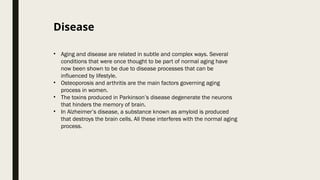
• Aging anddisease are related in subtle and complex ways. Several
conditions that were once thought to be part of normal aging have
now been shown to be due to disease processes that can be
influenced by lifestyle.
• Osteoporosis and arthritis are the main factors governing aging
process in women.
• The toxins produced in Parkinson’s disease degenerate the neurons
that hinders the memory of brain.
• In Alzheimer’s disease, a substance known as amyloid is produced
that destroys the brain cells. All these interferes with the normal aging
process.
Disease
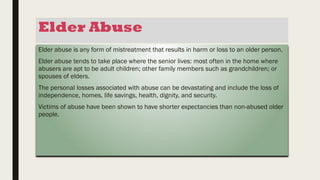
Elder Abuse
Elder abuseis any form of mistreatment that results in harm or loss to an older person.
Elder abuse tends to take place where the senior lives: most often in the home where
abusers are apt to be adult children; other family members such as grandchildren; or
spouses of elders.
The personal losses associated with abuse can be devastating and include the loss of
independence, homes, life savings, health, dignity, and security.
Victims of abuse have been shown to have shorter expectancies than non-abused older
people.
38.
RISK FACTORS forElder Abuse
• Poor health and functional impairment in older person
• Cognitive impairment
• Substances abuse or mental illness
• Dependence of the abuse on the victims
• Shared living arrangement
• Social isolation
• History violence
RISK FACTORS among Caregivers
Among caregivers, significant risk factors for elder abuse are:
o Inability to cope with stress
o Depression {common}
o Lack of support from other potential caregivers
o Substance abuse
o The caregiver’s perception that taking care of the elder is burden some and
without psychological reward.
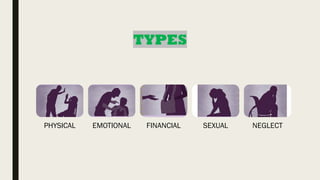
TYPES
■ Physical Abuse-Use of physical force against an older adult that may result in bodily
injury, physical pain or impairment.
■ Emotional abuse- Infliction of anguish, pain, or distress on an older adult through
verbal or nonverbal acts.
■ Financial abuse- Illegal or improper use of an older adult’s funds, property or assets.
■ Sexual abuse- Non-consensual sexual contact of any kind with an older adult.
■ Neglect- Refusal or failure to fulfil any part of a person’s duties to an older adult.
•Anguish-severe mental pain
•Infliction- cause
•Non- consensual= not agreed to by one
41.
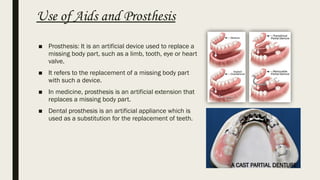
Use of Aidsand Prosthesis
■ Prosthesis: It is an artificial device used to replace a
missing body part, such as a limb, tooth, eye or heart
valve.
■ It refers to the replacement of a missing body part
with such a device.
■ In medicine, prosthesis is an artificial extension that
replaces a missing body part.
■ Dental prosthesis is an artificial appliance which is
used as a substitution for the replacement of teeth.
A CAST PARTIAL DENTURE
42.
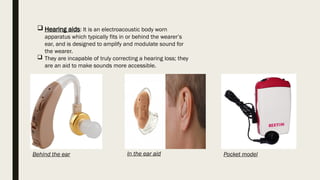
Hearing aids:It is an electroacoustic body worn
apparatus which typically fits in or behind the wearer’s
ear, and is designed to amplify and modulate sound for
the wearer.
They are incapable of truly correcting a hearing loss; they
are an aid to make sounds more accessible.
Behind the ear In the ear aid Pocket model
43.
Role of Nursein Geriatric care
1) Acute Care
• Gather medical, family and psychological history
• Perform patient assessment
• Explain diagnosis and treatment to the patient and family
• Work closely with patient, family and other health care professionals
• Maintain hydration, nutrition, aeration and comfort
• Provide medications and treatment and evaluate response
• Administer emergency treatment when necessary
• Initiate discharge planning & coordinate referral to community agencies
• Serve as patient advocate
• Inform doctor of any change in patient’s condition
44.
2) Long termCare
• Gather medical, family and psychological history
• Perform patient assessment
• Involve patient and family in preparation & implementation of nursing plan
• Promote the atmosphere that emphasizes quality living, not disease and dying
• Ensure that patient receives medical, dental, eye care
• Maintain hydration, nutrition, aeration and comfort
• Provide medications, treatment, rehabilitative exercises and evaluate response
• Teach and advise patient and family
• Perform emergency measure when necessary
• Serve as patient advocate
• Inform doctor of any change in patient’s condition
45.
3) Community Care
•Identify health, social or economic needs.
• Refer elderly person to professional or agency best able to meet needs.
• Explain diagnosis and treatment to the patient and family
• Evaluate compliance with and response to treatment.
• Use clinic and home visits for health promotion.
• Teach and advise patient and family
• Evaluate elderly person’s ability to live independently
• Become advocate for elderly persons
• Encourage elderly to become advocate on his own self.
46.
Summary
■ Elderly careis the fulfilment of the special needs and requirements that are unique to senior
citizens. This broad term encompasses such services as assisted living, adult day care, long
term care, nursing homes, hospital care, and In-Home care.
■ Components of geriatric assessment are:
Functional assessment
Physical Examination
Nutrition Assessment
■ Normal aging has four aspects:
1. Biological aspects of aging
2. Psychological aspects of aging
3. Sociocultural aspects of aging
4. Sexual aspects of aging
■ Role of nurse includes acute care, long term care and community care.