Comprehensive Life and Career Skills Exam for Grade 11 Students
A multiple-choice exam covering physiological development, mindfulness, communication, diversity, personal and career skills, and healthy relationships for Grade 11 learners.
TEST I: MULTIPLECHOICE
Instructions: Choose the
BEST answer for each
questions. Write the CAPITAL
LETTER of your answer. AVOID
ERASURES.
3.
1. Which termrefers to the healthy
growth, functioning, and
maintenance of the body?
A. Social development
B. Cognitive development
C. Physiological development
D. Emotional development
4.
2. Which activityis primarily
considered a mindfulness practice?
A. Deep breathing with focused
attention
B. Jogging around the school grounds
C. Playing volleyball with classmates
D. Performing strength exercises
5.
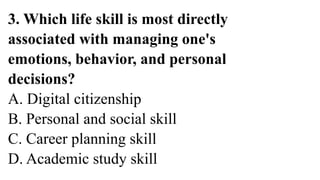
3. Which lifeskill is most directly
associated with managing one's
emotions, behavior, and personal
decisions?
A. Digital citizenship
B. Personal and social skill
C. Career planning skill
D. Academic study skill
6.
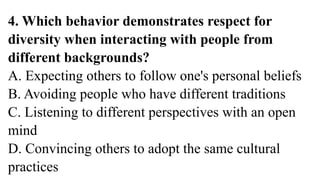
4. Which behaviordemonstrates respect for
diversity when interacting with people from
different backgrounds?
A. Expecting others to follow one's personal beliefs
B. Avoiding people who have different traditions
C. Listening to different perspectives with an open
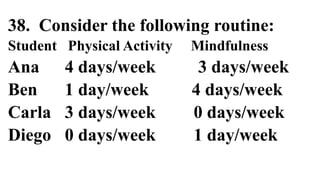
mind
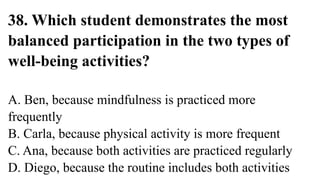
D. Convincing others to adopt the same cultural
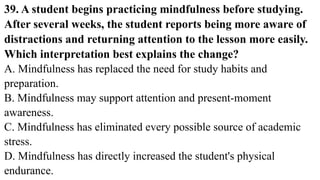
practices
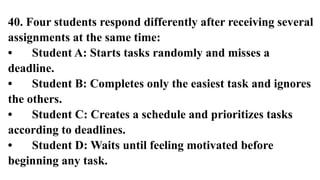
7.
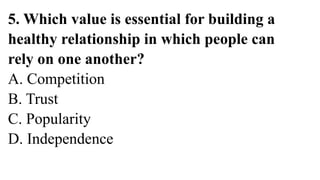
5. Which valueis essential for building a
healthy relationship in which people can
rely on one another?
A. Competition
B. Trust
C. Popularity
D. Independence
8.
6. Which termrefers to recognizing and
respecting the limits a person sets
regarding their body, feelings, time, or
personal space?
A. Cooperation
B. Honesty
C. Empathy
D. Boundaries
9.
7. Which communicationmethod
involves the use of spoken words to
express ideas, feelings, or information?
A. Verbal communication
B. Non-verbal communication
C. Visual communication
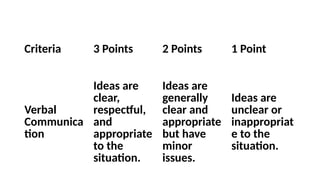
D. Written symbolism
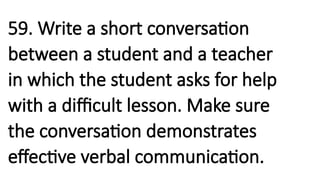
10.
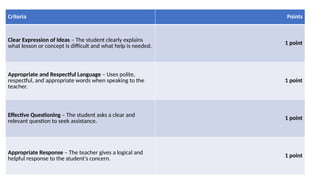
8. Which ofthe following is an example
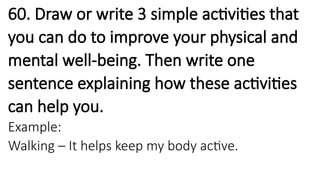
of non-verbal communication?
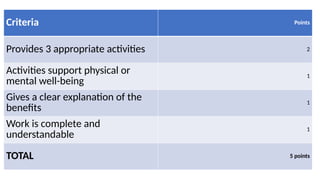
A. Asking a classmate for clarification
B. Writing a message to a teacher
C. Nodding while listening to a speaker
D. Explaining an idea during a discussion
11.
9. Which communicationskill involves
recognizing another person's feelings
and showing that you understand their
experience?
A. Assertiveness
B. Empathy
C. Negotiation
D. Persuasion
12.
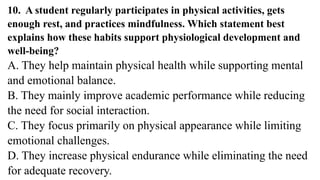
10. A studentregularly participates in physical activities, gets
enough rest, and practices mindfulness. Which statement best
explains how these habits support physiological development and
well-being?
A. They help maintain physical health while supporting mental
and emotional balance.
B. They mainly improve academic performance while reducing
the need for social interaction.
C. They focus primarily on physical appearance while limiting
emotional challenges.
D. They increase physical endurance while eliminating the need
for adequate recovery.
13.
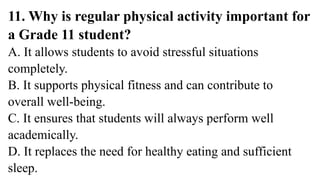
11. Why isregular physical activity important for
a Grade 11 student?
A. It allows students to avoid stressful situations
completely.
B. It supports physical fitness and can contribute to
overall well-being.
C. It ensures that students will always perform well
academically.
D. It replaces the need for healthy eating and sufficient
sleep.
14.
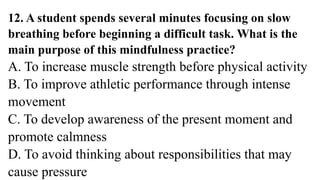
12. A studentspends several minutes focusing on slow
breathing before beginning a difficult task. What is the
main purpose of this mindfulness practice?
A. To increase muscle strength before physical activity
B. To improve athletic performance through intense
movement
C. To develop awareness of the present moment and
promote calmness
D. To avoid thinking about responsibilities that may
cause pressure
15.
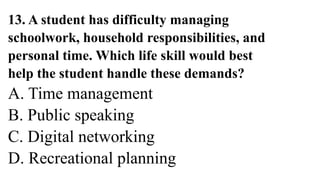
13. A studenthas difficulty managing
schoolwork, household responsibilities, and
personal time. Which life skill would best
help the student handle these demands?
A. Time management
B. Public speaking
C. Digital networking
D. Recreational planning
16.
14. A Grade11 student is preparing for a future career and begins
identifying personal strengths, interests, skills, and possible
occupations. How does this activity demonstrate a career-related life
skill?
A. It encourages the student to choose a career based only on
popularity.
B. It allows the student to connect personal characteristics with
possible career paths.
C. It helps the student avoid considering skills that may need
further development.
D. It encourages the student to select an occupation without
considering personal interests.
17.
15. A studentreceives a suspicious message asking for a
password and personal information. Which response best
demonstrates an appropriate digital life skill?
A. Forward the message to classmates so they can identify
the sender.
B. Reply to the sender and request additional information
about the offer.
C. Share the message publicly to ask strangers whether it is
legitimate.
D. Avoid sharing personal information and verify the source
before responding.
18.
16. During agroup activity, one member has a
cultural practice that differs from the others. Which
behavior best demonstrates appreciation of diversity?
A. Asking the member to follow the group's usual practice
B. Ignoring the difference so that the activity can continue
C. Listening respectfully and allowing the member to
explain the practice
D. Comparing the practice with others to determine which is
more appropriate
19.
17. Two classmatesdisagree about how to complete
a group project. One listens to the other's ideas,
explains their own viewpoint calmly, and works
toward a shared decision. Which principle of
healthy social relationships is best demonstrated?
A. Cooperation
B. Competition
C. Independence
D. Popularity
20.
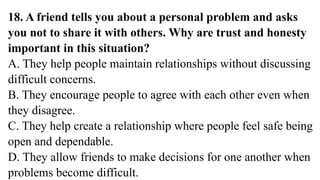
18. A friendtells you about a personal problem and asks
you not to share it with others. Why are trust and honesty
important in this situation?
A. They help people maintain relationships without discussing
difficult concerns.
B. They encourage people to agree with each other even when
they disagree.
C. They help create a relationship where people feel safe being
open and dependable.
D. They allow friends to make decisions for one another when
problems become difficult.
21.
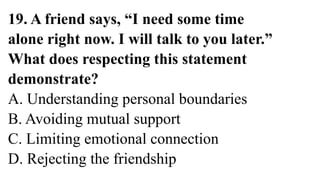
19. A friendsays, “I need some time
alone right now. I will talk to you later.”
What does respecting this statement
demonstrate?
A. Understanding personal boundaries
B. Avoiding mutual support
C. Limiting emotional connection
D. Rejecting the friendship
22.
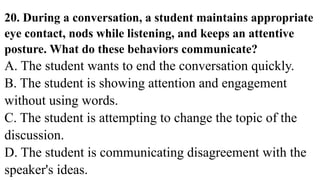
20. During aconversation, a student maintains appropriate
eye contact, nods while listening, and keeps an attentive
posture. What do these behaviors communicate?
A. The student wants to end the conversation quickly.
B. The student is showing attention and engagement
without using words.
C. The student is attempting to change the topic of the
discussion.
D. The student is communicating disagreement with the
speaker's ideas.
23.
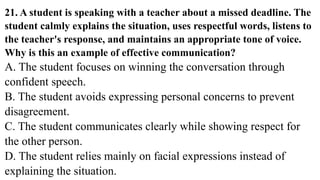
21. A studentis speaking with a teacher about a missed deadline. The
student calmly explains the situation, uses respectful words, listens to
the teacher's response, and maintains an appropriate tone of voice.
Why is this an example of effective communication?
A. The student focuses on winning the conversation through
confident speech.
B. The student avoids expressing personal concerns to prevent
disagreement.
C. The student communicates clearly while showing respect for
the other person.
D. The student relies mainly on facial expressions instead of
explaining the situation.
24.
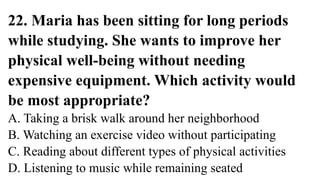
22. Maria hasbeen sitting for long periods
while studying. She wants to improve her
physical well-being without needing
expensive equipment. Which activity would
be most appropriate?
A. Taking a brisk walk around her neighborhood
B. Watching an exercise video without participating
C. Reading about different types of physical activities
D. Listening to music while remaining seated
25.
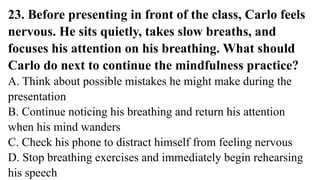
23. Before presentingin front of the class, Carlo feels
nervous. He sits quietly, takes slow breaths, and
focuses his attention on his breathing. What should
Carlo do next to continue the mindfulness practice?
A. Think about possible mistakes he might make during the
presentation
B. Continue noticing his breathing and return his attention
when his mind wanders
C. Check his phone to distract himself from feeling nervous
D. Stop breathing exercises and immediately begin rehearsing
his speech
26.
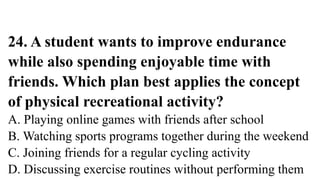
24. A studentwants to improve endurance
while also spending enjoyable time with
friends. Which plan best applies the concept
of physical recreational activity?
A. Playing online games with friends after school
B. Watching sports programs together during the weekend
C. Joining friends for a regular cycling activity
D. Discussing exercise routines without performing them
27.
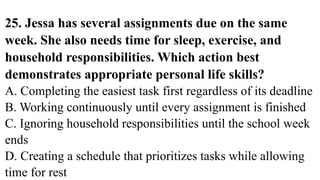
25. Jessa hasseveral assignments due on the same
week. She also needs time for sleep, exercise, and
household responsibilities. Which action best
demonstrates appropriate personal life skills?
A. Completing the easiest task first regardless of its deadline
B. Working continuously until every assignment is finished
C. Ignoring household responsibilities until the school week
ends
D. Creating a schedule that prioritizes tasks while allowing
time for rest
28.
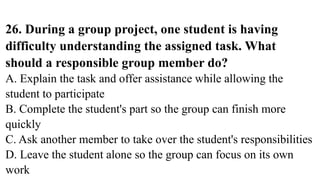
26. During agroup project, one student is having
difficulty understanding the assigned task. What
should a responsible group member do?
A. Explain the task and offer assistance while allowing the
student to participate
B. Complete the student's part so the group can finish more
quickly
C. Ask another member to take over the student's responsibilities
D. Leave the student alone so the group can focus on its own
work
29.
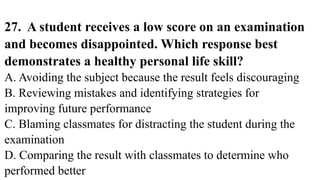
27. A studentreceives a low score on an examination
and becomes disappointed. Which response best
demonstrates a healthy personal life skill?
A. Avoiding the subject because the result feels discouraging
B. Reviewing mistakes and identifying strategies for
improving future performance
C. Blaming classmates for distracting the student during the
examination
D. Comparing the result with classmates to determine who
performed better
30.
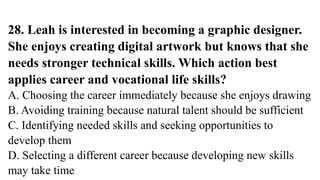
28. Leah isinterested in becoming a graphic designer.
She enjoys creating digital artwork but knows that she
needs stronger technical skills. Which action best
applies career and vocational life skills?
A. Choosing the career immediately because she enjoys drawing
B. Avoiding training because natural talent should be sufficient
C. Identifying needed skills and seeking opportunities to
develop them
D. Selecting a different career because developing new skills
may take time
31.
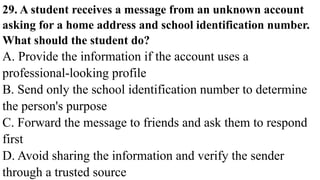
29. A studentreceives a message from an unknown account
asking for a home address and school identification number.
What should the student do?
A. Provide the information if the account uses a
professional-looking profile
B. Send only the school identification number to determine
the person's purpose
C. Forward the message to friends and ask them to respond
first
D. Avoid sharing the information and verify the sender
through a trusted source
32.
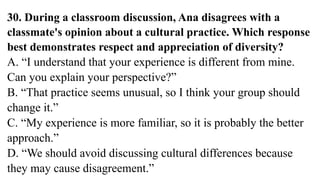
30. During aclassroom discussion, Ana disagrees with a
classmate's opinion about a cultural practice. Which response
best demonstrates respect and appreciation of diversity?
A. “I understand that your experience is different from mine.
Can you explain your perspective?”
B. “That practice seems unusual, so I think your group should
change it.”
C. “My experience is more familiar, so it is probably the better
approach.”
D. “We should avoid discussing cultural differences because
they may cause disagreement.”
33.
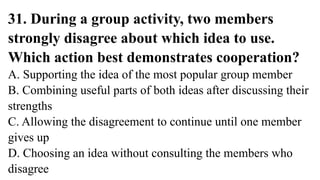
31. During agroup activity, two members
strongly disagree about which idea to use.
Which action best demonstrates cooperation?
A. Supporting the idea of the most popular group member
B. Combining useful parts of both ideas after discussing their
strengths
C. Allowing the disagreement to continue until one member
gives up
D. Choosing an idea without consulting the members who
disagree
34.
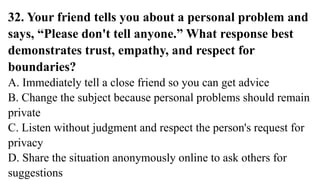
32. Your friendtells you about a personal problem and
says, “Please don't tell anyone.” What response best
demonstrates trust, empathy, and respect for
boundaries?
A. Immediately tell a close friend so you can get advice
B. Change the subject because personal problems should remain
private
C. Listen without judgment and respect the person's request for
privacy
D. Share the situation anonymously online to ask others for
suggestions
35.
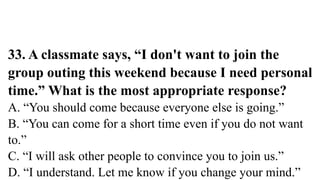
33. A classmatesays, “I don't want to join the
group outing this weekend because I need personal
time.” What is the most appropriate response?
A. “You should come because everyone else is going.”
B. “You can come for a short time even if you do not want
to.”
C. “I will ask other people to convince you to join us.”
D. “I understand. Let me know if you change your mind.”
36.
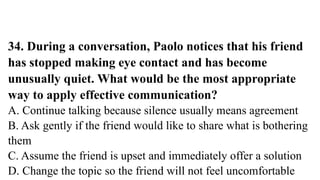
34. During aconversation, Paolo notices that his friend
has stopped making eye contact and has become
unusually quiet. What would be the most appropriate
way to apply effective communication?
A. Continue talking because silence usually means agreement
B. Ask gently if the friend would like to share what is bothering
them
C. Assume the friend is upset and immediately offer a solution
D. Change the topic so the friend will not feel uncomfortable
37.
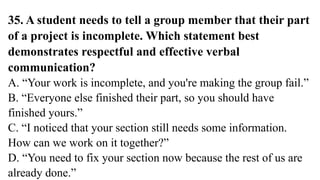
35. A studentneeds to tell a group member that their part
of a project is incomplete. Which statement best
demonstrates respectful and effective verbal
communication?
A. “Your work is incomplete, and you're making the group fail.”
B. “Everyone else finished their part, so you should have
finished yours.”
C. “I noticed that your section still needs some information.
How can we work on it together?”
D. “You need to fix your section now because the rest of us are
already done.”
38.
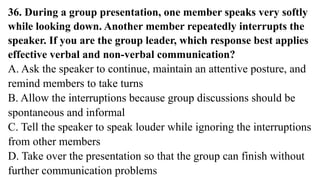
36. During agroup presentation, one member speaks very softly
while looking down. Another member repeatedly interrupts the
speaker. If you are the group leader, which response best applies
effective verbal and non-verbal communication?
A. Ask the speaker to continue, maintain an attentive posture, and
remind members to take turns
B. Allow the interruptions because group discussions should be
spontaneous and informal
C. Tell the speaker to speak louder while ignoring the interruptions
from other members
D. Take over the presentation so that the group can finish without
further communication problems
39.
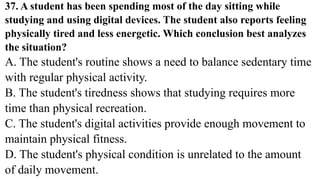
37. A studenthas been spending most of the day sitting while
studying and using digital devices. The student also reports feeling
physically tired and less energetic. Which conclusion best analyzes
the situation?
A. The student's routine shows a need to balance sedentary time
with regular physical activity.
B. The student's tiredness shows that studying requires more
time than physical recreation.
C. The student's digital activities provide enough movement to
maintain physical fitness.
D. The student's physical condition is unrelated to the amount
of daily movement.
40.
38. Consider thefollowing routine:
Student Physical Activity Mindfulness
Ana 4 days/week 3 days/week
Ben 1 day/week 4 days/week
Carla 3 days/week 0 days/week
Diego 0 days/week 1 day/week
41.
38. Which studentdemonstrates the most
balanced participation in the two types of
well-being activities?
A. Ben, because mindfulness is practiced more
frequently
B. Carla, because physical activity is more frequent
C. Ana, because both activities are practiced regularly
D. Diego, because the routine includes both activities
42.
39. A studentbegins practicing mindfulness before studying.
After several weeks, the student reports being more aware of
distractions and returning attention to the lesson more easily.
Which interpretation best explains the change?
A. Mindfulness has replaced the need for study habits and
preparation.
B. Mindfulness may support attention and present-moment
awareness.
C. Mindfulness has eliminated every possible source of academic
stress.
D. Mindfulness has directly increased the student's physical
endurance.
43.
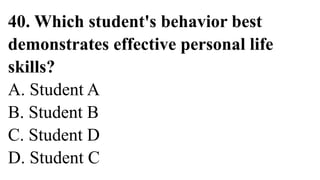
40. Four studentsrespond differently after receiving several
assignments at the same time:
• Student A: Starts tasks randomly and misses a
deadline.
• Student B: Completes only the easiest task and ignores
the others.
• Student C: Creates a schedule and prioritizes tasks
according to deadlines.
• Student D: Waits until feeling motivated before
beginning any task.
44.
40. Which student'sbehavior best
demonstrates effective personal life
skills?
A. Student A
B. Student B
C. Student D
D. Student C
45.
41. A studentreceives a disappointing grade and
immediately says, “I am not capable of learning
this subject.” Which analysis best identifies a
more productive life-skill response?
A. Avoid the subject to prevent another disappointing result.
B. Compare the grade with classmates to determine personal ability.
C. Review the mistakes and identify strategies for improving
performance.
D. Ask someone else to complete future academic tasks to avoid
mistakes.
46.
42. A studentwants to become a chef. The student enjoys
cooking but has little experience with food safety and
professional kitchen procedures. Which analysis best
connects the student's interests with career preparation?
A. The student should choose the career because enjoyment is enough
preparation.
B. The student should identify skill gaps and seek appropriate training
opportunities.
C. The student should abandon the career because professional skills
take time to develop.
D. The student should focus only on personal cooking experiences
instead of formal preparation.
47.
43. A studentreceives an online message claiming that the
student has won a scholarship. The message requests a
password, home address, and identification number. Which
analysis is most appropriate?
A. The message may present a digital safety risk because it requests
sensitive information.
B. The message is trustworthy because scholarships commonly
require personal information.
C. The message should be forwarded to friends so they can
determine whether it is legitimate.
D. The message should be answered with partial information to test
whether the sender is genuine.
48.
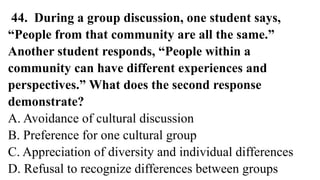
44. During agroup discussion, one student says,
“People from that community are all the same.”
Another student responds, “People within a
community can have different experiences and
perspectives.” What does the second response
demonstrate?
A. Avoidance of cultural discussion
B. Preference for one cultural group
C. Appreciation of diversity and individual differences
D. Refusal to recognize differences between groups
49.
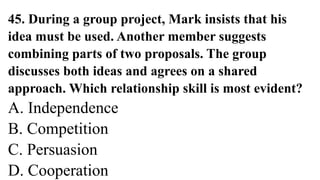
45. During agroup project, Mark insists that his
idea must be used. Another member suggests
combining parts of two proposals. The group
discusses both ideas and agrees on a shared
approach. Which relationship skill is most evident?
A. Independence
B. Competition
C. Persuasion
D. Cooperation
50.
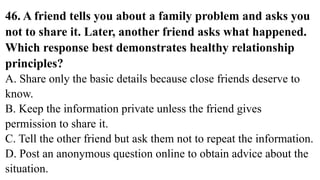
46. A friendtells you about a family problem and asks you
not to share it. Later, another friend asks what happened.
Which response best demonstrates healthy relationship
principles?
A. Share only the basic details because close friends deserve to
know.
B. Keep the information private unless the friend gives
permission to share it.
C. Tell the other friend but ask them not to repeat the information.
D. Post an anonymous question online to obtain advice about the
situation.
51.
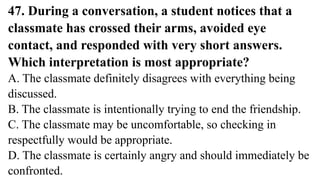
47. During aconversation, a student notices that a
classmate has crossed their arms, avoided eye
contact, and responded with very short answers.
Which interpretation is most appropriate?
A. The classmate definitely disagrees with everything being
discussed.
B. The classmate is intentionally trying to end the friendship.
C. The classmate may be uncomfortable, so checking in
respectfully would be appropriate.
D. The classmate is certainly angry and should immediately be
confronted.
52.
48. A groupleader notices that one member repeatedly
interrupts another member during a presentation. The
speaker becomes quieter and avoids eye contact. Which
analysis best identifies the communication problem
and an appropriate response?
A. The main issue is lack of confidence, so the
speaker should present alone.
B. The main issue is disagreement, so the group
should avoid discussing the topic.
53.
C. The mainissue is excessive silence, so
the speaker should be asked more
questions.
D. The main issue is disrupted turn-taking,
so the leader should encourage respectful
listening and equal speaking opportunities.
54.
49. A Grade11 student spends most of the day sitting,
rarely exercises, and often feels tired. The student
plans to improve well-being by exercising once a
month for several hours. Which evaluation of this
plan is most appropriate?
A. It is effective because occasional
intense exercise is enough to maintain
well-being.
55.
B. It isappropriate because physical activity is
only needed when fatigue occurs.
C. It is incomplete because regular,
manageable physical activity is more
sustainable.
D. It is unnecessary because rest alone can
improve the effects of prolonged sitting.
56.
50. Two studentspropose different wellness
routines:
• Student A: Exercises regularly but gets
very little sleep and rarely takes time to
relax.
• Student B: Gets adequate sleep,
exercises regularly, and practices
mindfulness several times a week.
57.
50. Which routineshould a teacher recommend as
the stronger overall approach to well-being?
A. Student A's, because physical activity is the most
important part of wellness.
B. Student B's, because it combines physical activity,
recovery, and mindfulness.
C. Student A's, because relaxation practices are
unnecessary for active students.
D. Student B's, because mindfulness can replace the
need for physical activity.
58.
51. A studenthas five assignments due within
one week and also needs time for sleep, exercise,
and family responsibilities. Which strategy
would be the best recommendation?
A. Complete tasks according to priority while
scheduling time for personal needs.
59.
B. Finish allschoolwork first and use
remaining time for sleep and exercise.
C. Work on whichever assignment seems
easiest and postpone the difficult ones.
D. Reduce sleep temporarily so that every
academic task can be completed.
60.
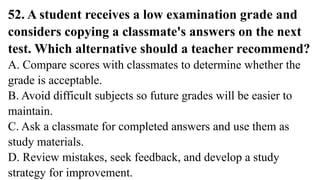
52. A studentreceives a low examination grade and
considers copying a classmate's answers on the next
test. Which alternative should a teacher recommend?
A. Compare scores with classmates to determine whether the
grade is acceptable.
B. Avoid difficult subjects so future grades will be easier to
maintain.
C. Ask a classmate for completed answers and use them as
study materials.
D. Review mistakes, seek feedback, and develop a study
strategy for improvement.
61.
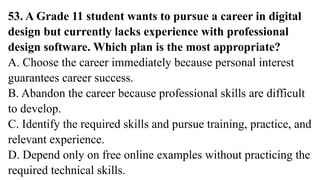
53. A Grade11 student wants to pursue a career in digital
design but currently lacks experience with professional
design software. Which plan is the most appropriate?
A. Choose the career immediately because personal interest
guarantees career success.
B. Abandon the career because professional skills are difficult
to develop.
C. Identify the required skills and pursue training, practice, and
relevant experience.
D. Depend only on free online examples without practicing the
required technical skills.
62.
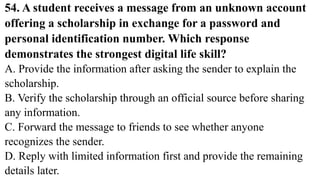
54. A studentreceives a message from an unknown account
offering a scholarship in exchange for a password and
personal identification number. Which response
demonstrates the strongest digital life skill?
A. Provide the information after asking the sender to explain the
scholarship.
B. Verify the scholarship through an official source before sharing
any information.
C. Forward the message to friends to see whether anyone
recognizes the sender.
D. Reply with limited information first and provide the remaining
details later.
63.
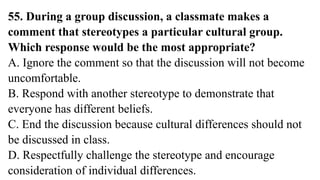
55. During agroup discussion, a classmate makes a
comment that stereotypes a particular cultural group.
Which response would be the most appropriate?
A. Ignore the comment so that the discussion will not become
uncomfortable.
B. Respond with another stereotype to demonstrate that
everyone has different beliefs.
C. End the discussion because cultural differences should not
be discussed in class.
D. Respectfully challenge the stereotype and encourage
consideration of individual differences.
64.
56. A friendtells you about a private family concern and asks
you not to share it. Later, another friend asks what
happened. Which response best demonstrates healthy
relationship values?
A. Keep the information private and encourage the friend to seek
appropriate support if needed.
B. Share the information only with trusted friends because they may
know how to help.
C. Tell the other friend but ask them to keep the information
confidential afterward.
D. Post the situation anonymously online to receive advice without
using names.
65.
57. During agroup presentation, one student repeatedly interrupts
while another student is speaking. The speaker becomes quiet,
avoids eye contact, and appears uncomfortable. As group leader,
which response would best demonstrate effective communication?
A. Allow the interruptions because different communication styles
should always be accepted.
B. Ask the quieter student to speak more loudly while allowing the
interruptions to continue.
C. Pause the discussion, remind everyone to take turns, and invite
the speaker to continue.
D. Take over the presentation so the group can avoid further
communication difficulties.
66.
58. Create ashort written dialogue
between two classmates who are
resolving a misunderstanding. Use
appropriate verbal communication
to express their thoughts
respectfully.
67.
Criteria 3 Points2 Points 1 Point
Verbal
Communica
tion
Ideas are
clear,
respectful,
and
appropriate
to the
situation.
Ideas are
generally
clear and
appropriate
but have
minor
issues.
Ideas are
unclear or
inappropriat
e to the
situation.
68.
59. Write ashort conversation
between a student and a teacher
in which the student asks for help
with a difficult lesson. Make sure
the conversation demonstrates
effective verbal communication.
69.
Criteria Points
Clear Expressionof Ideas – The student clearly explains
what lesson or concept is difficult and what help is needed. 1 point
Appropriate and Respectful Language – Uses polite,
respectful, and appropriate words when speaking to the
teacher.
1 point
Effective Questioning – The student asks a clear and
relevant question to seek assistance.
1 point
Appropriate Response – The teacher gives a logical and
helpful response to the student's concern. 1 point
70.
60. Draw orwrite 3 simple activities that
you can do to improve your physical and
mental well-being. Then write one
sentence explaining how these activities
can help you.
Example:
Walking – It helps keep my body active.
71.
Criteria Points
Provides 3appropriate activities 2
Activities support physical or
mental well-being
1
Gives a clear explanation of the
benefits
1
Work is complete and
understandable
1
TOTAL 5 points
 Most read
 Most read
 Most read