Comprehensive Lesson Exemplar on Translational and Rotational Motion in Simple and Compound Machines for Senior High School
This lesson exemplar covers translational and rotational motion principles, their applications in simple and compound machines, and hands-on prototype design for senior high school General Science students.
Lesson Exemplar forGeneral Science
Quarter 1: Unit 1
This material is intended exclusively for the use of senior high school teachers participating in the implementation of the
Strengthened Senior High School Curriculum. It aims to assist in delivering the curriculum content, standards, and lesson competencies.
Any unauthorized reproduction, distribution, modification, or utilization of this material beyond the designated scope is strictly prohibited
and may result in appropriate legal actions and disciplinary measures.
Borrowed content included in this material are owned by their respective copyright holders. Every effort has been made to locate
and obtain permission to use these materials from their respective copyright owners. The publisher and development team do not represent
nor claim ownership over them.
Every care has been taken to ensure the accuracy of the information provided in this material. For inquiries or feedback, please write or
call the Office of the Director of the Bureau of Learning Resources via telephone numbers (02) 8634-1072 and 8631-6922 or by email at
blr.od@deped.gov.ph.
Development Team
Writer:
Consultant:
Learning Area Specialists:
Shiela Marie S. Quiamson
Alfons Jayson O. Pelgone, PhD
Philippine Normal University
John Cyrus L. Doblada
Danilo G. Soriano, Jr.
Bureau of Learning Delivery
Bureau of Curriculum Development
Bureau of Learning Resources
3.
Republic of thePhilippines
Department of Education
BUREAU OF LEARNING DELIVERY
General Science Quarter 1 1
LESSON EXEMPLAR
Learning Area General Science Grade Level 11
Semester 1st Quarter FIRST
I. OBJECTIVES (Identifying the Goals)
Content Standard
By the end of this lesson, learners’ efficiency of simple and compound machines can be improved by application of basic
principles of physics.
Performance
Standard
By the end of the quarter, learners identify general physics principles and their applications in daily life. They use
scientific principles to solve problems, make informed decisions, and illustrate the applications of physics for self, society,
and the environment. They design simple and compound machines and hydraulic systems to demonstrate applications
of force, torque, center of mass, and hydraulic-related principles. They evaluate energy-efficient practices in electricity
supply and consumption at home, in local businesses and in exploring advantages and drawbacks of light and sound
in medical imaging, security, communication and entertainment.
Learning
Competencies
By the end of this lesson, learners apply concepts of translational and rotational motion to design and build prototypes
of efficient simple and compound machines.
II. REFERENCES
and MATERIALS
(Selecting Resources
and Material)
Halliday, David, Robert Resnick, and Jearl Walker. Fundamentals of Physics. 11th ed. Hoboken, NJ: Wiley, 2018.
Serway, Raymond A., and John W. Jewett Jr. Physics for Scientists and Engineers. 10th ed. Boston: Cengage Learning,
2019.
Paredes, Rodrigo, and Jorge Angeles. 2020. "The Design of a Novel Pure-Rolling Transmission to Convert Rotational
into Translational Motion." Mechanism and Machine Theory 148: 103782. https://doi.org/10.xxxx..
4.
Republic of thePhilippines
Department of Education
BUREAU OF LEARNING DELIVERY
General Science Quarter 1 2
Norman, J., and A. L. Liddle. 2019. "Rotational and Translational Motion Interact Independently with Form." Vision
Research 162: 81–91. https://doi.org/10.xxxx..
Krynkin, Anton, Roger J. Sandberg, Paul D. Tait, and David M. J. S. Bowman. 2016. "Measuring Rotational and
Translational Movements in Rotating Machines Using a Computer Vision Approach." Journal of Mechanical
Engineering Science 230 (4): 610–623. https://doi.org/10.xxxx..
The Physics Classroom. "Types of Motion." Accessed May 13, 2025. https://www.physicsclassroom.com..
PhET Interactive Simulations. "Rotational Motion: Interactive Learning." University of Colorado Boulder. Accessed
May 13, 2025. https://phet.colorado.edu/en/simulations..
TED-Ed. "How Wind Turbines Work." Accessed May 13, 2025. https://shorturl.at/ZPxag..
(These shall be accomplished per topic)
III. CONTENT
(Sequencing Content)
Simple and compound machines
IV. OBJECTIVES
(Setting Clear
Objectives and
Analyzing the Tasks)
By the end of this lesson, the learners should be able to:
● Define translational and rotational motion, as well as simple and compound machines, while recognizing their
significance in daily life.
● Identify examples of translational and rotational motion and explain their role in the functioning of simple and
compound machines.
● Show appreciation for motion principles by creating a simple or compound machine, demonstrating curiosity,
teamwork, and perseverance.
● Construct and present a working prototype, showcasing its practical use and effectiveness.
5.
Republic of thePhilippines
Department of Education
BUREAU OF LEARNING DELIVERY
General Science Quarter 1 3
IV. PROCEDURES ANNOTATION
A. Activating Prior
Knowledge
1. Activating Prior Knowledge
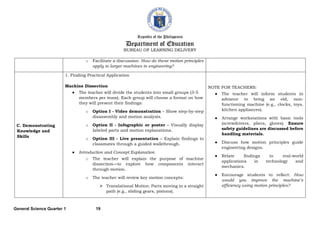
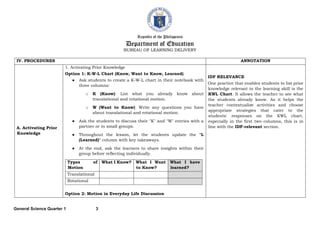
Option 1: K-W-L Chart (Know, Want to Know, Learned)
● Ask students to create a K-W-L chart in their notebook with
three columns:
o K (Know): List what you already know about
translational and rotational motion.
o W (Want to Know): Write any questions you have
about translational and rotational motion.
● Ask the students to discuss their "K" and "W" entries with a
partner or in small groups.
● Throughout the lesson, let the students update the "L
(Learned)" column with key takeaways.
● At the end, ask the learners to share insights within their
group before reflecting individually.
Types of
Motion
What I Know? What I Want
to Know?
What I have
learned?
Translational
Rotational
Option 2: Motion in Everyday Life Discussion
IDF RELEVANCE
One practice that enables students to list prior
knowledge relevant to the learning skill is the
KWL Chart. It allows the teacher to see what
the students already know. As it helps the
teacher contextualize activities and choose
appropriate strategies that cater to the
students' responses on the KWL chart,
especially in the first two columns, this is in
line with the IDF-relevant section.
6.
Republic of thePhilippines
Department of Education
BUREAU OF LEARNING DELIVERY
General Science Quarter 1 4
● The teacher will begin by asking students to think about the
machines they use every day and explain that motion plays a
crucial role in how these machines operate.
● Ask students to share examples of machines they frequently
use (e.g., bicycles, fans, cars).
Guide Questions:
1. What are examples of machines you use every day?
2. How do they function in terms of motion?
Option 3: Brainstorming Group Activity
● The teacher will divide the students into small groups (choose
a specific number based on class size) and provide each group
with chart paper and markers for recording ideas.
● Each group will list different machines they frequently
encounter at home, school, or in their community. The
students will analyze how each machine moves and determine
whether it uses rotational or translational motion (or both).
Encourage discussion within groups and ensure everyone
contributes.
Guide Questions:
1. What movements do these machines perform?
NOTE FOR TEACHERS: Encourage open
discussion using the guide questions. Guide
students to identify the type of motion involved
(e.g., rotational motion in wheels, translational
motion in elevators) and highlight the
significance of motion in making tasks easier
and improving efficiency. If possible, show
simple machines in action or use illustrations.
Allow students to demonstrate motions they
observe in their surroundings.
NOTE FOR TEACHERS: Explain that students
will brainstorm in small groups to identify
common machines and categorize them by
motion type (rotational or translational).
● The teacher will suggest that students
think beyond obvious examples—how
do machines like escalators, wind
turbines, or sewing machines apply
motion?
● The teacher prompt groups with guiding
questions
7.
Republic of thePhilippines
Department of Education
BUREAU OF LEARNING DELIVERY
General Science Quarter 1 5
2. How does this motion help the machine function?
● Each group present their findings to the class, explaining
their reasoning for categorizing each machine.
● The teacher will allow students to compare results and refine
their understanding of motion concepts.
2. Establishing the Purpose of the Lesson
After the conduct of the activities in activating prior knowledge, the
teacher will ask the students about the relevance of having
knowledge on translational motion and rotational motion.
Option 1: Real-World Applications
● The teacher will divide the class into three (3) groups. All the
students will ask to watch the videos. Each group will be
assigned to examine a specific video showing how
translational and rotational motion are used by real-world
machinery such as wind turbines, bicycles, and cranes, and
thoroughly examine how these two motion types affect the
equipment's function.
● Each group will be guided by the following guide questions.
Guide Questions:
● How Wind Turbines Work – TED-Ed Animation
1. What type of motion do the blades of a wind turbine
exhibit?
● The teacher will ask the students - how
does understanding motion help
improve machine design?
● The teacher will connect the activity to
real-world applications, like engineering
and technology advancements.
NOTE FOR TEACHERS:
● The teacher will begin by explaining that
machines rely on different types of
motion to function effectively. Introduce
translational motion (straight-line
movement) and rotational motion
(circular movement).
● State the goal: Students will analyze
motion types in wind turbines, bicycles,
and cranes using real-world examples.
● Show videos or pictures illustrating
these applications to create context.
8.
Republic of thePhilippines
Department of Education
BUREAU OF LEARNING DELIVERY
General Science Quarter 1 6
2. How does rotational motion in the blades convert into
electrical energy?
3. What role does wind speed play in the efficiency of the
turbine’s motion?
4. Could a wind turbine function with only translational
motion? Why or why not?
● Bike Wheel Experiment: Angular Momentum
1. What type of motion does the bike wheel demonstrate?
2. How does rotational motion influence balance and
stability in bicycles?
3. How do gears and pedals contribute to both
translational and rotational motion in a bicycle?
● How Cranes Work – Animation
1. What components of a crane use rotational motion?
2. How does translational motion help crane lift and
move heavy loads?
3. Why is the combination of translational and
rotational motion important in crane operation?
4. How advancements in motion mechanics improved
the efficiency and safety of cranes over time?
Option 2: Inspire Innovation: Comparison from Old to Present
Designs
1. How Wind Turbines Work – TED-
Ed Animation
(https://shorturl.at/ZPxag)
2. Bike Wheel Experiment: Angular
Momentum
(https://shorturl.at/LlfNs)
3. How Cranes Work – Animation
(https://shorturl.at/sJB3I)
NOTE FOR TEACHERS:
● The teacher will begin by discussing the
role of translational and rotational
9.
Republic of thePhilippines
Department of Education
BUREAU OF LEARNING DELIVERY
General Science Quarter 1 7
● The teacher will divide the students into small groups and
assign each group a specific machine type.
● The teacher will provide students with the comparison
readings showing old vs present designs for:
1. Bicycle Design
2. Wind Turbines
3. Cranes and Lifting Machines
4. Cars and Engines
Guide Questions:
1. How do old and new machine designs use rotational and
translational motion differently?
2. How do modern machines convert rotational motion into
translational motion more efficiently?
3. What improvements in motion mechanics make modern
machines better than older ones?
motion in engineering and design.
Explain that students will compare past
and present designs to see how motion
mechanics have evolved.
● Set the goal: Identify how technological
advancements have improved efficiency
and usability through motion principles.
● Each group presents their findings,
explaining key advancements.
● Encourage reflection: How could future
innovations use motion concepts even
more effectively?
● The teacher will wrap up by connecting
motion principles to real-world problem-
solving and creative design thinking.
IDF RELEVANCE
The IDF for these activities focuses on engaging
students in analyzing translational and
rotational motion in real-world applications
and engineering innovations. The Real-World
Applications activity uses videos and guided
discussions to help students explore how
motion affects the functionality of wind
10.
Republic of thePhilippines
Department of Education
BUREAU OF LEARNING DELIVERY
General Science Quarter 1 8
turbines, bicycles, and cranes. The Inspire
Innovation activity encourages students to
compare historical and modern machine
designs, highlighting improvements in
efficiency and usability through motion
mechanics. Both approaches integrate active
learning, collaboration, and real-world
problem-solving, fostering critical thinking and
creativity in technological advancements.
B. Instituting New
Knowledge
1. Presenting Examples
Option 1: Demonstration of a Simple Machine: The Lever
● The teacher will prepare all the needed materials for the
activity.
o A sturdy plank or ruler (lever)
o A block or small object (fulcrum)
o A weight (such as a book or small bag of sand)
o A handle or force application point (where students
apply pressure)
● Introduce the concept
o Explain the basic parts of a lever: fulcrum, effort, and
load.
NOTE FOR TEACHERS:
● The teacher will demonstrate a lever
using a fulcrum, weight, and handle.
Ask students to observe the
transformation of forces through
translational motion to lift the weight
easily.
11.
Republic of thePhilippines
Department of Education
BUREAU OF LEARNING DELIVERY
General Science Quarter 1 9
o Discuss how translational motion is used to make
lifting easier.
o Ask students to predict how shifting the fulcrum might
affect force efficiency.
● Set Up the Demonstration
o Place the fulcrum (block or object) near the center or
one end of the plank.
o Position the weight (load) on one side of the lever.
o Ask a student to apply force on the opposite end
(handle) to lift the weight.
● Observation and Discussion
o Have students observe how the force transforms
through motion.
o Ask: Does moving the fulcrum closer to the weight
make lifting easier?
o Discuss real-world examples like seesaws, crowbars,
and scissors.
● Hands-On Application
● Ask students to identify examples of
levers they encounter in daily life.
● Relate the activity to motion mechanics
in machinery and construction.
● Wrap-Up & Reflection
o Discuss: Why are levers
important in engineering and
everyday tools?
12.
Republic of thePhilippines
Department of Education
BUREAU OF LEARNING DELIVERY
General Science Quarter 1 10
o Allow students to adjust the fulcrum’s position and
test different force applications.
o Encourage them to compare the effort required at
different points.
Option 2: Interactive Physics Simulations
● The teacher will ensure access to PhET or other online
simulations that model motion principles.
● Provide students with devices (or pair them in groups if
limited resources are available).
● Introduction and Learning Goals
o Explain the purpose of using simulations—to observe
motion changes dynamically by adjusting variables.
o Define translational vs. rotational motion and highlight
their real-world applications.
● Guided Exploration
o The teacher will demonstrate how to navigate the
simulation interface.
o Show students how to adjust variables (force, mass,
friction, etc.) and predict outcomes.
● Student Experimentation and Observation
o Allow students to test different settings and observe
motion behaviors.
o Encourage them to identify patterns in translational
and rotational effects.
o Have students record findings and compare cause-
effect relationships.
● Discussion and Analysis
NOTE FOR TEACHERS:
● Utilize digital simulations (like PhET) to
showcase translational and rotational
motions through interactive
experiments. Allow students to
manipulate variables and observe
outcomes.
● The teacher will use the following PhET:
● https://phet.colorado.edu/en/simulati
ons/rotation
● https://phet.colorado.edu/en/simulati
ons/torque
● The teacher will shortly discuss how
virtual simulations help visualize
physics concepts.
● Ask students to relate findings to real-
world machines (e.g., bicycles, gears,
pulleys).
13.
Republic of thePhilippines
Department of Education
BUREAU OF LEARNING DELIVERY
General Science Quarter 1 11
o Use guiding questions to deepen understanding:
1. How does increasing mass affect translational
motion?
2. What happens when rotational speed increases?
3. How do friction and external forces impact
movement?
Option 3: Mechanical Toys Exploration
● Preparation and Setup
o The teacher will gather mechanical toys that
demonstrate both translational (linear) and rotational
(circular) motion, such as:
⮚ Wind-up cars
⮚ Spinning tops
⮚ Gears and pulley toys
⮚ Toy trains or vehicles with rotating wheels
o The teacher will arrange a hands-on exploration
station where students can freely interact with the
toys.
● Introduction and Learning Goals
o The teacher will begin by explaining the importance of
mechanical motion in toys and everyday machines.
● Assign a short reflection where students
explain their observations in relation to
engineering applications.
NOTE FOR TEACHERS:
● The teacher will ask the students to
bring in mechanical toys that utilize
both types of motion. Have students
analyze and describe the movements
happening in the toys and relate them
back to concepts discussed in class.
● For Wrap-Up & Reflection, the teacher
will ask the students to summarize how
mechanical toys demonstrate
fundamental principles of motion and
engineering design.
● The teacher will challenge students to
identify other objects in their daily lives
that utilize both motion types.
● Consider assigning a creative follow-up:
Design a toy concept that effectively uses
both rotational and translational motion.
14.
Republic of thePhilippines
Department of Education
BUREAU OF LEARNING DELIVERY
General Science Quarter 1 12
o Review the concepts of translational vs. rotational
motion, ensuring students understand their real-world
applications.
o Ask students to predict which types of motion each toy
might exhibit before testing them.
● Observing and Analyzing Motion
o Allow students to manipulate the toys and observe
their movement.
o The teacher will guide the students in identifying which
parts of the toy use rotational motion (gears, wheels,
spinning components) and which use translational
motion (straight-line movement, sliding parts, shifting
pieces).
o Encourage discussions using guiding questions:
1. What type of motion does the toy primarily
exhibit?
2. How does force transfer from one part of the toy
to another?
3. Would the toy function differently if it used only
one type of motion?
● Group Discussion and Concept Application
IDF RELEVANCE
This Instructional Design Framework (IDF)
engages students in hands-on learning
through three interactive activities, each
highlighting translational and rotational
motion in different contexts. The
Demonstration of a Simple Machine: The
Lever allows students to observe force
transformation in lifting a weight, reinforcing
how levers improve mechanical efficiency. The
Interactive Physics Simulations provide a
digital exploration of motion principles,
enabling students to manipulate variables and
analyze their effects dynamically. Lastly, the
Mechanical Toys Exploration fosters critical
thinking and real-world connections as
students examine how toys utilize motion
mechanics in design and function. Together,
these activities encourage active learning,
experimentation, and innovation,
strengthening students' understanding of
motion applications in engineering and
everyday life.
15.
Republic of thePhilippines
Department of Education
BUREAU OF LEARNING DELIVERY
General Science Quarter 1 13
o The students will compare different toys and classify
their motion types.
o The teacher will lead a discussion on how these
mechanical principles are applied in real-world
machines like bicycles, cranes, or cars.
o Ask students to think creatively: How could
understanding motion lead to the design of better toys
or machines?
2. Discussing New Concept
In this part, the teacher may provide students with reading materials
that they can use in the conduct of the selected activity.
Option 1: Peer Teaching
● Introduction and Group Formation
o The teacher will begin by explaining the peer teaching
method—students will work in pairs to research and
teach the class about a machine.
o Clarify the difference between simple machines (one
mechanism) and compound machines (multiple
working parts).
o Assign or allow students to choose their machine to
research.
NOTE FOR TEACHERS:
● This task requires students to conduct
research on a simple or compound
machine in pairs, produce a brief
presentation, and share their results
with the class. In addition to improving
their presentation and teaching
abilities, this will assist students gain a
deeper grasp of how various machines
operate, especially with regard to
translational and rotational motion.
16.
Republic of thePhilippines
Department of Education
BUREAU OF LEARNING DELIVERY
General Science Quarter 1 14
● Research and Preparation
o The teacher will provide students with reliable sources
(textbooks, websites, simulation tools like PhET).
o Instruct pairs to investigate how their machine utilizes
translational and rotational motion.
o Have each group prepare a short presentation (3-5
minutes) with:
⮚ A basic explanation of how the machine works
⮚ Examples of real-world applications
⮚ A visual aid (drawing, model, or digital slide)
● Presentation and Demonstration
o Each pair presents their findings to the class,
explaining the motion principles involved.
o Encourage students to ask questions after each
presentation.
o If possible, allow groups to demonstrate the machine
physically or using simulations.
Option 2: Group Discussion on Forces
● Introduction and Concept Explanation
o The students will define translational motion (linear
movement) and rotational motion (circular movement).
o The teacher will introduce key forces acting on
machines:
● Assign a follow-up task: How would you
modify or improve your machine using
motion principles?
● The teacher will summarize key
insights, emphasizing the role of motion
in mechanical efficiency and discuss
how innovations in machine design
improve real-world applications.
17.
Republic of thePhilippines
Department of Education
BUREAU OF LEARNING DELIVERY
General Science Quarter 1 15
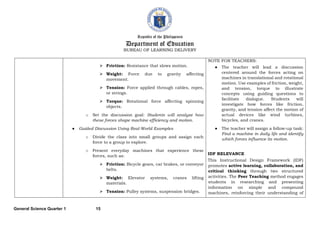
⮚ Friction: Resistance that slows motion.
⮚ Weight: Force due to gravity affecting
movement.
⮚ Tension: Force applied through cables, ropes,
or strings.
⮚ Torque: Rotational force affecting spinning
objects.
o Set the discussion goal: Students will analyze how
these forces shape machine efficiency and motion.
● Guided Discussion Using Real-World Examples
o Divide the class into small groups and assign each
force to a group to explore.
o Present everyday machines that experience these
forces, such as:
⮚ Friction: Bicycle gears, car brakes, or conveyor
belts.
⮚ Weight: Elevator systems, cranes lifting
materials.
⮚ Tension: Pulley systems, suspension bridges.
NOTE FOR TEACHERS:
● The teacher will lead a discussion
centered around the forces acting on
machines in translational and rotational
motion. Use examples of friction, weight,
and tension, torque to illustrate
concepts using guiding questions to
facilitate dialogue. Students will
investigate how forces like friction,
gravity, and tension affect the motion of
actual devices like wind turbines,
bicycles, and cranes.
● The teacher will assign a follow-up task:
Find a machine in daily life and identify
which forces influence its motion.
IDF RELEVANCE
This Instructional Design Framework (IDF)
promotes active learning, collaboration, and
critical thinking through two structured
activities. The Peer Teaching method engages
students in researching and presenting
information on simple and compound
machines, reinforcing their understanding of
18.
Republic of thePhilippines
Department of Education
BUREAU OF LEARNING DELIVERY
General Science Quarter 1 16
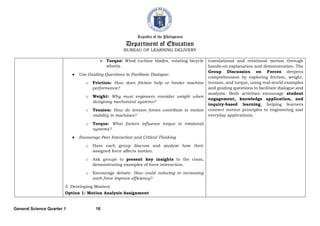
⮚ Torque: Wind turbine blades, rotating bicycle
wheels.
● Use Guiding Questions to Facilitate Dialogue:
o Friction: How does friction help or hinder machine
performance?
o Weight: Why must engineers consider weight when
designing mechanical systems?
o Tension: How do tension forces contribute to motion
stability in machines?
o Torque: What factors influence torque in rotational
systems?
● Encourage Peer Interaction and Critical Thinking
o Have each group discuss and analyze how their
assigned force affects motion.
o Ask groups to present key insights to the class,
demonstrating examples of force interaction.
o Encourage debate: How could reducing or increasing
each force improve efficiency?
3. Developing Mastery
Option 1: Motion Analysis Assignment
translational and rotational motion through
hands-on explanation and demonstration. The
Group Discussion on Forces deepens
comprehension by exploring friction, weight,
tension, and torque, using real-world examples
and guiding questions to facilitate dialogue and
analysis. Both activities encourage student
engagement, knowledge application, and
inquiry-based learning, helping learners
connect motion principles to engineering and
everyday applications.
19.
Republic of thePhilippines
Department of Education
BUREAU OF LEARNING DELIVERY
General Science Quarter 1 17
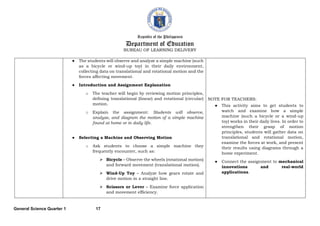
● The students will observe and analyze a simple machine (such
as a bicycle or wind-up toy) in their daily environment,
collecting data on translational and rotational motion and the
forces affecting movement.
● Introduction and Assignment Explanation
o The teacher will begin by reviewing motion principles,
defining translational (linear) and rotational (circular)
motion.
o Explain the assignment: Students will observe,
analyze, and diagram the motion of a simple machine
found at home or in daily life.
● Selecting a Machine and Observing Motion
o Ask students to choose a simple machine they
frequently encounter, such as:
⮚ Bicycle – Observe the wheels (rotational motion)
and forward movement (translational motion).
⮚ Wind-Up Toy – Analyze how gears rotate and
drive motion in a straight line.
⮚ Scissors or Lever – Examine force application
and movement efficiency.
NOTE FOR TEACHERS:
● This activity aims to get students to
watch and examine how a simple
machine (such a bicycle or a wind-up
toy) works in their daily lives. In order to
strengthen their grasp of motion
principles, students will gather data on
translational and rotational motion,
examine the forces at work, and present
their results using diagrams through a
home experiment.
● Connect the assignment to mechanical
innovations and real-world
applications.
20.
Republic of thePhilippines
Department of Education
BUREAU OF LEARNING DELIVERY
General Science Quarter 1 18
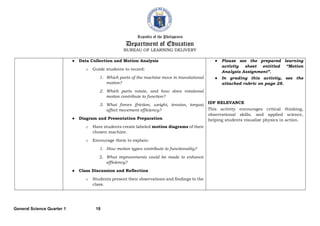
● Data Collection and Motion Analysis
o Guide students to record:
1. Which parts of the machine move in translational
motion?
2. Which parts rotate, and how does rotational
motion contribute to function?
3. What forces (friction, weight, tension, torque)
affect movement efficiency?
● Diagram and Presentation Preparation
o Have students create labeled motion diagrams of their
chosen machine.
o Encourage them to explain:
1. How motion types contribute to functionality?
2. What improvements could be made to enhance
efficiency?
● Class Discussion and Reflection
o Students present their observations and findings to the
class.
● Please see the prepared learning
activity sheet entitled “Motion
Analysis Assignment”.
● In grading this activity, see the
attached rubric on page 28.
IDF RELEVANCE
This activity encourages critical thinking,
observational skills, and applied science,
helping students visualize physics in action.
21.
Republic of thePhilippines
Department of Education
BUREAU OF LEARNING DELIVERY
General Science Quarter 1 19
o Facilitate a discussion: How do these motion principles
apply to larger machines in engineering?
C. Demonstrating
Knowledge and
Skills
1. Finding Practical Application
Machine Dissection
● The teacher will divide the students into small groups (3-5
members per team). Each group will choose a format on how
they will present their findings:
o Option I - Video demonstration – Show step-by-step
disassembly and motion analysis.
o Option II - Infographic or poster – Visually display
labeled parts and motion explanations.
o Option III - Live presentation – Explain findings to
classmates through a guided walkthrough.
● Introduction and Concept Explanation
o The teacher will explain the purpose of machine
dissection—to explore how components interact
through motion.
o The teacher will review key motion concepts:
⮚ Translational Motion: Parts moving in a straight
path (e.g., sliding gears, pistons).
NOTE FOR TEACHERS:
● The teacher will inform students in
advance to bring an old, non-
functioning machine (e.g., clocks, toys,
kitchen appliances).
● Arrange workstations with basic tools
(screwdrivers, pliers, gloves). Ensure
safety guidelines are discussed before
handling materials.
● Discuss how motion principles guide
engineering designs.
● Relate findings to real-world
applications in technology and
mechanics.
● Encourage students to reflect: How
would you improve the machine’s
efficiency using motion principles?
22.
Republic of thePhilippines
Department of Education
BUREAU OF LEARNING DELIVERY
General Science Quarter 1 20
⮚ Rotational Motion: Circular movement (e.g.,
gears, wheels, rotating motors).
o Set expectations for observing, labeling, and recording
findings.
● Group Formation and Machine Disassembly
o Each group carefully disassembles their machine,
documenting the process.
o Guide them to label parts and categorize motion types.
● Analysis and Reflection
o Ask guiding questions:
⮚ Which components exhibit translational motion?
⮚ How do rotational parts affect movement
efficiency?
⮚ What forces (friction, torque) influence the
machine's functionality?
o Encourage groups to compare similarities and
differences between machines.
2. Making Generalization
● Please see the attached rubric for the
“Machine Dissection Activity” on
page 29.
IDF RELEVANCE
This hands-on activity fosters critical thinking,
collaboration, and real-world engineering
connections, helping students visualize motion
mechanics through practical exploration.
After then, the lesson shifts to synthesis and
individual learning integration. Students go
over and finish the "What I Learned" portion of
23.
Republic of thePhilippines
Department of Education
BUREAU OF LEARNING DELIVERY
General Science Quarter 1 21
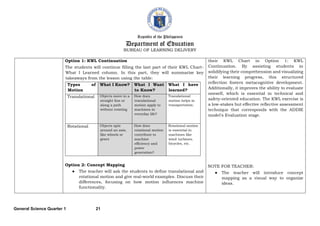
Option 1: KWL Continuation
The students will continue filling the last part of their KWL Chart-
What I Learned column. In this part, they will summarize key
takeaways from the lesson using the table:
Types of
Motion
What I Know? What I Want
to Know?
What I have
learned?
Translational Objects move in a
straight line or
along a path
without rotating
How does
translational
motion apply to
machines in
everyday life?
Translational
motion helps in
transportation.
Rotational Objects spin
around an axis,
like wheels or
gears
How does
rotational motion
contribute to
machine
efficiency and
power
generation?
Rotational motion
is essential in
machines like
wind turbines,
bicycles, etc.
Option 2: Concept Mapping
● The teacher will ask the students to define translational and
rotational motion and give real-world examples. Discuss their
differences, focusing on how motion influences machine
functionality.
their KWL Chart in Option 1: KWL
Continuation. By assisting students in
solidifying their comprehension and visualizing
their learning progress, this structured
reflection fosters metacognitive development.
Additionally, it improves the ability to evaluate
oneself, which is essential in technical and
safety-oriented education. The KWL exercise is
a low-stakes but effective reflective assessment
technique that corresponds with the ADDIE
model's Evaluation stage.
NOTE FOR TEACHER:
● The teacher will introduce concept
mapping as a visual way to organize
ideas.
24.
Republic of thePhilippines
Department of Education
BUREAU OF LEARNING DELIVERY
General Science Quarter 1 22
● Provide guiding questions:
o How does translational motion differ from rotational
motion?
o What machines rely on each type of motion?
o How do forces interact with both motion types?
● Presentation and Class Discussion
o Each group presents their concept map to the class,
explaining their connections.
o Facilitate peer questions and discussions:
⮚ Which machines combine both motions?
⮚ How do engineers optimize motion for efficiency?
● Assign a reflection task, asking students to consider: How
could understanding motion principles improve machine
design?
Option 3: Reflection Journals
● The students will write reflections on what they learned about
translational and rotational motion, summarizing key
takeaways and generalizing principles for future applications.
o Guide Questions:
● Divide students into pairs or small
groups to brainstorm and organize
ideas.
● Instruct students to create a
comparison chart, dividing sections
into:
o Definition: Explain each motion
type in simple terms.
o Examples: List everyday objects
demonstrating these motions.
o Machine Applications: Identify
engineering uses, such as
pulleys, wheels, and turbines.
● Encourage them to add arrows, links,
and annotations showing how both
motions interact.
● Ask students to highlight key forces
affecting each motion (e.g., friction,
torque, gravity).
NOTE FOR TEACHERS:
● Provide students with time at the end of
each class to write reflections on what
they learned about translational and
25.
Republic of thePhilippines
Department of Education
BUREAU OF LEARNING DELIVERY
General Science Quarter 1 23
⮚ What is the most important concept you learned
today?
⮚ How does translational or rotational motion
apply to machines you use daily?
⮚ What principles from today's lesson could help in
designing better technology?
⮚ How did this lesson change your understanding
of motion and forces?
3. Evaluating Learning
Option 1: Self-Assessment
● Provide students with a structured questionnaire that
includes:
1. Concept Understanding:
o Can I clearly define translational and rotational motion?
o Can I identify real-world examples of each motion type?
o Do I understand how forces (torque, friction, gravity)
affect motion?
rotational motion. Ask them to
generalize a principle or concept that
they can apply to future tasks. Allocate
5-10 minutes at the end of class for
students to write their reflections.
Encourage clear organization, using
headers such as:
o Key Lesson Takeaways – Briefly
summarize the main motion
concepts learned.
o Real-World Applications –
Describe where they see these
principles in action.
o Future Connections – Predict
how motion principles might help
in future challenges.
NOTE FOR TEACHERS:
● Explain the importance of self-reflection
in learning, helping students gauge their
comprehension of motion principles.
26.
Republic of thePhilippines
Department of Education
BUREAU OF LEARNING DELIVERY
General Science Quarter 1 24
2. Application of Concepts:
o Can I explain how motion principles improve machine
efficiency?
o Can I analyze how motion contributes to engineering
advancements?
o Am I able to describe how machines integrate both
motions?
3. Confidence Level and Areas for Growth:
o Which motion concept do I feel most confident in?
o What specific topic do I need to review or understand
better?
o What strategies can help me strengthen my
understanding?
Option 2: Exit Ticket
At the end of the lesson, students submit an exit ticket responding
to the question: "How do translational and rotational motions work
together in machines?"
● Review Before Submission
o Before answering, guide a short class discussion on
examples:
● Set expectations: This is a personal
evaluation, designed to help students
recognize what they know and what they
need to revisit.
● Allocate 10–15 minutes for students to
answer honestly and reflect on their
learning.
● Encourage students to write down
examples or concepts they need
clarification on.
NOTE FOR TEACHER:
● Explain that this quick reflection helps
gauge student comprehension of motion
concepts.
27.
Republic of thePhilippines
Department of Education
BUREAU OF LEARNING DELIVERY
General Science Quarter 1 25
⮚ Bicycles: Rotational motion in the wheels
creates translational movement forward.
⮚ Wind Turbines: Rotational blades convert
energy into usable electrical motion.
⮚ Cars: Rotational motion in the wheels enables
linear movement.
● Writing the Exit Ticket Response
o Provide students with index cards, paper slips, or
digital forms to submit answers.
o Instruct them to write a concise response (2–3
sentences) explaining:
⮚ How both motions interact in a machine of their
choice
⮚ Why combining motion types improves
functionality
4. Additional Activity
Case Study Analysis: Motion-Based Innovations
● The teacher will provide students with relevant resources
(articles, engineering reports, or video documentaries).
● Encourage students to think critically
about how machines integrate both
types of motion.
● Gather responses to analyze
understanding trends (strengths,
misconceptions, gaps).
● Use student answers to guide future
lessons or clarifications on motion
principles.
28.
Republic of thePhilippines
Department of Education
BUREAU OF LEARNING DELIVERY
General Science Quarter 1 26
● Divide students into small groups (3–5 members per team).
● Instruct students to investigate their case study, focusing on:
o How motion principles influenced efficiency
improvements?
o What forces (friction, torque, tension) contributed to
functionality
o How the invention evolved over time
● The teacher will encourage the students to gather diagrams,
key findings, and historical comparisons.
● Guide each group to structure their 5–7-minute presentation,
including:
o Overview of the invention and its purpose
o How translational and rotational motion were applied
o What design changes led to efficiency improvements
o Visual representation (graphs, diagrams, or digital
slides)
● Each team presents their case study findings.
● Encourage peer engagement by allowing classmates to ask
questions.
NOTE FOR TEACHERS:
● Assign a case study on an invention that
improved efficiency through the
application of motion principles. Groups
will present their findings to the class.
● Select or allow students to choose a
motion-based invention, such as:
o Wind turbines – Efficiency in
energy generation.
o Bicycles – Optimization of
rotational motion for speed and
balance.
o Hydraulic cranes – Translational
and rotational integration for
lifting heavy loads.
o Conveyor belts – Motion
mechanics for industrial
efficiency.
● Summarize key takeaways from each
case study.
● Relate findings to modern-day
engineering challenges and future
innovations.
29.
Republic of thePhilippines
Department of Education
BUREAU OF LEARNING DELIVERY
General Science Quarter 1 27
● Facilitate a discussion: How do motion principles drive
engineering advancements?
● Assign a follow-up task: How could
motion principles be applied to solve
current efficiency problems in
technology?
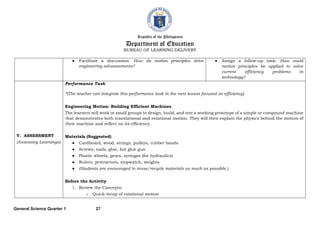
V. ASSESSMENT
(Assessing Learnings)
Performance Task
*(The teacher can integrate this performance task in the next lesson focused on efficiency)
Engineering Motion: Building Efficient Machines
The learners will work in small groups to design, build, and test a working prototype of a simple or compound machine
that demonstrates both translational and rotational motion. They will then explain the physics behind the motion of
their machine and reflect on its efficiency.
Materials (Suggested)
● Cardboard, wood, strings, pulleys, rubber bands
● Screws, nails, glue, hot glue gun
● Plastic wheels, gears, syringes (for hydraulics)
● Rulers, protractors, stopwatch, weights
● (Students are encouraged to reuse/recycle materials as much as possible.)
Before the Activity
1. Review the Concepts:
o Quick recap of rotational motion
30.
Republic of thePhilippines
Department of Education
BUREAU OF LEARNING DELIVERY
General Science Quarter 1 28
o Quick recap of translational motion
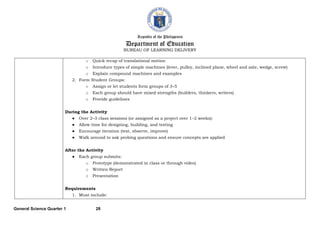
o Introduce types of simple machines (lever, pulley, inclined plane, wheel and axle, wedge, screw)
o Explain compound machines and examples
2. Form Student Groups:
o Assign or let students form groups of 3–5
o Each group should have mixed strengths (builders, thinkers, writers)
o Provide guidelines
During the Activity
● Over 2–3 class sessions (or assigned as a project over 1–2 weeks):
● Allow time for designing, building, and testing
● Encourage iteration (test, observe, improve)
● Walk around to ask probing questions and ensure concepts are applied
After the Activity
● Each group submits:
o Prototype (demonstrated in class or through video)
o Written Report
o Presentation
Requirements
1. Must include:
31.
Republic of thePhilippines
Department of Education
BUREAU OF LEARNING DELIVERY
General Science Quarter 1 29
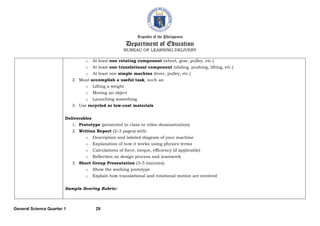
o At least one rotating component (wheel, gear, pulley, etc.)
o At least one translational component (sliding, pushing, lifting, etc.)
o At least one simple machine (lever, pulley, etc.)
2. Must accomplish a useful task, such as:
o Lifting a weight
o Moving an object
o Launching something
3. Use recycled or low-cost materials
Deliverables
1. Prototype (presented in class or video demonstration)
2. Written Report (2–3 pages) with:
o Description and labeled diagram of your machine
o Explanation of how it works using physics terms
o Calculations of force, torque, efficiency (if applicable)
o Reflection on design process and teamwork
3. Short Group Presentation (3–5 minutes):
o Show the working prototype
o Explain how translational and rotational motion are involved
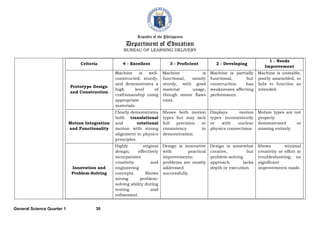
Sample Scoring Rubric:
32.
Republic of thePhilippines
Department of Education
BUREAU OF LEARNING DELIVERY
General Science Quarter 1 30
Criteria 4 - Excellent 3 - Proficient 2 - Developing
1 - Needs
Improvement
Prototype Design
and Construction
Machine is well-
constructed, sturdy,
and demonstrates a
high level of
craftsmanship using
appropriate
materials.
Machine is
functional, mostly
sturdy, with good
material usage,
though minor flaws
exist.
Machine is partially
functional, but
construction has
weaknesses affecting
performance.
Machine is unstable,
poorly assembled, or
fails to function as
intended.
Motion Integration
and Functionality
Clearly demonstrates
both translational
and rotational
motion with strong
alignment to physics
principles.
Shows both motion
types but may lack
full precision or
consistency in
demonstration.
Displays motion
types inconsistently
or with unclear
physics connections.
Motion types are not
properly
demonstrated or
missing entirely.
Innovation and
Problem-Solving
Highly original
design; effectively
incorporates
creativity and
engineering
concepts. Shows
strong problem-
solving ability during
testing and
refinement.
Design is innovative
with practical
improvements;
problems are mostly
addressed
successfully.
Design is somewhat
creative, but
problem-solving
approach lacks
depth or execution.
Shows minimal
creativity or effort in
troubleshooting; no
significant
improvements made.
33.
Republic of thePhilippines
Department of Education
BUREAU OF LEARNING DELIVERY
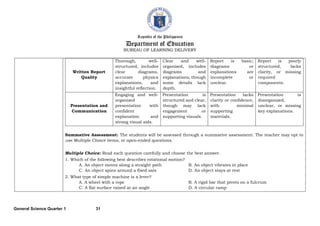
General Science Quarter 1 31
Written Report
Quality
Thorough, well-
structured, includes
clear diagrams,
accurate physics
explanations, and
insightful reflection.
Clear and well-
organized, includes
diagrams and
explanations, though
some details lack
depth.
Report is basic;
diagrams or
explanations are
incomplete or
unclear.
Report is poorly
structured, lacks
clarity, or missing
required
components.
Presentation and
Communication
Engaging and well-
organized
presentation with
confident
explanation and
strong visual aids.
Presentation is
structured and clear,
though may lack
engagement or
supporting visuals.
Presentation lacks
clarity or confidence,
with minimal
supporting
materials.
Presentation is
disorganized,
unclear, or missing
key explanations.
Summative Assessment: The students will be assessed through a summative assessment. The teacher may opt to
use Multiple Choice items, or open-ended questions.
Multiple Choice: Read each question carefully and choose the best answer.
1. Which of the following best describes rotational motion?
A. An object moves along a straight path B. An object vibrates in place
C. An object spins around a fixed axis D. An object stays at rest
2. What type of simple machine is a lever?
A. A wheel with a rope B. A rigid bar that pivots on a fulcrum
C. A flat surface raised at an angle D. A circular ramp
34.
Republic of thePhilippines
Department of Education
BUREAU OF LEARNING DELIVERY
General Science Quarter 1 32
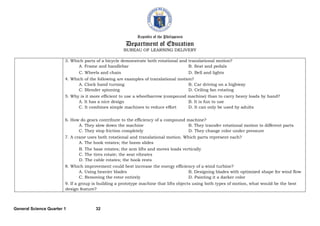
3. Which parts of a bicycle demonstrate both rotational and translational motion?
A. Frame and handlebar B. Seat and pedals
C. Wheels and chain D. Bell and lights
4. Which of the following are examples of translational motion?
A. Clock hand turning B. Car driving on a highway
C. Blender spinning D. Ceiling fan rotating
5. Why is it more efficient to use a wheelbarrow (compound machine) than to carry heavy loads by hand?
A. It has a nice design B. It is fun to use
C. It combines simple machines to reduce effort D. It can only be used by adults
6. How do gears contribute to the efficiency of a compound machine?
A. They slow down the machine B. They transfer rotational motion to different parts
C. They stop friction completely D. They change color under pressure
7. A crane uses both rotational and translational motion. Which parts represent each?
A. The hook rotates; the boom slides
B. The base rotates; the arm lifts and moves loads vertically
C. The tires rotate; the seat vibrates
D. The cable rotates; the hook rests
8. Which improvement could best increase the energy efficiency of a wind turbine?
A. Using heavier blades B. Designing blades with optimized shape for wind flow
C. Removing the rotor entirely D. Painting it a darker color
9. If a group is building a prototype machine that lifts objects using both types of motion, what would be the best
design feature?
35.
Republic of thePhilippines
Department of Education
BUREAU OF LEARNING DELIVERY
General Science Quarter 1 33
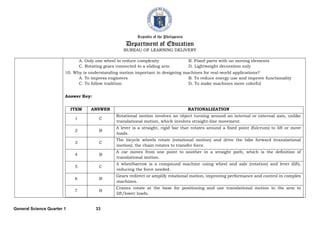
A. Only one wheel to reduce complexity B. Fixed parts with no moving elements
C. Rotating gears connected to a sliding arm D. Lightweight decoration only
10. Why is understanding motion important in designing machines for real-world applications?
A. To impress engineers B. To reduce energy use and improve functionality
C. To follow tradition D. To make machines more colorful
Answer Key:
ITEM ANSWER RATIONALIZATION
1 C
Rotational motion involves an object turning around an internal or external axis, unlike
translational motion, which involves straight-line movement.
2 B
A lever is a straight, rigid bar that rotates around a fixed point (fulcrum) to lift or move
loads.
3 C
The bicycle wheels rotate (rotational motion) and drive the bike forward (translational
motion); the chain rotates to transfer force.
4 B
A car moves from one point to another in a straight path, which is the definition of
translational motion.
5 C
A wheelbarrow is a compound machine using wheel and axle (rotation) and lever (lift),
reducing the force needed.
6 B
Gears redirect or amplify rotational motion, improving performance and control in complex
machines.
7 B
Cranes rotate at the base for positioning and use translational motion in the arm to
lift/lower loads.
36.
Republic of thePhilippines
Department of Education
BUREAU OF LEARNING DELIVERY
General Science Quarter 1 34
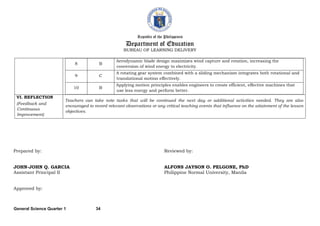
8 B
Aerodynamic blade design maximizes wind capture and rotation, increasing the
conversion of wind energy to electricity.
9 C
A rotating gear system combined with a sliding mechanism integrates both rotational and
translational motion effectively.
10 B
Applying motion principles enables engineers to create efficient, effective machines that
use less energy and perform better.
VI. REFLECTION
(Feedback and
Continuous
Improvement)
Teachers can take note tasks that will be continued the next day or additional activities needed. They are also
encouraged to record relevant observations or any critical teaching events that influence on the attainment of the lesson
objectives.
Prepared by: Reviewed by:
JOHN-JOHN Q. GARCIA ALFONS JAYSON O. PELGONE, PhD
Assistant Principal II Philippine Normal University, Manila
Approved by:
37.
Republic of thePhilippines
Department of Education
BUREAU OF LEARNING DELIVERY
General Science Quarter 1 35
JOHN CYRUS L. DOBLADA
General Science Specialist
BLD-TLD
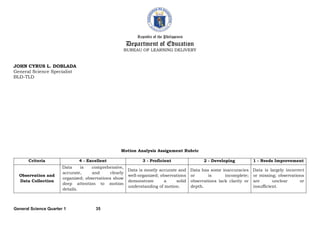
Motion Analysis Assignment Rubric
Criteria 4 - Excellent 3 - Proficient 2 - Developing 1 - Needs Improvement
Observation and
Data Collection
Data is comprehensive,
accurate, and clearly
organized; observations show
deep attention to motion
details.
Data is mostly accurate and
well-organized; observations
demonstrate a solid
understanding of motion.
Data has some inaccuracies
or is incomplete;
observations lack clarity or
depth.
Data is largely incorrect
or missing; observations
are unclear or
insufficient.
38.
Republic of thePhilippines
Department of Education
BUREAU OF LEARNING DELIVERY
General Science Quarter 1 36
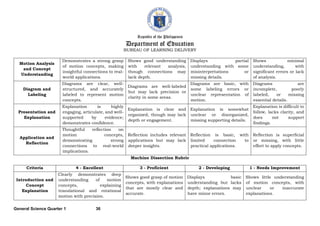
Motion Analysis
and Concept
Understanding
Demonstrates a strong grasp
of motion concepts, making
insightful connections to real-
world applications.
Shows good understanding
with relevant analysis,
though connections may
lack depth.
Displays partial
understanding with some
misinterpretations or
missing details.
Shows minimal
understanding, with
significant errors or lack
of analysis.
Diagram and
Labeling
Diagrams are clear, well-
structured, and accurately
labeled to represent motion
concepts.
Diagrams are well-labeled
but may lack precision or
clarity in some areas.
Diagrams are basic, with
some labeling errors or
unclear representation of
motion.
Diagrams are
incomplete, poorly
labeled, or missing
essential details.
Presentation and
Explanation
Explanation is highly
engaging, articulate, and well-
supported by evidence;
demonstrates confidence.
Explanation is clear and
organized, though may lack
depth or engagement.
Explanation is somewhat
unclear or disorganized,
missing supporting details.
Explanation is difficult to
follow, lacks clarity, and
does not support
findings.
Application and
Reflection
Thoughtful reflection on
motion concepts,
demonstrating strong
connections to real-world
implications.
Reflection includes relevant
applications but may lack
deeper insights.
Reflection is basic, with
limited connection to
practical applications.
Reflection is superficial
or missing, with little
effort to apply concepts.
Machine Dissection Rubric
Criteria 4 - Excellent 3 - Proficient 2 - Developing 1 - Needs Improvement
Introduction and
Concept
Explanation
Clearly demonstrates deep
understanding of motion
concepts, explaining
translational and rotational
motion with precision.
Shows good grasp of motion
concepts, with explanations
that are mostly clear and
accurate.
Displays basic
understanding but lacks
depth; explanations may
have minor errors.
Shows little understanding
of motion concepts, with
unclear or inaccurate
explanations.
39.
Republic of thePhilippines
Department of Education
BUREAU OF LEARNING DELIVERY
General Science Quarter 1 37
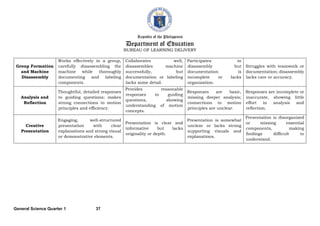
Group Formation
and Machine
Disassembly
Works effectively in a group,
carefully disassembling the
machine while thoroughly
documenting and labeling
components.
Collaborates well,
disassembles machine
successfully, but
documentation or labeling
lacks some detail.
Participates in
disassembly but
documentation is
incomplete or lacks
organization.
Struggles with teamwork or
documentation; disassembly
lacks care or accuracy.
Analysis and
Reflection
Thoughtful, detailed responses
to guiding questions; makes
strong connections to motion
principles and efficiency.
Provides reasonable
responses to guiding
questions, showing
understanding of motion
concepts.
Responses are basic,
missing deeper analysis;
connections to motion
principles are unclear.
Responses are incomplete or
inaccurate, showing little
effort in analysis and
reflection.
Creative
Presentation
Engaging, well-structured
presentation with clear
explanations and strong visual
or demonstrative elements.
Presentation is clear and
informative but lacks
originality or depth.
Presentation is somewhat
unclear or lacks strong
supporting visuals and
explanations.
Presentation is disorganized
or missing essential
components, making
findings difficult to
understand.
 Most read
 Most read
 Most read